
PHOT-230 · Lesson 8 of 12 · 25 min
Long-term projects
Many of the most important bodies of documentary and street photography took years, even decades, to make. Time allows photographers to go beyond first impressions, build relationships, witness change, and gather enough strong images to tell a complex story. A long-term project also gives a photographer's practice direction and purpose: instead of wandering in search of single images, they return again and again to a subject that matters to them. This lesson covers why long-term projects matter, choosing a subject, defining a project's focus, writing a project proposal, planning time and resources, funding through grants and other sources, keeping a project alive over time, editing as you go, and knowing when a project is finished.
Why long-term projects matter
Single photographs can be powerful, but sustained projects offer depth that single images rarely achieve. Over time, photographers learn the rhythms of a place, the personalities of the people, and the stories beneath the surface; people become used to their presence and behave naturally; and the work can show change, such as a neighbourhood gentrifying, a family growing up, a landscape transformed or a community recovering from disaster. Long-term work is also how many documentary photographers build reputations: projects become books, exhibitions, grants and awards. Examples include Larry Towell's decades-long work with Mennonite communities, Nicholas Nixon's portraits of his wife and her three sisters made every year since 1975 (The Brown Sisters), and Dawoud Bey's long engagement with Black communities and history in the United States.
Choosing a subject
The best long-term subjects combine personal connection, access and significance. Questions to ask include:
- What do I care about enough to photograph for years? Passion sustains projects through difficult periods.
- What do I have access to? Projects close to home, in your own community, workplace, family or interests, are often more feasible and more insightful than distant subjects.
- What is visual? Some important subjects are hard to photograph because they happen in private, in abstract systems or in the past; consider how the story can be shown.
- What is my perspective? Insiders and outsiders see differently; consider what you bring and what you might miss.
- Has it been done, and if so, what can I add? Many subjects have been photographed extensively; a fresh angle, a different community or a personal approach can still make a strong contribution.
- Is it ethical and safe for me and the people involved? (Lessons 2 and 9).
Many photographers start several small explorations before committing to one, letting the subject choose them as much as they choose it.
| Kind of project | Example | Typical duration |
|---|---|---|
| Place-based | A neighbourhood, a street, a river, a town | Months to decades |
| Community or group | A sports club, a religious community, workers in an industry | One to several years |
| Issue-based | Housing, migration, climate impacts, health | One to several years |
| Personal or family | One's own family, illness, ageing parents | Years to a lifetime |
| Typological | Storefronts, bus shelters, uniforms, portraits in one format | Months to years |
| Event or change | A construction project, a recovery after disaster, an election | Duration of the event |
Defining the focus
A project needs a focus that is narrow enough to be manageable and deep, and broad enough to sustain interest and allow surprises. "Climate change" is too broad; "the farming families of one Prairie county adapting to drought over five years" is focused. A project statement, a few sentences describing what the project is about, why it matters, and how it will be approached, helps clarify thinking. It will change as the work develops; documentary projects often begin with one idea and find a different, better story through the process of photographing. Allow that evolution while keeping a sense of direction.
Writing a project proposal
Grants, residencies, commissions, publishers and partners usually ask for a written proposal. A strong proposal typically includes:
- A title and a short summary of one or two sentences.
- Background: the subject, its context and why it matters now.
- Approach: how you will photograph it, including access, methods, visual style and collaboration with participants.
- Your qualifications and connection to the subject.
- A timeline with phases and milestones.
- A budget with realistic costs.
- Intended outcomes: book, exhibition, publication, community presentation, archive.
- Ethical considerations: consent, representation, risks and safeguards.
- Sample images, usually 10 to 20 photographs from the project so far or related work.
Write clearly and specifically, avoid jargon, and show that the project is feasible. Funders want to see both a compelling idea and evidence that you can carry it out.
Worked problem
Sharpening a project focus
A photographer proposes a project called "Life in the city". A grant reviewer comments that it lacks focus. How could the proposal be improved?
Show solution
- Identify what specifically draws the photographer to the city: in this case, the late-night workers who keep the city running.
- Narrow the focus: "Night shift: the people who work between midnight and 6 a.m. in one downtown district", photographed over two years.
- Explain why it matters: an invisible workforce essential to the city, shaped by labour conditions and migration.
- Describe access: relationships with a transit depot, a hospital cleaning crew and a bakery, with letters of support.
- Outline outcomes: an exhibition at a community centre, a book proposal and portraits returned to participants.
Answer: Replace the broad theme with a specific subject, place and time frame, explain significance and access, and set clear outcomes.
Planning time and resources
Long-term projects require planning even when much of the work is unpredictable. Estimate how often you will photograph, for how long each time, and over what period. Consider travel and accommodation, equipment, storage and backup, printing, fees for fixers or translators, insurance and the time needed for editing, writing and research. Many documentary photographers fit projects around paid work, photographing on weekends, evenings or in concentrated trips. A simple project log, recording each visit, the people met, the images made and ideas for next time, helps maintain momentum and provides material for captions and writing later.
Funding long-term work
In Canada, documentary and artistic photography projects may be supported by public arts funders, including the Canada Council for the Arts, provincial agencies such as the Ontario Arts Council, the Conseil des arts et des lettres du Québec, the BC Arts Council and the Alberta Foundation for the Arts, and some municipal arts councils. These funders generally support artists rather than commercial projects and require eligibility as a professional artist. Other sources include foundations, journalism funds, residencies, book prizes, crowdfunding, partnerships with non-profit organizations and commissions from publications. International grants, such as those offered by the Magnum Foundation, the Pulitzer Center and the W. Eugene Smith Memorial Fund, are open to photographers from many countries, and the Guggenheim Fellowship is open to citizens and permanent residents of the United States and Canada.
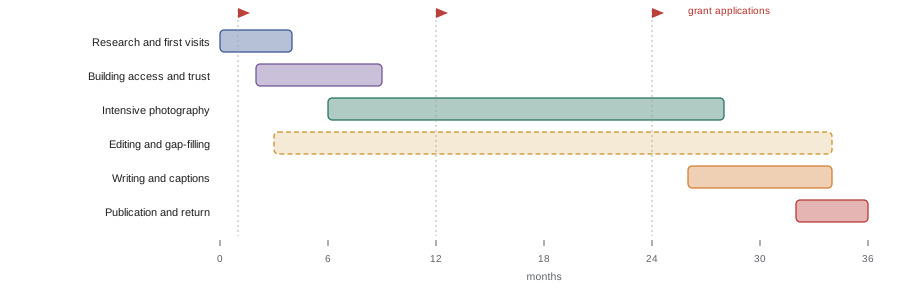
Applying for grants is a skill in itself: read the guidelines carefully, tailor each application, meet deadlines, ask others to review your proposal, and keep applying, since rejection is common even for strong projects. Some funding comes with conditions, such as editorial independence requirements, credit lines or restrictions on partisan work, which should be weighed.
Keeping a project alive
Long-term projects face periods of boredom, doubt, lost access and competing demands. Strategies that help include setting regular schedules for photographing; sharing work in progress with a trusted group or mentor for feedback; showing work to participants; publishing interim stories or exhibitions, which bring encouragement and sometimes funding; and allowing the project to evolve rather than forcing it to match the original plan. Some photographers keep several projects at different stages, moving between them as access and energy allow. If a project stalls, revisiting your early contact sheets and the reasons you began can rekindle motivation.
Editing as you go
Editing should not wait until the end. Regular editing, reviewing new work, making work prints, pinning them on a wall and grouping them, reveals what the project is becoming, which images are strongest, what is missing and where the story is heading. Gaps become visible: perhaps there are many portraits but few images showing work, or many scenes of hardship but none of joy. Lesson 10 covers sequencing in detail. A wall of small prints is a powerful tool because it lets you see the whole project at once and rearrange images physically, which screens make harder.
Knowing when a project is finished
Some projects have natural endings: an event concludes, a building is completed, a family moves away. Others could continue indefinitely. Signs that a project may be ready for publication include having a coherent body of strong images that tells a story or expresses an idea; new photographs repeating what you already have; and having addressed the main gaps. A project can be published and still continue, and many photographers revisit earlier projects years later to show change. Ending a project well also involves people: thanking participants, sharing the results with them, and maintaining relationships.
Collaborating with organizations
Many long-term documentary projects involve partnerships with non-profit organizations, community groups, universities or museums. Partners can provide access, research expertise, funding, venues and audiences, and the project can serve their goals, such as raising awareness or preserving community history. Partnerships also require clarity: who owns the images, who decides what is published, whether the partner can use images in fundraising or advocacy, how participants will be credited, and how editorial independence will be protected. Writing a simple memorandum of understanding at the start avoids misunderstandings later. Be cautious about partnerships that could compromise the honesty of the work, for example an organization that wants only images supporting its campaign.
Personal documentary and the long view
Some of the most moving documentary projects are personal: photographers documenting their own families, illnesses, relationships, communities or ageing over years or decades. Examples include Sally Mann's photographs of her children, Larry Sultan's Pictures from Home about his parents, and many projects about caring for parents with dementia. Personal projects raise distinct ethical questions, especially when they involve children or family members who may later disagree with how they were shown, and the photographer must balance artistic honesty with care for relationships. They also show that long-term documentary work need not involve travel or dramatic subjects: the people closest to you, photographed with attention over time, can be a lifetime's project.
Measuring progress
Long-term projects can feel endless, so it helps to set intermediate goals: a set number of visits per month; a first edit of 20 images after three months; a work-in-progress zine after six months; a grant application by a certain deadline; a small exhibition or online essay after a year. Each milestone gives feedback, motivation and sometimes new opportunities. Reviewing the project log and edit regularly against the original proposal shows how the project has evolved and whether the focus needs adjusting.
Ethics in long-term projects
The ethical questions of Lesson 2 become more complex over time. Relationships deepen, people's circumstances change, children grow up, and consent given at the start of a project may need to be revisited years later, especially before publication. A person who welcomed the photographer during a difficult period may later prefer that images of it remain private. Long-term documentary photographers often build in moments to review images with participants and renew agreements, and they accept that some strong images may never be published. Such care is part of what makes long-term work trustworthy.
Learning from finished projects
Studying how other photographers built their projects is one of the best preparations for your own. Many photobooks and websites include afterwords describing how a project began, how access was gained, how long it took, what went wrong and how it was funded. Reading these accounts, and interviews with photographers, reveals the practical realities behind finished work and offers models for your own planning.
Above all, give a long-term project time to surprise you: the subject you set out to document is rarely the story you end up telling, and that discovery is often the project's greatest strength.
Common mistakes
MistakeChoosing a subject only because it is fashionable.
InsteadChoose subjects you care about and can access.
MistakeDefining projects too broadly.
InsteadNarrow to a specific subject, place and time.
MistakeWaiting until the end to edit.
InsteadEdit regularly and use work prints.
MistakeUnderestimating time and costs.
InsteadPlan budgets and timelines realistically.
MistakeGiving up after a few grant rejections.
InsteadSeek feedback and keep applying.
Summary and key terms
- Long-term projects allow depth, trust and the documentation of change.
- Choose subjects with personal connection, access and significance.
- A focused project statement guides the work and can evolve.
- Proposals include background, approach, timeline, budget, outcomes, ethics and samples.
- Plan time and resources realistically and keep a project log.
- Funding comes from arts councils, foundations, residencies and partnerships.
- Edit continuously, keep momentum and close projects with care for participants.
- Long-term project
- A sustained body of work over months or years.
- Project statement
- Short description of a project's subject, purpose and approach.
- Proposal
- Written plan submitted to funders or partners.
- Access
- Permission and opportunity to photograph a subject.
- Project log
- Record of visits, people and ideas.
- Work print
- Small print used for editing and sequencing.
- Gap
- Missing element in a project's story.
- Grant
- Funding awarded for a project, usually non-repayable.
- Residency
- Supported period of work in a place or institution.
- Typological project
- Series of similar subjects photographed consistently.
Practice problems
Work each problem on paper first, then reveal the answer to check.
Name two benefits of long-term projects.
Show answer
Depth, trust, documenting change, reputation.
Name three questions for choosing a subject.
Show answer
Care, access, visual potential, perspective, originality, ethics.
Why are projects close to home often stronger?
Show answer
Better access and insight.
Improve the focus "climate change".
Show answer
A specific community, place and period affected by a climate issue.
List four parts of a proposal.
Show answer
Summary, background, approach, timeline, budget, outcomes, ethics, samples.
How many sample images do proposals usually include?
Show answer
About 10 to 20.
What is a project log?
Show answer
A record of visits, people, images and ideas.
Why use a wall of work prints?
Show answer
To see and rearrange the whole project.
How can a stalled project be revived?
Show answer
Revisit early work, seek feedback, share interim results.
When might a project be ready?
Show answer
A coherent body of strong images and new work repeating old.
Lesson quiz · 5 questions
Score 60% or more to complete this lesson.
Create a free account to save your progress, take quizzes and earn a certificate.