
PHOT-230 · Lesson 6 of 12 · 25 min
Working with people on the street and in the field
Street and documentary photography are about people, and how photographers behave toward the people they photograph affects both the images and the people themselves. Some photographers prefer to remain invisible; others engage, talk and ask; most move between the two depending on the situation. This lesson covers the spectrum of engagement, being present and unobtrusive, approaching strangers, asking for portraits, responding when someone objects, photographing children and vulnerable people in public, cultural sensitivity in unfamiliar places, building trust in documentary work, and talking about your work with the people you meet.
The spectrum of engagement
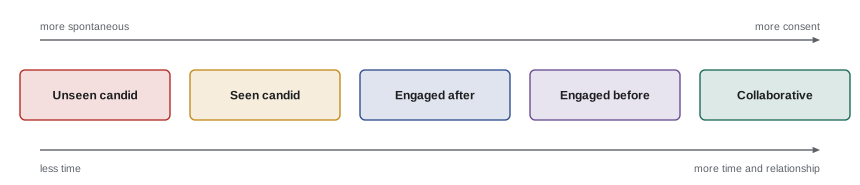
Photographers relate to people in public in different ways, from completely candid to fully collaborative:
| Mode | Description | Strengths | Concerns |
|---|---|---|---|
| Unseen candid | Subject unaware of being photographed | Natural behaviour, unguarded moments | No consent; risk of intrusion |
| Seen candid | Subject notices but is not asked | Natural, with acknowledgement | Reactions may change the moment |
| Engaged after | Photograph first, then talk and explain | Natural image plus a chance to respond | Subject may ask for deletion |
| Engaged before | Ask, then photograph | Consent, connection, names for captions | Behaviour may become posed |
| Collaborative | Ongoing relationship and shared decisions | Trust, depth, accuracy | Time and commitment |
No single mode is always right. Candid images capture authentic moments but give people no choice; asked portraits give choice but change behaviour. Many photographers shoot candidly in crowds and at public events, engage directly with individuals they photograph closely, and seek consent for anything that might be sensitive.
Being present and unobtrusive
Paradoxically, the best way to avoid disturbing a scene is often to be openly present rather than sneaking. People notice furtive behaviour, such as hiding a camera or shooting from a distance and then looking away, and it makes them suspicious. Photographers who stay in one place, move calmly, hold the camera openly and make eye contact and smile when noticed tend to be ignored or accepted. Spending time in a place before photographing, becoming part of the scenery, lets people get used to you. Dressing to blend in, carrying minimal gear, and moving with the flow of people rather than against it all help. If someone looks at you, a friendly nod or smile, or lowering the camera briefly, usually defuses tension.
Approaching strangers for portraits
Asking strangers for portraits is a skill that improves with practice and makes many photographers less anxious about street work in general. Approaches that tend to work include:
- Being specific and sincere: "I love the way the light falls on you in that doorway; could I take your photograph?"
- Being brief and clear about who you are and what the photograph is for, such as a personal project, a class or a publication.
- Accepting refusals graciously; most people who say no do so politely, and a refusal is not a failure.
- Offering to send the photograph, and following through.
- Asking questions and listening; a short conversation often leads to more relaxed, expressive portraits, and to names and stories for captions.
- Working quickly once permission is given, making a few frames and perhaps adjusting position slightly, without turning the encounter into a long session.
Projects such as Humans of New York, begun by Brandon Stanton in 2010, showed how short conversations with strangers, combined with portraits and quotations, can reach huge audiences and build empathy, while also raising questions about how people's stories are framed and shared.
When someone objects
Sometimes people react badly to being photographed: they may wave you away, ask what you are doing, demand that you delete the image or become angry. How you respond matters ethically and for your safety. Useful principles include:
- Stay calm and polite, and lower the camera.
- Explain honestly what you are doing and why; many objections soften once people understand.
- Consider their concern: they may have good reasons, such as fear of being identified by an abuser or an employer, cultural or religious reasons, or simply discomfort.
- Offer to delete the image if they ask, especially if it is not important; even where the law does not require deletion, doing so is often the respectful choice.
- If the situation escalates, walk away; no photograph is worth a fight.
Keep in mind that the law in most places in Canada and the United States does not require you to delete photographs taken lawfully in public (Lesson 7), and no private person has the right to take your camera. But legal rights and ethical choices are different questions.
Worked problem
Responding to an objection
A photographer makes a candid image of a woman sitting on a park bench in beautiful light. She notices, approaches and asks angrily why she was photographed and demands that the photograph be deleted. How should the photographer respond?
Show solution
- Lower the camera, stay calm, and apologize for startling her.
- Explain briefly: they are working on a personal project about light in the park, and show her the image if she wishes.
- Listen to her concern; she may have a reason she does not wish to share.
- Delete the photograph in front of her if she still wants it removed, and thank her.
- Reflect afterward on whether a different approach, such as asking first, would suit similar situations.
Answer: Stay calm, explain, listen, delete if she asks, and reflect on how to approach similar moments.
Children in public
Photographing children in public is legal in most places in Canada and the United States, but it is sensitive. Parents may be protective, and an adult stranger photographing children can provoke alarm, especially in parks, schools and playgrounds. Many street photographers avoid making children the main subject of candid photographs, include children only as part of wider scenes, or ask parents first. If a parent objects, delete the image and apologize. Never photograph children in ways that could be exploitative, and be cautious about publishing identifiable images of children, especially with locations. In documentary projects involving children, always obtain consent from parents or guardians and the child's own agreement, and follow the policies of schools and organizations.
Vulnerable people in public
Streets are also where people who are homeless, intoxicated, in mental health crisis, injured or grieving may be visible. Photographing them candidly raises ethical concerns: they may be unable to object, and images may humiliate them or deepen stigma. Many photographers adopt a rule of not photographing people in such situations without engagement and consent, or only in ways that do not identify them. Documentary projects on homelessness, addiction or mental health are usually best done through sustained relationships, collaboration and organizations that work with the people concerned, rather than through candid street images. Ask whether the photograph would still be acceptable if the person saw it, and whether it adds understanding rather than spectacle.
Cultural sensitivity
Attitudes to photography vary between cultures, communities and individuals. In some places and religious traditions, photographing people, especially women, children, religious leaders or worshippers, is considered offensive without permission. Some communities have experienced exploitative photography by outsiders and are understandably wary. Before photographing in an unfamiliar place, learn local customs and laws, observe how locals behave toward cameras, dress respectfully, and ask permission more readily than you might at home. Learning a few words of the local language, being patient and showing genuine interest go a long way. Religious sites, ceremonies, markets and private gatherings often have explicit or implicit rules; follow them.
Building trust in documentary work
Documentary projects that involve sustained access to people's lives depend on trust. Building trust takes time: visiting repeatedly, often without photographing at first; explaining the project clearly; listening; respecting limits; showing work in progress; keeping promises; and being honest about where images may appear. Many documentary photographers describe the first weeks or months of a project as relationship-building rather than photography. Trust can be lost quickly if images are published without warning, used in ways people did not expect, or if the photographer behaves disrespectfully. Gatekeepers, such as community leaders, organizations or family members, often control access and must be treated with respect (Lesson 9).
Talking about your work
People are often curious about why someone is photographing their street, market or community. Having a short, honest explanation ready makes encounters easier: "I photograph everyday life in this neighbourhood for a long-term project" or "I'm a student working on a series about public markets." Carrying cards with your name, website and contact details lets people see your work and contact you later, which can turn suspicious encounters into collaborations. Being open about your work builds goodwill in places where you return often, and sometimes leads to invitations that open doors to new photographs.
Your own presence and identity
How people react to a photographer depends partly on who the photographer is: their apparent age, gender, race, size, accent and dress. Some photographers find that they are seen as threatening in some places and invisible in others. Women photographers may face harassment; photographers of colour may face suspicion or profiling, including from security guards and police; photographers in their own communities may have access outsiders lack. Being aware of how your presence is read helps you choose approaches and stay safe, and reflecting on whose streets you photograph and from what position is part of an ethical practice.
Photographing at events and protests
Public events, such as parades, festivals, sporting events, rallies and protests, are rich subjects for street and documentary photographers. At celebratory events, people are often happy to be photographed, and engaging openly is easy. At protests, the situation is more complex: participants may want their message documented but may fear identification by police, employers or opponents, especially when protests involve undocumented people, political dissidents or marginalized groups. Good practice includes identifying yourself if asked, respecting people who cover their faces or ask not to be photographed, avoiding close-ups of identifiable individuals who appear vulnerable, and thinking about how images could be used before publishing them. Photographers should also be aware of their own safety, keeping exit routes in mind and staying alert to changes in mood.
Working in your own community
Photographing your own neighbourhood, family, workplace or cultural community offers unique advantages: you already have relationships and knowledge, you understand nuances that outsiders miss, and people may trust you more readily. It also brings challenges: people may expect you to show them only in a flattering light; you may be too close to see some things clearly; and publishing images can affect your own relationships. Discussing the project openly with the people involved, sharing work as it develops, and being clear about where it will appear help manage these tensions. Many acclaimed documentary projects come from photographers working within their own communities, and their insider perspective is often what gives the work its depth.
Gifts, payment and exchange
Documentary photographers sometimes face questions about payment: should subjects be paid for being photographed? Many journalistic organizations prohibit paying subjects, because payment can influence behaviour and compromise credibility. In longer-term documentary projects, however, photographers often reciprocate in other ways, such as giving prints, sharing meals, helping with tasks, or paying for people's time when they contribute substantially, for example in collaborative projects or interviews. Whatever approach you take, be transparent about it and avoid creating expectations that distort the situation or exploit people's needs.
Showing people their photographs
Showing people the image you have just made, on the camera screen or phone, is often the simplest way to build goodwill. Many people are curious and pleased, some ask for a copy, and a few change their minds about being photographed, which is useful to know before publication. Offering to email or message the photograph, and actually doing so, turns a brief encounter into a positive memory and sometimes a lasting connection.
Common mistakes
MistakeSneaking photographs furtively.
InsteadBe openly present, calm and friendly.
MistakeArguing with someone who objects.
InsteadStay calm, explain, listen and delete if asked.
MistakeMaking children the focus of candid images without care.
InsteadAsk parents and avoid exploitative or identifying images.
MistakePhotographing people in crisis as spectacle.
InsteadEngage, seek consent or do not photograph.
MistakeIgnoring local customs abroad.
InsteadLearn customs and ask permission readily.
Summary and key terms
- Engagement ranges from unseen candid to collaborative.
- Open, calm presence is less disturbing than sneaking.
- Asking strangers for portraits is a learnable skill.
- Respond to objections calmly; delete when asked if appropriate.
- Children and vulnerable people require special care.
- Cultural norms about photography vary; learn and respect them.
- Documentary trust is built over time through honesty and respect.
- Candid
- Photographed without posing or awareness.
- Engaged portrait
- Portrait made after interacting with the subject.
- Gatekeeper
- Person who controls access to a community or place.
- Access
- Permission and opportunity to photograph a subject.
- Objection
- A subject's protest at being photographed.
- Vulnerable person
- Someone at heightened risk of harm or unable to consent.
- Cultural sensitivity
- Awareness of and respect for local customs.
- Business card
- Card with contact details to share with subjects.
- Positionality
- How a photographer's identity shapes their relationships.
- Rapport
- A relationship of trust and understanding.
Practice problems
Work each problem on paper first, then reveal the answer to check.
Name the five modes of engagement.
Show answer
Unseen candid, seen candid, engaged after, engaged before, collaborative.
Why is open presence better than sneaking?
Show answer
Furtive behaviour arouses suspicion.
Name two tips for asking strangers.
Show answer
Be specific and sincere, explain, accept refusals, offer the photo.
What should you do if someone objects?
Show answer
Stay calm, explain, listen, delete if asked, walk away if needed.
Must you legally delete lawful public photos when asked?
Show answer
Generally no, but deleting may be the respectful choice.
How should children be photographed in public?
Show answer
With care, parental permission and no exploitative images.
How should vulnerable people be approached?
Show answer
Engage, seek consent or avoid identifying images.
How do you prepare for photographing abroad?
Show answer
Learn customs, observe, dress respectfully, ask permission.
How is documentary trust built?
Show answer
Time, honesty, listening, keeping promises, sharing work.
Why carry business cards?
Show answer
So people can see your work and contact you.
Lesson quiz · 5 questions
Score 60% or more to complete this lesson.
Create a free account to save your progress, take quizzes and earn a certificate.