
PRIN-131 · Lesson 1 of 12 · 30 min
The quality practice I: expectations, acceptance criteria and the approach
This course is an independent study of four of the seven PRINCE2 practices: quality, risk, issues and progress. PRINCE2® is a registered trademark of PeopleCert. Every explanation, example and question here is original; none of it reproduces the official manual or real exam questions. When you sit a PRINCE2 exam, the official PRINCE2 7 manual is the authority, and in the Practitioner exam it is the only book you may consult.
PRIN-130 studied the three practices that set a project up: business case, organizing and plans. This course studies the four practices that keep it under control once it is running. Quality asks what fit for purpose means and how the project will know it has been achieved. Risk asks what might happen and what the project will do about it. Issues asks what has happened and how change is controlled. Progress asks where the project is now, where it will end up, and who needs to decide what as a result. Together they turn the plans and the business case from documents into a working control system.
How this course is organized
| Lessons | Practice | Central question |
|---|---|---|
| 1–2 | Quality | What does fit for purpose mean, and how will we know? |
| 3–4 | Risk | What might happen, and what will we do about it? |
| 5–6 | Issues, including change control | What has happened, and how do we control change to baselines? |
| 7–9 | Progress, including tolerances and exceptions | Where are we, where will we end up, and who must decide? |
| 10 | All four together | How do the four practices pass information to one another? |
| 11 | Tailoring | How much of each practice does this project need? |
| 12 | Capstone | Can you control a whole stage, and answer exam questions about it? |
Most lessons follow Ridgeline Water, the invented municipal water utility from PRIN-130, as its smart-metering project moves from the pilot stage into rollout. The pilot stage plan from PRIN-130 gives us a 29-week schedule, a budget of 1,450 thousand with a +5 % cost tolerance, a scope of one district of about 3,000 connections and a quality target of a 98 % daily read rate. Those numbers now become the baselines that quality, risk, issues and progress control. The capstone switches to Harbour City Libraries, the second case from PRIN-130, for its pilot branch stage. All figures are illustrative.
The purpose of the quality practice
In plain terms, the quality practice exists to make sure the project defines, in advance and in measurable terms, what its products must be like, and then checks that they are like that before they are accepted. It has two halves. Quality planning defines the expectations, criteria and methods. Quality control carries out the checks, records the results and gains approval and acceptance. A project that does only the first half has good intentions and no evidence. A project that does only the second half tests products against criteria that nobody agreed.
The quality practice supports the principle of focus on products. Products are defined by product descriptions that include quality criteria, so a project cannot focus on products without saying what a good product looks like. It also supports continued business justification: benefits depend on outcomes, outcomes depend on people using the outputs, and people will not use outputs that do not work. A meter that reports readings 90 % of the time instead of 98 % undermines the billing benefit just as surely as a cost overrun undermines the investment appraisal.
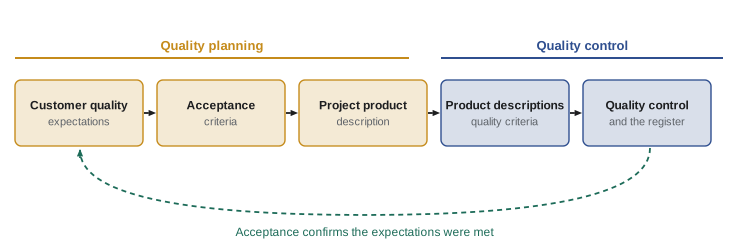
Customer quality expectations
Quality planning starts with the customer's quality expectations: statements about the key quality characteristics of the project's final product. They are usually captured during starting up a project, when the project product description is first drafted, and they are often vague at first. A senior user might say that the new meters must be reliable, that customers must trust their bills and that the system must be easy for billing staff to use. These are genuine expectations, but nobody could test a meter against the word reliable. The work of quality planning is to turn them into something that can be measured.
Expectations should also be prioritized. Not every expectation is equally important, and when time or money runs short the project needs to know which ones may be relaxed. PRINCE2 guidance commonly suggests a prioritization method such as MoSCoW, which sorts requirements into must have, should have, could have and won't have this time. Prioritization at this point is valuable later: it tells the board which quality tolerances can be flexed in an exception and which cannot.
| Customer quality expectation (vague) | Why it is hard to test | Questions that make it measurable |
|---|---|---|
| Meters must be reliable | Reliable over what period, in what conditions? | What proportion of daily reads must arrive? What failure rate per year is acceptable? |
| Customers must trust their bills | Trust is an attitude, not a property of a product | How many bills may be estimated? How many disputes per thousand accounts? |
| Easy for billing staff to use | Easy for whom, doing what? | How long should it take a trained clerk to resolve an exception read? What error rate in a usability test? |
| Alerts must be useful to customers | Useful is judged by the customer | What proportion of test customers understand what to do? How quickly do they act? |
Acceptance criteria
Acceptance criteria are a prioritized list of measurable definitions of the attributes required for the project's final product to be acceptable to key stakeholders. They answer the question the senior user will be asked at the end of the project: does this meet what you need? A good acceptance criterion is specific, measurable, agreed with the people who will accept the product and realistic for the supplier to achieve. Acceptance criteria may cover functionality, performance, reliability, appearance, ease of use, security, sustainability, operating cost and the date by which the product must be available.
| Acceptance criterion | Measure and target | Priority | Who confirms |
|---|---|---|---|
| Daily read rate | At least 98 % of meters report a valid daily reading over a 30-day period | Must | Manager of customer operations |
| Billing accuracy | Fewer than 1 in 1,000 bills require manual correction in the first two billing cycles | Must | Billing manager |
| Leak alerts understood | At least 80 % of customers in a usability test describe the correct action | Must | Manager of customer operations |
| Exception handling time | A trained clerk resolves a missing-read exception in under 4 minutes on average | Should | Billing manager |
| Meter battery life | Supplier evidence of at least 15 years in normal use | Should | Senior supplier with user assurance |
| Customer portal accessibility | Meets the accessibility standard the utility has adopted for public websites | Must | Accessibility specialist on behalf of senior user |
| Installation complaints | Fewer than 5 complaints per 1,000 installations | Could | Manager of customer operations |
Each criterion has a measure, a target, a priority and someone who will confirm it. The priorities matter. If, late in rollout, the supplier proposes to save three weeks by relaxing the installation complaints target, the board can see that it is a could-have criterion and may accept a concession. If the proposal were to relax the daily read rate, the board can see immediately that it is a must-have criterion and that relaxing it would threaten the billing benefit. Acceptance criteria therefore feed directly into the issues and progress practices.
Public-sector projects often inherit acceptance criteria from outside the project. A Canadian municipal utility, for example, must meet provincial measurement and drinking-water rules, and Measurement Canada approves the design of meters used in trade for some utilities such as electricity and natural gas; check which rules apply to the specific product before writing the criterion. Accessibility requirements for the customer portal may come from provincial accessibility law, such as Ontario's AODA, or from the organization's own policy. Writing these inherited requirements into the acceptance criteria makes them visible to the supplier and testable at acceptance, instead of discovering them during an audit.
The project product description
The project product description is a special product description for the project's final product. It is created in starting up a project and refined during initiation. In plain terms, it describes the overall purpose of the final product, its composition (the major products it is made of), the customer's quality expectations, the acceptance criteria, any project-level quality tolerances, the acceptance method, and who is responsible for acceptance. It is used in closing the project to confirm that the project has delivered what was expected.
Ordinary product descriptions do the same job for each individual product that the project will create. PRIN-130 showed how they are written during product-based planning. For the quality practice, the important parts are the quality criteria, the quality tolerance on each criterion, the quality method that will be used to check the product, the skills required to carry out the check, and the people responsible for producing, reviewing and approving the product. If any of those are missing, quality control will have nothing firm to work against.
| Element | Project product description | Ordinary product description |
|---|---|---|
| Scope | The final product of the whole project | One product, specialist or management |
| Created | Starting up a project; refined in initiation | When the product is identified in planning |
| Quality content | Customer quality expectations, acceptance criteria, project-level tolerances, acceptance method and responsibilities | Quality criteria, tolerances, quality method, skills, producer, reviewers and approvers |
| Used for | Confirming acceptance of the final product when closing | Checking and approving each product during delivery |
| Ridgeline example | Smart metering operating across all 20 districts | Billing interface: end-to-end test on 500 sample accounts |
The quality management approach
During initiation, the project manager prepares a quality management approach, which becomes part of the project initiation documentation. It describes how quality will be managed on this project: which standards, procedures and techniques apply, how quality planning and quality control will be done, which records will be kept, how and when quality assurance outside the project will take place, and who is responsible for what. It also explains how the project's approach fits with any corporate or customer quality management system, such as an ISO 9001 certified system at the supplier.
| Topic | Question it answers | Ridgeline Water |
|---|---|---|
| Standards and procedures | Which quality standards and procedures apply? | Utility's asset acceptance procedure; supplier's certified quality management system; accessibility standard for web content |
| Quality methods | How will products be checked? | Factory acceptance tests for meters; field coverage tests; end-to-end billing tests; usability tests; document reviews |
| Records | Which records will be kept and where? | Quality register in the project tool; test reports filed against each product |
| Quality assurance | Who outside the project will check that the approach is followed? | The utility's internal audit team reviews quality records at the end of the pilot |
| Responsibilities | Who plans, performs, reviews and approves? | Team managers produce; named reviewers from customer operations and billing review; senior user approves |
| Timing | When do major quality activities happen? | Coverage test before go-live; billing test after two cycles; usability test before alerts are switched on |
| Tailoring | What is simplified and why? | Document reviews for low-risk products by a single reviewer instead of a full review meeting |
Who is responsible for what
Quality responsibilities follow the customer–supplier split that PRIN-120 described. The customer, represented by the senior user, defines what is acceptable and confirms acceptance. The supplier, represented by the senior supplier, confirms that the product can be built to that standard and provides the specialist resources for quality checks. The project manager plans and coordinates quality activities. Project assurance checks, on behalf of the board, that quality planning and control are actually happening. Project support usually maintains the quality register.
| Role | Quality responsibilities (summary in our words) |
|---|---|
| Business layer | Provides corporate quality standards and any external quality assurance |
| Executive | Approves the quality management approach as part of the project initiation documentation; confirms the project delivers value |
| Senior user | Provides customer quality expectations and acceptance criteria; ensures users take part in quality checks; confirms acceptance |
| Senior supplier | Confirms that quality criteria are achievable; provides resources for quality activities; approves supplier quality methods |
| Project manager | Prepares the quality management approach and product descriptions; ensures quality activities are planned and carried out |
| Team manager | Produces products to their quality criteria; carries out or arranges quality checks in the work package |
| Project assurance | Advises on standards; checks that quality activities follow the approach; checks that users are involved |
| Project support | Maintains the quality register and quality records |
Two distinctions are worth keeping clear. First, project assurance is not the same as quality assurance. Project assurance is carried out on behalf of the project board and checks every aspect of the project, not only quality. Quality assurance, in the PRINCE2 sense, is an independent check, usually by the business layer or the customer's quality function, that the project's quality management is adequate and follows corporate standards. Second, quality planning is a customer-led activity even when the supplier writes most of the documents: a supplier who defines its own acceptance criteria is marking its own homework.
Checking that criteria are measurable
A common assurance check is to read acceptance and quality criteria and ask whether each one could actually be tested. The code below applies two simple tests to a list of draft criteria: does the criterion contain a number or threshold, and does it avoid words that cannot be measured on their own? It is a teaching device, not a substitute for reading the criteria with the people who will accept the product.
import re
vague = ["reliable", "user-friendly", "easy", "robust", "fast", "high quality", "adequate", "modern"]
drafts = {
    "Daily read rate": "At least 98 % of meters report a valid daily reading over 30 days",
    "Portal": "The customer portal must be user-friendly and modern",
    "Billing accuracy": "Fewer than 1 in 1,000 bills need manual correction",
    "Meters": "Meters must be robust and reliable",
    "Alerts": "At least 80 % of test customers describe the correct action",
    "Clerk time": "Exceptions are resolved fast by trained clerks",
}
for name, text in drafts.items():
    has_number = bool(re.search(r"\d", text))
    found = [w for w in vague if w in text.lower()]
    ok = has_number and not found
    note = "measurable" if ok else "rewrite: " + ("no threshold" if not has_number else "") + (
        (" vague: " + ", ".join(found)) if found else "")
print(f"{name:17} {note}")Daily read rate measurable Portal rewrite: no threshold vague: user-friendly, modern Billing accuracy measurable Meters rewrite: no threshold vague: reliable, robust Alerts measurable Clerk time rewrite: no threshold vague: fast
Three of the six drafts pass. The portal, meters and clerk time criteria fail: they have no threshold and use words such as user-friendly, robust and fast. Each would need to be rewritten, for example as an accessibility conformance level and a usability test result for the portal, a read rate and annual failure rate for the meters, and an average resolution time for the clerks. Small checks like this are cheap during initiation and very expensive to fix after a supplier has built to the vague version.
Worked problem
Turning an expectation into acceptance criteria
In starting up, the senior user tells the project manager: customers must be able to see their own water use easily, and they must not be alarmed by false leak alerts. Draft acceptance criteria for the project product description and suggest priorities.
Show solution
- Separate the two expectations: visibility of use, and the accuracy of leak alerts.
- For visibility, define a measure: for example, customers can view daily use for the past 13 months on the portal, and at least 85 % of test users find last month's total within one minute.
- For false alerts, define a measure: for example, fewer than 2 % of leak alerts in the pilot are later shown to be false.
- Agree priorities with the senior user: alert accuracy is a must have, because false alerts would destroy trust in the leak benefit; the one-minute usability target might be a should have.
- Name who confirms each criterion and how: customer operations confirms the false-alert rate from pilot data; user assurance observes the usability test.
Answer: Two measurable criteria with priorities, measures and named confirmers replace two vague expectations, and the priorities tell the board which criterion it can relax if needed.
Common mistakes
MistakeWriting acceptance criteria with words such as reliable or user-friendly and no thresholds.
InsteadGive every criterion a measure and a target that a reviewer could test.
MistakeLetting the supplier define the acceptance criteria.
InsteadThe senior user provides expectations and acceptance criteria; the supplier confirms they are achievable.
MistakeTreating project assurance and quality assurance as the same thing.
InsteadProject assurance works for the board on every aspect; quality assurance is an independent check of quality management, usually from outside the project.
MistakeLeaving acceptance criteria unprioritized.
InsteadPrioritize them, for example with MoSCoW, so the board knows which can be relaxed in an exception.
MistakeWriting the quality management approach once and never using it.
InsteadUse it to plan quality activities into each stage and to guide assurance checks.
Summary and key terms
- The quality practice has two halves: quality planning defines what fit for purpose means; quality control checks products against it.
- Customer quality expectations are refined into prioritized, measurable acceptance criteria.
- The project product description holds the expectations, acceptance criteria, acceptance method and responsibilities for the final product.
- Each product description holds quality criteria, tolerances, methods, skills and the producer, reviewers and approvers.
- The quality management approach, created in initiation, explains how quality will be managed on this project.
- The senior user leads on what is acceptable; the senior supplier confirms it is achievable.
- Project assurance and quality assurance are different checks for different audiences.
- Quality planning
- Defining the products required, their quality criteria, methods and responsibilities.
- Quality control
- Carrying out and recording the checks that show whether products meet their criteria.
- Customer quality expectations
- Statements about the key quality characteristics required of the project's final product.
- Acceptance criteria
- A prioritized list of measurable attributes the final product must have to be acceptable.
- Project product description
- The product description of the project's final product, including acceptance criteria.
- Quality criteria
- Measurable descriptions of the characteristics a product must have to be approved.
- Quality tolerance
- The permissible range around a quality criterion.
- Quality management approach
- The description of how quality will be managed on a particular project.
- Quality assurance
- An independent check that a project's quality management is adequate and follows standards.
- MoSCoW
- A prioritization method: must have, should have, could have, won't have this time.
Practice problems
Work each problem on paper first, then reveal the answer to check.
Name the two halves of the quality practice.
Show answer
Quality planning and quality control.
Who provides the customer's quality expectations?
Show answer
The senior user, on behalf of the users.
Where are acceptance criteria recorded?
Show answer
In the project product description.
When is the project product description first created?
Show answer
During starting up a project.
Rewrite the criterion 'the portal must be fast' so it can be tested.
Show answer
For example: 95 % of portal pages load in under two seconds on a standard broadband connection.
Which management product explains how quality will be managed on the project?
Show answer
The quality management approach.
Why prioritize acceptance criteria?
Show answer
So the board knows which criteria can be relaxed if time or cost pressures arise.
Who usually maintains the quality register?
Show answer
Project support.
How does quality assurance differ from project assurance?
Show answer
Quality assurance is an independent check of quality management, usually from outside the project; project assurance checks all aspects on the board's behalf.
Which principle does the quality practice most directly support?
Show answer
Focus on products.
Lesson quiz · 5 questions
Score 60% or more to complete this lesson.
Create a free account to save your progress, take quizzes and earn a certificate.