
PRIN-131 · Lesson 3 of 12 · 28 min
The risk practice I: the approach and identifying risks
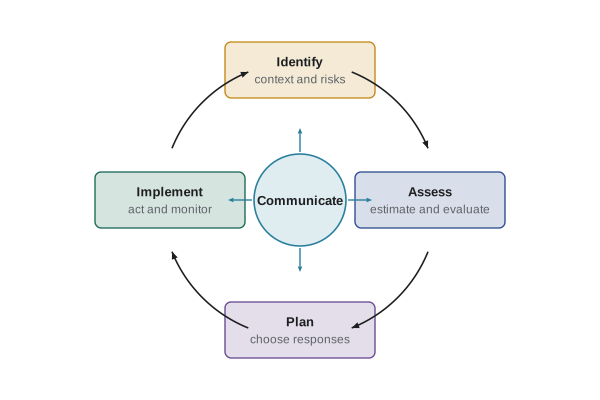
Every plan is a forecast, and every forecast rests on assumptions that may turn out to be wrong. The risk practice exists to identify, assess and control uncertainty so that the project is more likely to succeed. This lesson covers what PRINCE2 means by risk, the risk management approach that sets the rules for a project, how risk appetite and risk tolerance shape those rules, and the first step of the risk management procedure: identifying risks and recording them well. Lesson 4 covers assessing, planning, implementing and communicating.
What a risk is
In PRINCE2, a risk is an uncertain event or set of events that, should it occur, will have an effect on the achievement of objectives. Two features of this definition matter. First, a risk has not happened yet; once it has happened it is an issue, handled by the issues practice. Second, the effect can be negative or positive. A risk with a negative effect is a threat; a risk with a positive effect is an opportunity. Many projects manage only threats, which means they quietly give up the chance to finish early, cheaper or with more benefit than planned.
| Term | Meaning | Ridgeline Water example |
|---|---|---|
| Threat | An uncertain event that would harm objectives | Radio coverage in hilly streets is poorer than the survey showed |
| Opportunity | An uncertain event that would help objectives | A provincial or state subsidy for smart meters becomes available |
| Issue | An event that has happened and needs management | Meter batch 2 failed its sample test |
| Assumption | Something treated as true for planning | Customers will respond to leak alerts within two weeks |
| Cause | The source of a risk: a fact or situation | Many older homes have meters in deep, flooded pits |
Writing a risk well: cause, event, effect
A risk description that reads simply 'supplier' or 'budget overrun' cannot be managed, because nobody can tell what might happen or why. PRINCE2 guidance recommends describing each risk in three parts: the cause, which is a definite fact or situation that gives rise to the uncertainty; the event, which is the uncertain thing that might happen; and the effect, which is the impact on objectives if it does. A useful pattern is: because of a cause, an event may occur, which would lead to an effect.
| Poor description | Cause | Event | Effect |
|---|---|---|---|
| Supplier risk | The meter supplier has one factory and a backlog of orders | Pilot meters may be delivered late | Installation would start late, using time tolerance |
| Customers | Leak alerts are a new kind of message for customers | Customers may ignore alerts | Leak savings would fall below the benefit forecast |
| IT | The billing system is 15 years old with little documentation | The interface may take longer than estimated to build and test | The pilot could miss its stage end date and cost tolerance |
| Grant | A provincial or state program is considering funding for smart water meters | A subsidy covering part of meter costs may be announced | Project cost would fall, improving the business case |
Separating the three parts helps later. Responses aimed at the cause tend to reduce probability; responses aimed at the effect tend to reduce impact. Assessors can estimate probability for the event and impact for the effect. And the same cause can produce several risks, which is useful when many risks share a root, such as an ageing billing system.
The risk management approach
During initiation the project manager prepares a risk management approach, which describes how risk management will be carried out on this project. It sits in the project initiation documentation and is approved by the board. It should reflect any corporate risk policy, the board's risk appetite and the nature of the project. A small internal project might have a page; a large public infrastructure project might have a substantial document aligned with an organizational risk framework.
| Topic | Question it answers | Ridgeline Water |
|---|---|---|
| Procedure | What steps will be followed? | Identify, assess, plan, implement, communicate, as described in lessons 3 and 4 |
| Tools and techniques | Which techniques will be used? | Risk workshops at each stage boundary; prompt list; probability-impact grid; expected value |
| Records | Where are risks recorded? | Risk register in the project log; minor risks may be noted in the daily log |
| Scales | How are probability and impact scored? | Five-point scales defined in money, weeks and benefit terms (lesson 4) |
| Risk tolerance | What level of risk must be escalated? | Any single risk with expected impact above 100 thousand goes to the board |
| Risk budget | Is there money for responses, and who can use it? | A risk budget of 120 thousand in the pilot stage, released by the executive |
| Roles | Who owns, acts on and reviews risks? | Named risk owners; project manager maintains the register; business assurance reviews monthly |
| Timing and reporting | When are risks reviewed and reported? | Weekly by the project manager; summary in each highlight report |
| Early warning indicators | What signals suggest a risk is becoming more likely? | Supplier factory output; interface defect counts; alert response rate |
Risk appetite and risk tolerance
Risk appetite is an organization's unique attitude towards risk taking: broadly, how much uncertainty it is prepared to accept in pursuit of its objectives. A start-up developing a new product may have a large appetite; a water utility responsible for public health has a small appetite for anything that affects water quality but may accept more risk in its customer service systems. Risk tolerance turns appetite into thresholds: the level of risk exposure which, if exceeded, triggers an escalation. Risk tolerance is one of the performance targets on which the business layer and board set tolerances, alongside time, cost, scope, quality, benefits and sustainability.
| Level | Ridgeline Water statement | How it is used |
|---|---|---|
| Risk appetite (business layer) | Very low appetite for risks to drinking-water safety or customer data; moderate appetite for schedule and technology risk in the metering program | Shapes project tolerances and the risk management approach |
| Project risk tolerance | No risk to water safety may be accepted without utility board approval; aggregate expected cost of threats must stay below 8 % of project budget | Escalated by the board to the utility board if exceeded |
| Stage risk tolerance | No single risk with expected impact above 100 thousand without board review | Exception report or escalation to the board if exceeded |
Roles: risk owner and risk actionee
Each risk in the register should have a risk owner: a named individual responsible for managing it, including monitoring triggers and making sure responses are carried out. Where a response involves specific actions, these may be assigned to a risk actionee, who carries out the actions under the owner's direction. The owner is chosen for being best placed to manage the risk, not for seniority or convenience. A risk that belongs to everyone is managed by no one.
| Risk | Risk owner | Risk actionee for main response | Why this owner |
|---|---|---|---|
| Pilot meters delivered late | Senior supplier (meter supplier's delivery director) | Supplier's logistics manager: weekly production report | Controls the factory and delivery schedule |
| Customers ignore leak alerts | Senior user (manager of customer operations) | Customer operations supervisor: follow-up calls for large flows | Owns the customer relationship and the benefit |
| Billing interface overruns | Project manager | IT development lead: early prototype of the interface | Within the project's own delivery work |
| Subsidy announced | Executive | Finance analyst: monitor the program and prepare an application | Owns the business case and funding |
Identifying risks
The risk management procedure begins with identification, which has two parts. First, identify the context: the objectives at risk, the scope of risk management, the stakeholders and their appetite, and any relevant corporate rules. Much of this is captured in the risk management approach. Second, identify the risks themselves, recording each as cause, event and effect, along with early warning indicators where possible. Identification is not a one-off workshop in initiation: new risks appear throughout the project, and the board should expect to see the register change at every stage boundary.
| Technique | How it works | Strength | Limitation |
|---|---|---|---|
| Review lessons | Read lessons logs and reports from similar projects | Cheap; based on real experience | Only finds risks someone recorded before |
| Risk checklist or prompt list | Work through categories such as political, economic, social, technological, legal and environmental | Broad coverage; helps avoid blind spots | Can become a box-ticking exercise |
| Brainstorming or workshop | Stakeholders generate risks together, then group and refine them | Draws on many views; builds ownership | Dominated by loud voices without a good facilitator |
| Assumptions analysis | Examine each planning assumption and ask what if it is false | Finds risks hidden in plans and the business case | Needs assumptions to be written down first |
| Risk breakdown structure | A hierarchy of risk sources used to organize identification | Systematic; reveals concentrations of risk | Takes effort to build the first time |
| Interviews and expert judgment | Ask specialists about their area | Deep insight in technical areas | Limited to the experts consulted |
Ridgeline Water's project manager combines several techniques at the start of the pilot stage: a review of lessons from another utility's metering project, an assumptions analysis of the business case, and a two-hour workshop with the board members, team managers and a representative of the customer contact centre. The workshop uses a simple risk breakdown structure as its agenda, so that every source of risk gets attention.
The risk register
Identified risks are recorded in the risk register, which in PRINCE2 7 is part of the project log. A register entry typically includes an identifier, the author and date, the category, the description as cause, event and effect, the probability, impact and expected value, proximity, the response category and actions, the risk owner and actionee, and the current status. The register is a working tool for the project manager and owners, not a document to impress the board. Its usefulness depends on keeping descriptions specific and statuses current.
The code below takes a draft register and checks two quality points that assurance often finds lacking: whether each description contains a cause, an event and an effect, using the 'because ... may ... leading to' pattern, and whether each risk has a named owner. It then counts risks by source in the risk breakdown structure to show where they concentrate.
import re
from collections import Counter
risks = [
    ("R1", "supplier", "Because the supplier has one factory, pilot meters may arrive late, leading to a later start of installation", "senior supplier"),
    ("R2", "customer", "Customers ignore alerts", ""),
    ("R3", "technology", "Because the billing system is old, the interface may take longer, leading to schedule overrun", "project manager"),
    ("R4", "technology", "Because hills block radio signals, coverage may fall below 98 %, leading to more estimated bills", "senior supplier"),
    ("R5", "funding", "Because a subsidy program is under review, a grant may be announced, leading to lower net cost", "executive"),
    ("R6", "technology", "Head-end vendor risk", "IT manager"),
    ("R7", "customer", "Because some homes have meters in flooded pits, installers may be unable to fit meters, leading to scope shortfall", ""),
]
pattern = re.compile(r"because .+ may .+ leading to .+", re.I)
for rid, src, text, owner in risks:
    problems = []
    if not pattern.search(text):
        problems.append("not cause-event-effect")
    if not owner:
        problems.append("no owner")
    print(f"{rid}: {'ok' if not problems else '; '.join(problems)}")
print("risks by source:", dict(Counter(r[1] for r in risks)))R1: ok
R2: not cause-event-effect; no owner
R3: ok
R4: ok
R5: ok
R6: not cause-event-effect
R7: no owner
risks by source: {'supplier': 1, 'customer': 2, 'technology': 3, 'funding': 1}Four of the seven entries pass. R2 and R6 are vague labels rather than risks, and R2 and R7 have no owner. The count by source shows three technology risks, two customer risks and one each for supplier and funding. The concentration in technology is not surprising for a metering project, but the absence of any risk in categories such as legal, privacy or people suggests the workshop may have missed whole areas; the project manager might revisit the prompt list before the register is presented to the board.
Worked problem
Identifying risks from assumptions
Ridgeline Water's business case assumes that customers respond to leak alerts within two weeks, that the pilot district is representative of the whole service area, and that meter prices stay within 5 % of the quote. Use assumptions analysis to identify risks.
Show solution
- For each assumption, ask what would happen if it were false and why it might be false.
- Alert response: because alerts are a new kind of message, customers may respond slowly or not at all, leading to lower leak savings than forecast. Owner: senior user.
- Representativeness: because the pilot district has newer housing than average, pilot results may overstate savings and coverage, leading to an optimistic decision at the end of the pilot. Owner: executive.
- Prices: because meter components are traded internationally, prices may rise above the quote, leading to higher rollout costs. Owner: senior supplier.
- Record each in the risk register with early warning indicators, such as the alert response rate in the first month and the supplier's price review notices.
Answer: Three assumptions yield three risks with causes, events, effects and owners. The representativeness risk is the easiest to miss and one of the most important, because it affects the decision the pilot exists to inform.
Common mistakes
MistakeRecording risks as one-word labels such as 'supplier' or 'budget'.
InsteadDescribe each risk as cause, event and effect so it can be assessed and managed.
MistakeManaging only threats.
InsteadIdentify and manage opportunities too, such as subsidies or faster methods.
MistakeRecording something that has already happened as a risk.
InsteadAn event that has happened is an issue; handle it through the issues practice.
MistakeMaking the project manager the owner of every risk.
InsteadAssign each risk to the person best placed to manage it, often a board member or supplier.
MistakeIdentifying risks only at the initiation workshop.
InsteadKeep identifying risks throughout, and review the register at least at every stage boundary.
Summary and key terms
- A risk is an uncertain event that would affect objectives; threats harm them and opportunities help them.
- Describe risks as cause, event and effect.
- The risk management approach sets the procedure, scales, tolerances, budget, roles and reporting for the project.
- Risk appetite is an organization's attitude to risk; risk tolerance turns it into escalation thresholds.
- Each risk has an owner best placed to manage it and may have actionees who carry out responses.
- Identification uses lessons, prompt lists, workshops, assumptions analysis and risk breakdown structures.
- The risk register, held in the project log, records and tracks every risk.
- Risk
- An uncertain event or set of events that, should it occur, would affect the achievement of objectives.
- Threat
- A risk that would have a negative effect on objectives.
- Opportunity
- A risk that would have a positive effect on objectives.
- Risk cause
- A definite fact or situation that gives rise to a risk.
- Risk event
- The uncertain occurrence described by a risk.
- Risk effect
- The impact on objectives if the risk event occurs.
- Risk management approach
- The description of how risk will be managed on a particular project.
- Risk appetite
- An organization's attitude towards taking risk in pursuit of its objectives.
- Risk tolerance
- The threshold of risk exposure which, if exceeded, triggers escalation.
- Risk owner
- The named individual responsible for managing a particular risk.
- Risk actionee
- A person who carries out a specific risk response under the owner's direction.
- Risk register
- The record of identified risks, their assessment, responses, owners and status.
Practice problems
Work each problem on paper first, then reveal the answer to check.
What is the difference between a risk and an issue?
Show answer
A risk is uncertain and has not happened; an issue has happened and needs management.
Rewrite 'IT problems' as cause, event and effect.
Show answer
For example: because the billing system is undocumented, the interface may take longer to build, leading to a missed stage end date.
Who approves the risk management approach?
Show answer
The project board, as part of the project initiation documentation.
What does risk tolerance define?
Show answer
The level of risk exposure which, if exceeded, must be escalated.
Who should own a risk?
Show answer
The person best placed to manage it.
What does a risk actionee do?
Show answer
Carries out specific response actions under the risk owner's direction.
Name two risk identification techniques.
Show answer
For example, assumptions analysis and a risk workshop using a prompt list.
Give an example of an opportunity for Ridgeline Water.
Show answer
A subsidy for smart meters becoming available.
Where are risks recorded in PRINCE2 7?
Show answer
In the risk register, which is part of the project log.
Why separate cause and effect?
Show answer
Responses aimed at the cause reduce probability; responses aimed at the effect reduce impact.
Lesson quiz · 5 questions
Score 60% or more to complete this lesson.
Create a free account to save your progress, take quizzes and earn a certificate.