
PRIN-131 · Lesson 2 of 12 · 27 min
The quality practice II: quality control, assurance and the quality register
Lesson 1 dealt with quality planning: expectations, acceptance criteria, product descriptions and the quality management approach. This lesson deals with quality control: how products are actually checked, how the results are recorded, how products are approved and accepted, and what happens when a product fails. It also looks at how the quality register gives the project manager and the board a running picture of whether quality work is keeping pace with delivery.
Quality methods
A quality method is any way of checking that a product meets its quality criteria. Quality methods fall into two broad families. In-process methods build quality in while the product is being made: specialist tools and techniques, training, automated checks, peer working, and controlled production processes. Appraisal methods check a finished or partly finished product: testing, inspection, measurement, review and audit. Most products need both. Testing a billing interface at the end will find defects, but a team that writes automated checks as it builds will produce fewer defects for the test to find.
| Method | Family | Best suited to | Ridgeline Water example |
|---|---|---|---|
| Testing | Appraisal | Products whose behaviour can be measured objectively | End-to-end billing test on 500 sample accounts |
| Inspection | Appraisal | Physical products and installations | Installer checklist and photograph for every meter fitted |
| Sampling | Appraisal | Large batches where checking every item is costly | Factory acceptance test of 50 meters from each delivery |
| Quality review | Appraisal | Documents, designs and other products judged by people | Review of customer letters and alert wording |
| Usability test | Appraisal | Products used by people where ease of use matters | Test customers interpret leak alerts |
| Automated checks | In-process | Software and data products | Validation rules that reject impossible readings at the head-end |
| Training and certification | In-process | Work done by people where skill drives quality | Installers certified before working unsupervised |
The quality method for each product is chosen during planning and written into its product description. The choice is a trade-off. Full testing of every meter in the factory would be the most thorough but would add cost and time; sampling is cheaper but accepts a small chance that a poor batch passes. Lesson 1's quality management approach records the general policy; each product description records the specific method.
The quality review technique
Many products, especially documents and designs, cannot be tested by a machine. They are checked by people who compare them with their quality criteria. PRINCE2 has long described a structured quality review technique for this. It defines four roles. The chair runs the review and makes sure it reaches a conclusion. The presenter introduces the product and represents the people who produced it. Reviewers check the product against its quality criteria and raise questions. The administrator records actions and results. One person may hold more than one role on a small project, but the chair and presenter should usually be different people so that the person defending the product is not also deciding the outcome.
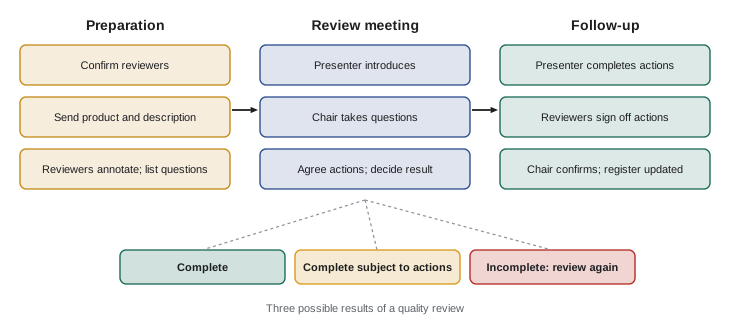
| Step | What happens | Common weakness |
|---|---|---|
| Preparation | The chair confirms reviewers; the product and its description are sent out; reviewers annotate and list major questions in advance | Reviewers read the product for the first time in the meeting |
| Review meeting | The presenter introduces the product; the chair takes the major questions; actions are agreed; the chair decides the result | The meeting becomes a redesign session instead of a check against criteria |
| Follow-up | The presenter coordinates the actions; reviewers confirm their actions are done; the chair signs off; the administrator updates the quality register | Actions are agreed but never checked, so the product is approved with known defects |
A quality review can end in one of three ways: the product is complete and ready for approval; it is complete subject to agreed actions, which reviewers will confirm; or it is incomplete and needs another review. The technique also produces useful side effects: reviewers learn about products they will later use or support, and the presenter gets structured feedback rather than a collection of conflicting emails.
Approval and acceptance
Passing a quality check is not the same as being approved, and approval of individual products is not the same as acceptance of the project's final product. Quality checks produce quality records. The people named as approvers in each product description then give formal approval, producing approval records. At the end of the project, the people named in the project product description confirm that the final product meets its acceptance criteria, producing acceptance records. Some products are accepted in stages, for example as each district goes live.
| Record | Evidence of | Typical example | Who creates it |
|---|---|---|---|
| Quality record | That a planned quality check was carried out, and its result | Test report showing 497 of 500 sample bills correct | The person or team carrying out the check |
| Approval record | That an authorized person approved a product as fit for purpose | Email or signed form from the billing manager approving the interface | The approver named in the product description |
| Acceptance record | That the final product, or a release of it, meets its acceptance criteria | Senior user's acceptance of district 1 after 30 days of live running | The people named in the project product description |
The quality register
The quality register is a summary of all the quality activities that are planned or have taken place. It does not hold the detailed results, which sit in quality records; it gives a single view of what is due, what has been done and what passed. It is usually maintained by project support, and in PRINCE2 7 it is one of the records held in the project log, alongside the daily log, issue register, risk register, lessons log and product register. The project manager uses it to see whether quality work is on schedule; project assurance uses it to check that planned checks are actually happening.
| Field | Purpose | Example entry |
|---|---|---|
| Quality identifier | Unique reference for the activity | Q-014 |
| Product | The product being checked | Billing interface |
| Method | How it will be checked | End-to-end test, 500 sample accounts |
| Roles | Who produces, reviews and approves | IT development lead; billing reviewers; billing manager approves |
| Dates | Planned, forecast and actual dates | Planned week 20; actual week 21 |
| Result | Pass, fail or conditional | Conditional: 3 accounts incorrect, fix required |
| Records | References to the detailed quality records | Test report TR-07 |
The code below holds a small extract of Ridgeline Water's quality register in week 22 of the pilot stage and reports three things: which checks are overdue, the pass rate so far, and which products are ready for approval because every one of their planned checks has passed.
today = 22  # pilot stage week
register = [
    # id, product, method, planned week, actual week or None, result
    ("Q-010", "Pilot radio network", "coverage test", 12, 12, "pass"),
    ("Q-011", "Head-end configured", "acceptance test", 11, 13, "pass"),
    ("Q-012", "Meter batch 1", "factory sample of 50", 9, 9, "pass"),
    ("Q-013", "Meter batch 2", "factory sample of 50", 15, 15, "fail"),
    ("Q-014", "Billing interface", "end-to-end test", 20, 21, "conditional"),
    ("Q-015", "Alert design", "usability test", 19, None, None),
    ("Q-016", "Customer letters", "quality review", 17, 18, "pass"),
    ("Q-017", "Meter batch 2", "retest of replacement batch", 20, None, None),
]
done = [r for r in register if r[4] is not None]
overdue = [r for r in register if r[4] is None and r[3] < today]
passed = sum(1 for r in done if r[5] == "pass")
print(f"checks done {len(done)} of {len(register)}; passed first time {passed} of {len(done)}")
for r in overdue:
    print(f"OVERDUE {r[0]} {r[1]} ({r[2]}) planned week {r[3]}")
products = {}
for r in register:
    products.setdefault(r[1], []).append(r)
ready = [p for p, rs in products.items() if all(x[5] == "pass" for x in rs[-1:])]
print("ready for approval:", ", ".join(ready))checks done 6 of 8; passed first time 4 of 6 OVERDUE Q-015 Alert design (usability test) planned week 19 OVERDUE Q-017 Meter batch 2 (retest of replacement batch) planned week 20 ready for approval: Pilot radio network, Head-end configured, Meter batch 1, Customer letters
Six of the eight planned checks have been done and four passed first time. Two checks are overdue: the alert usability test was due in week 19 and the retest of the replacement meter batch in week 20. Four products are ready for approval: the network, the head-end, the first meter batch and the customer letters. The billing interface has a conditional result and cannot yet be approved. For the project manager, the overdue usability test is the most worrying item, because PRIN-130's schedule showed alert design with little float; for the highlight report, the first-time pass rate is a useful indicator of supplier quality.
Sampling large batches
Where products arrive in large batches, checking every item may be impractical. Sampling accepts or rejects a batch based on a sample. Its weakness is that a poor batch can still pass if the sample happens to contain few defects. The code below estimates, for Ridgeline Water's rule of testing 50 meters per batch and rejecting the batch if more than one fails, the chance of accepting batches with different true defect rates.
from math import comb
n, max_fail = 50, 1
def p_accept(rate):
    return sum(comb(n, k) * rate**k * (1 - rate)**(n - k) for k in range(max_fail + 1))
for rate in [0.005, 0.01, 0.02, 0.05, 0.08]:
print(f"true defect rate {rate:5.1%}: chance batch is accepted {p_accept(rate):5.1%}")true defect rate 0.5%: chance batch is accepted 97.4% true defect rate 1.0%: chance batch is accepted 91.1% true defect rate 2.0%: chance batch is accepted 73.6% true defect rate 5.0%: chance batch is accepted 27.9% true defect rate 8.0%: chance batch is accepted 8.3%
A batch with a 0.5 % defect rate is accepted about 97 % of the time, which is what the project wants. A batch with a 5 % defect rate, ten times worse, is still accepted about 28 % of the time, and one at 8 % about 8 % of the time. If a 5 % defect rate would seriously harm the daily read rate, the sampling plan is too weak and should be strengthened, for example with a larger sample, a zero-failure rule or tightened inspection after a failed batch. The point for the quality practice is that the method must match the risk; the quality management approach should state the sampling rule and the reasoning behind it.
When a product fails
A product that fails a quality check is not automatically an issue. If it can be corrected within the work package's tolerances, the team manager simply fixes it and rechecks, and the quality register shows the retest. If it cannot be corrected within tolerance, or if the customer is asked to accept it as it is, it becomes an off-specification and is handled through the issues practice. An off-specification may lead to the product being fixed, to a concession in which the customer accepts it with a known shortfall, or to an exception if tolerances are threatened. Lessons 5 and 6 cover that route.
Worked problem
A failed meter batch
Meter batch 2 failed its factory sample: 4 of 50 meters failed the radio test, against a maximum of one. The supplier offers to replace the batch at its own cost within five weeks; the pilot schedule can absorb three weeks of delay on meters because they have float. What should happen in quality and issues terms?
Show solution
- Record the failed result in the quality register against Q-013 with a reference to the test report.
- Because the batch cannot be accepted and replacement threatens the schedule, the project manager raises an off-specification in the issue register.
- The project manager assesses the impact: five weeks against three weeks of float could delay installation by about two weeks, which is within the stage's two-week time tolerance but uses all of it.
- Options include accepting the replacement plan, asking the supplier to expedite part of the batch, or sourcing a second batch; the project manager decides within his or her authority or escalates if tolerance is threatened.
- Plan the retest of the replacement batch (Q-017) and record it in the quality register.
Answer: The failure is recorded as a quality result, handled as an off-specification because it affects a baseline, assessed against tolerance, and followed by a planned retest; nothing is approved until the replacement batch passes.
Common mistakes
MistakeTreating a passed test as approval of the product.
InsteadQuality records show a check was done; approval records show an authorized person approved the product.
MistakeUsing the quality review meeting to redesign the product.
InsteadCheck the product against its criteria, agree actions and leave redesign to the producer.
MistakeLetting the presenter also chair the review.
InsteadKeep chair and presenter separate so the person defending the product does not decide the result.
MistakeKeeping detailed test results in the quality register.
InsteadThe register summarizes activities and refers to the detailed quality records.
MistakeChoosing a sampling rule without checking how often it accepts poor batches.
InsteadMatch the sampling plan to the risk and record the reasoning in the quality management approach.
Summary and key terms
- Quality methods include in-process methods that build quality in and appraisal methods that check products.
- The quality review technique uses a chair, presenter, reviewers and administrator in preparation, a meeting and follow-up.
- A review ends with the product complete, complete subject to actions, or incomplete.
- Quality records, approval records and acceptance records are different kinds of evidence.
- The quality register summarizes planned and actual quality activities and is held in the project log.
- Sampling plans must be checked against the risk of accepting poor batches.
- A product that cannot be fixed within tolerance becomes an off-specification in the issues practice.
- Quality method
- A way of checking that a product meets its quality criteria.
- In-process method
- A method that builds quality into a product while it is being made.
- Appraisal method
- A method that checks a product, such as testing or inspection.
- Quality review technique
- A structured review of a product against its quality criteria by named roles.
- Chair
- The quality review role responsible for running the review and deciding its result.
- Presenter
- The quality review role that introduces the product and represents its producers.
- Reviewer
- A person who checks a product against its quality criteria.
- Quality register
- A summary of planned and completed quality activities.
- Approval record
- Evidence that an authorized person has approved a product.
- Acceptance record
- Evidence that the final product, or a release of it, has been accepted.
Practice problems
Work each problem on paper first, then reveal the answer to check.
Give one in-process and one appraisal quality method.
Show answer
For example, automated validation rules (in-process) and testing (appraisal).
Name the four roles in the quality review technique.
Show answer
Chair, presenter, reviewer and administrator.
What are the three possible results of a quality review?
Show answer
Complete; complete subject to actions; incomplete.
Where are detailed test results kept?
Show answer
In quality records, referenced from the quality register.
Who gives approval of a product?
Show answer
The approvers named in its product description.
Which record confirms that the final product meets its acceptance criteria?
Show answer
The acceptance record.
In PRINCE2 7, which collection of records holds the quality register?
Show answer
The project log.
A failed product can be fixed within work package tolerance. Is it an issue?
Show answer
Not necessarily; the team fixes and retests it, recording the retest in the quality register.
What is a concession?
Show answer
An agreement by the customer to accept a product that does not fully meet its specification.
Why should the chair and presenter usually be different people?
Show answer
So that the person representing the product does not also decide whether it passes.
Lesson quiz · 5 questions
Score 60% or more to complete this lesson.
Create a free account to save your progress, take quizzes and earn a certificate.