
PRIN-131 · Lesson 12 of 12 · 27 min
Capstone: controlling a stage, with exam strategy for these practices
This capstone applies all four control practices to one management stage of a different project. It uses Harbour City Libraries, the invented library system from the PRIN-130 capstone, which planned a 25-week pilot branch stage to install self-service kiosks with RFID tags and an online room booking system in one branch, and to measure customer uptake. Here the stage has been authorized and work is under way. You will set up quality and risk control, handle issues as they arise, report progress, and decide whether an exception is needed. The lesson ends with exam strategy for questions on quality, risk, issues and progress. All names and figures are invented and illustrative.
The authorized stage
| Item | Pilot branch stage plan |
|---|---|
| Duration | 25 weeks; time tolerance +3 weeks (tagging uncertainty) |
| Budget | 360 thousand; cost tolerance +5 % (18 thousand) |
| Scope | One branch: kiosks, tagged collection, booking system, trained staff, 8-week measured pilot |
| Quality | At least 70 % of checkouts by self-service by the end of the measured pilot; booking system meets the city's web accessibility standard |
| Risk | No single risk with expected impact above 15 thousand without board review; risk budget 25 thousand |
| Change authority | Project manager up to 5 thousand per change from a 40 thousand change budget; board above that |
| Reporting | Weekly checkpoint reports from team managers; highlight reports every four weeks |
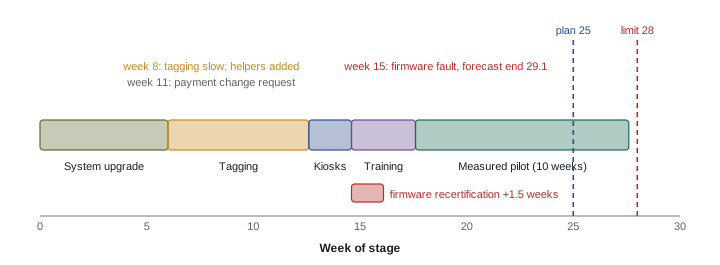
| Critical path | Library system upgrade (weeks 0–6), collection tagging (6–12), kiosk installation (12–14), staff training (14–17), measured pilot (17–25) |
Step 1: quality control for the stage
The project product description already contains the acceptance criteria. For the stage, the project manager makes sure each product description has measurable quality criteria and a method, and plans the quality activities into the stage schedule and the quality register. The most important quality activity is the measurement of uptake during the pilot, because it feeds the board's decision on rollout; it is planned as a product in its own right, with its method agreed in advance so that nobody can argue later about how uptake was calculated.
| Product | Key quality criterion | Method | Reviewer or approver |
|---|---|---|---|
| Library system upgraded | All circulation transactions pass regression tests | Testing by city IT | City IT manager approves |
| Pilot collection tagged | At least 99.5 % of items read correctly at the kiosk | Sample of 1,000 items read at a test kiosk | Branch manager approves |
| Kiosks installed | Kiosk screens and scanners within accessible reach ranges; all kiosks pass vendor commissioning | Inspection against the accessibility checklist; vendor tests | User assurance (accessibility) reviews; manager of branch services approves |
| Booking system configured | Meets the city's web accessibility standard; no double bookings in a 2-week parallel run | Accessibility audit; parallel run | Facilities coordinator approves |
| Uptake measurement report | Self-service share calculated from system data by the agreed method | Quality review of the report | Executive and senior user approve |
Step 2: risks for the stage
At the start of the stage, the project manager holds a short workshop with the team managers and assurance roles and reviews lessons from Ridgeline Water's project, which the city's project office has shared. Five main risks are recorded with owners and responses. The code below calculates their expected values before and after responses, checks them against the 15 thousand risk tolerance and adds up the cost of responses against the 25 thousand risk budget.
risks = [
    # id, description, p, impact k, response, response cost k, p after, impact after
    ("H1", "Tagging slower than planned", 0.5, 30, "train extra staff; temp helpers on standby", 6, 0.3, 20),
    ("H2", "Patrons avoid kiosks", 0.4, 45, "staff ambassadors at kiosks for 4 weeks", 8, 0.25, 45),
    ("H3", "Kiosk delivery late", 0.2, 12, "accept; kiosks have float", 0, 0.2, 12),
    ("H4", "Booking system fails accessibility audit", 0.3, 20, "early audit of templates", 4, 0.1, 20),
    ("H5", "Library system upgrade overruns", 0.3, 25, "vendor support contract hours", 5, 0.15, 25),
]
budget, tol = 25, 15
spent = 0
for rid, text, p, imp, resp, cost, p2, imp2 in risks:
    before, after = p * imp, p2 * imp2
    spent += cost
    flag = "  board review" if after > tol else ""
    print(f"{rid} {text:40} EV {before:5.1f} -> {after:5.1f}{flag}")
print(f"responses cost {spent}k of {budget}k risk budget")
print(f"total EV before {sum(r[2]*r[3] for r in risks):.1f}k, after {sum(r[6]*r[7] for r in risks):.1f}k")H1 Tagging slower than planned EV 15.0 -> 6.0 H2 Patrons avoid kiosks EV 18.0 -> 11.2 H3 Kiosk delivery late EV 2.4 -> 2.4 H4 Booking system fails accessibility audit EV 6.0 -> 2.0 H5 Library system upgrade overruns EV 7.5 -> 3.8 responses cost 23k of 25k risk budget total EV before 48.9k, after 25.4k
Responses cost 23 thousand of the 25 thousand risk budget and cut the total expected value of the threats from about 49 to about 25 thousand. Before responses, patron avoidance, at 18 thousand, exceeded the 15 thousand tolerance and would have needed board review; after responses, no single risk exceeds it, and patron avoidance remains the largest at about 11 thousand. That is appropriate: uptake is the uncertainty the pilot exists to measure, and no response can remove it completely. The project manager records the residual risk clearly so that the board does not mistake a well-managed risk for a resolved one.
Step 3: issues as they arise
Over the first twelve weeks, the project manager captures many small items in the daily log and three significant issues in the issue register. Each is classified, assessed and routed according to the issue management approach and the change authority limits.
| Week | Issue | Type | Assessment | Decision |
|---|---|---|---|---|
| 8 | Tagging rate is below plan; risk H1 has occurred | Problem or concern (from risk H1) | Forecast tagging finish moves from week 12 to about week 13.8 at current rate | Project manager activates the standby helpers from the risk budget (within authority) |
| 10 | Three kiosk screens mounted above the accessible reach range | Off-specification | Vendor can remount at its own cost in one day; no schedule effect | Project manager requires correction; quality register updated with a re-inspection |
| 11 | Friends of the Library request online payment for room bookings | Request for change | Cost 12 thousand; adds about 1 week to booking configuration, which has 1 week of float | Above the 5 thousand limit: issue report to the board |
The routing follows the rules from lessons 5 and 6. The tagging problem is handled by the project manager because the response is already planned and funded. The kiosk off-specification is corrected rather than accepted, because accessibility is a must-have criterion and no concession is appropriate. The payment request goes to the board because it exceeds the project manager's change authority, even though it would not breach any tolerance on its own.
Step 4: progress at week 12
At week 12 the project manager prepares the third highlight report. The main question is the time forecast, because tagging is on the critical path. The code below forecasts the end of tagging from the actual weekly rates, including the standby helpers who started in week 9, and works out the effect on the stage end date and on time tolerance, with and without the payment change.
items_total = 60000
weekly = {6: 7200, 7: 7800, 8: 8100, 9: 9900, 10: 10400, 11: 10600}   # items tagged each week
done = sum(weekly.values())
recent_rate = sum(list(weekly.values())[-3:]) / 3
weeks_left = (items_total - done) / recent_rate
tag_finish = 12 + weeks_left
slip = tag_finish - 12            # tagging was planned to finish at week 12
stage_end = 25 + slip
tol = 3.0
print(f"tagged {done} of {items_total}; recent rate {recent_rate:.0f} per week")
print(f"tagging forecast to finish week {tag_finish:.1f}; slip {slip:.1f} weeks")
print(f"stage end forecast week {stage_end:.1f}; time tolerance used {slip / tol:.0%}")
# the payment change uses booking float (1 week) exactly, so no extra critical path delay
print("with payment change: no additional delay (uses booking float)")
# but if the board also extends the measured pilot by 2 weeks to cover a school term:
print(f"with pilot extended 2 weeks: stage end week {stage_end + 2:.1f}; tolerance used {(slip + 2) / tol:.0%}")tagged 54000 of 60000; recent rate 10300 per week tagging forecast to finish week 12.6; slip 0.6 weeks stage end forecast week 25.6; time tolerance used 19% with payment change: no additional delay (uses booking float) with pilot extended 2 weeks: stage end week 27.6; tolerance used 86%
With the helpers, tagging is now running at about 10,300 items a week. The 6,000 items still to tag will take a little over half a week, so tagging finishes around week 12.6, about 0.6 weeks late, and the stage is forecast to end around week 25.6, using about 19 % of the time tolerance. The payment change would use the booking system's float without delaying the stage. The highlight report shows time as green, notes that the tagging response worked, and asks the board to decide the payment request.
At the board meeting, the chief librarian raises a new point: the measured pilot will run during the summer, when patron numbers and patterns differ from the rest of the year. The library board wants the pilot extended by two weeks to include the first two weeks of the school term. The project manager's forecast shows that this would push the stage end to around week 27.6, using about 86 % of the time tolerance, still within it, but leaving little margin for anything else. The board approves both changes, notes the reduced margin, and asks for weekly rather than four-weekly status emails until the measured pilot starts.
Step 5: an exception after all
In week 15, the kiosk vendor reports that a firmware fault found at another library means all kiosks must be updated and recertified before the pilot can go live, taking 1.5 weeks. Kiosk installation is on the critical path. With the pilot extension already approved, the forecast stage end becomes about week 29.1, beyond the 28-week limit. The project manager raises an exception report. The options are to shorten the extended pilot back to 8 weeks, accepting a less representative measurement; to start the measured pilot with staff-assisted checkout while kiosks are recertified, which would distort the uptake measure; to ask the board for a revised time tolerance at little extra cost, since the vendor bears the firmware cost; or to defer the booking system go-live, which would not help because it is not on the critical path. The project manager recommends a stage exception plan with a revised time tolerance, because the measurement is the purpose of the stage and project tolerances can absorb the delay.
| Practice | Contribution to the exception decision |
|---|---|
| Quality | Uptake measurement method requires kiosks working for the full measured period; recertification is a quality requirement |
| Risk | Vendor firmware risk was not identified; added to the lessons log; residual risk on uptake unchanged |
| Issues | Firmware fault recorded as a problem or concern; vendor bears cost under the contract |
| Progress | Forecast breach of time tolerance triggers the exception report; project tolerance still sufficient |
Exam strategy for these practices
PRIN-101 and PRIN-120 summarized the exam formats: the PRINCE2 7 Foundation exam is a closed-book paper of 60 multiple-choice questions in 60 minutes with a pass mark of 36, and the Practitioner exam is a 150-minute, 70-question objective test based on a scenario, with a pass mark of 60 %, in which the official PRINCE2 7 manual may be consulted. Formats change from time to time, so check the current guidance from PeopleCert or an accredited training provider before you sit an exam. PRIN-160 covers exam strategy in depth; the table below summarizes the traps that questions on these four practices most often set.
| Practice | Common trap | What to check |
|---|---|---|
| Quality | Confusing quality assurance with project assurance, or quality records with approval records | Who is checking, on whose behalf, and what the record proves |
| Quality | Assuming the supplier sets acceptance criteria | Customer defines; supplier confirms achievability |
| Risk | Calling an event that has happened a risk | Has it happened? If so, it is an issue |
| Risk | Mixing up response types, such as reduce and contingent plans | Is the action taken now, or only if the risk occurs? |
| Risk | Using the risk budget for overruns or changes | Risk budget for responses; cost tolerance for variation; change budget for changes |
| Issues | Treating every problem as a request for change | Does it propose or require a change to a baseline? |
| Issues | Letting the project manager approve a change that breaches tolerance | Is the decision within both the authority limit and the tolerance? |
| Progress | Escalating on actual breaches instead of forecasts | Is a breach forecast? If so, escalate now |
| Progress | Sending an exception to the wrong level | Which tolerance is threatened: work package, stage or project? |
A reliable method for scenario questions is to ask, in order: what has happened or been proposed; which practice it belongs to; which management product records it; which role is responsible for the next action; and which tolerance or authority limit applies. Most wrong options in well-written questions fail one of these checks: they assign the action to the wrong role, use the wrong record, or escalate to the wrong level.
questions, minutes = 70, 150
reserve = 15                 # minutes kept for review at the end
per_q = (minutes - reserve) / questions
print(f"about {per_q:.1f} minutes per question, with {reserve} minutes reserved")
checkpoints = [10, 20, 35, 50, 70]
for q in checkpoints:
print(f"after question {q:2}: aim to be at about {q * per_q:5.0f} minutes")about 1.9 minutes per question, with 15 minutes reserved after question 10: aim to be at about 19 minutes after question 20: aim to be at about 39 minutes after question 35: aim to be at about 68 minutes after question 50: aim to be at about 96 minutes after question 70: aim to be at about 135 minutes
With 15 minutes kept for review, each question gets just under two minutes. Checkpoints help a candidate notice early if look-ups in the manual are taking too long. For questions on these four practices, the most time-efficient look-ups are the contents of management products, such as what an exception report contains, and the responsibilities tables, such as who approves the quality management approach.
Self-assessment
Before finishing the course, check your own capstone work against these questions. Does every key product have measurable quality criteria, a method and a named approver, and is the uptake measurement method agreed before the pilot starts? Is every significant risk described as cause, event and effect, with an owner, a proportionate response and an expected value? Were the three issues classified correctly and routed according to the change authority and tolerances? Does the highlight report show tolerance used, not just in or out, and ask for decisions where needed? Was the exception raised when the breach was forecast, with genuine options? If you can answer yes to each, you have applied the control practices as an integrated system rather than as four separate sets of paperwork.
Common mistakes
MistakeAgreeing the uptake measurement method after the pilot has started.
InsteadDefine the method in the product description before measurement begins.
MistakeAccepting an accessibility off-specification by concession to save time.
InsteadCorrect must-have quality failures; concessions suit lower-priority criteria.
MistakeApproving a change because it does not breach tolerance, although it exceeds the authority limit.
InsteadRoute decisions by both authority limits and tolerances.
MistakeApproving changes that consume most of the tolerance without noting the reduced margin.
InsteadRecord and report tolerance used after each decision.
MistakeDelaying the exception report until the firmware update is complete.
InsteadRaise it as soon as the breach is forecast.
Summary and key terms
- Quality control for a stage plans measurable checks, methods and approvers into the schedule and quality register.
- Risk responses should be proportionate; residual risk on the key uncertainty is normal and should be visible.
- Issues are classified and routed by the issue management approach, authority limits and tolerances.
- Highlight reports should forecast from actual data and show tolerance used.
- Approved changes reduce the margin for later problems; boards should note this explicitly.
- Exceptions are raised on forecasts, with genuine options linked to all four practices.
- Exam questions on these practices often test the right role, record and escalation level.
- Uptake
- The share of transactions customers complete using the new self-service products.
- Residual risk
- The risk that remains after responses have been carried out.
- Stage exception plan
- An exception plan that replaces the remainder of the current stage plan.
- Margin
- The unused part of a tolerance available to absorb future problems.
- Measured pilot
- A period of live operation during which agreed measures are collected for a decision.
Practice problems
Work each problem on paper first, then reveal the answer to check.
Why plan the uptake measurement as a product with its own criteria?
Show answer
So its method is agreed before data are collected and the rollout decision rests on accepted evidence.
Which practice handles the kiosks mounted too high?
Show answer
Issues, as an off-specification arising from a quality check.
Why does the payment request go to the board?
Show answer
Its cost exceeds the project manager's 5 thousand change authority.
What triggers the exception report in week 15?
Show answer
A forecast breach of the stage time tolerance.
Who approves a stage exception plan?
Show answer
The project board.
What should happen to the unidentified vendor firmware risk?
Show answer
It is recorded as a lesson so future projects consider it.
In a Practitioner paper with 15 minutes reserved, roughly how long per question?
Show answer
Just under two minutes.
Name one common trap in risk questions.
Show answer
Calling something that has happened a risk.
What are the five checks for scenario questions?
Show answer
What happened, which practice, which record, which role, which tolerance or authority.
Why might the board ask for more frequent status reports after approving changes?
Show answer
Because the remaining margin in tolerance is small.
Lesson quiz · 5 questions
Score 60% or more to complete this lesson.
Create a free account to save your progress, take quizzes and earn a certificate.