
SLS-220 · Lesson 2 of 12 · 22 min
Account planning
▶ Video coming soon A video version of this lesson is on the way.
Farida's second Monday session began with a binder. It was the account plan for the City of Regina facilities office, and it was surprisingly thin: twelve pages, the first of which was a single page headed "The plan on a page". Maya had expected something heavier. "Thick plans do not get read," Farida said. "This one gets read every quarter by me, by Rob, by our service manager and, in part, by the City's facilities director. If it were fifty pages, none of us would open it."
An account plan is a written document that sets out what a supplier wants to achieve with a key account over a period, usually one to three years, and how it will get there. It records what the supplier knows about the customer, the state of the relationship, the opportunities and risks, measurable objectives, the strategy, the actions with owners and dates, and the resources needed. It is a working tool, not a report: it is reviewed and updated regularly, and the best plans are shaped with the customer's input.
This lesson works through how Farida built and maintained the City's plan, and how Maya would start the plans for her own accounts before Ridgeline's new fiscal year began on December 1, 2026.
Why plan an account at all?
A key account usually involves many people on both sides, several products, long contracts and decisions that take months. Without a plan, effort goes wherever the latest phone call points. With a plan, everyone on the supplier's team knows what the account is trying to achieve, what Ridgeline is trying to achieve with it, and what they personally are responsible for.
Research on key account management, including the work of Malcolm McDonald and Diana Woodburn and of Noel Capon at Columbia Business School, treats planning as one of the practices that distinguishes well-run key account programs from badly run ones. The evidence is mostly from surveys and case studies of large suppliers, so it shows that good programs plan, rather than proving that planning on its own causes success. Farida's own argument was simpler. "A plan makes us say out loud what we are trying to do. Then we can tell whether we did it."
What goes into an account plan
There is no single standard format, and many CRM systems include a template. Most plans cover the same ground. Ridgeline's template, which Farida had adapted from a SAMA workshop several years earlier, had nine sections.
| Section | What it contains | City example |
|---|---|---|
| 1. Plan on a page | Objectives, top actions, key risks and the review date on one page | Grow to 400,000 dollars; prepare for the 2027 managed print competition; protect service levels |
| 2. Account overview | What the customer does, its size, structure, sites and direction | Facilities office runs 11 civic buildings; 2027 budget pressure |
| 3. Customer goals and challenges | What the customer is trying to achieve, in its words | Cut energy use, consolidate offices, improve booking of shared rooms |
| 4. History and current position | What has been bought, results, satisfaction, share of spending | Customer since 2019; 318,000 dollars in fiscal 2026 |
| 5. Relationship map | Who matters on both sides and how strong each relationship is | Strong with the facilities manager; weak with finance |
| 6. Opportunities | Specific ways the customer could buy more or differently | Meeting-room technology in two buildings; furniture for a consolidation |
| 7. Objectives | Measurable goals for the period | See below |
| 8. Strategy and actions | How Ridgeline will reach the objectives; who does what by when | Joint workplace review in February 2027 |
| 9. Risks and resources | What could go wrong, and what the plan needs from Ridgeline | Competitor offer at renewal; service technician time |
The order matters. The customer's goals come before Ridgeline's objectives, because an objective that does not serve one of the customer's goals is a sales target, not an account plan. Farida checked every objective against section 3. "If I cannot draw a line from what we want to something they want, I take it out or I go back and learn more."
Starting from the customer's goals
The City's facilities office had told Ridgeline what it was trying to do, in budget documents, council reports and conversations. In 2026 the facilities director, Andrea Lindgren, had three priorities: reduce energy use and floor space across civic buildings, move staff out of two leased offices and into owned buildings by 2028, and fix the chronic shortage of bookable meeting rooms that came with that consolidation. Each priority had a public document behind it. City councils publish budgets, capital plans and committee reports, and reading them is part of the account manager's job (lesson 4 covers understanding the customer's business in depth).
Farida had written the goals in the plan in the City's own language, quoting the capital plan where she could, and with the source and date beside each one. When the City's priorities changed, she would know, because the plan pointed to where they came from.
Setting objectives
Objectives in an account plan should be specific and measurable, so that at the end of the year anyone can tell whether they were met. Many companies use the SMART test: specific, measurable, achievable, relevant and time-bound. The test is useful but easy to satisfy on paper. Farida added two questions of her own: "Does the customer benefit if we hit this?" and "Will we know by the date whether we did?"
| Weak objective | Better objective |
|---|---|
| Grow the City account. | Increase fiscal 2027 revenue from the City to 400,000 dollars, through meeting-room technology and consolidation furniture. |
| Improve the relationship. | Hold a joint workplace review with the facilities director and the City's finance lead by the end of February 2027. |
| Keep service good. | Meet the four-business-hour service response on at least 95 in 100 calls in every quarter of fiscal 2027. |
| Keep the print business. | Submit a compliant, well-evidenced response to the City's managed print competition, expected in late 2027, before the contract ends on March 31, 2028. |
Building a revenue objective
Revenue objectives are where account plans most often go wrong. A common mistake is to take last year's revenue, add a growth percentage handed down from head office, and write it in. The number is then disconnected from anything the customer is actually planning to do. Farida built the City's revenue objective from the bottom up, starting with what was likely to continue and then adding specific opportunities weighted by their chances.
Worked problem
Building the City's fiscal 2027 revenue objective
In fiscal 2026 the City spent 318,000 dollars with Ridgeline: managed print 196,000, furniture 88,000, meeting-room technology and RoomFlow 34,000. For fiscal 2027 Farida expects managed print to continue at 196,000 dollars plus a contracted 2 in 100 price increase. Routine furniture replacement is likely to be about 60,000 dollars. She lists three opportunities: meeting-room technology for two buildings (estimated 70,000 dollars, probability 60 in 100), consolidation furniture for a floor of the main civic building (110,000 dollars, probability 40 in 100) and RoomFlow expansion to all eleven buildings (18,000 dollars a year, probability 70 in 100). What is the expected fiscal 2027 revenue?
Show solution
- Managed print: 196,000 × 1.02 = 199,920 dollars.
- Routine furniture: 60,000 dollars.
- Base (likely to continue): 199,920 + 60,000 = 259,920 dollars.
- Weighted opportunities:
- \[70{,}000(0.60) + 110{,}000(0.40) + 18{,}000(0.70) = 42{,}000 + 44{,}000 + 12{,}600 = 98{,}600\]
- Expected total: 259,920 + 98,600 = 358,520 dollars.
Answer: The expected revenue is about 358,500 dollars. A target of 400,000 dollars is achievable only if the consolidation furniture or the meeting-room project is won with a high probability, so the plan should say which opportunities the stretch depends on.
Rob's company-wide target for key accounts was growth of 15 in 100. For the City that would have meant 318,000 × 1.15 = 365,700 dollars, close to Farida's expected figure. She kept her bottom-up number as the forecast and the 400,000 dollars as a stretch objective, and wrote down which wins would close the gap. That made the conversation with Rob about effort and resources concrete: the stretch required winning the consolidation furniture, and that required time from Ridgeline's designer in January.
Share of wallet
Another useful measure in account planning is share of wallet: the share of a customer's total spending in the supplier's categories that goes to the supplier. It shows how much room there is to grow without the customer spending more overall, and it is a check on how strong the supplier's position really is.
Worked problem
Calculating share of wallet
From the City's published capital and operating budgets and conversations with the facilities office, Farida estimates that the City spends about 1.2 million dollars a year on print, office furniture and meeting-room technology. Ridgeline's fiscal 2026 revenue from the City is 318,000 dollars. What is Ridgeline's share of wallet, and what would it be at 400,000 dollars if total spending stays the same?
Show solution
- \[\frac{318{,}000}{1{,}200{,}000} = 0.265 \approx 26.5 \text{ in } 100\]
- \[\frac{400{,}000}{1{,}200{,}000} = 0.333 \approx 33 \text{ in } 100\]
Answer: Ridgeline has about a quarter of the City's spending in its categories, and the stretch objective would take it to about a third. The other two-thirds goes to competitors or to products Ridgeline does not sell, such as the specialized furniture in the City's police and fire buildings.
Share-of-wallet estimates are rough. Customers rarely tell suppliers their total spending, and public bodies publish budgets by department and purpose rather than by supplier category. Farida recorded her estimate with its sources and a note on how confident she was, and she improved it each year as she learned more.
Strategy and actions
The strategy section says how Ridgeline will reach the objectives in a few sentences. For the City, Farida's strategy was: "Become the facilities office's planning partner for the office consolidation, so that furniture, meeting rooms and print are designed together; protect the managed print base by building the record of results that will win the next competition." Everything in the action list had to serve that strategy.
Actions are where plans turn into work. Each one has an owner, a date and a way of knowing it is done. Farida's rule was that an action without an owner is a wish.
| Action | Owner | Due | Done when |
|---|---|---|---|
| Send the fiscal 2026 service report to the facilities manager | Ridgeline service manager | December 15, 2026 | Report sent and walked through |
| Propose a joint workplace review for February 2027 | Farida | January 8, 2027 | Date agreed with the facilities director |
| Meet the City's finance lead with the facilities manager | Rob (executive sponsor) | February 2027 | Meeting held; notes in the CRM |
| Prepare consolidation furniture concepts for the main civic building | Ridgeline designer with Farida | March 2027 | Concepts reviewed with the facilities office |
| Prepare for the City's managed print competition | Farida with Leah Marchand | September 2027 | Eight-year results summary and draft solution ready |
The plan on a page
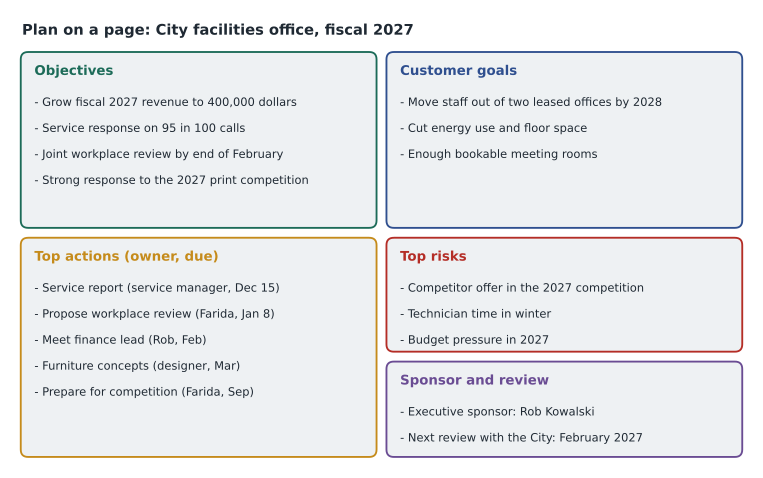
The first page of every Ridgeline account plan was a one-page summary that anyone could read in two minutes. It held the three to five objectives, the top five actions, the top three risks, the executive sponsor's name and the date of the next review. Farida used it in Ridgeline's monthly key account meeting and pinned it to the front of the CRM account record. If someone asked her about the City in a corridor, she could answer from it.
Planning with the customer
The strongest account plans are not written about the customer in private. They are shaped with the customer, at least in part. Farida shared the customer goals section and a simplified action list with the City's facilities manager every year and asked two questions: "Have we got your priorities right?" and "What should we be doing that we are not?" In 2025 the answer to the second question had led to RoomFlow being tested in two City buildings, which had become a 34,000-dollar line of business.
Some parts of a plan stay internal. Ridgeline's margins, its view of competitors, its assessment of individual people's influence and its own revenue targets are not things a customer needs to see. Farida kept a clear line between the shared joint plan and the internal account plan, and she never put anything in writing about a customer's staff that she would be embarrassed for them to read. Personal information about the customer's people, like any personal information, should be limited to what the business needs and handled under the privacy rules covered in SLS-140 and SLS-150.
Keeping the plan alive
Most account plans fail not because they are badly written but because nobody looks at them after they are written. Farida kept the City plan alive with three habits.
- She reviewed it every quarter, before the quarterly business review with the customer, and changed what was out of date.
- She brought the plan on a page to Ridgeline's monthly key account meeting and reported progress against each action.
- She logged every significant contact and change in the CRM, linked to the account, so that the plan's history was there for whoever came next.
Maya's task for the following week was to draft plans on a page for two of her own accounts, Keystone Grain Equipment and Northfield Family Clinic, using the template. Both had signed with Ridgeline that fall: Northfield in early October for managed print and RoomFlow, and Keystone on October 30 for meeting-room technology in two rooms. Neither was yet a named key account, but Rob had asked for plans for every account that might become one.
Common mistakes
MistakeWriting a long plan that nobody reads.
InsteadKeep a one-page summary at the front and keep the full plan short and current.
MistakeSetting revenue objectives by adding a growth rate to last year.
InsteadBuild the number from the base business plus specific opportunities weighted by probability.
MistakeWriting Ridgeline's goals before understanding the customer's.
InsteadStart from the customer's goals, in their words, and link every objective to one of them.
MistakeListing actions without owners or dates.
InsteadGive every action an owner, a due date and a way of knowing it is done.
MistakeFiling the plan and never updating it.
InsteadReview it every quarter and bring it to internal account meetings.
Summary and key terms
- An account plan sets out what a supplier wants to achieve with a key account over a period and how it will get there.
- A typical plan covers a one-page summary, an account overview, the customer's goals, history and current position, a relationship map, opportunities, objectives, strategy and actions, and risks and resources.
- Customer goals come before the supplier's objectives, and every objective should serve one of them.
- Objectives should be specific and measurable; revenue objectives are best built from the base business plus opportunities weighted by probability.
- Share of wallet shows how much of the customer's spending in the supplier's categories the supplier has.
- Every action needs an owner, a date and a test of completion.
- Strong plans are shaped with the customer's input, while margins, competitor views and internal targets stay internal.
- Plans stay useful only if they are reviewed regularly.
- Account plan
- A written plan setting out a supplier's objectives with a key account and how it will achieve them over a period.
- Plan on a page
- A one-page summary of an account plan's objectives, top actions, risks, sponsor and next review date.
- SMART objective
- An objective that is specific, measurable, achievable, relevant and time-bound.
- Share of wallet
- The share of a customer's total spending in the supplier's categories that goes to the supplier.
- Weighted opportunity
- An opportunity's estimated value multiplied by the probability of winning it.
- Joint plan
- The part of an account plan that is shared and developed with the customer.
Practice problems
Work each problem on paper first, then reveal the answer to check.
A customer spent 150,000 dollars last year. You expect 120,000 dollars of base business and two opportunities: 50,000 dollars at 50 in 100 and 30,000 dollars at 20 in 100. What is the expected revenue?
Show answer
120,000 + 25,000 + 6,000 = 151,000 dollars.
Rewrite "Strengthen relationships at Keystone" as a better objective.
Show answer
For example: "Meet Keystone's finance director and the head of dealer training, with Dale Petrie, before the end of January 2027, and record their priorities in the plan."
Which parts of an account plan should normally stay internal?
Show answer
Margins, the supplier's revenue targets, its view of competitors and its private assessment of individual people's influence.
Lesson quiz · 5 questions
Score 60% or more to complete this lesson.
Create a free account to save your progress, take quizzes and earn a certificate.