
SLS-220 · Lesson 6 of 12 · 22 min
Cross-selling and upselling
▶ Video coming soon A video version of this lesson is on the way.
At the end of October, Rob Kowalski sent the sales team a note about fiscal 2027. Ridgeline's growth would come from two places, he wrote: new customers, and existing customers buying more. Of the two, the second was cheaper, faster and less risky, because Ridgeline already knew those customers and they already trusted Ridgeline. He wanted every account plan to say where the growth would come from. Maya forwarded the note to Farida with one question: "How do I do this without becoming the person who tries to sell them something every time I call?"
Farida's answer filled the next Monday session. "The difference between growing an account and pestering it," she said, "is whether the customer would thank you for the suggestion if they understood it as well as you do. If they would, you are doing them a favour. If they would not, you are spending trust you will need later."
Cross-selling means selling a customer products or services in categories it does not yet buy from you: a managed print customer that starts buying furniture, for example. Upselling means selling a customer a higher-value version or a larger quantity of what it already buys: more meeting rooms on RoomFlow, or a larger print plan. Both are central to key account management, and both can be done well or badly. This lesson covers how to find growth in an account, how to judge whether it serves the customer, and how to raise it.
Why existing customers are where growth starts
Selling to an existing customer is usually cheaper than winning a new one, because the supplier already has relationships, knowledge of the customer's needs and a record of performance. How much cheaper varies a great deal, and the figures quoted in marketing books, such as that a new customer costs five or seven times as much to win, come from particular studies and industries and should not be treated as universal. For Ridgeline, Grace Liu had measured it directly: in fiscal 2026 the average sales cost of a new-customer deal, counting the time of everyone involved, was about 2,900 dollars, against about 900 dollars for an expansion deal of similar size with an existing customer.
Existing customers also buy for different reasons. A new customer is taking a risk on an unknown supplier. An existing customer that has been well served is choosing to extend a relationship that works. That is why expansion depends so heavily on the earlier lessons: the account plan, the relationship map, an understanding of the customer's business and regular business reviews all create the conditions in which a sensible suggestion is welcome.
Finding growth: the white-space map
A white-space map is a grid that shows, for an account, which of the supplier's products or services each part of the customer already buys, and where the gaps are. The rows are the customer's sites, departments or business units; the columns are the supplier's offerings. Each cell is marked as already bought, an opportunity, not relevant, or bought from a competitor. The empty cells, the white space, are where growth might come from.
| Northfield Family Clinic | Managed print | RoomFlow | Office furniture | Meeting-room technology | Laptops through the leasing partner |
|---|---|---|---|---|---|
| Existing clinic | Bought (October 2026) | Bought, 3 rooms | Bought from Ridgeline five years ago | Not relevant | Bought from a competitor |
| Expansion unit | Opportunity: covered by current plan | Opportunity: phone room | Opportunity: workstations | Not relevant | Opportunity when leases end |
Maya's map for Northfield showed what she already knew, the workstations for the expansion, and one thing she had not thought about: the clinic's laptops were leased from a competitor, and the leases would end in 2028. That was not an opportunity to pursue now, but it belonged in the account plan with a date. "White space is not a to-do list," Farida said. "It is a map. Most of the cells will never be worth pursuing. The map helps you choose."
Judging an opportunity
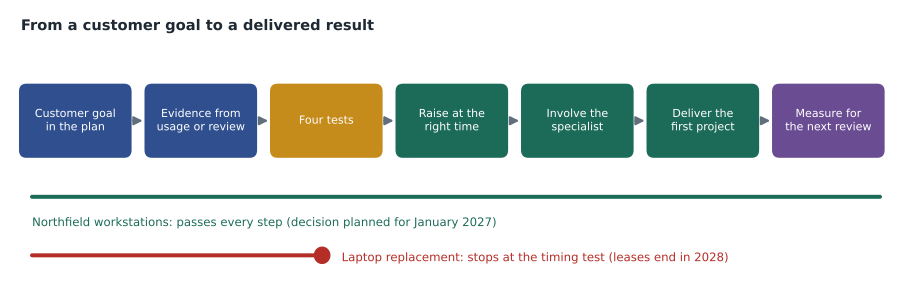
Farida taught Maya to test every expansion idea against four questions before raising it with the customer.
| Question | What a good answer looks like |
|---|---|
| Does it serve one of the customer's goals? | It links to a goal recorded in the account plan, in the customer's words. |
| Is it the right time? | It fits the customer's budget cycle and does not compete with something more important to them. |
| Can we deliver it well? | Ridgeline has the product, the skills and the capacity, and failure would not damage the core relationship. |
| Would the customer thank us if they understood it fully? | The customer would be better off, not just Ridgeline. |
Northfield's workstations passed all four. They served the clinic's goal of keeping its clinicians, the decision was planned for January 2027, Ridgeline's designer had already walked the empty unit, and Dr. Ravi Anand had asked for options. The laptops failed the second test: the leases had two years to run. A proposal to replace a different supplier's equipment midway through its lease would have cost the clinic early termination fees and made Ridgeline look as if it cared more about its own sales than the clinic's money.
When the right answer is to sell less
Some of the most valuable advice an account manager can give is to buy less, or to buy nothing. That advice costs revenue in the short term and builds the kind of trust that makes the long term possible. Northfield's own printing showed how.
Worked problem
Upgrade or pay the overage?
Northfield's managed print plan costs 395 dollars a month and includes 4,000 pages a month, with extra pages at 1.2 cents each. Once the expansion opens, Maya expects the clinic to print about 5,200 pages a month. Ridgeline's next plan up costs 415 dollars a month and includes 6,000 pages. Which costs Northfield less, and by how much a year?
Show solution
- Extra pages on the current plan: 5,200 − 4,000 = 1,200 a month.
- Overage cost: 1,200 × 0.012 = 14.40 dollars a month.
- Current plan total: 395 + 14.40 = 409.40 dollars a month.
- Upgraded plan: 415 dollars a month.
- Difference: 415 − 409.40 = 5.60 dollars a month, or 5.60 × 12 = 67.20 dollars a year.
Answer: Staying on the current plan and paying the overage costs Northfield about 67 dollars a year less. Maya should tell the clinic to stay on its plan, and suggest reviewing it if printing rises above about 5,700 pages a month, where the two options cost about the same.
The break-even point in the answer comes from asking when the overage equals the 20-dollar difference between the plans: 20 ÷ 0.012 ≈ 1,667 extra pages, or about 5,667 pages a month in total. Maya put the calculation in her next note to Janet Morrow. Janet replied within the hour: "Thank you, nobody has ever told me not to buy something before."
Upselling with evidence
An upsell is easiest to justify when the customer's own usage shows the need. RoomFlow, Ridgeline's room-booking software, recorded every booking, cancellation and clash. When the data showed that a customer's rooms were full most of the day, more rooms or better use of existing ones was a conversation the customer usually wanted to have.
Worked problem
Using usage data to size an upsell
At the City of Regina, RoomFlow manages 16 bookable rooms in two buildings. In October 2026 the rooms were available for 21 working days of 9 hours each and were booked for 2,540 hours in total. Staff from the two leased offices will move into these buildings in 2027, and the facilities office expects bookings to rise by about 30 in 100. What was October's average room utilization, and what would it be after the move with no new rooms?
Show solution
- Available hours: 16 rooms × 21 days × 9 hours = 3,024 hours.
- \[\text{Utilization} = \frac{2{,}540}{3{,}024} = 0.840 \approx 84 \text{ in } 100\]
- Bookings after the move: 2,540 × 1.30 = 3,302 hours.
- \[\frac{3{,}302}{3{,}024} = 1.092 \approx 109 \text{ in } 100\]
Answer: Rooms were already about 84 in 100 booked, which is very high, and after the move demand would exceed the available hours. The City will need more rooms or shorter, better-managed bookings, which is the case for the meeting-room project the City asked Ridgeline to scope.
Because the numbers came from the City's own system and pointed to a problem the City had already named, Farida could present the meeting-room project as an answer to the City's question rather than a pitch.
Cross-selling across Ridgeline's offerings
Cross-selling is harder than upselling, because the customer has to trust the supplier in a new area. A customer that is happy with Ridgeline's printers has no evidence yet about its furniture. The account manager's job is to transfer trust carefully: introduce the specialist who will do the work, show examples from similar customers, start small where possible and deliver the first job flawlessly.
Keystone Grain Equipment showed the pattern. Keystone had been a Ridgeline printer customer since 2023. Its first purchase in a new category, meeting-room technology for two rooms, had been signed on October 30, 2026, and kept under Dale Petrie's 20,000-dollar approval limit. The larger idea, a dealer training centre estimated at 48,000 dollars, would go to Keystone's owners' board in January 2027. Farida's advice was blunt: "The training centre will be decided by how well the two rooms go in January. Put your best installer on it."
Estimating expansion revenue
For the account plan and for Rob's forecast, Maya needed to estimate how much expansion revenue her accounts might bring in fiscal 2027. She used the same weighted approach Farida had used for the City's revenue objective.
Worked problem
Weighting an expansion pipeline
Maya lists three expansion opportunities for fiscal 2027: Northfield's workstations and phone room at 18,080 dollars (probability 60 in 100), Keystone's training centre at 48,000 dollars (probability 50 in 100) and RoomFlow for two rooms at Lakeview Veterinary Hospital at 2,136 dollars a year (probability 30 in 100). What is the weighted expansion pipeline?
Show solution
- \[18{,}080(0.60) + 48{,}000(0.50) + 2{,}136(0.30) = 10{,}848 + 24{,}000 + 640.80 = 35{,}488.80\]
Answer: The weighted pipeline is about 35,500 dollars. Almost seven-tenths of it depends on a single decision, Keystone's training centre, so Maya's plan should show that dependency and what she will do to support Dale's business case before the board meets.
How to raise an expansion idea
Timing and framing matter as much as the idea. Farida suggested raising expansion ideas in three ways, in rising order of directness.
- In a business review, under looking ahead, as a response to something the customer has said about its plans.
- In a short note that shares data or an observation, such as the room utilization figures, and asks whether the customer wants to discuss it.
- In a direct conversation when the customer has asked for options, as Northfield had.
She also listed things to avoid. Do not raise a new sale in the middle of fixing a service problem. Do not attach an unrelated offer to every invoice or report. Do not go around the main contact to sell to someone else in their organization without telling them. And do not offer a discount on a new product as a way of making up for poor service on an existing one; fix the service.
Who should sell it
In many suppliers, a specialist handles some products. At Ridgeline, furniture projects involved a designer, meeting-room technology an audiovisual specialist and software a RoomFlow consultant. The account manager's role in cross-selling is often to spot the need, introduce the specialist, keep the customer's goals at the centre of the conversation and make sure the customer is not passed from person to person. Customers notice when a supplier's people do not talk to each other, and in a key account they should never have to explain their situation twice.
Common mistakes
MistakeTreating every white-space cell as an opportunity to pursue now.
InsteadUse the map to choose, and record later opportunities with dates.
MistakeSelling a customer more than it needs.
InsteadRecommend the option that serves the customer best, even when it earns less.
MistakeRaising a new sale while a service problem is still open.
InsteadFix the problem first; raise growth when the relationship is on solid ground.
MistakeExpecting trust in one product to carry over automatically to another.
InsteadIntroduce specialists, start small and deliver the first project flawlessly.
MistakeCounting an expansion opportunity at full value in the forecast.
InsteadWeight each opportunity by its probability and show which decisions the forecast depends on.
Summary and key terms
- Cross-selling is selling an existing customer products in new categories; upselling is selling a higher-value version or more of what it already buys.
- Existing customers are usually cheaper to grow than new ones are to win, though the ratio varies widely.
- A white-space map shows which offerings each part of a customer buys and where the gaps are.
- Each opportunity should pass four tests: it serves a customer goal, the timing is right, the supplier can deliver it well, and the customer would thank the supplier for it.
- Sometimes the right advice is to buy less, which builds trust.
- Usage data makes upselling evidence-based.
- Cross-selling needs trust to be transferred carefully, usually through specialists and a well-delivered first project.
- Expansion revenue should be weighted by probability, and ideas should be raised at the right time and in the right way.
- Cross-selling
- Selling an existing customer products or services in categories it does not yet buy from the supplier.
- Upselling
- Selling an existing customer a higher-value version or a larger quantity of what it already buys.
- White-space map
- A grid of a customer's units against the supplier's offerings, showing what is bought and where gaps are.
- Overage
- A charge for usage above the amount included in a plan, such as extra printed pages.
- Utilization
- The share of available capacity that is used, such as booked hours divided by available hours.
- Expansion revenue
- Revenue from existing customers buying more, through cross-selling or upselling.
Practice problems
Work each problem on paper first, then reveal the answer to check.
A plan costs 300 dollars a month for 3,000 pages, with extra pages at 1.5 cents. The next plan is 330 dollars for 5,000 pages. A customer prints 4,500 pages a month. Which is cheaper?
Show answer
Current plan: 300 + 1,500 × 0.015 = 322.50 dollars a month, which is 7.50 dollars a month less than the 330-dollar plan, so stay on the current plan.
Ten rooms are available 20 days of 8 hours and are booked 1,200 hours. What is utilization?
Show answer
10 × 20 × 8 = 1,600 hours available; 1,200 ÷ 1,600 = 0.75, or 75 in 100.
Why did Maya not propose replacing Northfield's leased laptops?
Show answer
The leases from another supplier had two years to run, so switching now would cost the clinic early termination fees; the opportunity belongs in the plan for 2028.
Lesson quiz · 5 questions
Score 60% or more to complete this lesson.
Create a free account to save your progress, take quizzes and earn a certificate.