
SLS-220 · Lesson 4 of 12 · 21 min
Understanding the customer's business
▶ Video coming soon A video version of this lesson is on the way.
Farida opened the third Monday session with a question for Maya. "Keystone signed with us on October 30. Tell me how Keystone makes money." Maya knew a lot about Keystone Grain Equipment: its meeting rooms were double-booked two or three times a month, a dealer visit had ended up in the lunchroom in September, the operations director Dale Petrie had a capital approval limit of 20,000 dollars, and the owners' board met quarterly. She knew far less about the business itself. She knew Keystone built grain dryers. She did not know who bought them, when, how they were paid for, or what kept the owners awake at night.
"That is normal for a salesperson," Farida said. "Discovery is about the problem you can solve. Account management is about the customer's whole business, because that is where the next problems, and the next opportunities, come from. If you only understand the part of Keystone that touches us, you will always be the last to know what is coming."
This lesson is about business acumen applied to a single account: understanding how a customer creates value, earns money, spends it, plans and decides, so that the supplier can see the customer's situation the way its leaders do. SLS-222 covers financial statements and value selling in more depth. Here the focus is on what an account manager needs to know about a key account, where to find it, and how to use it.
Four questions about any customer
Farida taught Maya to start with four questions. They apply to a manufacturer, a clinic, a school division or a city.
| Question | What it covers | Keystone example |
|---|---|---|
| How does the customer create value? | What it makes or does, for whom, and why customers choose it | Grain dryers, bins and handling equipment for farms, sold through dealers |
| How does it earn and spend money? | Revenue sources, main costs, margins, cash timing | Equipment sales to dealers; steel, labour and freight are the big costs |
| What drives its results? | Markets, seasons, regulations, competitors, technology | Farm income, crop size, interest rates, steel prices, harvest timing |
| How does it plan and decide? | Strategy, budget cycle, approval limits, who decides | Owners' board meets quarterly; capital over 20,000 dollars needs approval |
How Keystone creates value
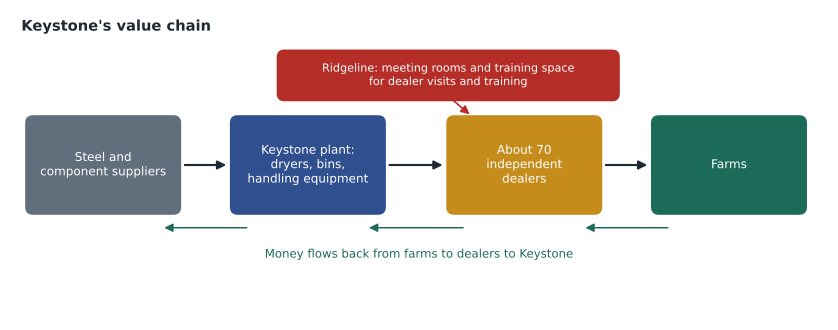
Keystone Grain Equipment is a family-owned manufacturer with about 180 people, a plant on the edge of Regina and roughly 70 independent dealers across the Prairies. It designs and builds grain dryers, storage bins and the augers and conveyors that move grain between them. Farmers rarely buy directly; they buy from a dealer, who also installs and services the equipment. Keystone's real customers, in the sense of who orders from it, are the dealers.
That fact changed how Maya saw her own deal. Keystone's meeting-room problem was not mainly an internal inconvenience. Dealers came to the plant for product launches, training and planning. When Keystone launched a new dryer line, the largest dealer groups visited to see it, and a dealer group that was embarrassed by a disorganized visit might put more of its orders through a competitor. The room problem was a dealer-relationship problem, and dealer relationships were how Keystone made money.
How Keystone earns and spends money
Manufacturers like Keystone typically have a few large cost lines: materials, especially steel; labour; energy; freight; and overhead. Their revenue depends on volume and price, and their profit on the gap between price and cost. Because Keystone is privately owned, it publishes no financial statements. Farida explained how an account manager builds a picture anyway: from the customer's own comments, from trade publications, from public information about the industry, and from the customer's behaviour, such as hiring, building or delaying purchases.
What mattered most for Ridgeline was seasonality: the way a business's sales and cash flow rise and fall through the year. Grain equipment sales follow the farm calendar. Dealers order ahead of the harvest so that equipment can be installed in time, and farmers make many buying decisions after they know the size and price of their crop.
Worked problem
Reading a seasonal pattern
Dale Petrie told Maya that Keystone ships roughly 10 in 100 of its annual volume in each of the four months from April to July, 15 in 100 in each of August and September, and the remainder spread evenly over the other six months. What share of annual volume ships in each of those six months? In which months is Keystone's plant busiest, and when would be the worst time to install new meeting-room equipment?
Show solution
- April to July: 4 × 10 = 40 in 100.
- August and September: 2 × 15 = 30 in 100.
- Remaining: 100 − 40 − 30 = 30 in 100, spread over six months.
- \[\frac{30}{6} = 5 \text{ in } 100 \text{ per month}\]
- The busiest months are August and September, followed by April to July.
Answer: Each of the six quieter months (October to March) carries about 5 in 100 of annual volume. Installation, training and planning meetings belong in the quiet months, which is why the installation was booked for the week of January 11, 2027, not in the summer.
Seasonality also shapes cash. A manufacturer that ships most of its product in summer often carries large inventories in spring and waits for payment in the fall. Keystone's finance team had pushed hard in mid-October for 60-day payment terms on Ridgeline's purchase order; Ridgeline's contracts manager, Leah Marchand, had agreed 45 days. With the seasonal pattern in mind, Maya understood why. A supplier that knows when a customer is short of cash avoids asking for large commitments at the wrong moment and can offer payment timing that fits.
What drives the customer's results
Every business is pushed and pulled by forces outside it. For Keystone the big ones were farm income, the size and price of the harvest, interest rates (because many farmers and dealers borrow to buy equipment), steel prices and competition from larger national manufacturers. None of these was Ridgeline's business directly, but each affected whether Keystone would grow, hold steady or cut back.
An account manager does not need to be an expert in the customer's industry. They need to know enough to ask good questions, to recognize news that matters and to avoid saying something foolish. Farida kept a short list of sources for each key account and checked them once a month.
| Source | What it tells you | Keystone or Prairie Valley example |
|---|---|---|
| The customer's own website and news | Products, launches, hiring, expansion | Keystone's new dryer line launch |
| Trade publications and associations | Industry trends, competitors, events | Farm equipment trade press; dealer association meetings |
| Government statistics | Market size and direction | Statistics Canada farm income and crop data |
| Public budgets and reports | Spending priorities and pressures of public bodies | Prairie Valley's budget and board minutes |
| Job postings | New roles, growth, priorities | Prairie Valley posting for a new IT manager |
| Conversations with the customer's people | What they worry about and plan | Dale on dealer visits; Patricia on budget pressure |
How the customer plans and decides
Knowing a customer's planning and decision cycle tells a supplier when to raise an idea, when a proposal will be considered and when money becomes available. Missing the cycle can mean waiting a year.
Keystone's owners' board met quarterly, with the next meeting in January 2027. Any capital purchase over 20,000 dollars needed its approval. That was why Dale had insisted that his October order stay under 20,000 dollars, and why Keystone's larger idea, a fully equipped dealer training centre estimated at 48,000 dollars, had been moved to January with Ridgeline holding the price until January 31, 2027. For the account plan, those two facts set the timing for the next stage of the relationship: a short business case for the training centre had to be in Dale's hands well before the board's papers went out.
Public bodies plan on a stricter cycle. Prairie Valley School Division's fiscal year runs from September 1 to August 31, and its budget for the next year is built in the spring. Spending that is not in the budget generally cannot happen, whatever its merits. Large purchases go through procurement rules, as Ridgeline had seen with the managed print request for proposals. An account manager who wants to propose something new for the following school year needs to raise it before the budget is set, which means in the winter, not in the summer.
Worked problem
Putting a contract in the customer's terms
Prairie Valley's annual operating budget is about 86 million dollars. The managed print contract Ridgeline has been selected for is about 66,000 dollars a year. What share of the operating budget is that? What does the answer suggest about how the business manager will judge the contract?
Show solution
- \[\frac{66{,}000}{86{,}000{,}000} = 0.000767 \approx 0.08 \text{ in } 100\]
- That is less than one-tenth of one in 100 of the budget.
Answer: The contract is a tiny share of the division's spending, so it will rarely be judged on price alone. Patricia Klassen will judge it on whether it quietly works: no disruption to teaching, no surprises on invoices, no complaints from schools, and reports she can take to the board. Reliability and good reporting matter more to this account than another small discount.
Understanding the customer's customers
Many of the best account managers think one step beyond their customer, to their customer's customers. Keystone's customers were dealers and, beyond them, farmers. Prairie Valley's were students and families. The City's were residents. Northfield Family Clinic's were patients. When a supplier understands what the end customer needs, it can see how its products help its customer serve them, which is often the most persuasive argument it has.
For Northfield, this changed the conversation about furniture for its expansion. Janet Morrow had first asked for six desks and six chairs. In discovery, Maya had learned that ten clinicians were staying after closing to finish their charting, about 45 minutes a day, four days a week, because the clinic had no quiet place to do it during the day. The clinic's real goal was to keep its clinicians, and through them to keep seeing patients. Option C, eight semi-enclosed workstations and a furnished phone room for 18,080 dollars, was a staff retention and patient access proposal, not a furniture order. Northfield's decision was due in January 2027.
Asking business questions
Understanding a customer's business comes mostly from asking about it. Customers are usually happy to talk about their own goals and challenges, as long as the questions are genuine and the seller listens. Farida suggested questions that work with senior people because they are about the customer, not the supplier.
- "What are your priorities for the next year, and what would make it a good year?"
- "What is changing in your market or your funding that we should understand?"
- "Where are you under the most pressure at the moment?"
- "How do you plan and approve spending, and when does that happen?"
- "If you look back in three years, what would you want to have changed?"
The answers go into the account plan, in the customer's words, with the date. Over time they build a picture of the customer that no competitor who only arrives at renewal time can match.
Using what you learn
Business knowledge is useful only if it changes what the supplier does. Farida pointed out three uses in Ridgeline's accounts that fall.
- Timing: Keystone's quiet months set the installation date; Prairie Valley's budget cycle set when to raise new ideas; Keystone's board calendar set the deadline for the training-centre business case.
- Framing: at Prairie Valley, reliability and reporting mattered more than price; at Northfield, the real goal was keeping clinicians.
- Anticipation: Keystone's new dryer launch meant more dealer visits, which meant the training centre would matter more next year; Prairie Valley's IT manager's retirement meant a relationship to rebuild.
"You do not need to know everything about their business," Farida said. "You need to know what keeps their leaders busy, when they decide things and how what we do connects to what they care about."
Common mistakes
MistakeLearning only about the part of the customer's business that buys from you.
InsteadUnderstand how the whole business creates value, earns money and decides.
MistakeAssuming a private company's finances are unknowable.
InsteadBuild a picture from conversations, trade sources, public data and the customer's behaviour.
MistakeProposing large purchases at the wrong point in the customer's cycle.
InsteadLearn the budget and approval calendar and time proposals to fit it.
MistakeJudging what the customer values by your own priorities.
InsteadPut your offer in the customer's terms, as Prairie Valley's tiny share of budget showed.
MistakeRecording vague impressions instead of facts.
InsteadRecord what customers said, with dates and sources, in the account plan.
Summary and key terms
- Account managers need to understand a key account's whole business, not only the part that buys from them.
- Four questions help: how the customer creates value, how it earns and spends money, what drives its results and how it plans and decides.
- Seasonality affects when a customer is busy and when it has cash, and shapes the timing of installations and requests.
- Private companies publish little, but a picture can be built from conversations, trade sources, public data and behaviour.
- Public bodies plan on fixed fiscal years and budget cycles, and large purchases follow procurement rules.
- Putting a contract in the customer's terms shows what they will judge it on.
- Thinking about the customer's customers often reveals the most persuasive value.
- Business knowledge should change timing, framing and anticipation in the account plan.
- Business acumen
- Understanding how a business creates value, earns money, spends it, plans and decides.
- Seasonality
- The regular rise and fall of a business's sales and cash through the year.
- Fiscal year
- The twelve-month period an organization uses for its budget and accounts.
- Capital approval limit
- The largest capital purchase a manager can approve without a higher authority.
- Value chain
- The sequence of activities and organizations through which a product is made and reaches its end customer.
- End customer
- The customer's own customer, such as the farmer who buys from Keystone's dealer.
Practice problems
Work each problem on paper first, then reveal the answer to check.
A customer ships 12 in 100 of annual volume in each of its five busiest months and the rest evenly over the other seven. What share ships in each quieter month?
Show answer
5 × 12 = 60 in 100; the remaining 40 in 100 over seven months is about 5.7 in 100 a month.
Why did Keystone's training-centre proposal move to January 2027?
Show answer
It was estimated at 48,000 dollars, above Dale's 20,000-dollar approval limit, so it needed the owners' board, which next met in January.
A public customer's fiscal year starts July 1 and budgets are built in spring. When should you raise a new idea for next year?
Show answer
In the winter, before the budget is built, so the spending can be included.
Lesson quiz · 5 questions
Score 60% or more to complete this lesson.
Create a free account to save your progress, take quizzes and earn a certificate.