
SLS-220 · Lesson 7 of 12 · 20 min
Renewals and contract cycles
▶ Video coming soon A video version of this lesson is on the way.
On the second Monday in November, Farida put a calendar on the screen. It was a single row of months from December 2026 to November 2027, Ridgeline's fiscal 2027, with a coloured bar for every key account contract that would end, renew or reach an option date in that year. Most of the bars were green. One, in February, was amber: Riverbend Dental Group's managed print agreement. Another, far to the right in March 2028, just past the edge of the year, was marked in blue with the words "City managed print: start here".
"Most of our revenue from key accounts comes from contracts that are already signed," Farida said. "That revenue is not ours forever. It is ours until the contract ends. Renewals are where key accounts are kept or lost, and they are won or lost long before the renewal date."
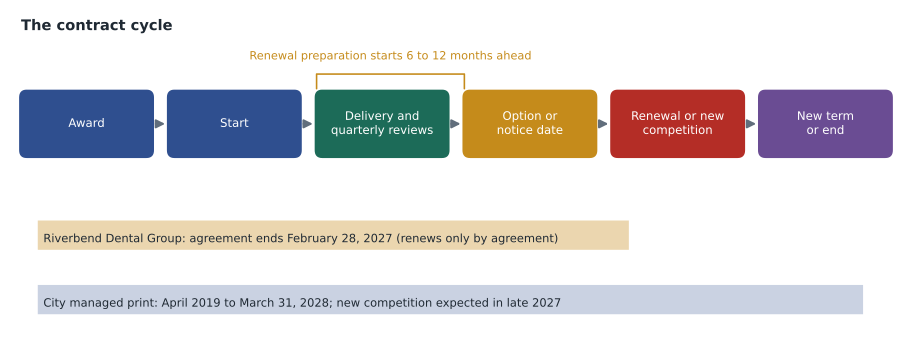
A renewal is the decision by a customer to continue a contract for a further period, on the same or new terms. A contract cycle is the full life of a contract: award, start, delivery, review points, any options to extend, renewal or retender, and end. This lesson covers how to read the parts of a contract that govern renewal, how to build a renewal calendar, how to forecast renewal revenue, how to prepare a renewal, and what changes when the customer is a public body.
Reading the renewal terms
Every account manager should know exactly what each key account contract says about how it ends and how it continues. Farida kept a one-line summary of the renewal terms at the top of every account plan, checked against the signed contract by Ridgeline's contracts manager, Leah Marchand.
| Term | What it means | Why it matters |
|---|---|---|
| Initial term | The first period of the contract, such as three or five years | Sets the first renewal date |
| Automatic renewal | The contract continues for another period unless one side gives notice | A missed notice date can lock both sides in |
| Required notice | How far ahead a party must say it will not renew | Determines when the real renewal decision happens |
| Renewal or extension options | The customer's right to extend for set periods, often one year at a time | Common in public contracts; limits how far a contract can run |
| Price adjustment | How prices change at renewal or each year, such as a fixed increase or an index | A source of disputes if not explained in advance |
| Termination for convenience | The right to end the contract early without cause, usually with notice and sometimes a fee | Shows how easily the customer can leave mid-term |
| Service credits | Payments or discounts the supplier owes when it misses service levels | A record of performance the customer will remember at renewal |
Automatic renewal clauses deserve special care. In business-to-business contracts, the clause is usually governed by the contract itself and general contract law. Consumer protection laws on automatic renewals, which exist in a number of places, generally protect individual consumers rather than businesses, and the details vary by jurisdiction. Whatever the law requires, Farida's practice was to remind every key account customer of an approaching notice date in writing, well ahead of time. "If a customer only stays because they missed a notice date, we have not kept them. We have trapped them, and they will leave next time and tell everyone why."
The renewal calendar
A renewal calendar lists every contract renewal, notice date and option date in a period, with its value and owner. It turns renewals from surprises into planned work. For key accounts, Ridgeline began renewal preparation at least six months before the notice date, and for very large contracts a year or more ahead.
| Account | Contract | Annual value (dollars) | Last date to give notice | Renewal or end date | Prep starts |
|---|---|---|---|---|---|
| Riverbend Dental Group | Managed print | 14,160 | Not applicable (renews by agreement) | February 28, 2027 | Already started |
| Regional insurance brokerage | Managed print, 12 offices | 96,000 | March 31, 2027 | June 30, 2027 | October 2026 |
| Coteau Engineering | Managed print and RoomFlow | 38,400 | May 31, 2027 | August 31, 2027 | December 2026 |
| City of Regina | Managed print (final option year ends) | 199,920 | Not applicable | March 31, 2028 | September 2027 |
Riverbend's renewal was different from the others. Its contract did not renew automatically; it simply ended on February 28, 2027, and both sides had to agree a new one. That made the January business review in lesson 5 the start of the renewal, whether or not anyone called it that.
Forecasting renewal revenue
Not every renewal is equally certain. Ridgeline's forecasting method assigned each renewal a probability, based on the account's health (lesson 8), the strength of the relationships, the customer's satisfaction and any known competitive threat. Weighted renewal revenue is the sum of each contract's annual value multiplied by its probability.
Worked problem
Weighting fiscal 2027 renewals
Farida assigns these probabilities to the three fiscal 2027 renewals: Riverbend 14,160 dollars at 70 in 100 (a new director who has never met Ridgeline); the insurance brokerage 96,000 dollars at 85 in 100; Coteau Engineering 38,400 dollars at 90 in 100. What is the total annual value up for renewal, the weighted renewal revenue, and the revenue at risk?
Show solution
- Total value: 14,160 + 96,000 + 38,400 = 148,560 dollars.
- Weighted:
- \[14{,}160(0.70) + 96{,}000(0.85) + 38{,}400(0.90) = 9{,}912 + 81{,}600 + 34{,}560 = 126{,}072\]
- Revenue at risk: 148,560 − 126,072 = 22,488 dollars.
Answer: About 148,600 dollars a year is up for renewal, the weighted forecast is about 126,100 dollars, and about 22,500 dollars is at risk. The brokerage carries the largest amount at risk in dollars (14,400) even though its probability is high, because it is so much larger than the other two.
Two measures help a supplier track renewals across all its key accounts over time. Gross revenue retention is the revenue kept from existing customers over a period, before counting any growth, as a share of what they brought in at the start. It can never exceed 100 in 100. Net revenue retention adds expansion from the same customers and subtracts any reductions, so it can exceed 100 in 100 when existing customers grow. Lesson 8 shows how to calculate both.
Preparing a renewal
Renewal preparation for a key account has a predictable shape. Farida's checklist for Riverbend, started in November 2026, had six steps.
- Read the contract with Leah: term, end date, price terms, service levels, credits paid, any termination rights.
- Gather the record: service performance for every month, credits paid, issues and how they were resolved, results from business reviews.
- Update the relationship map, especially for new people such as Dr. Nwosu, and plan who will meet whom.
- Learn the customer's current goals and how they may have changed since the contract was signed.
- Decide Ridgeline's position: what it would like to offer, what it can concede, and what it will not.
- Plan the conversations, starting with the business review and leaving terms until trust is in place.
The record mattered most. Riverbend had seen several months in 2026 when Ridgeline missed its four-business-hour response target, and Ridgeline had paid service credits under the agreement each time, at 5 in 100 of the monthly charge per missed call, capped at 20 in 100. Farida did not intend to hide those months. She intended to show them, explain what had changed, and show the months since then.
Price at renewal
Renewal is the moment when price is most likely to be questioned. A competitor may have offered the customer a lower price, the customer's budget may be under pressure, or prices may need to rise because of the supplier's own costs. Each situation calls for a different response, and in each one the supplier should know its numbers before the conversation starts.
Worked problem
What a renewal discount is worth
Riverbend pays 1,180 dollars a month. Suppose Dr. Nwosu asks for 5 in 100 off for a new three-year agreement. Ridgeline's gross margin on the contract is 34 in 100 at today's price, and its cost to serve the account is about 1,900 dollars a year. What would Ridgeline earn over three years at today's price, at the discounted price, and if Riverbend left?
Show solution
- Annual revenue at today's price: 1,180 × 12 = 14,160 dollars.
- Annual gross margin: 14,160 × 0.34 = 4,814.40 dollars; less cost to serve: 4,814.40 − 1,900 = 2,914.40 dollars.
- Three years at today's price: 2,914.40 × 3 = 8,743.20 dollars.
- Discounted revenue: 14,160 × 0.95 = 13,452 dollars. The cost of the products and service does not fall, so the 708-dollar discount comes straight off the margin: 4,814.40 − 708 = 4,106.40 dollars; less cost to serve: 2,206.40 dollars a year.
- Three years discounted: 2,206.40 × 3 = 6,619.20 dollars.
- If Riverbend left: 0 dollars, plus the cost of removing equipment.
Answer: A 5 in 100 discount would cut Ridgeline's three-year contribution from about 8,743 dollars to about 6,619 dollars, a loss of about 2,124 dollars, or about 24 in 100 of the contribution. That is much less than losing the account, but much more than the headline 5 in 100 suggests, so any discount should be traded for something, such as a longer term.
The calculation shows why a small discount on price is a large discount on profit: the discount comes entirely out of the margin. SLS-213 covered how to trade concessions in negotiation. In a renewal, the supplier's strongest position is a record of value delivered, because it changes the question from "Can you be cheaper?" to "Is what we get worth what we pay?"
Price increases need the same preparation. Ridgeline's agreements allowed an annual adjustment linked to a published price index, capped at 3 in 100. Farida's rule was that no key account should learn about an increase from its invoice. She explained increases in writing at least sixty days ahead, with the index and the calculation, and offered to discuss them in the next business review.
Renewals with public bodies
Public customers such as the City and Prairie Valley follow procurement rules that shape how contracts are renewed. A public contract usually has a defined term and may include a set number of option periods that the customer can choose to use. Once those options are used up, the customer generally cannot simply renew with the same supplier; it must run a new competition under its procurement rules, including, depending on value, the trade agreements and policies that applied when the contract was awarded. The account manager cannot change that, and should never suggest ways around it.
The City's managed print contract had started on April 1, 2019, with a six-year initial term and three one-year options, and the City had confirmed the last of those options. It would end on March 31, 2028, and the City had told Ridgeline it would issue a new request for proposals in late 2027. For Ridgeline that meant the City renewal was really a competition, to be won through the record of the previous eight years and a strong proposal. Farida's plan for fiscal 2027 therefore included the actions that would make that proposal credible: honest quarterly reviews, documented savings, a joint workplace review and delivery of the meeting-room project.
Prairie Valley's new contract, if the board approved it on November 17 and it was signed as planned later that month, would have its own term and options. Farida asked Leah to put its key dates into the renewal calendar on the day it was signed, so that the first renewal conversation would be planned years ahead, not discovered.
Common mistakes
MistakeDiscovering a renewal date a few weeks before it arrives.
InsteadKeep a renewal calendar and start preparing at least six months before the notice date.
MistakeRelying on an automatic renewal clause to keep a customer.
InsteadRemind customers of notice dates in writing and earn the renewal with results.
MistakeTreating a small discount as a small cost.
InsteadCalculate what it does to contribution; it comes straight off the margin.
MistakeSurprising a customer with a price increase on an invoice.
InsteadExplain increases in writing well ahead, with the calculation.
MistakeExpecting a public contract to renew past its options.
InsteadPlan for a new competition and follow the procurement rules.
Summary and key terms
- A renewal is a customer's decision to continue a contract for a further period; the contract cycle runs from award through delivery, options and renewal or retender to the end.
- Account managers should know each key contract's initial term, automatic renewal and notice terms, options, price adjustment, termination rights and service credits.
- Automatic renewal clauses in business contracts are governed mainly by the contract, but customers should always be reminded of notice dates.
- A renewal calendar turns renewals into planned work, with preparation starting at least six months ahead.
- Weighted renewal revenue multiplies each contract's value by its probability; gross and net revenue retention track renewals over time.
- Preparation covers the contract, the service record, relationships, current goals and the supplier's position.
- A small discount at renewal is a large cut in contribution.
- Public contracts follow procurement rules, and once options are used up a new competition is usually required.
- Renewal
- A customer's decision to continue a contract for a further period, on the same or new terms.
- Contract cycle
- The full life of a contract from award to end, including options and renewal.
- Automatic renewal
- A clause under which a contract continues for another period unless a party gives notice.
- Period of notice
- How far ahead a party must say it will not renew or will end a contract.
- Renewal calendar
- A list of upcoming renewals, notice dates and option dates with their value and owner.
- Option period
- A defined extension, often one year, that a customer may choose to use under a contract.
Practice problems
Work each problem on paper first, then reveal the answer to check.
Two renewals: 50,000 dollars at 80 in 100 and 20,000 dollars at 60 in 100. What is the weighted renewal revenue, and how much is at risk?
Show answer
Weighted: 40,000 + 12,000 = 52,000 dollars; at risk: 70,000 − 52,000 = 18,000 dollars.
A contract earns 30,000 dollars a year at a 30 in 100 margin. What does a 4 in 100 discount do to the annual gross margin?
Show answer
Gross margin falls from 9,000 to 9,000 − 1,200 = 7,800 dollars, a cut of about 13 in 100.
A public customer has used both its one-year options. What should the account manager expect, and plan for?
Show answer
A new competition under the customer's procurement rules; plan to win it with a strong record and proposal, and do not look for ways around the rules.
Lesson quiz · 5 questions
Score 60% or more to complete this lesson.
Create a free account to save your progress, take quizzes and earn a certificate.