
SLS-220 · Lesson 8 of 12 · 20 min
Spotting churn risk
▶ Video coming soon A video version of this lesson is on the way.
Farida kept a folder she called "the ones that got away". In it were short write-ups of every key account Ridgeline had lost in the past six years: why it left, when the first sign appeared and when Ridgeline noticed. She gave Maya the folder on a Monday afternoon in November and asked her to read three of the write-ups before they talked. The pattern was the same in all three. The customer had not left suddenly. The signs had been there for months, scattered across the CRM, the service desk, the invoices and a few remarks in meetings, and nobody had put them together until the customer's letter arrived.
Churn is the loss of a customer or of part of a customer's business. In key account management, churn is rarely a single event. It is usually the end of a slow decline that the supplier could have seen and often could have stopped. This lesson covers the warning signs, how Ridgeline combined them into an account health score, how to measure revenue retention across a portfolio, and what to do when an account is at risk.
Full churn and partial churn
A customer that ends every contract and leaves has churned completely. Far more common in business-to-business markets is partial churn, sometimes called silent churn: the customer stays, but buys less, moves one category to a competitor, stops renewing add-ons or shrinks its contract at renewal. Partial churn is easy to miss because the account still looks active. It matters because it is often the first stage of full churn, and because across a portfolio it can cost as much revenue as outright losses.
Two of the three accounts in Farida's folder had shown partial churn first. One had moved its furniture purchasing to a national supplier a year before it ended its print contract. The other had cut its RoomFlow licences from twelve rooms to five, which Ridgeline had recorded as a routine change rather than a warning.
Warning signs
The warning signs fall into a few families. Some are visible in data the supplier already has; others appear only in conversations. Farida's list for Ridgeline's key accounts looked like this.
| Family | Signs to watch for | Where Ridgeline would see it |
|---|---|---|
| People | Champion leaves; new decision maker; executive sponsor never met | Relationship map, LinkedIn, the customer's announcements |
| Usage | Falling print volume, unused rooms, declining logins | Device data, RoomFlow reports |
| Service | Rising tickets, repeat faults, missed service levels, credits paid | Service desk, review data |
| Commercial | Late payments, invoice disputes, requests to shrink scope, price challenges | Accounts receivable, contracts manager |
| Engagement | Cancelled reviews, junior attendees, slow replies | CRM activity, meeting notes |
| Competitive | Competitor seen on site, a request for proposals, questions about contract end dates | Conversations, procurement notices |
| Customer situation | Budget cuts, merger, new strategy, relocation | News, public budgets, the customer's own updates |
No single sign means an account is lost. A new decision maker is a risk, not a verdict; a price challenge may simply be a buyer doing their job. What matters is the combination and the direction. Several signs from different families, all moving the wrong way, is a pattern worth acting on.
Some signs are leading indicators, which tend to appear before a customer decides to leave, such as a champion's departure or falling usage. Others are lagging indicators, which tend to appear after the decision has been made, such as a request for the contract's end date or a sudden demand for data exports. A health check that relies on lagging indicators tells the supplier what has already happened.
An account health score
An account health score combines several warning signs into a single rating so that a supplier can compare accounts and spot changes. Many CRM and customer success tools calculate one. Ridgeline's was simple, built by Grace Liu and Farida in a spreadsheet: six factors, each scored from 0 (serious concern) to 10 (no concern), weighted and added.
| Factor | Weight | What 10 means |
|---|---|---|
| Relationship coverage | 25 | Strong relationships with every high-influence stakeholder |
| Service performance | 20 | Every service level met for the last two quarters |
| Usage trend | 20 | Usage steady or growing |
| Engagement | 15 | Reviews held on schedule with senior attendees |
| Commercial health | 10 | Payments on time, no disputes |
| Competitive threat | 10 | No known competitor activity |
Worked problem
Scoring Riverbend Dental Group
In November 2026 Farida scores Riverbend: relationship coverage 3 (new director, never met), service performance 5 (several months of missed response targets earlier in 2026, all met since September), usage trend 8, engagement 6, commercial health 9, competitive threat 6 (Riverbend asked a competitor for a quote last year, according to its office manager). What is the health score out of 100?
Show solution
- Multiply each score by its weight:
- \[3(25) + 5(20) + 8(20) + 6(15) + 9(10) + 6(10) = 75 + 100 + 160 + 90 + 90 + 60 = 575\]
- Divide by 10 to express out of 100:
- \[\frac{575}{10} = 57.5\]
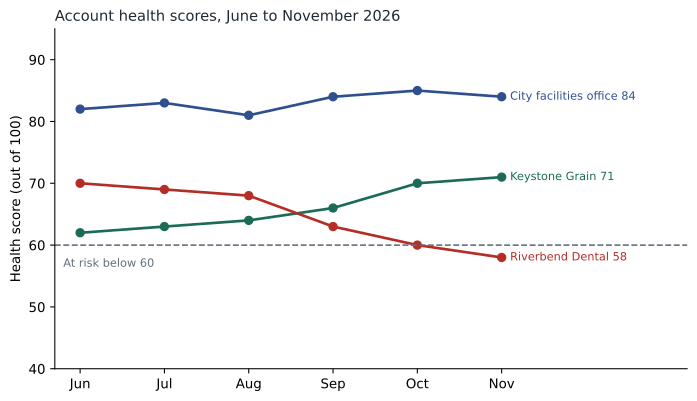
Answer: Riverbend's health score is about 58 out of 100. Ridgeline treated scores below 60 as at risk, so Riverbend went on the at-risk list, mainly because of relationship coverage and service performance.
The score pointed directly at what to fix. Raising relationship coverage from 3 to 7, by building a real relationship with Dr. Nwosu and his office manager Helen Park, would add (7 − 3) × 25 ÷ 10 = 10 points on its own, taking the account above the at-risk line. That was why the January business review was the top action in Riverbend's plan.
Health scores have limits. The weights are judgments, the factors overlap and a single number hides the story behind it. A score that has never been checked against which accounts actually churned is only an opinion in numerical form. Farida and Grace planned to compare the fiscal 2026 scores with fiscal 2027 outcomes and adjust the weights, and Farida never let the score replace reading the account. "The score tells me where to look," she said. "It does not tell me what I will find."
Measuring retention across a portfolio
Account managers are often measured on how much revenue they keep and grow across their accounts. Two measures from lesson 7 do this.
Worked problem
Gross and net revenue retention
At the start of fiscal 2026, Farida's portfolio of key and key development accounts brought in 1,240,000 dollars a year. During the year, one account left (52,000 dollars), two others reduced their spending by a total of 31,000 dollars, and existing accounts expanded by 146,000 dollars. What were gross and net revenue retention?
Show solution
- Revenue kept before expansion: 1,240,000 − 52,000 − 31,000 = 1,157,000 dollars.
- \[\text{Gross revenue retention} = \frac{1{,}157{,}000}{1{,}240{,}000} = 0.933 \approx 93 \text{ in } 100\]
- Revenue from the same accounts including expansion: 1,157,000 + 146,000 = 1,303,000 dollars.
- \[\text{Net revenue retention} = \frac{1{,}303{,}000}{1{,}240{,}000} = 1.051 \approx 105 \text{ in } 100\]
Answer: Gross revenue retention was about 93 in 100 and net revenue retention about 105 in 100. Expansion more than made up for losses, but the 83,000 dollars lost or reduced is still worth investigating, because it is where future churn usually starts.
Revenue from new customers won during the year is excluded from both measures, because they track what happened to the customers the supplier already had. Comparing the two numbers is useful. High net retention with low gross retention means the supplier is growing some accounts while losing others, which can hide a service or relationship problem behind good expansion selling.
Responding to risk
When an account goes on the at-risk list, Ridgeline's practice was to write a short save plan: a few lines in the account plan that say what the risk is, what is causing it, what Ridgeline will do, who will do it and by when. The plan is reviewed at every monthly key account meeting until the account comes off the list.
| Cause | Typical response |
|---|---|
| New decision maker | Introductory meeting led by the right level; learn their priorities; show results |
| Service problems | Fix the root cause; report openly; consider extra resources for a period |
| Falling usage | Find out why: changed needs, poor training or a better alternative; adjust the service |
| Price pressure | Show value with the customer's own data; consider changes to scope or term before price |
| Competitor activity | Strengthen relationships; make sure the decision makers know the record |
| Customer cutbacks | Help the customer reduce cost with you, rather than leave you |
The last row was the one Farida felt most strongly about. When a customer's budget is cut, the supplier that helps it find savings, even at the cost of some of its own revenue, is often the one that keeps the relationship. A smaller account that stays is worth more than a larger one that leaves, and it can grow again when the budget recovers.
Accounts that show risk in fall 2026
Maya and Farida reviewed the key and key development accounts together. Three showed signs worth recording, each for a different reason.
- Riverbend Dental Group: health score 58; a new director, past service misses and a competitor quote last year. Save plan: January business review with Dr. Nwosu and Helen Park, an honest service record, a renewal proposal only after the review.
- Prairie Valley School Division (not yet under contract): the IT manager, Ken Fehr, a sceptic with a practical veto, is retiring in the spring of 2027. Plan: give him a Ridgeline owner now and offer his successor an orientation once appointed.
- Keystone Grain Equipment: a finance dispute earlier in 2026 over a contracted price increase on its printers, settled by spreading the increase over three months. Plan: explain any future adjustment in writing sixty days ahead, and make sure the January installation goes flawlessly before the training-centre decision.
None of the three was in danger of leaving that week. That was the point. "The time to save an account is when it does not yet know it might leave," Farida said.
Talking to an at-risk customer
A save plan usually needs a direct conversation, and how it is opened matters. Farida's advice was to name the concern honestly and ask, rather than to arrive with an offer. A sentence such as "Our service in the spring fell short of what we promised you, and I would like to understand what it cost you and what you need from us now" invites the customer to say what is really on their mind. A discount offered before the customer has said what is wrong suggests that the supplier thinks price is the only thing it can fix, and it teaches the customer that complaining earns money off. Listen first, agree what will change and by when, put it in writing, and then report back on it at the next review. If the customer raises a competitor's offer, ask what the offer includes and what matters most to them in it before responding; the answer often shows that price is not the main issue at all.
Accepting some losses
Not every account can or should be saved. A customer whose needs have moved away from what the supplier does well, one that will buy only at a price that loses money, or one that has been acquired by a company with a national contract elsewhere may be better let go gracefully. Farida's write-ups always ended with the same questions: could we have seen it sooner, could we have done anything, and what did we learn? An account that leaves on good terms may return, and its people will move to other organizations and remember how they were treated.
Common mistakes
MistakeWatching only for customers that announce they are leaving.
InsteadTrack partial churn, such as falling usage or a category moved to a competitor.
MistakeReacting to a single warning sign as if the account were lost.
InsteadLook for combinations of signs across families and the direction they are moving.
MistakeTrusting a health score that has never been checked against outcomes.
InsteadCompare scores with actual churn and adjust the factors and weights.
MistakeDefending revenue when a customer's budget is cut.
InsteadHelp the customer reduce cost with you, so the relationship survives.
MistakeWriting a save plan and never revisiting it.
InsteadReview every save plan at the monthly account meeting until the risk is resolved.
Summary and key terms
- Churn is the loss of a customer or of part of its business.
- Partial churn, where the customer stays but buys less, is common and often comes before full churn.
- The warning signs come from people, usage, service, commercial, engagement, competitive and customer-situation families; a combination of signs moving the wrong way matters more than any single one.
- Leading indicators appear before a decision to leave; lagging indicators after it.
- An account health score combines weighted factors into one rating, but its weights are judgments and it should be checked against actual outcomes.
- Gross revenue retention measures revenue kept before expansion; net revenue retention includes expansion and reductions.
- At-risk accounts need a short save plan with a cause, actions, owners and dates.
- Helping a customer cut costs can keep a relationship that defending revenue would lose.
- Some accounts should be let go gracefully, and every loss should be reviewed for lessons.
- Churn
- The loss of a customer or of part of a customer's business.
- Partial churn
- A customer staying but buying less, moving a category to a competitor or shrinking its contract.
- Leading indicator
- A sign that tends to appear before a customer decides to leave, such as falling usage.
- Account health score
- A weighted combination of risk factors expressed as a single rating for an account.
- Gross revenue retention
- Revenue kept from existing customers over a period, before expansion, as a share of their starting revenue.
- Save plan
- A short plan for an at-risk account stating the risk, its cause, actions, owners and dates.
Practice problems
Work each problem on paper first, then reveal the answer to check.
An account scores 6 on a factor weighted 25. If you raise that factor to 9, how many points does the 100-point health score rise?
Show answer
(9 − 6) × 25 ÷ 10 = 7.5 points.
A portfolio starts the year at 800,000 dollars. Losses and reductions total 64,000 dollars and expansion adds 96,000 dollars. What are gross and net revenue retention?
Show answer
Gross: 736,000 ÷ 800,000 = 92 in 100; net: 832,000 ÷ 800,000 = 104 in 100.
Give one leading and one lagging indicator of churn.
Show answer
Leading: a champion leaves or usage falls. Lagging: the customer asks for the contract end date or requests an export of all its data.
Lesson quiz · 5 questions
Score 60% or more to complete this lesson.
Create a free account to save your progress, take quizzes and earn a certificate.