
SLS-252 · Lesson 1 of 12 · 22 min
Store operations overview
▶ Video coming soon A video version of this lesson is on the way.
On Tuesday, September 15, 2026, at 7:30 in the morning, Marcus Dube unlocked the staff door at the back of Juniper & Pine Home and walked Aiden Laroque through a part of the store most customers never see. Aiden had been on the payroll for two weeks, working in décor. He knew where the lamps were and how to ring up a throw pillow. He did not know that the 40,000-square-foot building held 10,000 square feet of space behind the walls: a two-door receiving dock, a warehouse with racking three pallets high, a repair and assembly bench, a cage for small high-value goods, a cash office, a break room and the managers' offices. "Everything you sell out front," Marcus said, "passes through here at least twice: once on the way in and once on the way out. If it goes wrong back here, nobody out front can fix it." That walk became the first of Marcus's Tuesday back-room sessions, held before opening every week through November 10.
What store operations means
Store operations is the work that keeps a store able to sell: getting merchandise in, keeping track of it, protecting it, taking payment for it, handling it when it comes back, and keeping the building and the people in it safe. Selling, merchandising and marketing get most of the attention in retail, but operations decides whether the sofa a customer chose is actually in the warehouse, whether the price on the ticket matches the price at the till, whether the cash in the drawer matches the sales, and whether the person carrying a dresser down the dock ramp goes home uninjured.
Operations work is mostly invisible when it goes well and very visible when it does not. A customer never thanks the store for receiving their mattress correctly. They do remember the delivery that arrived with the wrong headboard, the refund that took three visits, or the floor model they were sold that turned out to be out of stock everywhere. Bev Halvorsen, the store manager, put it this way at the start of the fall: "Sales sets the promise. Operations keeps it."
The flow of merchandise
It helps to picture the store as a flow. Merchandise is ordered from suppliers, arrives on trucks, is checked and recorded, moves into stock or onto the floor, is sold, is picked or delivered, and sometimes comes back. Money flows the other way: customers pay, the store deposits the money, and the store pays its suppliers. Information follows both flows, because every movement of goods or money should be recorded in the store's systems.
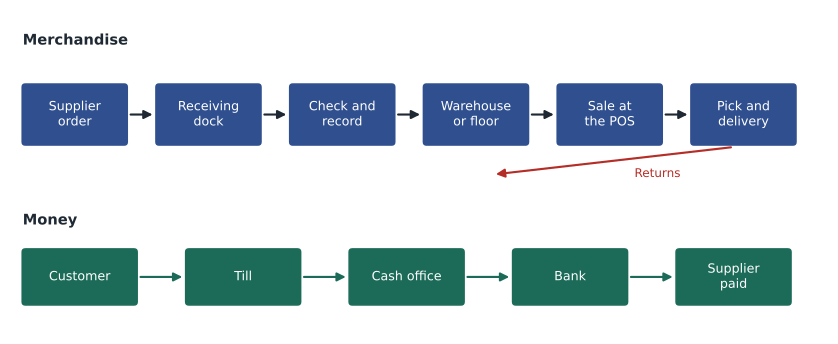
| Stage | What happens | Main risk if it goes wrong | Where this course covers it |
|---|---|---|---|
| Ordering | The buyer or the system orders stock from suppliers | Too much or too little stock | Lesson 4 |
| Receiving | Goods are checked against the order and recorded | Paying for goods never received; damage missed | Lesson 2 |
| Stocking | Goods are put away in labelled locations or set on the floor | Lost stock; slow picking | Lesson 2 |
| Counting | Records are checked against what is physically there | Records that cannot be trusted | Lesson 3 |
| Protecting | Theft, damage and errors are prevented and investigated | Shrink | Lessons 5, 6 and 12 |
| Selling | The sale is recorded and paid for at the point of sale | Wrong prices; lost sales data | Lesson 7 |
| Payment and cash | Card, cash and financed payments are taken and balanced | Cash losses; card data breaches | Lesson 8 |
| Returns | Goods come back and refunds or exchanges are issued | Refund fraud; resaleable stock written off | Lesson 9 |
| Safety | People and the building are kept safe | Injuries and legal penalties | Lesson 10 |
| Opening and closing | The store is safely opened, secured and handed over | Burglary; missed tasks | Lesson 11 |
Operations in numbers
Operations shows up on the profit and loss statement in several places, and Aiden had already met that statement at Bev's Monday numbers mornings. In 2025, Juniper & Pine had net sales of 12.40 million dollars, a gross margin of 4.881 million dollars, operating expenses of 4.26 million dollars and an operating profit of 0.62 million dollars, about 5 in 100 of sales. Shrink, the difference between the inventory the records said the store should have and the inventory actually counted, is taken out of gross margin. Wages for receiving, warehouse and cashiering staff, card processing fees, cleaning, security and repairs are operating expenses.
That gives operations a direct line to profit. Every dollar of shrink or avoidable expense comes straight out of the 0.62 million dollars of operating profit, because none of it brings in any sales. Marcus showed the group a simple way to see how much that matters.
Worked problem
What one dollar of loss costs in sales
Juniper & Pine earns an operating profit of about 5 in 100 of net sales. A décor shelf is damaged and written off, losing 250 dollars of merchandise at cost. How many dollars of extra sales does the store need, at its normal profit rate, to earn back that loss?
Show solution
- Operating profit rate = 0.62 million ÷ 12.40 million = 0.05.
- \[\text{Sales needed} = \frac{\text{Loss}}{\text{Profit rate}} = \frac{250}{0.05} = 5{,}000\]
- Check: 5 in 100 of 5,000 dollars of sales is 250 dollars of profit.
Answer: The store would need about 5,000 dollars of extra sales just to replace the profit lost on a 250-dollar write-off. Preventing the loss is far cheaper than selling enough to cover it.
The same arithmetic applies to every operations cost. A card fee that is a little higher than it needs to be, a delivery that has to be repeated, a pallet of mattresses stored badly and damaged by a forklift: each one takes profit that the sales floor then has to earn again.
Who does what at Juniper & Pine
Every store divides operations work differently, depending on its size and what it sells. At Juniper & Pine, the work is shared among a small operations team and the sales staff.
| Role | Main operations duties |
|---|---|
| Store manager (Bev Halvorsen) | Overall responsibility; approves policies, large refunds and write-offs; holds the safe combination with one other manager |
| Operations and loss prevention lead (Marcus Dube) | Receiving, warehouse, counts, shrink reporting, loss prevention, safety programs, opening and closing procedures |
| Receivers and warehouse associates (four people) | Unloading trucks, checking deliveries, putting away, picking orders, staging deliveries |
| Cash office lead (part-time) | Counting tills, preparing the bank deposit, balancing the day |
| Delivery crew (contracted, led by Hamid) | Loading, delivery, installation and haul-away |
| Sales associates (including Aiden and Carl Jensen) | Accurate sales entries, price checks, holds, returns at the counter, watching the floor, reporting problems |
| E-commerce and marketing coordinator (Tessa Yellowbird) | Online orders and buy online, pick up in store, which depend on accurate stock records |
Smaller stores combine these roles, and in a store with five employees the manager may do all of them. Large chains add specialists: asset protection teams, inventory control analysts, a regional safety manager and a payments team at head office. The tasks are the same; only the number of people doing them changes.
Policies, procedures and standards
Operations runs on written procedures. A policy states what the store will and will not do, such as "refunds over 500 dollars need a manager's approval". A procedure sets out how to do a task step by step, such as how to count a cash drawer. A standard sets the level of performance expected, such as "every delivery is checked against its packing slip on the day it arrives". Juniper & Pine keeps its procedures in a binder in the back office and in the staff app, and Marcus reviews them each January.
Written procedures matter for three reasons. They make the work consistent, so that a refund is handled the same way whoever is at the counter. They make training possible, because a new associate can learn a task from the procedure rather than from whoever happens to be on shift. And they protect the store and its staff, because they show that the store took reasonable care, which matters when something goes wrong, whether it is a cash shortage, a shoplifting incident or an injury.
A good procedure is short, written in plain language, and tested by someone who did not write it. Marcus asked Aiden to follow the store's written procedure for receiving a parcel delivery without help. Aiden got stuck at step four, which said to "complete the receiving entry", because nobody had told him which screen that meant. Marcus rewrote the step that afternoon.
Measuring operations
Stores track operations with a handful of measures, usually called key performance indicators or KPIs. Each one is useful only if it is measured the same way every time and someone acts on it. Juniper & Pine's operations dashboard in fall 2026 tracked the measures below.
| Measure | How it is calculated | Juniper & Pine target |
|---|---|---|
| Shrink rate | Shrink at retail ÷ net sales | Below 0.7 in 100 of sales |
| Inventory record accuracy | Locations counted correctly ÷ locations counted | At least 97 in 100 |
| Receiving on time | Deliveries checked and recorded the same day ÷ deliveries received | 100 in 100 |
| In-stock rate | Items in stock ÷ items that should be in stock | At least 95 in 100 for core items |
| Cash over and short | Counted cash − expected cash, per drawer | Within 5 dollars per drawer per day |
| Return rate | Value of returns ÷ gross sales | Tracked by department |
| Lost-time injuries | Injuries causing time off work | Zero |
Worked problem
Reading the return rate
In 2025, Juniper & Pine had gross sales of 12.71 million dollars and returns of 0.31 million dollars, leaving net sales of 12.40 million dollars. What was the return rate on gross sales?
Show solution
- \[\text{Return rate} = \frac{\text{Returns}}{\text{Gross sales}} = \frac{0.31}{12.71} \approx 0.0244\]
Answer: Returns were about 2.4 in 100 of gross sales. Lesson 9 shows why a furniture store watches this number by department and by reason, not only as a total.
A single number rarely tells the whole story. A falling shrink rate is good news, unless it fell because the store stopped counting high-risk areas. A perfect cash over-and-short record is good news, unless cashiers are quietly topping up drawers from their own pockets to avoid questions. Marcus's rule was to look at every measure alongside the work behind it.
Operations and the customer
Operations is not only about the back room. Most operations failures reach the customer sooner or later. An inaccurate stock record leads to a sale that cannot be delivered. A slow receiving process leaves new stock in boxes while customers ask for it. A confusing refund procedure keeps a customer waiting at the counter. And a store that is not clean, safe and well lit loses shoppers who never say why.
For that reason, Juniper & Pine expects every associate to do some operations work. Sales associates check prices when they set up a display, report damaged items, keep stockroom doors closed, enter sales accurately, and follow the returns and cash procedures exactly. Aiden's first week on the décor floor had already shown him one example: a lamp had a ticket price of 89 dollars but rang up at 99 dollars, because the price change had been entered at the till but the new tickets had never been printed. The customer was charged the lower ticket price, as the store's policy requires, and Aiden logged the error so the tickets could be fixed.
Price accuracy is a legal matter as well as a service one. In Canada, the Competition Act prohibits charging more than the advertised or displayed price, and the voluntary Scanner Price Accuracy Code, which many large retailers follow, gives customers an item free or a discount when the scanned price is higher than the shelf price. In the United States, state weights-and-measures and consumer protection laws cover price accuracy, and many stores follow a policy of charging the lowest displayed price. Juniper & Pine's own policy is simpler: if the ticket is lower than the price at the till, the customer pays the ticket price, and the error is reported the same day.
Planning the operations year
Operations work follows the retail calendar. At Juniper & Pine, the busy periods are the Labour Day and Thanksgiving weekends, Black Friday, Boxing Week or the week after Christmas, and the spring sale. Each busy period needs extra receiving before it, extra cashier and delivery capacity during it, and extra returns handling after it. The year's full physical inventory count happens in late January, after the holiday returns have been processed and before spring merchandise arrives. Safety training is refreshed each spring, before the heavy delivery season, and procedures are reviewed each January.
Marcus's calendar for the rest of 2026 had three big dates on it. Black Friday on November 27 would bring the heaviest traffic of the year, the week after Christmas would bring the heaviest returns, and the full count was set for the last weekend of January 2027. Everything he planned to teach Aiden that fall pointed toward those three dates.
Common mistakes
MistakeTreating operations as the warehouse team's job only.
InsteadEvery associate affects stock records, prices, cash, returns and safety.
MistakeThinking a loss is small because the item was cheap.
InsteadAt a 5 in 100 profit rate, every dollar lost needs about 20 dollars of extra sales to replace it.
MistakeDoing a task the way the last person did it.
InsteadFollow the written procedure, and report steps that do not work so they can be fixed.
MistakeReading one measure on its own.
InsteadCheck each measure against the work behind it before deciding it is good or bad news.
MistakeCharging the till price when the ticket shows less.
InsteadCharge the displayed price and report the error the same day.
Summary and key terms
- Store operations is the work that keeps a store able to sell: receiving, stocking, counting, replenishing, protecting, selling, taking payment, handling returns, keeping people safe, and opening and closing.
- Merchandise flows in from suppliers and out to customers, money flows the other way, and every movement should be recorded.
- Losses and avoidable costs come straight out of operating profit, so at a 5 in 100 profit rate a 250-dollar loss needs about 5,000 dollars of extra sales to replace.
- Policies state what the store will do, procedures set out how, and standards set the level expected.
- Operations is measured with indicators such as shrink rate, inventory record accuracy, in-stock rate, cash over and short, return rate and injuries.
- Many operations failures reach the customer, and price accuracy is a legal as well as a service issue.
- Operations work follows the retail calendar of busy periods, returns peaks and the annual count.
- Store operations
- The work that gets merchandise in, tracks and protects it, takes payment, handles returns and keeps people and the building safe.
- Back of house
- The parts of a store customers do not see: receiving, warehouse, offices and cash office.
- Policy
- A statement of what the store will and will not do.
- Procedure
- Step-by-step instructions for a task.
- Standard
- The level of performance expected for a task.
- Key performance indicator (KPI)
- A measure used regularly to track how well the work is being done.
- Shrink
- The difference between recorded inventory and inventory actually counted.
- In-stock rate
- The share of items that should be in stock that actually are.
Practice problems
Work each problem on paper first, then reveal the answer to check.
Juniper & Pine writes off a damaged mirror that cost 400 dollars. At a 5 in 100 operating profit rate, how much extra in sales replaces that loss?
Show answer
400 ÷ 0.05 = 8,000 dollars of extra sales.
What is the difference between a policy and a procedure? Give one example of each.
Show answer
A policy says what the store will do, such as "refunds over 500 dollars need a manager's approval"; a procedure says how to do a task, such as the steps for counting a drawer.
A store had gross sales of 2,000,000 dollars and returns of 70,000 dollars. What was its return rate on gross sales?
Show answer
70,000 ÷ 2,000,000 = 0.035, or 3.5 in 100.
Lesson quiz · 5 questions
Score 60% or more to complete this lesson.
Create a free account to save your progress, take quizzes and earn a certificate.