
SLS-252 · Lesson 7 of 12 · 24 min
Point-of-sale systems
▶ Video coming soon A video version of this lesson is on the way.
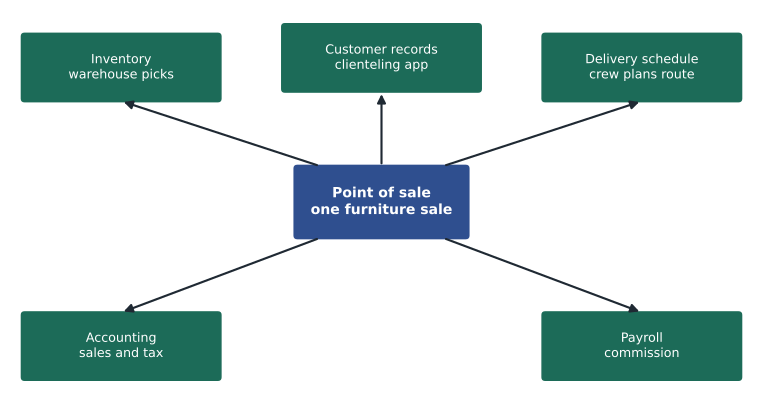
Aiden's move to the main sales floor on October 19 came with a new login for the point-of-sale system and a half-hour session with Marcus at the cash counter. On the décor floor, Aiden had mostly rung up single items. On the main floor, a single sale might include a sectional in three pieces, a fabric protection plan, delivery, haul-away of an old sofa, a deposit paid today and a balance paid on delivery, and a commission split with Carl. "Every one of those lines tells a different part of the store what to do," Marcus said. "The warehouse picks from it, the delivery crew plans from it, accounting books from it, and payroll pays your commission from it. If you key it wrong, all four get it wrong."
What a point-of-sale system does
A point-of-sale system (POS) is the hardware and software a store uses to record sales and take payment. At its simplest, it is a cash register. A modern retail POS is a connected system that looks up items and prices, calculates taxes, takes card and cash payments, prints or emails receipts, and sends every transaction to the store's inventory, accounting and customer records in real time.
| Component | What it does | At Juniper & Pine |
|---|---|---|
| Terminals | Run the POS software and display the sale | Four fixed terminals at the cash counter |
| Mobile POS | Tablets or phones that ring up sales anywhere in the store | Tablets on the sales floor, shared with the clienteling app |
| Scanner | Reads barcodes on tickets and products | Handheld scanners at each terminal |
| Payment terminal | Reads cards and mobile wallets by tap, chip or swipe | One per terminal and one per floor tablet |
| Cash drawer | Holds cash, opened by the POS | One per fixed terminal |
| Receipt printer | Prints receipts, or the system emails them | At each fixed terminal; email from tablets |
| Back-office software | Prices, items, reports, users and settings | Cloud-based, managed by Marcus and Bev |
The item file and prices
Every item the POS can sell is set up in the item file, sometimes called the price file or product master: an item number (SKU), a description, the barcode, the department and class, the cost, the regular price, any current sale price, the tax category and the supplier. The POS charges whatever price is in the item file at the time of sale. That makes the item file one of the most important records in the store.
Price errors usually come from gaps between the item file and the tickets on the floor. A sale price may be loaded in the system but the floor tickets not changed, or the tickets may be changed for a promotion that was never loaded. Juniper & Pine runs a price audit every Monday: an associate scans a sample of 50 tickets in each department and compares each with the price the POS charges. Any difference is fixed the same day, and if the ticket is lower, customers are charged the ticket price until it is fixed.
Worked problem
Price audit accuracy
At the October 26 price audit, the associate scanned 250 tickets across the store. Seven rang up at a different price from the ticket: four higher and three lower. What was the price accuracy, and why do the four higher prices matter more?
Show solution
- \[\text{Price accuracy} = \frac{250 - 7}{250} = \frac{243}{250} = 0.972\]
Answer: Price accuracy was 97.2 in 100. The four items that rang up higher than the ticket matter most, because charging more than the displayed price breaks the store's policy and can break consumer protection law. They were fixed before the store opened.
Ringing up a furniture sale
A furniture sale often has more parts than a typical retail sale. The POS at Juniper & Pine handles each part as its own line, so each department and system gets the right information.
- Merchandise lines. Each item sold, with its SKU. A sectional sold as a set has one line for each piece, or a set SKU that the system breaks into pieces for the warehouse.
- Floor model or stock. Whether the customer is buying the floor model, stock from the warehouse, or a special order to be made.
- Services. Delivery, haul-away of old furniture, assembly and installation, each with its own service code.
- Protection plans. Extended protection plans sold through the store's plan provider.
- Discounts. Any authorized discount, with a reason code. Discounts above a set level need a manager's approval at the terminal.
- Salesperson. Who made the sale, and any agreed split, because commission is paid on margin.
- Customer and fulfillment. Name, address, phone, delivery date and window, or pickup.
- Payment. Deposit and balance, and the method of each.
The order in which lines are entered matters less than getting every one right. Bev's counter checklist ends with a read-back: the associate reads the order aloud to the customer from the screen, line by line, before taking payment. That read-back caught Aiden's first mistake on the main floor, a queen headboard keyed where the customer had ordered a king.
Sales tax at the point of sale
The POS calculates sales tax from each item's tax category and the store's location. Getting tax right matters, because the store collects it on behalf of the government and must pay it over whether or not it charged the customer correctly.
In Saskatchewan, most goods are subject to the 5 in 100 federal Goods and Services Tax (GST) and the 6 in 100 provincial sales tax (PST), for a combined 11 in 100. Some items and services are treated differently under each tax, so the item file sets the tax category for every SKU, and Juniper & Pine's accountant reviews the categories whenever new kinds of products or services are added.
Worked problem
Tax on a recliner sale
A customer in Regina buys a power recliner at 1,349 dollars and a fabric protector at 129 dollars, both taxable at GST and PST. What is the total?
Show solution
- Subtotal = 1,349 + 129 = 1,478.00 dollars.
- GST at 5 in 100 = 0.05 × 1,478 = 73.90 dollars.
- PST at 6 in 100 = 0.06 × 1,478 = 88.68 dollars.
- Total = 1,478.00 + 73.90 + 88.68 = 1,640.58 dollars.
Answer: The total is 1,640.58 dollars. The receipt shows GST and PST separately, as Canadian rules expect, along with the store's GST registration number.
Deposits, special orders and balances
Many furniture sales are not completed on the day. A special-order sofa may take ten weeks to arrive, and the customer pays a deposit at the time of sale and the balance before delivery. The POS records the order, the deposit and the balance owing, and tracks the order until it is fulfilled. Juniper & Pine requires a deposit of at least a third of the order value on special orders, because a cancelled special order may leave the store with a sofa in a fabric nobody else wants.
Worked problem
Deposit and balance
A customer orders a special-order sofa at 2,799 dollars plus delivery at 79 dollars, before tax. The store requires a deposit of at least one third of the pre-tax order value, rounded up to the next dollar. How much is the minimum deposit, and what balance remains before tax?
Show solution
- Pre-tax order value = 2,799 + 79 = 2,878 dollars.
- One third = 2,878 ÷ 3 ≈ 959.33, rounded up to 960 dollars.
- Balance before tax = 2,878 − 960 = 1,918 dollars.
Answer: The minimum deposit is 960 dollars before tax, leaving a pre-tax balance of 1,918 dollars to be paid before delivery. The POS records tax on each payment according to the store's tax settings.
Deposits are customer money until the order is fulfilled, so they are recorded as a liability, not as sales. The sale is recognized when the goods are delivered. A store that counted deposits as sales would overstate its sales in the months before deliveries, which is one reason the POS tracks orders and deposits separately.
Voids, overrides and permissions
Some POS functions can be used to steal or to hide mistakes, so they are controlled with user permissions. Every user logs in with their own credentials, and no one shares a login, so every transaction is tied to a person.
| Function | What it is | Who can do it at Juniper & Pine |
|---|---|---|
| Line void | Removing an item from a sale before payment | Any cashier |
| Post-void | Cancelling a completed sale | Manager only, with a reason |
| Price override | Changing an item's price at the till | Manager approval above 10 in 100 |
| No-sale | Opening the cash drawer without a sale | Manager only, logged |
| Refund | Returning money for returned goods | Cashiers up to 500 dollars; manager above |
| Manual entry | Keying an item or card number instead of scanning | Allowed for items; card keying only by manager approval |
These permissions are not about distrust. They protect honest employees, because when a drawer is short or a sale is questioned, the record shows who did what. Marcus's weekly exception report lists every post-void, override, no-sale and large refund by user, and he follows up on patterns, not single events.
Reports from the point of sale
The POS is also the store's main source of sales information. Every transaction records the time, the items, the salesperson and the payment, which lets the store see sales by hour, day, department, item and salesperson. The figures Bev uses to schedule staff and coach the floor come straight from the POS.
Worked problem
Average transaction value and units per transaction
On Saturday, October 31, 2026, the POS showed 86 transactions with total net sales of 61,920 dollars and 223 units sold. What were the average transaction value (ATV) and units per transaction (UPT)?
Show solution
- \[\text{ATV} = \frac{61{,}920}{86} = 720.00\]
- \[\text{UPT} = \frac{223}{86} \approx 2.59\]
Answer: The average transaction was 720 dollars, with about 2.6 units per transaction. Bev compares these with the same Saturday last year and with each salesperson's figures when she coaches the floor.
At the end of each day, the POS produces a summary, often called a Z report or end-of-day report, listing total sales by department and by payment type, refunds, voids, discounts and taxes. The cash office uses it to balance the day, which is the subject of the next lesson.
When the system goes down
Every POS fails sometimes: the internet connection drops, the cloud service has an outage, or a terminal freezes. A store needs a plan for selling when the system is down. Many cloud POS systems have an offline mode that stores transactions and sends them when the connection returns; card payments may be limited or held until then. Juniper & Pine's downtime procedure, kept in a red folder at the counter, covers taking cash and offline card payments, writing paper sales slips for furniture orders, and entering everything into the system as soon as it is back. The store practised the procedure in September, and it worked: when the internet failed for 40 minutes on November 8, the counter kept selling, and every sale was entered by closing.
Choosing and changing a POS
Retailers replace their point-of-sale systems every several years, and the choice shapes operations for a long time. A furniture store needs features many POS products lack: multi-piece items, special orders with deposits, delivery scheduling, commission splits and financing integration. Juniper & Pine moved to its current cloud POS in 2024, and Marcus's lesson from the change was that the item file, the user permissions and the downtime procedure need as much attention as the screens. The store ran the old and new systems side by side for a weekend before switching over.
Common mistakes
MistakeSharing a POS login to save time.
InsteadEvery user logs in with their own credentials, so every transaction is tied to a person.
MistakeKeying a similar item when the barcode will not scan.
InsteadLook up the exact SKU; a wrong item puts two records out at once.
MistakeRecording a special-order deposit as a completed sale.
InsteadRecord deposits as customer money until the goods are delivered.
MistakeLeaving sale prices in the system after the promotion ends, or tickets on the floor after the price changes.
InsteadRun the weekly price audit and fix differences the same day.
MistakeSkipping the read-back because the customer is in a hurry.
InsteadRead the order back line by line before taking payment.
Summary and key terms
- A point-of-sale system records sales and takes payment, and sends each transaction to inventory, accounting, customer and payroll records.
- The item file holds each SKU's description, barcode, department, cost, prices and tax category, and the POS charges whatever it says, so weekly price audits compare tickets with the system.
- A furniture sale includes merchandise lines, floor model or stock, services, protection plans, discounts, salesperson, fulfillment and payment, and a read-back catches errors.
- The POS calculates sales tax from each item's tax category and the store's location.
- Special orders carry a deposit, recorded as customer money until delivery.
- Voids, overrides, no-sales, refunds and manual entries are controlled by user permissions, and no one shares a login.
- POS reports give sales by hour, department and salesperson, ATV and UPT, and the end-of-day Z report used to balance the day.
- A downtime procedure keeps the store selling when the system fails.
- Point-of-sale system (POS)
- The hardware and software used to record sales and take payment.
- Mobile POS
- A tablet or phone that rings up sales anywhere in the store.
- Item file
- The record of every SKU the POS can sell, with its prices and tax category.
- Price audit
- A check comparing shelf or ticket prices with the prices the POS charges.
- Post-void
- Cancelling a sale after it has been completed.
- Price override
- Changing an item's price at the till.
- Z report
- The end-of-day summary of sales, payments, refunds, voids and taxes.
- Offline mode
- A POS feature that stores transactions when the connection is down and sends them later.
Practice problems
Work each problem on paper first, then reveal the answer to check.
A price audit scans 120 tickets and finds 3 that ring up at a different price. What is the price accuracy?
Show answer
117 ÷ 120 = 0.975, or 97.5 in 100.
A day has 50 transactions, net sales of 30,000 dollars and 110 units. What are the ATV and UPT?
Show answer
ATV = 600 dollars; UPT = 2.2.
Why is a special-order deposit recorded as a liability rather than a sale?
Show answer
It is the customer's money until the goods are delivered; the sale is recognized on delivery.
Lesson quiz · 5 questions
Score 60% or more to complete this lesson.
Create a free account to save your progress, take quizzes and earn a certificate.