
SLS-252 · Lesson 10 of 12 · 22 min
Store health and safety
▶ Video coming soon A video version of this lesson is on the way.
On the morning of Tuesday, November 3, 2026, the first snow of the season came in on customers' boots, and by 11 a.m. a shopper had slipped on the wet tile inside the front doors. She was not hurt, but she sat on the floor for a minute while Aiden and Bev helped her up and fetched her a chair. Marcus had the entrance mats doubled within the hour and a cone set out, and he wrote up the incident before lunch. At the back-room session that day, he did not start with the snow. He started with a photo of the dock from the week before: a receiver standing on the second-to-top step of a stepladder, reaching sideways for a carton of lamps. "Nobody fell," Marcus said. "That's not the same as nobody being at risk. Most injuries here don't come from bad luck. They come from things we do every day and stop noticing."
Why safety is part of operations
Retail looks safe compared with construction or manufacturing, but furniture and appliance stores have real hazards. Staff lift and carry heavy, awkward items, work on ladders and around pallet jacks, cut cartons open with blades, handle cleaning chemicals, and deal with the public, including the occasional angry or violent person. Customers walk on wet floors, sit on display furniture and let children climb on dressers. An injury costs the person who is hurt most of all, and it also costs the store in lost work, workers' compensation premiums, possible fines and staff morale.
In Saskatchewan, workplace safety is governed by Part III of The Saskatchewan Employment Act and The Occupational Health and Safety Regulations, 2020, enforced by the province's Occupational Health and Safety Division, with injury compensation through the Saskatchewan Workers' Compensation Board. Employers must provide a safe workplace, train and supervise workers, and consult workers on safety; workers must work safely, use the protective equipment provided and report hazards. Workers have the right to know about hazards, to participate in safety through an occupational health committee or representative, and to refuse work they believe is unusually dangerous.
Controlling hazards
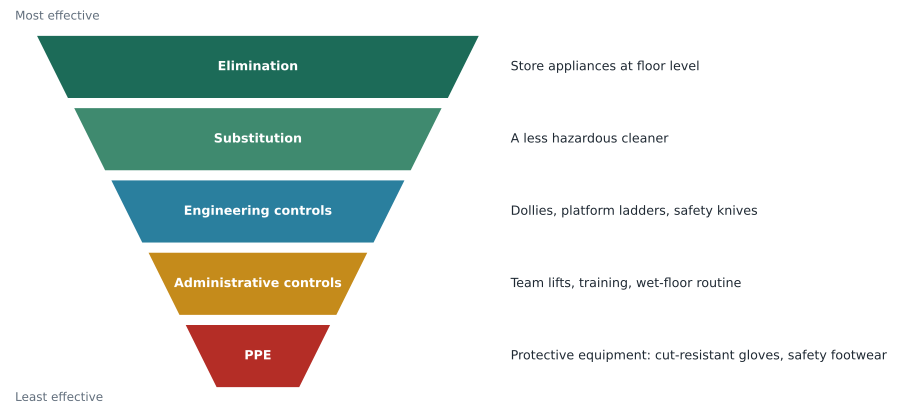
Safety professionals use a hierarchy of controls to decide how to deal with a hazard. The most effective controls remove the hazard altogether; the least effective rely on people remembering to protect themselves. A store should start at the top and work down.
| Level | Meaning | Example at Juniper & Pine |
|---|---|---|
| Elimination | Remove the hazard | Store heavy appliances at floor level so nobody lifts them onto racking |
| Substitution | Replace it with something less hazardous | Switch to a less hazardous cleaning product for glass tables |
| Engineering controls | Change the equipment or workplace | Appliance dollies, a powered pallet jack, a rolling platform ladder with handrails, self-retracting safety knives |
| Administrative controls | Change how work is done | Team lifts over 23 kilograms (50 pounds), training, rotation of heavy tasks, a wet-floor procedure |
| Personal protective equipment | Protect the person | Cut-resistant gloves for unpacking, safety footwear in the warehouse |
Lifting and carrying
Back and shoulder injuries from lifting, carrying, pushing and pulling are the most common serious injuries in furniture retail. A sofa may weigh 70 kilograms (about 155 pounds), a refrigerator more than 100 kilograms (220 pounds), and both are awkward, with no good handholds. The US National Institute for Occupational Safety and Health (NIOSH) lifting equation, widely used in both countries, starts from a maximum of 23 kilograms (51 pounds) for an ideal lift, close to the body, at waist height, without twisting, and reduces the recommended limit as conditions get worse. Most furniture lifts are far from ideal.
Juniper & Pine's rules follow from that. Anything over 23 kilograms (50 pounds) is a team lift or uses equipment. Appliances move only on appliance dollies with straps. Mattresses are carried flat by two people, never dragged. Nothing is lifted above shoulder height. And before a delivery, the crew checks the route, measures doorways and stairs, and plans the lift, which also protects the customer's walls.
Worked problem
Planning a team lift
A three-seat sofa weighs 72 kilograms (159 pounds). Juniper & Pine's rule is that no one person carries more than about 23 kilograms (50 pounds) in a lift that cannot be done with equipment. How many people should carry the sofa up a short flight of stairs where a dolly cannot be used?
Show solution
- Divide the weight by the per-person limit: 72 ÷ 23 ≈ 3.1 (or 159 ÷ 50 ≈ 3.2).
- Three people would each carry about 24 kilograms (53 pounds), slightly over the limit, and stairs make the lift harder.
- Four people would each carry about 18 kilograms (40 pounds).
Answer: The sofa needs four people on the stairs. A heavy, awkward item on stairs is exactly the kind of lift where the recommended limit should be reduced, not stretched.
Ladders, racking and falling objects
Falls from ladders and objects falling from height cause some of the most serious retail injuries. The safe-practice rules are simple and widely taught.
- Use the right ladder. A rolling platform ladder with handrails for the warehouse racking; a stepladder of the right height for the floor. Never stand on a chair, a box or a display.
- Three points of contact. Keep two hands and a foot, or two feet and a hand, on the ladder when climbing.
- Do not stand on the top steps of a stepladder or reach sideways; move the ladder.
- Set extension ladders at the right angle. Place the base one unit out from the wall for every four units of height to the top support.
- Load racking safely. Heavy items low, nothing over the edge of the beam, loads within the rated capacity posted on each bay, damaged racking reported and taken out of use.
- Secure furniture on display. Tall dressers and bookcases on the floor are anchored to the wall or set so they cannot tip, because children climb them.
Worked problem
The ladder angle
Warehouse staff use an extension ladder to reach a mezzanine edge 4 metres (13 feet) above the floor. How far from the base of the wall should the foot of the ladder be?
Show solution
- The rule is one unit out for every four units up.
- Metric: 4 ÷ 4 = 1 metre.
- US units: 13 ÷ 4 = 3.25 feet, about 3 feet 3 inches.
Answer: The foot of the ladder should be about 1 metre (about 3 feet 3 inches) from the wall, and the ladder should extend about 1 metre (3 feet) above the landing so the climber has something to hold.
Blades, pallet jacks and the dock
Cuts from box knives are the most common minor injury in receiving. Self-retracting safety knives, cutting away from the body, and cut-resistant gloves prevent most of them. Powered pallet jacks and forklifts need trained, authorized operators only, and the dock needs clear walkways, wheel chocks or a dock lock on every trailer, and a rule that nobody stands between a moving jack and a wall. Juniper & Pine does not use a sit-down forklift; its powered pallet jack is operated only by the two receivers trained and authorized to use it.
Chemicals
Cleaning products, furniture polish, adhesives and touch-up stains can be hazardous. Saskatchewan workplaces follow WHMIS 2015, the national Workplace Hazardous Materials Information System, which is aligned with the Globally Harmonized System. Hazardous products must carry supplier labels with pictograms, every product needs a current safety data sheet available to workers, and workers must be trained in what the labels and sheets mean and how to use the products safely. Products moved into another container need a workplace label.
Slips, trips and the front door
The November 3 slip was a reminder that customers are exposed to store hazards too. Slips and trips come from wet or icy entrances, spills, loose rugs on display, cords across walkways and cluttered aisles. In winter, Juniper & Pine lays extra matting at both entrances, sets out cones and mops on a schedule during snowfall, and clears the sidewalk and parking area early. Display rugs are taped or backed with non-slip pads, and associates check their zone at each shift change for spills and trip hazards.
Every customer incident gets an incident report, written the same day, with facts: time, place, what happened, conditions, who saw it, what help was given. The report is not an admission of fault; it is a record that protects both the customer and the store. Staff should help the person, call emergency services if needed, and not argue about blame.
Workplace violence
Retail workers face threats and violence from a small number of customers, including during thefts and robberies. Saskatchewan requires employers to have a written violence policy statement and prevention plan, developed with the occupational health committee or workers, identifying high-risk positions and settings, setting out how incidents are reported and investigated, committing to training and reviewed at least every three years. Late-night retail premises are a prescribed high-risk setting with extra requirements, although Juniper & Pine, which closes at 9 p.m., is not one.
Juniper & Pine's plan includes de-escalation training for all floor and counter staff, a code word on the radio that brings a manager and a second person, cash limits in drawers, the observe-and-report rule for theft, and a robbery procedure covered in the next lesson.
Reporting and measuring
Every injury and near miss is reported to the supervisor at once and recorded. Serious injuries and dangerous occurrences must be reported to Saskatchewan's Occupational Health and Safety Division, and injuries needing medical treatment or time off are reported to the Workers' Compensation Board. A near miss, like the receiver on the stepladder, is reported too, because it shows where the next injury will come from.
A common measure of safety performance is the incident rate: recordable injuries per 100 full-time workers per year. Because a full-time worker works about 2,000 hours a year, 100 workers work about 200,000 hours, which is the standard base.
Worked problem
Juniper & Pine's incident rate
In 2025, Juniper & Pine's employees worked a total of 96,000 hours and had 3 recordable injuries: a back strain on the dock, a cut from a box knife needing stitches, and a sprained ankle on a delivery. What was the incident rate?
Show solution
- \[\text{Incident rate} = \frac{3 \times 200{,}000}{96{,}000} = 6.25\]
Answer: The incident rate was 6.25 injuries per 100 full-time workers. With so few hours, one injury more or less changes the rate a lot, so Marcus also tracks near misses, which give earlier warning.
Training and the safety culture
Rules work only when people follow them when nobody is watching. Juniper & Pine trains every new employee in its safety basics in the first week: lifting, ladders, knives, chemicals, emergency exits and reporting. Receivers and the delivery crew get extra hands-on training, and only trained, authorized staff use the powered pallet jack. Safety is the first item at every team huddle, and the occupational health committee walks the store each month. Marcus's view is that the most important safety skill is speaking up: an associate who says "let's get a second person for this" is doing exactly what the program asks.
Common mistakes
MistakeTreating a near miss as nothing because nobody was hurt.
InsteadReport near misses; they show where the next injury will come from.
MistakeRelying on gloves and reminders first.
InsteadStart at the top of the hierarchy: eliminate, substitute and engineer before relying on procedures and PPE.
MistakeCarrying a heavy item alone to save time.
InsteadTeam lift or use equipment for anything over about 23 kilograms (50 pounds).
MistakeStanding on the top step of a stepladder to reach.
InsteadUse the right ladder, keep three points of contact and move the ladder rather than reaching.
MistakeArguing about blame after a customer falls.
InsteadHelp the person, get help if needed and write a factual incident report.
Summary and key terms
- Furniture and appliance stores have real hazards: heavy lifting, ladders and racking, blades, pallet jacks, chemicals, slips and trips, and violence.
- Safety law places duties on employers and workers, gives workers rights to information and participation, and is enforced by the provincial or federal safety regulator, with compensation through workers' compensation.
- The hierarchy of controls puts elimination, substitution and engineering controls ahead of administrative controls and protective equipment.
- Lifts over about 23 kilograms (50 pounds) are team lifts or use equipment.
- Ladders need three points of contact and the one-in-four angle, racking must stay within its rating, and tall display furniture is anchored.
- Hazardous products need labels, safety data sheets and training.
- Entrances and floors are managed for slips and trips, and every incident gets a factual report.
- Violence prevention needs a written plan and training.
- Injuries and near misses are reported, serious ones to the regulator, and the incident rate measures injuries per 200,000 hours worked.
- Hierarchy of controls
- A ranking of hazard controls from most effective (elimination) to least (protective equipment).
- Engineering control
- A change to equipment or the workplace that reduces a hazard.
- Administrative control
- A change in how work is done, such as training, procedures or team lifts.
- Team lift
- A lift shared by two or more people to keep each person's load within a safe limit.
- Safety data sheet
- A document describing a hazardous product's hazards and safe handling.
- Near miss
- An event that could have caused injury but did not.
- Incident report
- A written, factual record of an injury, near miss or other incident.
- Incident rate
- Recordable injuries per 100 full-time workers, using 200,000 hours as the base.
Practice problems
Work each problem on paper first, then reveal the answer to check.
A store's staff worked 150,000 hours and had 2 recordable injuries. What is its incident rate?
Show answer
2 × 200,000 ÷ 150,000 ≈ 2.67.
An appliance weighs 90 kilograms (about 200 pounds) and must be lifted without a dolly for a short distance. How many people should share it if each carries no more than 23 kilograms (50 pounds)?
Show answer
90 ÷ 23 ≈ 3.9, so four people.
Give one example from each of the top three levels of the hierarchy of controls in a store warehouse.
Show answer
Elimination: store appliances at floor level; substitution: a less hazardous cleaner; engineering: a rolling platform ladder or powered pallet jack.
Lesson quiz · 5 questions
Score 60% or more to complete this lesson.
Create a free account to save your progress, take quizzes and earn a certificate.