
SLS-252 · Lesson 5 of 12 · 24 min
Shrink and its causes
▶ Video coming soon A video version of this lesson is on the way.
On October 13, 2026, Marcus brought the results of January's full count to the back-room session. The count had been done on January 24 and 25, 2026, and it closed the books on 2025. The records had said the store should hold merchandise with a retail value of 4,512,000 dollars. The counters found 4,413,000 dollars. "Ninety-nine thousand dollars of merchandise," Marcus said, "that we paid for, recorded, and can't find. That's shrink. Some of it walked out the door. Most of it, I think, never really existed, because somebody recorded it wrong." Aiden asked how he could tell the difference. "Mostly by being patient," Marcus said, and turned to the next slide.
What shrink is
Shrink, also called shrinkage, is the loss of inventory that the store cannot account for. It is measured by comparing the inventory the records say the store should have, the book inventory, with the inventory actually counted, the physical inventory. Under the retail method of accounting used by most stores, both are valued at retail prices.
Shrink is usually reported as a share of net sales for the period since the last count, which makes stores of different sizes comparable. Industry surveys in the United States have reported average shrink rates of roughly 1.4 to 1.6 in 100 of sales in recent years, with wide differences between kinds of stores. Furniture and home stores usually run below the average, because large items are hard to steal; small, valuable, easy-to-resell goods such as electronics, cosmetics and alcohol run above it.
Worked problem
Juniper & Pine's 2025 shrink
At the January 2026 count, Juniper & Pine's book inventory at retail was 4,512,000 dollars and its physical inventory was 4,413,000 dollars. Net sales for 2025 were 12,400,000 dollars. What were the shrink and the shrink rate?
Show solution
- Shrink = 4,512,000 − 4,413,000 = 99,000 dollars at retail.
- \[\text{Shrink rate} = \frac{99{,}000}{12{,}400{,}000} \approx 0.0080\]
Answer: Shrink was 99,000 dollars, about 0.80 in 100 of net sales, above the store's target of 0.7 in 100. At the store's 39.4 in 100 gross margin, the cost of those goods was roughly 60,000 dollars.
Shrink is different from known losses that are recorded when they happen. When a receiver writes off a damaged lamp, or a manager marks down a scratched dresser, the record changes and the loss is not shrink. It becomes shrink only when the loss is not recorded: the lamp is thrown away without a write-off, or the dresser is sold at a discount that is never entered as a markdown.
Where shrink comes from
Shrink comes from four main sources. Retail loss prevention surveys in Canada and the United States use broadly the same categories, though the shares vary widely from store to store.
| Source | What it includes | Examples in a home furnishings store |
|---|---|---|
| External theft | Shoplifting, organized retail crime, fraud by customers | Décor taken from displays; returns of stolen goods; fraudulent payments |
| Internal theft | Theft and fraud by employees | Fake refunds; discounts for friends; goods taken from the warehouse |
| Process and paperwork errors | Mistakes in receiving, pricing, transfers, sales entry and write-offs | Short shipments recorded as full; wrong items scanned; unrecorded damage |
| Vendor and carrier fraud or error | Short shipments, invoicing for goods not delivered, theft in transit | Pallets short by a carton; billed freight never shipped |
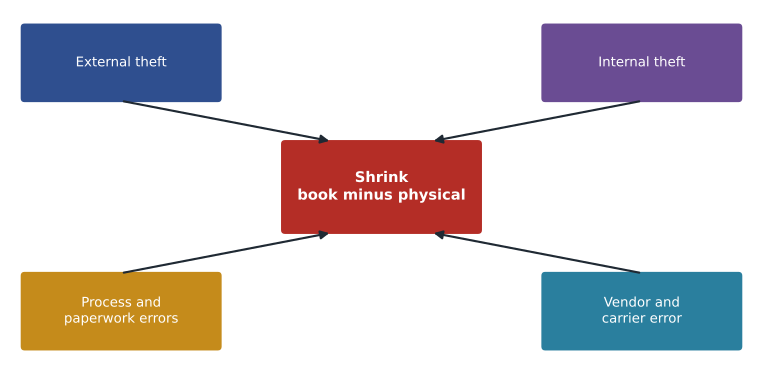
The count tells the store how much it lost but not why. Unless a theft is caught or an error is found, the cause has to be estimated from evidence: where in the store the losses were, which items, which documents, and what changed. That is why shrink is often discussed in terms of categories that stores believe are responsible, rather than proven ones.
What the surveys say
The National Retail Federation's security survey, published in August 2026 and covering 2025, reported that shoplifting incidents fell by about 12 in 100 and merchandise theft by about 8 in 100 compared with 2024, which retailers credited to security investments, better analysis and safety protocols. But the same retailers reported increases in other problems: repeat offenders, organized retail crime incidents, walkout or push-out thefts, phone scams, loyalty fraud and gift card fraud. Most said they report fewer than half of theft incidents to police, often because the losses fall below felony thresholds.
In Canada, the Retail Council of Canada has warned that retail theft costs the industry more than 9 billion dollars a year and has called for stronger enforcement against repeat and organized offenders. Saskatchewan retailers report the same pattern seen nationally: fewer opportunistic thefts in some categories, more organized and repeat theft, and more incidents involving threats to staff.
Two cautions apply to any survey. First, the figures come from retailers' estimates of causes, not proven causes. Second, averages hide huge differences: a store selling sofas and a store selling phone accessories face completely different risks. The useful question for any store is not the national average but its own pattern.
Shrink by department
Juniper & Pine values its count by department, so shrink can be compared across the store. The 2025 results showed a clear pattern.
| Department | Net sales 2025 | Shrink at retail | Shrink rate |
|---|---|---|---|
| Upholstery | 3,600,000 | 28,800 | 0.8 in 100 |
| Case goods | 2,600,000 | 18,200 | 0.7 in 100 |
| Mattresses | 1,600,000 | 6,400 | 0.4 in 100 |
| Appliances | 3,700,000 | 22,200 | 0.6 in 100 |
| Décor | 900,000 | 23,400 | 2.6 in 100 |
| Total | 12,400,000 | 99,000 | 0.8 in 100 |
Worked problem
Where the shrink is concentrated
Using the table, what share of the store's total shrink came from décor, and what share of net sales did décor make up?
Show solution
- Décor share of shrink = 23,400 ÷ 99,000 ≈ 0.236.
- Décor share of net sales = 900,000 ÷ 12,400,000 ≈ 0.073.
Answer: Décor produced about 23.6 in 100 of the store's shrink from only about 7.3 in 100 of its sales, more than three times its share. Décor is small, light, near the entrance and easy to resell, so theft is a likely factor. Lesson 12 follows Marcus's plan to bring décor shrink down.
Upholstery's 0.8 in 100 needed a different explanation, since nobody walks out with a sectional under their arm. When Marcus looked at the upholstery adjustments, most traced back to receiving and sales-entry errors on multi-piece sectionals: a three-piece set recorded as received when one carton was missing, or a chaise piece sold separately as a replacement without the sale being entered against the right item. Appliances had a similar story, with several cases of the wrong model number scanned at delivery.
Unrecorded damage and other process losses
In a furniture store, process losses often outweigh theft. Typical examples are:
- Damage without a write-off. A dining chair is broken on the dock and taken to the dumpster, but nobody records the loss.
- Markdowns not entered. An associate sells a scratched floor model at a discount agreed with a manager, and the discount is taken off at the till without being recorded as a markdown, so the books expect the full price.
- Wrong items received or sold. A navy sofa is recorded as grey; the book shows a grey sofa that is not there and is missing a navy one that is.
- Unrecorded transfers. A floor model is sent to a customer as a replacement and never charged out of inventory.
- Paperwork after returns. A returned item goes back on the floor without being recorded, or is recorded twice.
Each of these makes the count come up short even though nothing was stolen. They are also the easiest losses to prevent, because the fix is usually a clearer procedure, a better screen or a trained person, not cameras or guards.
The shrink provision
Because a full count is done only once a year, the store does not know its actual shrink month by month. Instead, its accountants record a shrink provision each month, an estimate based on past results, so that monthly gross margin reports are not overstated. For 2026, Juniper & Pine set its provision at 0.75 in 100 of sales. When the January 2027 count is done, the difference between the provision and the actual shrink will be booked as an adjustment.
Worked problem
Shrink provision and the year-end adjustment
Juniper & Pine expects net sales of about 12,800,000 dollars in 2026 and provides for shrink at 0.75 in 100 of sales. If the January 2027 count shows actual shrink of 0.60 in 100, what adjustment will be made?
Show solution
- Provision = 0.0075 × 12,800,000 = 96,000 dollars.
- Actual = 0.0060 × 12,800,000 = 76,800 dollars.
- Difference = 96,000 − 76,800 = 19,200 dollars.
Answer: The store will have over-provided by 19,200 dollars, so the adjustment will add about 19,200 dollars back to gross margin. If actual shrink came in above the provision, the adjustment would reduce margin instead.
Why shrink matters beyond the money
Shrink costs more than the goods. Stock that the records show but that is not there makes the store order too little, so items run out. Theft from displays leaves gaps and forces the store to lock up or tether products, which makes shopping harder. Organized theft and aggressive shoplifters put staff at risk. And internal theft damages trust within the team. Marcus summed up his view of shrink for Aiden: "I care about the 99,000 dollars. I care more about what's causing it, because the cause is costing us in ways the count doesn't show."
Reading the evidence by department
After the count, Marcus did not stop at the department totals. For each department, he looked at three kinds of evidence that point to different causes. Where the loss was found matters: losses concentrated in small, valuable items near the doors point to theft, while losses spread across large items in the warehouse point to process errors. What kind of item matters: a shortage of a complete sectional is unlikely to be theft, while a shortage of one chaise piece suggests a set recorded or sold wrongly. And what the records show matters: if write-offs for damage are low in a department where staff say breakage is common, unrecorded damage is likely to be part of the answer.
| Pattern in the evidence | Likely cause |
|---|---|
| Small, high-value items missing from displays near exits | External theft |
| Missing pieces of multi-piece sets | Receiving or sales-entry errors |
| Shortages traced to specific deliveries | Supplier or carrier error, or receiving errors |
| Low recorded damage where breakage is common | Unrecorded damage |
| Unusual refunds, voids or discounts on one register or shift | Possible internal theft, to be investigated carefully |
| Overages on one item and shortages on a similar one | Wrong item scanned or received |
None of these patterns proves a cause, but together they tell the store where to look first. Marcus's notes from January 2026 put décor at the top of the list for theft and unrecorded damage, and upholstery and appliances at the top for receiving and sales-entry errors. Those notes shaped the next ten months of work.
Worked problem
Translating shrink into lost profit
At its 39.4 in 100 gross margin and 5 in 100 operating profit, how much extra in sales would Juniper & Pine need to replace the profit lost through 2025 shrink, valued at about 60,000 dollars at cost?
Show solution
- \[\text{Sales needed} = \frac{60{,}000}{0.05} = 1{,}200{,}000\]
Answer: The store would need about 1.2 million dollars of extra sales, almost 10 in 100 more than it sold in 2025, to earn back the profit that shrink took. That is why a small improvement in the shrink rate is worth as much as a large sales increase.
Common mistakes
MistakeAssuming all shrink is shoplifting.
InsteadProcess and paperwork errors, internal theft and vendor errors all contribute; look at the evidence.
MistakeComparing the store's shrink rate only with a national average.
InsteadCompare with the store's own past results and with similar stores, department by department.
MistakeThrowing away damaged goods without a write-off.
InsteadRecord every known loss so it does not become unexplained shrink.
MistakeTaking a discount at the till without entering it as a markdown.
InsteadEnter every markdown so the books reflect the real selling price.
MistakeTreating the shrink provision as the actual result.
InsteadThe provision is an estimate; the count measures what actually happened.
Summary and key terms
- Shrink is the loss of inventory that cannot be accounted for: book inventory minus physical inventory, usually valued at retail and reported as a share of net sales.
- Juniper & Pine's 2025 shrink was 99,000 dollars, about 0.80 in 100 of sales.
- Shrink comes from external theft, internal theft, process and paperwork errors, and vendor or carrier error; the count shows the total but not the cause.
- Recent surveys report less shoplifting in 2025 but more organized, repeat and fraud-related losses, and much theft is never reported.
- Comparing departments shows where to look: décor produced about a quarter of the store's shrink from about 7 in 100 of its sales.
- In furniture stores, unrecorded damage, unentered markdowns, wrong items and unrecorded transfers are major causes.
- A monthly shrink provision estimates shrink until the count, when the difference is adjusted.
- Shrink also causes stockouts, safety risks and loss of trust.
- Shrink
- Inventory loss the store cannot account for; book inventory minus physical inventory.
- Book inventory
- The inventory the records say the store should have.
- Physical inventory
- The inventory actually counted.
- Shrink rate
- Shrink divided by net sales for the same period.
- External theft
- Theft and fraud by people outside the business, such as shoplifters.
- Internal theft
- Theft and fraud by employees.
- Organized retail crime
- Theft by groups who steal goods in quantity, usually to resell them.
- Shrink provision
- A monthly estimate of shrink recorded until the next count.
Practice problems
Work each problem on paper first, then reveal the answer to check.
A store's book inventory at retail is 820,000 dollars and its physical inventory is 805,000 dollars. Net sales were 1,500,000 dollars. What are the shrink and the shrink rate?
Show answer
Shrink = 15,000 dollars; rate = 15,000 ÷ 1,500,000 = 0.01, or 1 in 100.
A department makes up 10 in 100 of a store's sales and 30 in 100 of its shrink. What does that suggest?
Show answer
Its shrink rate is about three times the store's average, so it needs a closer look at theft and process causes.
Why is a scratched floor model sold at a discount without a recorded markdown a cause of shrink?
Show answer
The books still expect the full price, so the count will show a loss for the difference.
Lesson quiz · 5 questions
Score 60% or more to complete this lesson.
Create a free account to save your progress, take quizzes and earn a certificate.