
SLS-252 · Lesson 11 of 12 · 20 min
Opening and closing procedures
▶ Video coming soon A video version of this lesson is on the way.
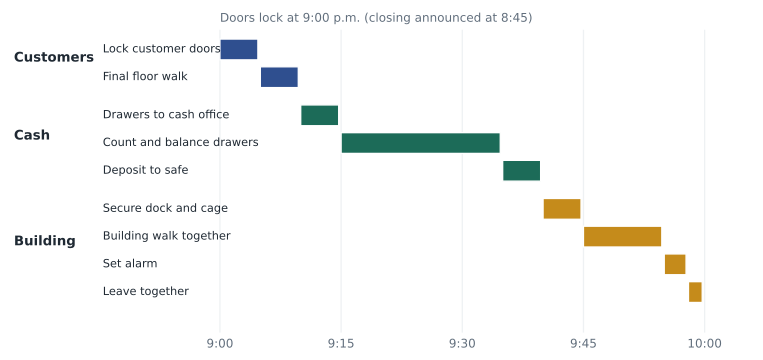
On Thursday, November 12, 2026, Aiden worked his first close with Marcus. The store's doors locked at 9:00 p.m. At 9:05 the last customers, a couple still debating two recliners, were walked to the door with a business card and a promise of a follow-up call. By 9:20 the drawers were in the cash office. At 9:45 Marcus and Aiden walked the building together, checking the washrooms, the warehouse and the dock door, and at 9:58 Marcus set the alarm while Aiden waited at the staff door. They walked to their cars together. "Most of what goes wrong in a store goes wrong at the edges of the day," Marcus said in the parking lot. "Opening and closing are when the building is emptiest, the cash is all in one place, and everybody's tired or rushing. So we do them the same way every time."
Why opening and closing need procedures
Opening and closing are the most routine tasks in a store, and that is exactly why they need written procedures. Done well, they make sure the store is safe, secure, clean, priced, stocked and staffed when customers arrive, and that cash, merchandise and the building are protected overnight. Done carelessly, they leave doors unlocked, alarms unset, cash in drawers and staff alone in an empty building at night.
Retail security guidance consistently identifies opening and closing as high-risk times for robbery and for staff safety, because few people are present and cash is being moved. Juniper & Pine's procedures are written as checklists, signed by the manager on duty and kept for 90 days.
The two-person rule
Juniper & Pine never opens or closes with one person. At least two employees, one of them a key holder, arrive together, stay together while the alarm is disarmed or set, and leave together. If one person arrives early, they wait in their car with the doors locked until the second arrives. If something looks wrong, such as a broken window, an open door, an alarm sounding or a stranger near the entrance, they do not go in; they leave and call the police and the manager.
The rule also fits Saskatchewan's requirements for working alone. The Occupational Health and Safety Regulations require employers to assess the risks when a worker works alone or at an isolated place and to put measures in place, such as regular contact with the worker, and Juniper & Pine's procedure meets that requirement by not having anyone open or close alone.
Opening the store
Juniper & Pine opens at 10:00 a.m., and the opening team of a key holder and one associate arrives at 9:00.
| Time | Task |
|---|---|
| 9:00 | Arrive together; look over the outside of the building, doors and windows before entering |
| 9:02 | Enter by the staff door; disarm the alarm with your own code; lock the door behind you |
| 9:05 | Walk the building together: sales floor, washrooms, warehouse, dock doors, offices |
| 9:15 | Lights, heat, music and displays on; check emergency exits are clear and unlocked from inside |
| 9:20 | Inspect each payment terminal against its photo and serial number for tampering |
| 9:25 | Count the floats into the drawers with two people; record on the drawer sheet |
| 9:35 | Check the change list: price changes, new tickets, holds and today's deliveries and pickups |
| 9:45 | Safety walk: entrance mats, wet floors, trip hazards, display stability; sidewalk cleared in winter |
| 9:50 | Team huddle with the arriving sales staff: goals, deliveries, events, safety notes |
| 10:00 | Unlock the customer doors |
Some of these tasks connect to earlier lessons. The terminal check is a PCI DSS control against skimming devices. The change list keeps the item file and the floor tickets in step. The safety walk catches the hazards that the November 3 slip showed. Each item has a reason.
Closing the store
Closing is longer and more sensitive, because it involves clearing customers, securing cash and securing the building.
| Time (weekday close) | Task |
|---|---|
| 8:45 p.m. | Announce closing in 15 minutes; stop starting new special orders that need long paperwork |
| 9:00 | Lock the customer doors; let remaining customers finish and leave by one door |
| 9:05 | Walk the floor for remaining customers, including washrooms and the back of the showroom |
| 9:10 | Close and remove drawers to the cash office; leave empty drawers open so they can be seen through the window |
| 9:15 | Count each drawer with two people in the cash office, with the door locked; balance against the Z report |
| 9:35 | Prepare the deposit; place deposit and floats in the safe; record and initial |
| 9:40 | Secure the dock doors and the warehouse; check the high-value cage is locked |
| 9:45 | Building walk together: every room, both exits, washrooms, the mezzanine |
| 9:55 | Lights to night setting; shut down terminals that need it; check the alarm panel shows all zones secure |
| 9:58 | Set the alarm with your own code; leave together by the staff door; check it is locked |
| 10:00 | Walk to cars together; do not leave until both cars have started |
Worked problem
How long does a close take?
On a Saturday, Juniper & Pine closes at 6:00 p.m. with four drawers in use. Counting and balancing takes about 8 minutes per drawer with two people, preparing the deposit 10 minutes, securing the dock and warehouse 10 minutes, and the final building walk and alarm 15 minutes. Clearing the floor takes about 10 minutes after the doors lock. If two people count drawers together while two others secure the dock, what is the earliest time the alarm can be set?
Show solution
- Clearing the floor: 6:00 to 6:10.
- Counting four drawers with one pair: 4 × 8 = 32 minutes, 6:10 to 6:42; the other pair secures the dock and warehouse in the same period.
- Deposit: 10 minutes, 6:42 to 6:52.
- Building walk and alarm: 15 minutes, 6:52 to 7:07.
Answer: The alarm can be set at about 7:07 p.m., so staff should be scheduled until about 7:15 p.m. Scheduling the closing team to leave at 6:30 would push people to rush the count or skip the walk, which is exactly when mistakes and risks rise.
Cash at the edges of the day
Cash is most exposed when it is being moved. Juniper & Pine's rules limit that exposure: drawers are counted only in the locked cash office, never on the sales floor; the safe uses a time-delay lock that staff cannot override; deposits are collected by an armoured car service on weekdays rather than carried to the bank by staff; and on weekends, when the service does not run, the deposit stays in the safe until Monday. Empty cash drawers are left open overnight so anyone looking through a window can see there is nothing to take.
Worked problem
How much cash stays overnight?
On a weekend, the store holds four floats of 200 dollars each, a change fund of 500 dollars and the weekend's cash deposits. Cash sales averaged 2,600 dollars on Saturdays and 1,400 dollars on Sundays in October. How much cash would typically be in the safe on Sunday night?
Show solution
- Floats = 4 × 200 = 800 dollars.
- Change fund = 500 dollars.
- Weekend deposits = 2,600 + 1,400 = 4,000 dollars.
- Total = 800 + 500 + 4,000 = 5,300 dollars.
Answer: About 5,300 dollars would be in the safe on a typical Sunday night. That figure is one reason the store uses a time-delay safe and an alarm, and why Bev asked the armoured car service in November about adding a Saturday pickup before the holiday season.
If a robbery happens
Robberies are rare in furniture stores, but every store needs a procedure, and every employee should know it. The procedure used by Juniper & Pine follows the advice police and retail associations give to retail workers.
- Stay calm and comply. Do what the robber asks, without arguing or making sudden moves. Money and merchandise can be replaced; people cannot.
- Do not resist or chase. Never fight, follow the robber or try to stop them leaving.
- Observe quietly. Without staring, notice details: height, build, clothing, voice, anything said, the direction of travel and any vehicle.
- Call emergency services once it is safe. Call 911, then the manager. Lock the doors if it is safe to do so.
- Protect the scene. Do not touch anything the robber touched; keep witnesses until police arrive.
- Write it down. Each witness writes their own account, without discussing it first, so memories are not mixed.
- Look after people. Anyone involved is offered support, time off and access to the employee assistance program. Being robbed is frightening, even when nobody is hurt.
Other emergencies
Opening and closing procedures sit alongside the store's emergency procedures, which every employee learns in orientation and practises at least once a year.
| Emergency | Main actions at Juniper & Pine |
|---|---|
| Fire or fire alarm | Evacuate by the nearest exit, help customers out, meet at the assembly point in the east parking lot, do not re-enter; the manager takes a head count |
| Medical emergency | Call 911, send someone to meet paramedics, trained first aiders give care, bring the defibrillator from the cash office |
| Severe winter weather | Manager decides on early closing; staff are not sent out on deliveries in blizzard conditions; check that the parking lot is safe |
| Power failure | Emergency lights come on; keep customers calm, guide them out if the outage lasts; secure cash; follow the POS downtime procedure if power returns |
| Threat or suspicious package | Do not touch it; move people away; call 911; follow police directions |
Keys, codes and handovers
Physical security depends on knowing who can get in. Juniper & Pine issues keys only to named key holders, who sign for them; keys are stamped "do not duplicate" and restricted so copies cannot be cut without authorization. Every key holder has a personal alarm code, so the alarm log shows who opened and who closed. When a key holder leaves the company, their key is collected and their alarm code deleted on their last day, and if a key is lost, the locks are re-keyed.
Shifts end, but information should not. The manager on duty keeps a shift log that the next manager reads at opening: deliveries that did not happen, customers expecting calls, maintenance problems, incidents, cash issues and anything unusual. Aiden noticed that the log Marcus wrote on November 12 included the recliner couple who left at closing, so that whoever opened the next morning would know to call them.
Checking the checklists
A checklist that is always signed but never checked becomes a form, not a control. Marcus checks the opening and closing sheets each week against the alarm log, which records when the alarm was disarmed and set and by whose code. If the sheet says the store was secured at 9:58 p.m. and the alarm log says 10:31 p.m., or the alarm was set by a code belonging to someone not on the shift, he asks why. Twice a year he also does an unannounced walk-through after a close, with Bev's approval, to see whether the dock doors, the cage and the cash office are actually secure. The first one, in spring 2026, found the warehouse fire door propped open with a pallet, which led to a new alarm contact on that door.
Common mistakes
MistakeOpening or closing alone to save a shift.
InsteadAt least two people, arriving and leaving together, every time.
MistakeGoing inside when the building looks wrong.
InsteadDo not enter; leave, call the police and the manager.
MistakeCounting drawers at the cash counter after closing.
InsteadCount only in the locked cash office, with two people.
MistakeResisting or following a robber.
InsteadComply, observe quietly and call 911 once it is safe.
MistakeScheduling closing staff to leave right at closing time.
InsteadSchedule enough time to complete every closing task without rushing.
Summary and key terms
- Opening and closing are high-risk times, with few people present and cash being moved, so they follow written checklists.
- Juniper & Pine always opens and closes with at least two people who arrive and leave together, and never enters if the building looks wrong.
- Opening covers the building walk, emergency exits, terminal tamper checks, floats, the change list, a safety walk and a team huddle.
- Closing clears customers, counts and balances drawers in the locked cash office, secures the deposit, dock and cage, walks the building, sets the alarm with a personal code and ends with staff leaving together.
- Schedules must allow enough time to close properly.
- Cash exposure is limited by safe drops, a time-delay safe, armoured car pickups and open empty drawers.
- In a robbery, staff comply, do not resist or chase, observe, call 911 when safe, protect the scene and write separate accounts.
- Emergency procedures cover fire, medical events, severe weather, power failures and threats.
- Key control, personal alarm codes and a shift log protect the building and keep information flowing between shifts.
- Two-person rule
- Never opening or closing the store with fewer than two employees present.
- Key holder
- A named employee authorized to hold keys and an alarm code.
- Change list
- The daily list of price changes, holds, deliveries and pickups checked at opening.
- Time-delay safe
- A safe that opens only after a set delay, which staff cannot override.
- Armoured car service
- A security company that collects and transports cash deposits.
- Assembly point
- The place outside where everyone gathers after an evacuation.
- Shift log
- A written record the manager on duty leaves for the next shift.
- Working alone
- Working where help is not readily available, which requires a risk assessment and safeguards.
Practice problems
Work each problem on paper first, then reveal the answer to check.
Why are empty cash drawers left open overnight?
Show answer
So anyone looking in can see there is no cash in them, which discourages break-ins.
A store closes at 9:00 p.m. Clearing customers takes 10 minutes, counting three drawers takes 8 minutes each with one pair, the deposit 10 minutes and the walk and alarm 15 minutes. What is the earliest time the alarm can be set?
Show answer
9:00 + 10 + 24 + 10 + 15 minutes = 9:59 p.m.
List three things staff should do during and after a robbery.
Show answer
Comply and stay calm, observe details without staring, and call 911 once it is safe; also protect the scene and write separate accounts.
Lesson quiz · 5 questions
Score 60% or more to complete this lesson.
Create a free account to save your progress, take quizzes and earn a certificate.