
SLS-256 · Lesson 1 of 12 · 20 min
What makes a sale high-ticket
▶ Video coming soon A video version of this lesson is on the way.
On the Wednesday after Aiden Laroque moved to the main floor at Juniper & Pine Home, Carl Jensen took him to the back of the appliance gallery at eleven in the morning, when the store was quiet. Carl had sold furniture, mattresses and appliances at the store for nine years and wrote more sales than anyone else on the floor. Bev Halvorsen, the store manager, had asked him to spend an hour with Aiden every Wednesday through the fall. "Bev calls it the big-ticket clinic," Carl said. "I call it the hour where I tell you all the mistakes I made so you can skip them."
Aiden had spent his first seven weeks in décor and small furniture, ringing up lamps, throws, cushions and side tables. A good décor sale took ten minutes and rarely went above a few hundred dollars. On the main floor, the average sale was more than ten times larger, and customers often took weeks to decide. "Everything you learned in décor still counts," Carl said. "But the stakes are different. When somebody spends three thousand dollars on a sectional, they are going to live with that decision every day for ten years. They know it, and they act like it."
This course follows Carl's clinic through the fall of 2026, from mid-October to mid-November, and the sales Aiden and Carl make on the floor in that time. It covers why big purchases are different, the longer sales cycle, building trust, presenting products, trade-ins, financing, protection plans, add-ons, delivery and installation, following up, commission pay and, in the last lesson, a complete sale from first visit to the follow-up call. Along the way it compares furniture and appliance sales with the other common high-ticket retail categories: vehicles, electronics and jewellery.
What high-ticket means
A high-ticket sale is one where the price is large compared with what the customer usually spends in a single purchase. There is no fixed dollar line. A 900-dollar mattress is high-ticket for a student and a routine purchase for a hotel buyer. What makes a sale high-ticket is the customer's experience of it: the money matters to them, the purchase is infrequent, and a mistake would be expensive or hard to undo.
Marketers call these considered purchases or high-involvement purchases. SLS-110 described the consumer decision process as need recognition, information search, evaluation of alternatives, purchase and post-purchase evaluation. For a box of tissues, most of those steps happen in a second or are skipped. For a sectional, a refrigerator or a car, the customer works through each one deliberately, often over weeks, and often with other people involved.
Carl listed the features that make a purchase considered on a whiteboard in the staff room.
- Price relative to budget. The amount is large enough that the customer has to plan for it, borrow for it or give something else up.
- Infrequency. People buy a sofa every eight to fifteen years and a refrigerator every ten to fifteen. They have little recent experience, and the products have changed since their last purchase.
- Long use. The customer will use the product daily for years, so small differences in comfort, reliability or running cost add up.
- Risk. A wrong choice is costly. Large items are hard to return, may not fit the space, and are often custom-ordered.
- Visibility and identity. Furniture, cars and jewellery say something about the buyer to the people who see them, so emotion and self-image play a large part.
- Several decision-makers. Couples, families and sometimes landlords or condo boards have a say, and they may not agree.
- Related decisions. The main item brings other choices with it: delivery, installation, removal of the old item, financing, protection plans and accessories.
How big-ticket sales shape a store
At Juniper & Pine, the high-ticket departments carry most of the business. Bev's 2025 figures, which the store used all fall in its Monday numbers mornings, showed net sales of 12.4 million dollars. Upholstery brought in 3.6 million, case goods 2.6 million, mattresses 1.6 million and appliances 3.7 million. Together those four departments made 11.5 million dollars, about 93 in 100 of the store's sales. Décor, at 0.9 million, was the only department made up mainly of small purchases.
The departments differ in how much of each sale the store keeps. Upholstery earned a gross margin of about 46 in 100 of sales, mattresses about 50 in 100 and case goods about 44 in 100. Appliances earned only about 21 in 100, because shoppers can compare identical models from store to store and price competition is fierce. Décor earned the highest rate, about 56 in 100, but on small amounts.
Worked problem
One sectional against a basket of lamps
Carl sells a 3,299-dollar sectional in upholstery, where the gross margin rate is about 46 in 100. Aiden, still in décor, sells three lamps at 180 dollars each, where the margin rate is about 56 in 100. Main-floor sellers earn a commission of 8 in 100 of gross margin on furniture. How much gross margin does each sale produce, and what commission does the sectional earn?
Show solution
- Sectional gross margin: multiply the price by the margin rate.
- \[3{,}299 \times 0.46 = 1{,}517.54 \text{ dollars}\]
- Lamp gross margin: three lamps at 180 dollars are 540 dollars of sales.
- \[540 \times 0.56 = 302.40 \text{ dollars}\]
- Commission on the sectional: 8 in 100 of its gross margin.
- \[1{,}517.54 \times 0.08 = 121.40 \text{ dollars}\]
Answer: The sectional produces about 1,518 dollars of gross margin, five times the lamps' 302 dollars, even though the lamps carry a higher margin rate. Carl's commission on the one sale is about 121 dollars.
Carl made a second point with the same numbers. "A big sale is worth a lot," he said, "so a lost big sale costs a lot. If I'm rushed on a Saturday and a couple walks out because nobody helped them, the store doesn't lose a lamp. It might lose a whole living room."
Worked problem
What a small change in closing costs
On a typical Saturday in October, about 40 groups come into Juniper & Pine seriously shopping for furniture, mattresses or appliances. The average main-floor sale is about 2,400 dollars. If the floor team closes 30 in 100 of those groups instead of 25 in 100, how much more is sold that day?
Show solution
- Sales at a 30-in-100 close rate:
- \[40 \times 0.30 \times 2{,}400 = 28{,}800 \text{ dollars}\]
- Sales at a 25-in-100 close rate:
- \[40 \times 0.25 \times 2{,}400 = 24{,}000 \text{ dollars}\]
- Difference:
- \[28{,}800 - 24{,}000 = 4{,}800 \text{ dollars}\]
Answer: Five more sales in every 100 serious shoppers adds about 4,800 dollars of sales on one Saturday. Over a year of Saturdays that is roughly a quarter of a million dollars.
What customers worry about
Carl's view was that every big-ticket customer arrives with the same three worries, whether they say them out loud or not. The first is making the wrong choice: buying the sofa that sags in two years, the fridge that does not fit the alcove, or the mattress that gives them a sore back. The second is paying too much: finding the same item cheaper next week or across town. The third is being taken advantage of: being pushed into a bigger purchase, a protection plan or a loan they did not need. The rest of this course is about answering those worries honestly.
Each worry has a practical answer. The fear of the wrong choice is answered by good discovery, accurate product knowledge, measurements and a clear return or exchange policy. Juniper & Pine's 90-night comfort exchange on mattresses exists because people cannot judge a mattress properly in a ten-minute test. The fear of paying too much is answered by transparent pricing, the store's price-match policy on identical models, and honest advice about timing. The fear of being taken advantage of is answered by how the seller behaves: explaining options without pressure, saying when something is not needed, and putting every promise in writing.
| Customer worry | What the seller does | What the store provides |
|---|---|---|
| Wrong choice | Asks good questions, measures, explains trade-offs, suggests a home visit for complex rooms | 90-night mattress comfort exchange, 30-day returns on most stock items, fabric swatches to take home |
| Paying too much | Shows the price clearly, explains what is included, is honest about upcoming sales | Price match on identical models, 14-day price adjustment if the store lowers its own price |
| Being taken advantage of | Offers add-ons as options, says when they are not needed, writes everything down | Clear written order with a read-back, cancellation terms in writing, disclosure documents from the lender |
Categories and how they differ
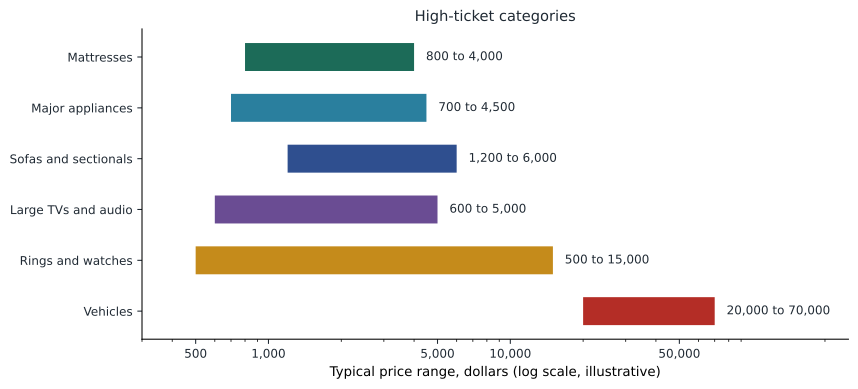
Most high-ticket retail categories share these features, but each has its own customs and its own rules. Furniture and mattresses are bought for comfort and appearance and often custom-ordered, so lead times, fabric choices and delivery matter. Major appliances are compared model by model and are sold on features, energy use, reliability and installation, with low margins and heavy price competition. Home electronics such as large televisions and home theatre systems change quickly, are easy to compare online, and are often sold with installation and protection plans. Jewellery is sold on emotion, trust and craftsmanship. Buyers rely on the seller's word about quality, so certification and honest descriptions matter.
Vehicles are the largest purchase most households make after a home. In Saskatchewan, businesses that sell vehicles must be licensed dealers, and since 2016 dealers have had to disclose important facts about a vehicle's history, such as previous damage and rental use, before the sale. Vehicle sales also involve trade-ins, financing and add-ons on a larger scale than any other retail category, which is why this course uses them for comparison in several lessons.
Carl had a friend from his early years at the store, Nadine Brule, who now sold vehicles at a dealership across town. Over the fall, Aiden met Nadine twice and asked her how car sales compared with what he was learning. Her answers appear in the lessons on trade-ins, financing and add-ons, and her advice was always the same: "Everything you do in furniture, we do with bigger numbers and more paperwork. The customer's worries are exactly the same."
The seller's job in a considered purchase
In a quick purchase, the seller's job is to be available, accurate and fast. In a considered purchase, the seller becomes an adviser. The customer is trying to make a big decision well, often with incomplete information and a partner who sees it differently. A good seller helps them define what they need, narrows the choices, explains the differences that matter, deals honestly with price and money, and makes the purchase easy to complete and easy to live with.
Carl put it in one sentence: "Your job is to make it easy for them to make a good decision, and then easy for them to be glad they made it." The rest of the course takes that sentence apart. Lessons 2 to 4 are about helping the customer decide well. Lessons 5 to 8 deal with the money and the extras around the main purchase: trade-ins, financing, protection plans and add-ons. Lessons 9 and 10 are about making the customer glad they bought: delivery, installation, handover and follow-up. Lesson 11 is about how sellers are paid, and how pay shapes behaviour. Lesson 12 puts it together.
A quick check before going on
Carl ended the first clinic with a question. "Think about the biggest purchase you've made in the last five years," he said. "What did the salesperson do that made you trust them, or not?" Aiden thought about the used car he had bought two years earlier. The salesperson had been friendly, but had changed the subject every time Aiden asked about the total price. Aiden had left, gone to another dealer and bought there. "That's lesson three," Carl said. "Hold on to it."
Common mistakes
MistakeTreating high-ticket as a fixed price level.
InsteadJudge it by the customer's experience: large for their budget, infrequent, risky and long-lasting.
MistakeSelling a sectional the way you would sell a lamp, quickly and at the counter.
InsteadSlow down, ask about the room, the people and the use, and expect more than one visit.
MistakeLooking only at the margin rate when comparing sales.
InsteadCompare margin dollars; a large sale at a lower rate can be worth far more.
MistakeAssuming the customer's worries are about price alone.
InsteadExpect worries about the wrong choice and about being pushed, and answer all three.
MistakeThinking a lost big sale is a small loss because it was only one customer.
InsteadRemember the size of each sale; one lost living room equals dozens of small sales.
Summary and key terms
- A high-ticket sale is large for the customer's budget, infrequent, risky and long-lasting, so the customer works deliberately through each step of the decision.
- Considered purchases often involve several decision-makers and bring related choices such as delivery, installation, financing and protection plans.
- At Juniper & Pine, the four big-ticket departments make about 93 in 100 of sales.
- A large sale at a lower margin rate can produce far more margin dollars than small sales at a higher rate.
- Customers bring three worries: the wrong choice, paying too much and being taken advantage of.
- The seller's role shifts from order-taker to adviser who makes a good decision easy.
- High-ticket sale
- A purchase that is large compared with what the customer usually spends at once.
- Considered purchase
- A high-involvement purchase that the customer researches and decides deliberately.
- Gross margin
- Net sales minus cost of goods sold, in dollars or as a rate of sales.
- Close rate
- The share of serious shoppers who buy.
- Comfort exchange
- A policy that lets a mattress buyer exchange it within a set period if it is not comfortable.
- Licensed dealer
- A business licensed by the province or state to sell vehicles to the public.
Practice problems
Work each problem on paper first, then reveal the answer to check.
Name four features that make a purchase considered.
Show answer
Any four of: large price for the budget, infrequent purchase, long use, high risk of a wrong choice, visibility and identity, several decision-makers, related decisions.
A 2,499-dollar recliner earns a margin of 46 in 100. What is its gross margin, and the commission at 8 in 100 of margin?
Show answer
2,499 × 0.46 = 1,149.54 dollars of margin; commission 1,149.54 × 0.08 ≈ 91.96 dollars.
What are the three worries Carl says every big-ticket customer brings?
Show answer
Making the wrong choice, paying too much, and being taken advantage of.
Lesson quiz · 5 questions
Score 60% or more to complete this lesson.
Create a free account to save your progress, take quizzes and earn a certificate.