
SLS-256 · Lesson 4 of 12 · 20 min
Presenting big-ticket products
▶ Video coming soon A video version of this lesson is on the way.
Walter Sikorski came into the appliance gallery on a Thursday afternoon in late October with a tape measure in his jacket pocket and a sheet of paper folded in quarters. His refrigerator was nineteen years old and had started to make a noise his late wife used to call "the tractor". He had written down the width, height and depth of the space, the width of the kitchen doorway, and three questions: how long would a new one last, how much would it cost to run, and could someone take the old one away. Aiden, who had been on the main floor for ten days, glanced at Carl. Carl gave him a small nod. This one was his.
Presenting a big-ticket product is different from showing a small one. The customer is not only choosing between items. They are trying to understand what the differences mean for their daily life, their space and their money over years. This lesson covers how to narrow the choice, how to demonstrate, how to present price and running costs, and how to avoid overwhelming the customer.
Start from the customer, not the product
SLS-250 described how Juniper & Pine's sellers use the ROOMS checklist to find out what the customer needs before showing anything. For big items, that discovery decides which products are even worth showing. Walter's sheet answered the fit questions. Aiden asked about the rest: how many people he cooked for (one, and his grandchildren on Sundays), whether he wanted an ice maker (no, it had broken on the old one and he never missed it), whether the freezer on top or bottom mattered (bottom, because his knees did not like bending to the vegetable drawer), and his budget ("I don't want to spend more than two thousand, but I want it to last").
Those answers cut the choice from 38 refrigerators on the floor to five that fit the space, had a bottom freezer and no ice maker, and were under 2,000 dollars. Aiden then narrowed the five to three that represented clear steps in quality and features.
Good, better, best
Retailers often present a category as good, better, best: three options at rising prices, each with a clear reason to step up. The approach helps customers who do not know the category well, because it turns dozens of models into one decision about how much they value the extra features. It works only if each step is explained honestly and the customer is free to choose the lowest step.
| Good | Better | Best | |
|---|---|---|---|
| Model | Bottom-freezer, 30 in | Bottom-freezer, 30 in, better shelving and lighting | Bottom-freezer, 30 in, dual cooling, stainless interior |
| Price | 1,499 dollars | 1,899 dollars | 2,599 dollars |
| Rated energy use | 680 kWh a year | 560 kWh a year | 540 kWh a year |
| Manufacturer warranty | 1 year parts and labour, 5 years sealed system | 1 year parts and labour, 10 years sealed system | 2 years parts and labour, 10 years sealed system |
| Noise | Average | Quieter (inverter compressor) | Quietest |
| Reason to step up | Longer sealed-system warranty, quieter, easier to clean | Holds humidity better for produce, longer full warranty |
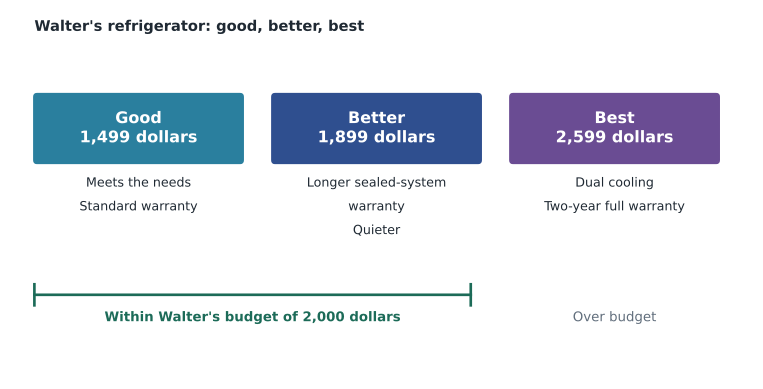
Aiden showed the best model last and briefly, because it was over Walter's limit. "This one is lovely," he said, "but it's six hundred over what you told me, and the main things it adds are a longer full warranty and better humidity for vegetables. If those don't matter much to you, the middle one gives you most of what you asked for." Walter asked about the warranty difference, and Aiden explained it accurately: the better model's sealed system, meaning the compressor and the cooling circuit, was covered for ten years, which answered Walter's question about how long it would last better than any promise could.
Worked problem
What each step earns the store
Appliances at Juniper & Pine earn a gross margin of about 21 in 100. What gross margin does each of Walter's three options earn, and how much more does the better model earn than the good one?
Show solution
- Good:
- \[1{,}499 \times 0.21 = 314.79 \text{ dollars}\]
- Better:
- \[1{,}899 \times 0.21 = 398.79 \text{ dollars}\]
- Best:
- \[2{,}599 \times 0.21 = 545.79 \text{ dollars}\]
- Difference between better and good:
- \[398.79 - 314.79 = 84.00 \text{ dollars}\]
Answer: The better model earns 84 dollars more margin than the good one, and the best earns about 231 dollars more. These are real differences, but they are small compared with the cost of a customer who feels pushed. Delivery, installation, haul-away and protection plans often matter more to appliance margin, which lesson 8 discusses.
Running costs and total cost of ownership
For products that use energy or need servicing, the purchase price is only part of the cost. Total cost of ownership adds the running costs over the product's life: electricity or gas, water, filters, maintenance and repairs. Customers increasingly ask about it, and it can be presented honestly with the official energy labels.
In Canada, major appliances carry the EnerGuide label, which shows the model's rated annual energy use in kilowatt-hours, and the most efficient models in each category may also carry the ENERGY STAR symbol. The rated figure comes from a standard test, so it is useful for comparing models rather than predicting an exact bill.
Worked problem
Does the energy saving pay for the step up?
Walter's good model is rated at 680 kWh a year and the better model at 560 kWh. Using an illustrative electricity price of about 18 cents a kilowatt-hour, how much would the better model save in a year and over ten years? How does that compare with the 400-dollar price difference?
Show solution
- Difference in rated energy use:
- \[680 - 560 = 120 \text{ kWh a year}\]
- Yearly saving at about 18 cents a kWh:
- \[120 \times 0.18 = 21.60 \text{ dollars}\]
- Ten-year saving:
- \[21.60 \times 10 = 216 \text{ dollars}\]
Answer: The better model saves about 22 dollars a year, or about 216 dollars over ten years. That is real money but less than the 400-dollar price difference, so energy alone does not justify the step up. The honest reasons to choose it are the longer sealed-system warranty, the quieter compressor and the easier cleaning.
Aiden showed Walter the calculation on the back of the printed quote. Walter appreciated being told that the saving would not pay for the difference. "Most fellows would have told me it pays for itself," he said. He chose the better model anyway, for the warranty and the quiet. "The tractor noise was enough for one lifetime."
Demonstrations
Big-ticket products should be experienced, not just described. A good demonstration lets the customer use the product the way they will at home and notice the differences that matter.
- Sofas and sectionals: sit, lie down, sit on the edge, get up without arms, try the depth with the cushions the customer prefers, and feel the fabric and the back.
- Mattresses: Juniper & Pine's testing routine has the customer lie in their usual sleeping position for several minutes on each of no more than three choices, with their own pillow if they brought it, and with their partner if they share the bed.
- Refrigerators: open the doors as the customer would in their kitchen, check the door swing against their measurements, load the shelves with the store's sample containers, and listen to the compressor.
- Ranges and cooktops: turn on the burners, show the oven controls, and explain the difference between gas, electric and induction with a pot on the surface.
- Washers and dryers: show the controls and the drum, and check the connections the customer has at home, such as a 3-prong or 4-prong dryer outlet.
Two rules apply to every demonstration. First, let the customer lead: they should touch, open and sit, not watch the seller do it. Second, connect what they notice back to what they said they needed. When Walter crouched to look into the freezer drawer, Aiden said, "That's the drawer you'll use most, and you can open it standing up."
Presenting price
Price is where many big-ticket presentations go wrong. Some sellers avoid it until the end, which customers read as hiding something. Others announce the item price but not the delivery, installation and taxes, so the final number at the counter is a shock. Juniper & Pine's practice is to show the complete price early and in writing.
- State the item price, then the services the customer will need: delivery, installation, haul-away of the old item and any parts such as a water line or cord.
- Show the taxes separately so the customer sees the total they will pay.
- Mention any real offer, such as a package price for four or more major appliances, without pressure.
- Present options as options: protection plans and accessories are listed as choices with their prices, not added by default.
For Walter, the written quote showed the refrigerator at 1,899 dollars, delivery at 79 dollars, haul-away of the old unit at 39 dollars and the water line for the fridge he did not need crossed out. The taxes were shown on a separate line, so the total he would pay was the number at the bottom.
Avoiding overload
Showing too many options makes a big decision harder, not easier. Research on choice overload is mixed, and the effect is weaker than early studies suggested, but sellers see a practical version every day: a customer shown nine sofas often leaves to think about it, while a customer shown three that fit their needs usually decides. Carl's limit was three serious options at a time, with a fourth only if the customer rejected all three for a clear reason. "If they say no to all three, you didn't listen," he said. "Go back to discovery."
Presenting to more than one decision-maker
Many high-ticket purchases are made by couples, families or a buyer with someone to answer to. The person who asks the most questions is not always the one who decides, and the quieter person often holds the veto. Carl's advice was to present to the whole group, not to whoever is closest.
- Find out who decides. Ask early and naturally: "Who else will be using it?" or "Is anyone else involved in choosing?"
- Learn each person's priority. One person may care about looks and the other about durability or price. Write both down.
- Speak to both. Make eye contact with each person and connect each feature to the person who cares about it.
- Give the quieter person room. Ask them directly what they think, then wait.
- Do not take sides. If they disagree, lay out the trade-off clearly and let them settle it.
| Situation | Unhelpful response | Helpful response |
|---|---|---|
| One partner loves the best model; the other frowns at the price | "It's worth every penny, trust me." | "Let's look at what you get for the extra 700 dollars, and you can decide if it matters to you both." |
| A parent is helping an adult child buy | Talking only to the parent, who is paying | Ask the adult child about the needs, then involve the parent in the budget |
| One person wants to decide today; the other wants to wait | Pushing for a decision now | Offer a written quote and a 48-hour hold so they can talk at home |
Carl's second visit with the Lindqvists showed this in practice. Ellen had done most of the talking on the first visit, but Tom was the one worried about cost. Carl recapped what they had told him (two dogs, the room measurements, a sectional with a chaise) before saying anything new, then asked Tom directly what mattered most to him. Tom asked how long the performance fabric would last; Carl showed him the fabric's warranty terms and the cleaning guide. Aiden noticed that the couple started deciding together only after both had been heard.
Common mistakes
MistakeShowing every model on the floor.
InsteadUse discovery to narrow to the few that fit, then present no more than three.
MistakeUsing good-better-best to push the top option.
InsteadGive an honest reason for each step and accept the lowest step as a good choice.
MistakeClaiming an efficient model pays for itself without doing the arithmetic.
InsteadCalculate the saving with the energy label and an honest electricity price.
MistakeDescribing the product while the customer watches.
InsteadLet the customer use it, and connect what they notice to their needs.
MistakeLeaving delivery, installation and taxes to the end.
InsteadShow the complete price early and in writing.
Summary and key terms
- Presenting a big-ticket product starts from discovery, which narrows dozens of models to the few that fit.
- Good, better, best presents three clear steps, each with an honest reason, and the customer must feel free to choose the lowest.
- Total cost of ownership adds running costs to the price, and official energy labels let sellers compare models fairly; often the energy saving does not pay for an upgrade on its own.
- Demonstrations let the customer use the product as they will at home, and the seller links what they notice to their needs.
- Complete prices, including services and taxes, should be shown early and in writing.
- Three serious options at a time avoids overload.
- Good, better, best
- Presenting a category as three options at rising prices, each with a clear reason to step up.
- Total cost of ownership
- The purchase price plus running, maintenance and repair costs over the product's life.
- EnerGuide label
- The Canadian label showing an appliance's rated annual energy use.
- Sealed system
- A refrigerator's compressor, condenser, evaporator and connecting tubing.
- Choice overload
- Difficulty deciding when shown too many options; the research effect is real in some settings and weak in others.
- Haul-away
- Removal and disposal or recycling of the customer's old item at delivery.
Practice problems
Work each problem on paper first, then reveal the answer to check.
Why should the lowest step in good, better, best be presented as a good choice?
Show answer
Because the approach only builds trust if the customer is free to choose it; pushing the top step turns it into pressure.
A dishwasher uses 270 kWh a year and another 230 kWh. At 15 cents a kWh, what does the second save in eight years?
Show answer
40 kWh × 0.15 = 6 dollars a year; 6 × 8 = 48 dollars.
Name three things a written big-ticket quote should show besides the item price.
Show answer
Delivery, installation, haul-away or parts, taxes, and any optional protection plan as a separate choice.
Lesson quiz · 5 questions
Score 60% or more to complete this lesson.
Create a free account to save your progress, take quizzes and earn a certificate.