
SLS-256 · Lesson 8 of 12 · 22 min
Selling add-ons ethically
▶ Video coming soon A video version of this lesson is on the way.
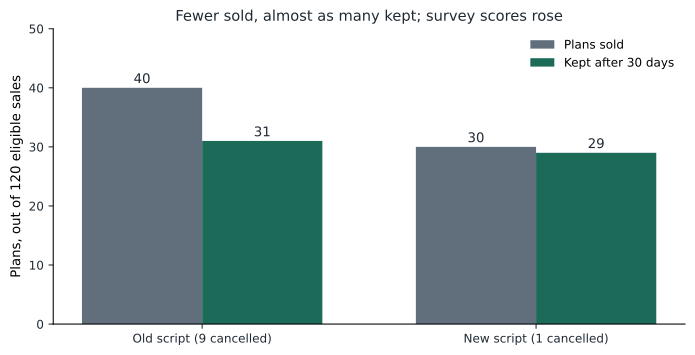
When Aiden worked in décor in September, he had a small bonus for every protection plan he sold on furniture, and he had learned a script from another associate. It ended with a question that was hard to refuse: "You'll want the protection on that, right?" About one customer in three said yes. Then he noticed that several of them looked uncomfortable, and two came back the following week to cancel. He rewrote the script into a plain description and a real question. His attachment rate fell to about one in four, and the store's after-sale survey scores for his customers went up. Bev had mentioned it at a staff meeting. When Carl reached add-ons in the clinic, he started with Aiden's story.
An add-on is anything sold alongside the main purchase: services such as delivery, installation and haul-away, accessories such as mattress protectors, pillows, stacking kits and furniture anchors, and optional products such as protection plans. Add-ons matter to customers, because some are genuinely needed for the main purchase to work, and to stores, because many carry high margins. They are also where customers most often feel pushed. This lesson is about selling them in a way that helps customers and keeps their trust.
Needed, useful and optional
Carl sorted add-ons into three groups, and the group decides how to present each one.
- Needed. The main purchase will not work properly, or safely, without it: a power cord for a dryer, a water line for a fridge with an ice maker, a gas connector for a range, a stacking kit for a stacked washer and dryer, an anchoring kit for a tall dresser in a home with children. The seller must raise these every time, because leaving them out causes failed installations and, sometimes, danger.
- Useful. Most customers would benefit, but the purchase works without it: a waterproof mattress protector that keeps the mattress warranty valid, felt pads for furniture on hardwood, a surge protector for a television. The seller should mention these briefly, explain the benefit, and accept a no.
- Optional. Some customers want it and others do not, and there is no right answer: protection plans, upgraded delivery, decorative extras. The seller describes them as choices, with their price, and does not argue.
| Main purchase | Needed | Useful | Optional |
|---|---|---|---|
| Electric dryer | Power cord matching the outlet (3-prong or 4-prong), vent kit | Lint-trap brush | Protection plan, pedestal |
| Refrigerator with ice maker | Water line kit and shutoff | Replacement filter | Protection plan |
| Tall dresser | Anchoring kit (included at Juniper & Pine) | Felt pads | Upholstery-style protection is not offered |
| Mattress | A suitable base or foundation | Waterproof protector, pillows | Adjustable base |
| Sectional | Delivery that fits the access (stairs, elevator) | Fabric care kit | Upholstery protection plan |
Worked problem
The cost of a missed needed add-on
In October, a couple bought a washer and dryer from Juniper & Pine. Nobody asked about the dryer outlet, and the cord supplied did not match the 4-prong outlet in their laundry room, so the installer could not connect the dryer. The rebooked installation cost the store about 95 dollars in crew time, and the store waived the 39-dollar cord charge as an apology. Selling the correct cord at the time of sale would have earned about 20 dollars of margin. How much did the missed question cost the store compared with getting it right?
Show solution
- Cost of the mistake:
- \[95 + 39 = 134 \text{ dollars}\]
- Margin lost by not selling the cord at the time of sale: 20 dollars.
- Total difference:
- \[134 + 20 = 154 \text{ dollars}\]
Answer: One missed question cost the store about 154 dollars and the customers a second day off work. Asking about the outlet is not upselling; it is part of selling the dryer properly.
Why add-ons are tempting to push
Add-ons often carry higher margin rates than the main product. A mattress protector selling for 129 dollars might earn 60 in 100, about 77 dollars of margin, more than many appliance sales. Protection plans earn the store a large share of their price. Stores set goals for add-on sales and sometimes pay bonuses on them, as Juniper & Pine did on protection plans in décor. All of that creates pressure on sellers, and customers know it.
SLS-150 discussed one widely reported example of what happens when that pressure goes unchecked: sales targets at Wells Fargo in the 2010s led employees to open accounts customers had not asked for, which cost the bank billions in penalties and settlements. Retail add-ons are smaller, but the pattern is the same. When the goal becomes the number of add-ons rather than the customer's benefit, some sellers start adding things by default, using pressure questions, or describing optional products as necessary.
What the law says
Several rules apply. The Competition Act prohibits misleading representations, including suggesting that an optional product is required, and its 2022 drip-pricing amendment treats a price that cannot be attained because of extra mandatory fixed charges as misleading. Tied selling, where a supplier requires a customer to buy one product to get another, can be reviewed by the Competition Tribunal. Saskatchewan's Consumer Protection and Business Practices Act lists unfair practices that include taking advantage of a consumer's inability to understand a transaction and using undue pressure. Adding a product to an order without the customer's clear agreement can be both an unfair practice and a breach of contract.
In every case, the safe practice is the ethical one: every optional item is presented as optional, priced separately, and added only after the customer says yes.
The ethical add-on conversation
Carl's method for add-ons had four rules.
- Needed items first, as part of the main sale. "Your laundry room has a 4-prong outlet, so you'll need this cord. It's 39 dollars." No question about whether they want it, because they need it, but a clear explanation of why.
- Useful items briefly, with the reason. "Most people get a waterproof protector with a new mattress. It keeps the mattress warranty valid, because stains void it. It's 129 dollars. Would you like one?"
- Optional items as real choices. Describe, price and ask an open question: "Would you like to add it, or leave it?" Never "You'll want that, right?"
- One no is enough. If the customer declines, move on. Asking again, or asking a manager to ask, is pressure.
He added a fifth rule for the written order: every add-on appears as its own line with its price, and the seller reads the order back before the customer signs or pays. The read-back in SLS-250 caught a queen-and-king mix-up; it also catches an add-on the customer did not mean to buy.
Worked problem
Attachment, cancellations and what is kept
Aiden's old script sold protection plans on 40 of 120 eligible décor sales, and 9 of those plans were cancelled within 30 days. His new script sold 30 plans on the next 120 eligible sales, and 1 was cancelled. The average plan price was 160 dollars. What was the attachment rate and the number of plans kept under each script, and what was the difference in plan revenue kept?
Show solution
- Old attachment rate:
- \[\frac{40}{120} \approx 0.33 \text{, or about 1 in 3}\]
- Plans kept:
- \[40 - 9 = 31\]
- New attachment rate:
- \[\frac{30}{120} = 0.25 \text{, or 1 in 4}\]
- Plans kept:
- \[30 - 1 = 29\]
- Revenue kept:
- \[31 \times 160 = 4{,}960 \qquad 29 \times 160 = 4{,}640\]
- Difference:
- \[4{,}960 - 4{,}640 = 320 \text{ dollars}\]
Answer: The honest script kept 29 plans instead of 31, about 320 dollars less plan revenue over 120 sales. In exchange, cancellations fell from 9 to 1, survey scores rose, and customers left without feeling pushed. Bev judged the trade worth it many times over, because a customer who feels pushed rarely comes back or refers friends.
Measuring add-ons honestly
Bev changed how Juniper & Pine measured add-ons after Aiden's experiment. Instead of counting only plans sold, the store's dashboard showed plans kept after 30 days, cancellations, and survey comments that mentioned pressure, alongside the attachment rate. A seller with a very high attachment rate and many cancellations was coached, not congratulated. The store also stopped paying bonuses on plans that were cancelled within 30 days.
Measurement matters because people do what they are rewarded for. Goodhart's law, often stated as "when a measure becomes a target, it ceases to be a good measure," describes the problem: a target on add-ons alone encourages behaviour that hits the number without serving the customer. Pairing the target with measures of customer outcome makes that behaviour visible.
Add-ons in other categories
Vehicle sales have the largest add-on business in retail, sold in what dealers call the finance and insurance office: extended service contracts, gap coverage, paint and fabric protection, tire and wheel plans, and theft-deterrent etching. Nadine told Aiden that her dealership presented every product on a single menu with prices, after the price and financing had been agreed, and recorded each yes or no. "The menu protects us as much as the customer," she said. "Nobody can say we slipped something in." Regulators in both countries have focused on add-ons in vehicle sales, especially products added to financing without the buyer's clear agreement.
Electronics stores sell installation, cables, surge protectors and protection plans; jewellery stores sell cleaning plans, sizing and insurance appraisals. The same rules apply everywhere: needed items explained, useful items offered, optional items as real choices, and every price on its own line.
Packages and bundles
Stores often group add-ons into packages: a mattress with a protector and pillows, a laundry pair with cords and pedestals, a television with a mount and installation. A package can save the customer money and time, but it can also hide an item the customer would not have chosen on its own. Carl's test was simple: every item in a package must be one the customer would plausibly want, and the customer must be able to see the price of each item separately and buy the main product without the package.
Worked problem
Is the package a good deal for this customer?
A sleep package offers a mattress protector (129 dollars), two pillows (89 dollars each) and a bed frame (249 dollars) for 449 dollars when bought with a mattress. A customer already owns a frame and good pillows. Is the package worth it for them?
Show solution
- Separate prices of everything in the package:
- \[129 + 89 + 89 + 249 = 556 \text{ dollars}\]
- Package saving if the customer wants everything:
- \[556 - 449 = 107 \text{ dollars}\]
- What this customer actually needs: the protector only, at 129 dollars. Package cost compared with that:
- \[449 - 129 = 320 \text{ dollars more}\]
Answer: The package saves 107 dollars for someone who needs all four items, but costs this customer 320 dollars more than buying the protector alone. The honest recommendation is the protector by itself, and Aiden says so.
Packages also raise a legal point. If a store advertises a package price, it must be able to sell the package at that price and must not claim a saving against prices it never really charges. If the main product is only available in a package, the advertised price should include the package, or the store risks a misleading price claim.
Add-ons at delivery
Some add-on needs only become clear in the home: a hose that is too short, a wall that needs a different bracket, an outlet in the wrong place. Juniper & Pine's crews carry the most common parts and may offer them at the posted price, but they do not sell plans or upgrades at the door. If the customer needs something the crew does not carry, the crew notes it and the seller follows up the next day. Carl liked the rule because it kept the delivery about the delivery and stopped anyone from selling to customers who could not easily walk away.
Common mistakes
MistakeTreating a needed item as an upsell, or forgetting it.
InsteadRaise needed items every time, as part of selling the main product properly.
MistakeAdding optional products to the order by default.
InsteadAdd them only after a clear yes, each on its own line.
MistakeUsing questions that are hard to refuse.
InsteadDescribe the item and ask an open question; accept the first no.
MistakeTelling customers an optional product is required to keep the warranty.
InsteadSay so only if it is true, as with a protector that prevents stains voiding a mattress warranty.
MistakeMeasuring add-ons only by attachment rate.
InsteadTrack cancellations and customer feedback alongside it.
Summary and key terms
- Add-ons are services, accessories and optional products sold with the main purchase.
- Sorting them into needed, useful and optional decides how to present each: needed items every time with the reason, useful items briefly with the benefit, optional items as real choices.
- Missing a needed item causes failed installations and costs more than it saves.
- High add-on margins and targets create pressure, which law in both countries limits through rules on misleading claims, tied selling, unfair practices and adding products without consent.
- The ethical conversation explains, prices separately, accepts one no and reads back the order.
- Measuring kept plans, cancellations and feedback alongside attachment prevents the target from distorting behaviour.
- Add-on
- Anything sold with the main purchase, such as a service, accessory or protection plan.
- Attachment rate
- The share of eligible sales that include a given add-on.
- Tied selling
- Requiring a customer to buy one product as a condition of buying another.
- Drip pricing
- Advertising a price that cannot be paid because extra mandatory charges are added later.
- Read-back
- Reading the written order to the customer before payment to confirm every item and price.
- Goodhart's law
- The observation that a measure turned into a target stops being a good measure.
Practice problems
Work each problem on paper first, then reveal the answer to check.
Is a water line kit for a refrigerator with an ice maker needed, useful or optional?
Show answer
Needed, if the customer wants the ice maker and water dispenser to work.
A seller sells 36 plans on 120 eligible sales and 6 are cancelled. What is the attachment rate and how many are kept?
Show answer
36 ÷ 120 = 0.30, or 30 in 100; 36 − 6 = 30 kept.
Why should a store pair an add-on target with other measures?
Show answer
Because a target on add-ons alone encourages pressure and default adding; cancellations and feedback show whether customers benefited.
Lesson quiz · 5 questions
Score 60% or more to complete this lesson.
Create a free account to save your progress, take quizzes and earn a certificate.