
SLS-256 · Lesson 3 of 12 · 20 min
Building trust for big purchases
▶ Video coming soon A video version of this lesson is on the way.
On the second Wednesday of the clinic, Carl asked Aiden what he would say if a customer asked whether the store's performance fabric was pet-proof. Aiden had read the label that morning. "It's stain-resistant and it holds up to pets," he said. Carl nodded slowly. "Half true," he said. "It cleans up beautifully, and it's tougher than most fabrics. But a big dog's claws can still pull a loop, and the warranty doesn't cover pet damage. If you tell a customer it's pet-proof and their dog snags it in March, what do they think of you?" Aiden did not need to answer.
Lesson 1 described three worries that every big-ticket customer brings: the wrong choice, paying too much and being taken advantage of. This lesson is about the quality that answers all three at once, which is trust. A customer who trusts the seller takes their advice on fit and features, believes them about price, and accepts an add-on recommendation as help rather than pressure. A customer who does not trust the seller checks everything twice, compares every price, and often leaves to buy elsewhere.
What trust is made of
SLS-101 introduced the trust equation from Maister, Green and Galford's book *The Trusted Advisor*: trust grows with credibility, reliability and intimacy, and shrinks with self-orientation. It is a way of thinking rather than a measured formula, but it fits the retail floor well.
- Credibility is whether the customer believes what you say. It comes from accurate product knowledge, honest answers about limitations, and admitting when you do not know something and finding out.
- Reliability is whether you do what you say. It comes from calling back when promised, having the swatches ready, and delivering on the date quoted.
- Intimacy is whether the customer feels safe telling you what they really need, including their budget, their worries and disagreements between partners. It comes from listening well and treating what they say with care.
- Self-orientation is how much the customer senses that you are thinking about yourself: your commission, your quota or getting to the next customer. It grows when the seller interrupts, pushes the most expensive option, or sounds rehearsed.
In big-ticket retail, self-orientation is the factor customers watch most closely, because they know sellers are often paid on commission. Customers expect to be sold to. What earns trust is a seller who clearly puts the customer's decision ahead of the sale, even when that costs the seller something.
Honesty about limits
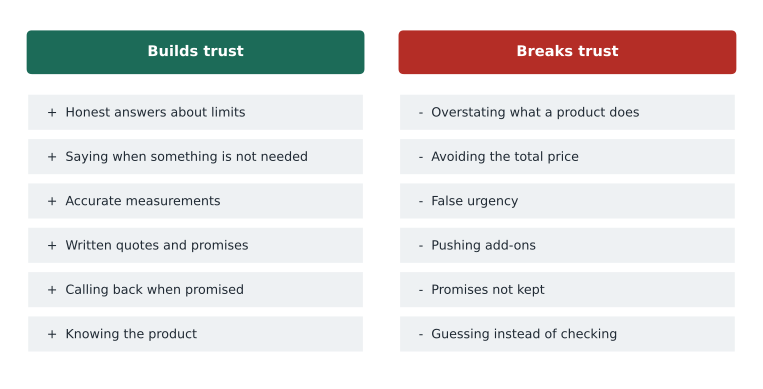
Carl's most repeated piece of advice was to tell customers what a product will not do. Every product has limits. Performance fabric resists stains but not claws. A memory-foam mattress sleeps warm for some people. A French-door refrigerator holds more but its doors swing wide in a narrow kitchen. A gas range cooks well but needs a gas line and a qualified installer. Naming the limit before the customer discovers it does three things: it makes everything else the seller says more believable, it helps the customer choose the right product, and it prevents complaints and returns later.
There is a legal reason as well. A seller's statements about a product can become part of the deal.
In Saskatchewan, The Consumer Protection and Business Practices Act treats a seller's promises or statements about a product's quality, performance or condition as express warranties when they are meant to encourage the purchase, and oral statements count. If the product does not live up to what the seller said, the customer can claim against the store. The Act also gives every consumer statutory warranties that the product is of acceptable quality, fit for its purpose and durable for a reasonable time, and a retailer cannot exclude them. Telling a customer a fabric is pet-proof could turn into a promise the store has to keep.
Puffery is different. General enthusiasm such as "this is a gorgeous sofa" or "customers love it" is opinion, not a factual claim, and is not usually treated as a warranty. The line is crossed when a statement is specific and can be checked: pet-proof, never fades, will last twenty years, uses half the electricity. If the seller cannot back it up, they should not say it.
Worked problem
The cost of one overstated claim
A customer buys a 3,299-dollar sectional after being told the fabric is pet-proof. The store's cost is 1,781.46 dollars, so the sale earns 1,517.54 dollars of gross margin. Three weeks later the dog pulls loops across the seat, and the store takes the sectional back. It costs the store about 240 dollars in crew time and truck costs to collect it, and the returned piece is sold as a floor model at 30 in 100 off. How much gross margin does the store lose compared with the original sale?
Show solution
- Floor-model price:
- \[3{,}299 \times 0.70 = 2{,}309.30 \text{ dollars}\]
- Margin on the floor-model sale:
- \[2{,}309.30 - 1{,}781.46 = 527.84 \text{ dollars}\]
- Margin given up compared with the first sale:
- \[1{,}517.54 - 527.84 = 989.70 \text{ dollars}\]
- Add the collection cost:
- \[989.70 + 240 = 1{,}229.70 \text{ dollars}\]
Answer: The store loses about 1,230 dollars of margin, more than eight times the commission on the original sale, and a customer who will not come back. An accurate sentence about claws would have cost nothing.
Saying when something is not needed
Big-ticket customers notice when a seller recommends against spending money. Carl had a set of honest "you don't need this" answers that he used often. A couple with a five-year-old sofa did not need the most expensive protection plan for a dresser. A family on a tight budget did not need the top refrigerator when the middle model had the same reliability and fit their space. A customer whose mattress was only three years old did not need a new one to fix a sore back if the real problem was a sagging base. Each of these cost Carl a little in the moment, and each one made the customer more likely to buy the things they did need, and to come back.
This is not the same as discouraging customers from spending. Many customers want the better product and can afford it, and the seller should help them see what the extra money buys. The test is whether the recommendation is driven by what the customer told you, or by what earns the most.
Social proof and reviews
Customers buying big items often rely on what other people say: reviews online, friends' recommendations, and the store's reputation. Reviews are powerful because they come from people with no stake in the sale, which is exactly why fake or manipulated reviews are taken seriously by regulators.
Under the Competition Act, a review that misrepresents who wrote it or what they experienced can be a misleading representation, and the Competition Bureau has warned businesses against fake reviews, paying for positive reviews without disclosure, and suppressing negative ones. Juniper & Pine's rule is that associates never write reviews of the store or its products, never offer customers a reward for a positive review, and can ask a satisfied customer to leave an honest review of their experience.
On the floor, the most useful social proof is specific and true. "This is our most-returned-to mattress in the comfort exchange" would be a strange thing to say, but "we sell more of this sectional to families with pets than any other, and the main complaint we hear is that the chaise is deep for short people" is both honest and helpful. Lesson 10 returns to asking for reviews after the sale.
Reliability: doing what you said
Many trust problems in big-ticket retail are not dishonesty at all. They are small promises not kept. The seller said they would call on Tuesday with the delivery date, and did not. The seller said the swatches would be at the counter, and they were not. The seller said the sofa would fit through the door, without measuring the door. Each small failure tells the customer that bigger promises may not be kept either.
Juniper & Pine's sellers use three habits to stay reliable. They write every promise into the clienteling app as a task with a date, so nothing depends on memory. They promise a little less than they can do, so a delivery quoted as "by the end of next week" that arrives on Wednesday is a pleasant surprise. And when something goes wrong, they call the customer before the customer calls them. Carl called the Lindqvists the day the factory pushed their fabric back by a week, three weeks before it mattered. "The bad news was small," he told Aiden. "Finding out on delivery day would have been big."
Trust in other high-ticket categories
Trust works the same way across categories, but each has its own sensitive points. In jewellery, customers cannot judge quality themselves, so sellers rely on independent grading reports for diamonds, clear descriptions of metals and treatments, and written return policies. In vehicles, customers' biggest fear is the total price and the money conversation, which is why rules require advertised prices to be complete.
In Saskatchewan, a licensed dealer that advertises a vehicle price must include every fee and charge it intends to collect, such as freight, administration fees, government levies and dealer-installed products, with only GST and PST left out. Nadine told Aiden that the rule had changed her dealership's conversations: "Customers trust the first number now, so we spend the time on the car instead of arguing about fees."
Price challenges and trust
Few moments test trust like a customer saying, "I saw this cheaper online." A defensive answer suggests the store has something to hide; an instant discount suggests the first price was not real. Carl's approach was to treat the claim as useful information and check it together.
| Step | What Aiden says or does |
|---|---|
| Thank and ask | "Thanks for telling me. Can you show me the listing so we can compare?" |
| Compare like with like | Check the model number, size, fabric or finish, and condition (new, floor model or open box). |
| Compare the whole price | Add delivery, haul-away, assembly and installation to both prices. |
| Apply the policy | If it is the identical new item from a qualifying retailer, apply Juniper & Pine's price match. |
| Explain any difference honestly | If it is not identical, say what differs and let the customer decide. |
Worked problem
Comparing the whole price
A customer finds the same dishwasher online for 949 dollars against Juniper & Pine's 999 dollars. The online seller charges 89 dollars for delivery and 149 dollars for installation and haul-away. Juniper & Pine charges 79 dollars for delivery and 139 dollars for installation including haul-away. Which is cheaper in total?
Show solution
- Online:
- \[949 + 89 + 149 = 1{,}187 \text{ dollars}\]
- Juniper & Pine:
- \[999 + 79 + 139 = 1{,}217 \text{ dollars}\]
Answer: The online seller is 30 dollars cheaper in total, so the customer's point is fair. Because the item is identical and new, Aiden applies the price match to the dishwasher itself. He does not pretend the difference is smaller than it is, and he does not criticize the other seller.
Carl's point was that the comparison builds trust whichever way it comes out. When the store is cheaper in total, the customer sees it for themselves; when it is not, the customer sees the seller being straight with them. Either way, the customer leaves believing the next number the seller gives them.
The same discipline applies to claims about competitors. A seller should not say another store's products are poorly made, that its warranty is worthless or that its prices are about to rise unless the seller knows this to be true and can show it. Comparisons should be about features, prices and terms the customer can check.
Common mistakes
MistakeOverstating what a product does to win the sale.
InsteadName the limits as well as the strengths; specific claims you cannot back up can become warranties.
MistakeTreating puffery and factual claims as the same.
InsteadEnthusiasm is fine; specific, checkable claims must be true.
MistakeAlways recommending the most expensive option.
InsteadRecommend what fits what the customer told you, and say when something is not needed.
MistakeAsking for or rewarding positive reviews.
InsteadAsk satisfied customers for honest reviews, never write or buy them.
MistakeLetting small promises slip.
InsteadRecord every promise as a dated task and call before the customer has to call you.
Summary and key terms
- Trust answers all three big-ticket worries at once.
- The trust equation describes it as credibility, reliability and intimacy, reduced by self-orientation, which customers watch closely when sellers are on commission.
- Naming a product's limits makes the seller believable, helps the customer choose and prevents returns.
- Specific statements about a product can become express warranties, while general enthusiasm is usually puffery.
- Saying when something is not needed builds trust that pays back later.
- Reviews must be genuine; fake or bought reviews break the law.
- Reliability comes from writing down every promise, promising a little less than you can do, and calling with bad news early.
- Each category has its own trust points, such as grading reports for jewellery and complete advertised prices for vehicles.
- Trust equation
- Credibility plus reliability plus intimacy, divided by self-orientation; a way of thinking about trust.
- Self-orientation
- How much the customer senses the seller is focused on their own interests.
- Express warranty
- A seller's promise or factual statement about a product that becomes part of the deal.
- Puffery
- General, unmeasurable praise that is not treated as a factual claim.
- Statutory warranty
- A warranty that the law gives every consumer, such as acceptable quality and fitness for purpose, which a retailer cannot exclude.
- Social proof
- Evidence from other customers, such as reviews and recommendations, that influences a buyer.
Practice problems
Work each problem on paper first, then reveal the answer to check.
Which part of the trust equation do commission-paid sellers need to watch most closely, and why?
Show answer
Self-orientation, because customers know sellers earn more on bigger sales and watch for signs of it.
Is "this sofa will never fade" puffery or a factual claim?
Show answer
A factual claim: it is specific and checkable, and it could be treated as a warranty.
A returned 2,000-dollar chair cost the store 1,100 dollars and is resold at 25 in 100 off. What margin does the resale earn?
Show answer
2,000 × 0.75 = 1,500; 1,500 − 1,100 = 400 dollars, compared with 900 on the original sale.
Lesson quiz · 5 questions
Score 60% or more to complete this lesson.
Create a free account to save your progress, take quizzes and earn a certificate.