
SLS-257 · Lesson 1 of 12 · 23 min
Why loyalty matters in retail
▶ Video coming soon A video version of this lesson is on the way.
On Friday, September 18, 2026, at two in the afternoon, Bev Halvorsen closed the door of the small meeting room behind the office at Juniper & Pine Home and put a single sheet of paper on the table. It was a letter from the owners. Over the summer, a national furniture chain had opened a store on the edge of Regina and launched a phone app with points on every purchase, and the owners wanted to know whether Juniper & Pine should do the same. "They are asking for a plan by the middle of November," Bev said. "Not just a points card. They want to know how we bring people back." Tessa Yellowbird, the store's e-commerce and marketing coordinator, had brought her laptop and the customer file. Aiden Laroque, in his third week at the store, had been asked to join the Friday meetings for the rest of the fall. "You will be the one asking customers to join whatever we build," Bev told him, "so you should know why we build it."
This course is about retail marketing: the work a store does to bring shoppers in, bring them back and give them reasons to choose it over the alternatives. Its central idea is customer loyalty, and its lessons follow the Friday meetings at Juniper & Pine through the fall of 2026, from this first afternoon to the loyalty program plan Tessa presented to the owners on Friday, November 13. SLS-130 explained service, satisfaction measures and retention. SLS-254 covered selling online and in other channels. SLS-253 taught the retail numbers. This course builds on all three and adds the tools of retail marketing: loyalty programs, promotions, events, local marketing, email and text messages, customer data, personalization, social media, reviews and measurement.
What retail marketing is for
Marketing in a store has four broad jobs. It attracts people who have never shopped there, through advertising, local presence, word of mouth and search. It converts visitors into buyers, partly through the store and website themselves and partly through offers and reasons to buy now. It retains customers, bringing them back for the next purchase. And it grows the relationship, so that a household that bought a mattress also thinks of the store for a sofa, a dishwasher or a lamp. A healthy store needs all four. A store that only attracts spends heavily to replace the customers it loses; a store that only retains slowly shrinks as its customers move, downsize or die.
Each job has its own tools, but they overlap. A good review attracts a stranger and reassures a returning customer. An in-store design evening brings in new faces and gives existing customers a reason to visit. A loyalty program is mainly a retention tool, but it also collects the customer information that makes the other tools work. Throughout this course, the test for any marketing activity is the same: does it change what customers do, and is that change worth more than it costs?
What loyalty means in a store
SLS-130 separated two meanings of loyalty. Behavioural loyalty is what customers do: they come back, buy again and spend more over time. Attitudinal loyalty is how they feel: they prefer the store, trust it and recommend it. Customers who buy again only out of habit or convenience show spurious loyalty, which disappears when a competitor makes switching easy. That is exactly the risk the owners saw in the national chain's app: customers who came back to Juniper & Pine simply because it was nearby might drift to a store that paid them to switch.
Furniture and appliance retail adds a twist. Most households buy a sofa, a fridge or a mattress only every several years, so a customer can be completely loyal and still not buy anything for a long time. Loyalty in this kind of store is therefore less about frequent visits and more about three things: being the first store the household thinks of when the next big need arises, winning the smaller purchases in between, such as décor, bedding and small furniture, and earning recommendations to friends and family. A household that buys a dining set in 2026, bedding and lamps in 2027 and a sectional in 2030, and sends two neighbours in the meantime, is a loyal customer even if it visits only once or twice a year.
| Driver | What it looks like at Juniper & Pine | Marketing tool that supports it |
|---|---|---|
| A good experience last time | Delivery on time, no damage, a fair answer to a problem | Service and follow-up (SLS-130) |
| Being remembered | Associates who know the household's rooms and past purchases | Clienteling and customer records (SLS-250, lesson 7) |
| A reason to visit | New collections, seasonal displays, events | Merchandising, events and email (lessons 4 and 6) |
| Recognition and rewards | Points, member prices, perks such as free delivery | Loyalty program (lessons 2 and 12) |
| Trust in the price | Confidence that the regular price is fair and sales are real | Honest promotions (lesson 3) |
| Social proof | Friends' recommendations and online reviews | Reviews and reputation, community presence (lessons 5 and 10) |
Where Juniper & Pine's sales come from
Tessa had spent the week before the meeting sorting the store's 2025 sales by customer. Of the store's 12.40 million dollars of net sales in 2025, about 5.08 million, or 41 in 100, came from households that had bought from the store before. The other 59 in 100 came from first purchases, or from sales the system could not link to a customer, such as cash sales without a name. Bev had expected the returning share to be higher. "Most of our money comes from people we may never see again," she said. Tessa pointed out the other side: the returning households were only about a quarter of the households who bought in 2025, but they spent more per visit and bought in more departments.
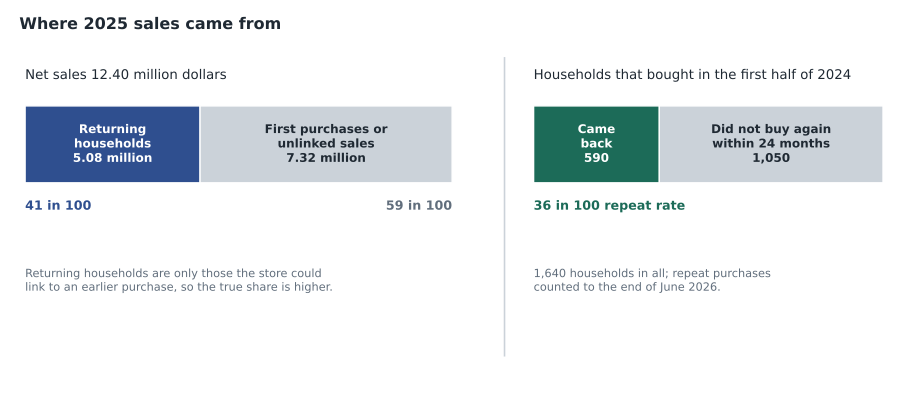
The second number on the sheet came from SLS-130: of the 1,640 households that bought something in the first half of 2024, 590 had bought again by the end of June 2026, a 24-month repeat purchase rate of 36 in 100. In other words, almost two-thirds of the households the store won in that half year had not come back within two years. Some had no reason to: they had bought their mattress and were done. But Tessa's survey of the October 2025 customers suggested that many had bought bedding, lamps or rugs somewhere else since, which meant the store was losing smaller sales it could have won.
Worked problem
What is a higher repeat rate worth?
Bev asked what it would be worth if the 24-month repeat purchase rate rose from 36 in 100 to 40 in 100. Each half-year group of first-time buyers is about 1,640 households. A household that comes back spends, on average, about 1,150 dollars on its repeat purchases within the 24 months, and the store's gross margin is 39.4 in 100 of sales. How much extra gross margin would one half-year group bring, and about how much would two groups a year bring?
Show solution
- Extra returning households in one group:
- \[1{,}640 \times (0.40 - 0.36) = 65.6 \approx 66\]
- Extra sales from those households:
- \[66 \times 1{,}150 = 75{,}900\]
- Extra gross margin:
- \[75{,}900 \times 0.394 \approx 29{,}905\]
- Two half-year groups a year:
- \[2 \times 29{,}905 = 59{,}810\]
Answer: A four-point rise in the repeat rate is worth about 29,900 dollars of gross margin for each half-year group, or roughly 60,000 dollars a year once the higher rate applies to both groups. That is the scale of benefit any loyalty plan has to be measured against, and it is gross margin, not profit: the cost of whatever brings the customers back must come out of it.
What the research says, and what it does not
Loyalty is surrounded by confident numbers, and some are better supported than others. A widely quoted study by Frederick Reichheld and W. Earl Sasser, published in the Harvard Business Review in 1990, found that in the service businesses they studied, reducing customer defections by 5 in 100 raised profits by 25 to 85 in 100. The finding was about specific industries such as banking, insurance and car servicing, where customers become more profitable each year they stay. It does not mean that any retailer will see the same gain, and later writers have warned against quoting it as a general law. Another favourite claim, that winning a new customer costs five times as much as keeping an existing one, is repeated everywhere but has no clear source and varies enormously by business.
A second line of research comes from marketing scientists who study how buying actually happens across many brands and stores. Andrew Ehrenberg, and later Byron Sharp in his 2010 book How Brands Grow, described a pattern called double jeopardy: smaller brands have fewer buyers, and those buyers are also slightly less loyal, so a brand mainly grows by reaching more buyers rather than by making its existing buyers dramatically more loyal. In an influential 1997 article, Grahame Dowling and Mark Uncles reviewed loyalty programs and concluded that many of them did little more than reward customers who would have bought anyway, especially when competitors copied them. These findings come mainly from frequently bought consumer goods, and a store with long purchase cycles is not the same, but they are a useful warning.
The balanced conclusion, which Tessa wrote at the top of the whiteboard, is that retention and acquisition both matter, that loyalty programs can work but often reward behaviour that would have happened anyway, and that the store must test what it does rather than rely on rules of thumb. Lesson 11 shows how. In the meantime, the most reliable sources of loyalty in a store are the unglamorous ones: products that last, honest prices, deliveries that arrive when promised and people who remember the customer.
The two kinds of marketing spending
It helps to separate marketing spending into two kinds. Earned loyalty comes from the experience itself and from the store's reputation: it costs money to provide good service and good products, but the loyalty that follows is not paid for directly. Bought loyalty comes from incentives: points, discounts, gifts and perks given in return for coming back. Bought loyalty is not wrong, and every loyalty program uses it. But it has two weaknesses. Competitors can copy it, and some of what it pays for would have happened anyway. When customers come back only for the incentive, the store is renting their loyalty, not earning it.
Worked problem
How much of a reward goes to people who would have bought anyway?
Tessa sketched a simple case. Suppose a points program gives members 2 dollars back for every 100 dollars they spend, and the 4,000 households who join spend 3.0 million dollars in the year. Suppose also that, without the program, those same households would have spent 2.8 million dollars anyway. How much of the program's reward cost goes to sales that would have happened without it, and how much gross margin do the extra sales bring?
Show solution
- Reward cost on all member sales:
- \[3{,}000{,}000 \times 0.02 = 60{,}000\]
- Reward cost on the sales that would have happened anyway:
- \[2{,}800{,}000 \times 0.02 = 56{,}000\]
- Extra sales caused by the program:
- \[3{,}000{,}000 - 2{,}800{,}000 = 200{,}000\]
- Gross margin on the extra sales:
- \[200{,}000 \times 0.394 = 78{,}800\]
Answer: Of the 60,000 dollars of rewards, 56,000 dollars, more than nine in ten, would reward purchases that would have happened anyway. The extra 200,000 dollars of sales would bring about 78,800 dollars of gross margin, so in this case the program pays for its rewards, but only just, and before its running costs. If the extra sales were 100,000 dollars instead, the margin of about 39,400 dollars would not cover the rewards. Lesson 2 builds the full cost of a program, including the points that are never redeemed.
How this course is organized
Lessons 2 to 5 cover the tools that bring customers into the store and back again: the design of a loyalty program, promotions and what they really cost, in-store events, and local and community marketing. Lessons 6 to 9 cover the tools that reach customers between visits: email and text messages, customer data and segments, personalization and social media. Lesson 10 turns to reviews and the store's reputation, lesson 11 to measuring whether any of it works, and lesson 12 follows Tessa's loyalty program plan from the first sketch to the owners' meeting. Each lesson includes the legal rules that apply in Saskatchewan and the practical judgement a store needs to stay on the right side of its customers.
Before the meeting ended, Bev gave Aiden his first assignment. For the next week, at the end of each sale, he was to ask one simple question: "Have you shopped with us before?" and note the answer. "You'll be surprised how many say yes," she said, "and how many of them we don't recognize."
Common mistakes
MistakeA loyalty program will make customers loyal.
InsteadA program can reward and encourage return visits, but real loyalty comes mainly from the experience, products and prices; a program cannot fix a bad delivery.
MistakeRetaining customers is always five times cheaper than winning new ones.
InsteadThe ratio varies widely by business and the popular figure has no clear source; both retention and acquisition matter.
MistakeCustomers who come back are proof of loyalty.
InsteadSome come back out of habit or convenience; that spurious loyalty disappears when a competitor makes switching easy.
MistakeEvery reward paid to a member is a cost of winning extra sales.
InsteadMuch of it rewards purchases that would have happened anyway; only the extra sales justify the cost.
MistakeIn a furniture store, customers who do not visit for a year are lost.
InsteadPurchase cycles are long; loyalty shows up as being first in mind for the next big need, winning smaller purchases and earning referrals.
Summary and key terms
- Retail marketing attracts, converts, retains and grows customers, and a healthy store needs all four.
- Behavioural loyalty is what customers do; attitudinal loyalty is how they feel; repeat buying without preference is spurious loyalty.
- In home furnishings, loyalty means being first in mind for the next big need, winning smaller purchases and earning referrals.
- At Juniper & Pine, 41 in 100 of 2025 sales came from returning households, and 36 in 100 of first-time households bought again within 24 months.
- Research on loyalty is mixed: famous figures are industry-specific, and programs often reward purchases that would have happened anyway.
- Earned loyalty comes from the experience; bought loyalty comes from incentives, which competitors can copy.
- Retail marketing
- The work a store does to attract, convert, retain and grow customers.
- Behavioural loyalty
- Loyalty shown by actions, such as repeat purchases.
- Attitudinal loyalty
- Loyalty shown by preference, trust and willingness to recommend.
- Repeat purchase rate
- The share of customers in a group who buy again within a set period.
- Double jeopardy
- The pattern in which smaller brands have fewer buyers and slightly lower loyalty among those buyers.
- Bought loyalty
- Return visits encouraged by incentives such as points, discounts or perks.
Practice problems
Work each problem on paper first, then reveal the answer to check.
A store's 1,200 first-time households in a half year include 420 who bought again within 24 months. What is the repeat purchase rate?
Show answer
420 divided by 1,200 is 0.35, or 35 in 100.
Why can a household be loyal to a furniture store and still not buy for two years?
Show answer
Big purchases are infrequent; loyalty shows in being first in mind for the next need, smaller purchases and referrals.
A program's members would have spent 1.9 million dollars anyway and spent 2.0 million with the program. If rewards are 2 in 100 of member sales, how much of the reward cost goes to purchases that would have happened anyway?
Show answer
1,900,000 times 0.02 is 38,000 dollars of the 40,000 dollars in rewards.
Give one reason to be cautious about the claim that keeping a customer costs five times less than winning one.
Show answer
The figure has no clear source and the ratio varies widely between businesses.
Lesson quiz · 5 questions
Score 60% or more to complete this lesson.
Create a free account to save your progress, take quizzes and earn a certificate.