
SLS-257 · Lesson 9 of 12 · 21 min
Social media for stores
▶ Video coming soon A video version of this lesson is on the way.
On Monday afternoon, November 9, 2026, after Bev's numbers morning, Tessa and Aiden sat down with the store's social media accounts and a problem. A post from the previous Thursday, showing the new holiday window, had drawn 46 comments. Most were friendly. One was from a customer whose dining chairs had arrived with a scratched leg in October, and who wrote that she was "still waiting for anyone to call back". Eleven people had liked her comment. "Social media is not a noticeboard," Tessa said. "It is a room full of our customers talking, and some of them are talking about us."
This lesson is about running a store's own social media: choosing where to be, planning content, managing the community that gathers there, using paid local advertising, running giveaways lawfully and measuring what it achieves. SLS-254 covered social commerce, shopping features, working with creators and their disclosure rules. This lesson takes the marketing view: social media as one of the main ways a local store stays present in its community's lives between purchases.
What social media does for a local store
For a home furnishings store, social media does four jobs. It inspires: room settings, before-and-after photos and new arrivals give people ideas for their homes. It informs: events, sales, new services, holiday hours and delivery updates reach followers quickly. It connects: comments, messages and shared customer photos make the store feel like part of the community, with faces and voices behind it. And it reassures: a new customer checking the store's pages sees real staff, real rooms and how the store answers questions and complaints. The last job is easy to forget. Many people who never comment still read the comments, as the scratched-chair thread showed.
Social media rarely sells sofas directly. It works over time, keeping the store in mind so that when a household's need arises, Juniper & Pine is the store they think of and trust. That makes its effect harder to measure than an email's, and it is why the store treats social media mainly as a way to build presence and reputation, with occasional, clearly measured campaigns.
Where to be
No small store can do everything well. Tessa's rule was to be excellent on two or three platforms rather than mediocre on six, choosing them by where the store's customers actually spent time. A short survey at the counter in October asked 300 customers which apps they used most for home ideas. The answers, together with the follower numbers on each account, guided the choice.
| Platform type | Why | Main content |
|---|---|---|
| A large photo and video network, used by many of the store's customers aged 25 to 55 | Most followers and most interaction | Room settings, short videos, stories, event invitations |
| The older social network with local community groups | Popular with homeowners over 45 and local groups | Events, sales, community news, holiday hours |
| A visual idea-board site | People plan rooms there months before buying | Room boards linking to product pages |
| Short-video apps | Tested with Noura's live pilot in October; growing audience | A small number of short videos, reviewed after three months |
Platforms change their features, rules and even their availability, sometimes suddenly, and their algorithms decide how many followers see each post. A store that builds its whole relationship with customers on rented platforms is exposed. That is one reason Tessa used social media to invite people onto the store's owned channels, its email list, Home Club and the store itself, rather than treating follower counts as the goal.
Planning content
Good social content for a store is mostly not advertising. Tessa used a simple mix for the store's main account: about half inspiration, such as room settings, styling tips and customer homes shared with permission; about a quarter people and community, such as staff introductions, behind-the-scenes moments, events and the charity furniture program from lesson 5; and about a quarter offers and news, such as new arrivals, sales and holiday hours. A store that posts only offers trains followers to ignore it.
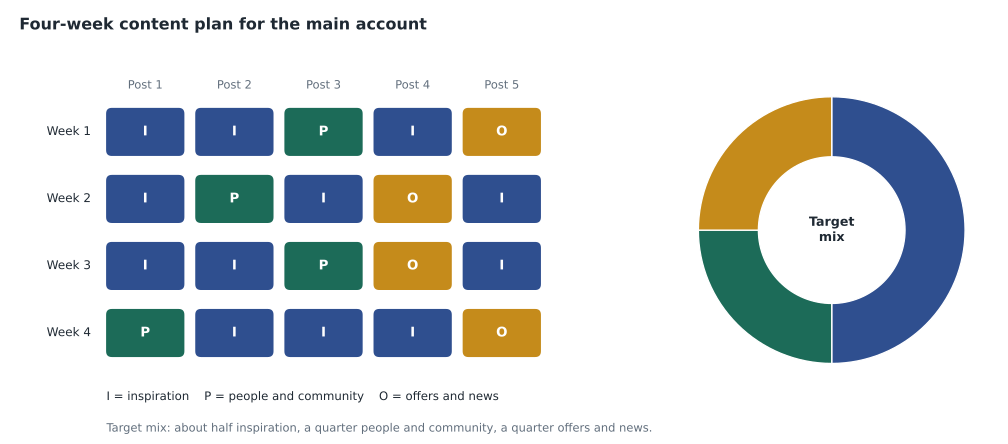
Each post needs a purpose and a next step: an inspiration post might link to the product page or invite people to visit; an event post links to the RSVP page. Photos and videos should be real: the store's own rooms, products and people, with accurate colours, the same standard SLS-254 set for product pages. Posts should also be accessible: descriptive text for images where the platform allows it, captions on videos and readable text on graphics.
Customer photos are some of the most persuasive content a store can share, but they belong to the customer. Juniper & Pine asked permission in writing, usually by direct message, before sharing any customer's photo, credited the customer if they wished, and never showed house numbers, children's faces or anything that could reveal where someone lives. The same care applied to staff: no one was filmed for social media without agreeing, and staff could ask for a post to be removed.
Managing the community
Comments and messages on social media are customer service in public. Tessa set three rules. Every comment or message gets a response within one business day, and most within a few hours. Complaints are acknowledged publicly, with an apology where it is due and an offer to fix the problem, and then moved to a private message or a phone call to deal with the details. And nothing is deleted except spam, abuse or posts that reveal personal information; deleting honest complaints makes them louder.
The scratched-chair comment was handled that afternoon. Tessa replied publicly: "We're sorry, this is not how a delivery should end, and you should have heard back from us. I've sent you a message so we can fix this today." In the private message she arranged for the service team to call within the hour; a replacement leg was installed on November 11. The customer later edited her comment to say the store had sorted it out. Eleven people had seen the complaint; many more saw how the store responded.
Worked problem
How quickly is the store responding?
In October, the store's accounts received 214 comments and messages that needed a reply. Of these, 131 were answered within four hours, 58 within one business day, and 25 took longer. What share was answered within one business day, and how many replies would need to speed up to reach a target of 95 in 100 within one business day?
Show solution
- Answered within one business day:
- \[131 + 58 = 189 \qquad 189 \div 214 \approx 0.883\]
- Replies needed within one business day to reach 95 in 100:
- \[214 \times 0.95 = 203.3 \approx 204\]
- Extra replies needed:
- \[204 - 189 = 15\]
Answer: About 88 in 100 were answered within one business day. Fifteen more of October's 25 slow replies would have needed to be faster to reach 95 in 100. Most slow replies came on weekends, so Tessa planned a short weekend check by a trained associate.
Paid social advertising
Social platforms sell advertising that can target people by location, age range and interests. For a local store, location targeting is the most useful feature: advertisements shown only to people within the trade area, or within the two gap suburbs from lesson 5. Before Black Friday 2026, Tessa planned a small test: 600 dollars of advertising promoting the holiday window and the Black Friday weekend, shown to adults within a 20-minute drive of the store, with a link to the sale page.
Worked problem
What did the October test advertisement achieve?
In October, as a trial, Tessa spent 600 dollars on a local advertisement for Design Night. It was shown to 38,500 people in the trade area, 740 clicked through to the RSVP page, and 31 of the 140 RSVPs came from those clicks. What was the cost per click and the cost per RSVP from the advertisement?
Show solution
- Cost per click:
- \[600 \div 740 \approx 0.81\]
- Cost per RSVP:
- \[600 \div 31 \approx 19.35\]
Answer: Each click cost about 81 cents and each RSVP about 19 dollars. Compared with the 76 dollars per new household that Design Night cost overall (lesson 4), the advertisement was a reasonable way to fill the room, though some of those 31 people might have heard about the event anyway. Paid social, like every channel, needs a comparison or holdout to show its true effect, a point lesson 11 develops.
Advertising on social media must follow the same rules as any advertising: prices, savings claims and conditions must be accurate, and the promotion rules in lesson 3 apply in full. Advertisements must also follow the platforms' own policies, which restrict targeting for some categories, such as housing, credit and employment, and which can change without notice. Financing offers in advertisements, a topic for SLS-256, carry extra disclosure rules.
Giveaways and contests
Giveaways, such as "Win a Halden sofa", are popular on social media because they spread quickly. They are also legally risky, because a prize given by chance to people who paid something to enter can be an illegal lottery.
In Canada, the Criminal Code's lottery provisions mean that a contest must not require both payment and pure chance. That is why Canadian contests offer a no purchase necessary way to enter and require winners to answer a skill-testing question, usually a short arithmetic problem, before they can claim a prize. The Competition Act, section 74.06, requires adequate and fair disclosure: the number and approximate value of prizes, any regional allocation, the chances of winning and any fact that materially affects them, the closing date, and how winners are chosen. A summary of these "mini rules" must appear on the promotion itself, with a link to the full rules, and prizes must be awarded within a reasonable time. Contests open to Quebec residents must also publish their information in French.
Platforms add their own rules. Most do not allow a store to require entrants to share a post on their personal page or tag friends falsely, and they require the promotion to state that the platform does not sponsor it. Tessa decided that the store's spring 2027 giveaway, a 1,499-dollar Halden sofa, would be open to adult residents of Saskatchewan only, with full rules on the website, free entry through the post or an entry form, and a skill-testing question for the winner. Because the prize was worth less than 5,000 dollars and entry was limited to one province, the most complex registration rules would not apply, but she still planned a legal review before launch.
Staff on social media
Staff are often the store's best ambassadors online, sharing room settings they built or events they worked. They can also cause problems: a careless post about a difficult customer, a photo of a customer's home taken during a delivery, or a review of the store posted without saying the writer works there. Juniper & Pine's short social media policy asked staff to say they work at the store when posting about it, never to post about customers, never to share photos from inside customers' homes, and to pass any complaint they saw online to Tessa rather than answering it themselves. Review rules for employees, covered in SLS-254, apply too: staff must not post reviews of the store or its products without disclosing their connection.
Measuring social media
Social platforms report many numbers: reach, impressions, likes, shares, comments, follows and video views. Tessa reported only a few each month: how many people in the trade area the posts reached, how many engaged, how quickly comments and messages were answered, and how many website visits and RSVPs came from social links. In October, the main account's posts reached about 21,000 people and drew 1,620 engagements. She treated these as response measures, useful for comparing posts with each other, and judged paid advertising separately by the clicks, RSVPs and purchases it produced.
Common mistakes
MistakeBe on every platform to reach everyone.
InsteadBe excellent on the two or three platforms the store's customers use, and invite followers onto owned channels.
MistakeSocial posts should mainly promote sales.
InsteadA mix weighted toward inspiration and community keeps followers interested; constant offers are ignored.
MistakeDelete negative comments to protect the store's image.
InsteadRespond publicly, fix the problem privately and remove only spam, abuse or personal information.
MistakeA giveaway is just a fun post.
InsteadContests need a free way to enter, a skill-testing question, fair disclosure and clear rules.
MistakeShare customers' photos if they tagged the store.
InsteadAsk permission, credit them if they wish and never reveal where they live.
Summary and key terms
- Social media inspires, informs, connects and reassures, building presence between purchases rather than selling directly.
- Choose two or three platforms where customers spend time; follower counts matter less than moving people to owned channels.
- A content mix of about half inspiration, a quarter people and community and a quarter offers keeps an audience engaged.
- Comments and messages are public customer service: reply quickly, apologize where due and resolve privately.
- Paid local advertising can target the trade area and should be measured like any channel.
- Contests need no-purchase entry, a skill-testing question and Competition Act disclosure.
- Owned channel
- A channel the store controls, such as its email list, website or loyalty program.
- Community management
- Responding to and guiding the conversations on a store's social media accounts.
- Location targeting
- Showing advertisements only to people within a chosen area.
- Cost per click
- Advertising spend divided by the number of clicks it produced.
- Skill-testing question
- A question winners must answer correctly to claim a contest prize in Canada.
- Mini rules
- A short summary of the key promotion terms shown wherever the promotion is advertised.
Practice problems
Work each problem on paper first, then reveal the answer to check.
An advertisement cost 450 dollars and produced 600 clicks and 18 sign-ups. What were the cost per click and cost per sign-up?
Show answer
450 divided by 600 is 0.75 dollars per click; 450 divided by 18 is 25 dollars per sign-up.
Why should a store respond publicly to a complaint on its social media before moving to a private message?
Show answer
Many other customers read the thread and judge the store by how it responds.
Give two things to check before sharing a customer's photo.
Show answer
Written permission and that nothing reveals where they live, such as a house number.
Why do Canadian contests ask winners a skill-testing question?
Show answer
To add skill so the contest is not a pure game of chance under the Criminal Code's lottery rules.
Lesson quiz · 5 questions
Score 60% or more to complete this lesson.
Create a free account to save your progress, take quizzes and earn a certificate.