
SLS-257 · Lesson 10 of 12 · 24 min
Reviews and reputation
▶ Video coming soon A video version of this lesson is on the way.
On Thursday morning, November 12, 2026, Bev printed the store's online review page and laid it on the counter beside the national chain's. Juniper & Pine Home showed 4.4 stars from 612 reviews. The chain's new store, open for two months, showed 4.6 from more than 1,200, many of them copied from its other locations. "I don't mind losing a sofa sale to a better sofa," Bev said. "I mind losing it because someone looked at two numbers on a phone for five seconds." She asked Aiden and Tessa to work out what the store's reputation really rested on, and what it could honestly do to improve it before the loyalty launch.
A store's reputation is what its community believes about it: whether it is fair, reliable, knowledgeable and pleasant to deal with. Online reviews are the most visible part of that reputation, but not the whole of it. Word of mouth, the store's record in the local news, how it treats complaints and how its staff behave in the community all count. This lesson looks at reputation as a marketing asset: how it is measured, how a store earns more of the good kind, how it responds when things go wrong and what the law says about reviews. SLS-254 dealt with reviews on product pages and in online selling; here the focus is the store's own reputation in its community.
Why reputation matters so much for a local store
Every purchase involves some risk, and for big-ticket items the risk is large. A customer spending 2,400 dollars on a sofa wants to know that the sofa will arrive as promised, that the store will fix problems and that the advice was honest. Reviews and word of mouth reduce that risk by letting customers learn from other customers. Surveys of shoppers consistently find that most read reviews before choosing a local business, though such surveys are usually run by review platforms and marketing firms with an interest in the answer, and they measure what people say rather than what they do.
Reputation also works through loyalty. A household that trusts the store comes back, recommends it and forgives an occasional mistake. A household that feels badly treated not only leaves but may tell others. The loyalty program designed in lesson 2 rewards repeat purchases, but it cannot create trust. A store with a poor reputation that launches a points program is paying people to return to a place they do not like, and points are a weak reason against a strong feeling.
Reading the store's ratings
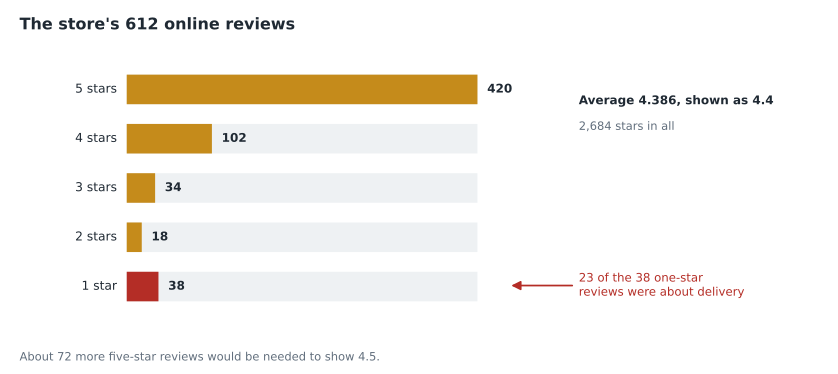
Aiden began by looking behind the 4.4. The 612 reviews broke down by stars as shown in the figure. Most were five stars, but 38 one-star reviews pulled the average down. Reading them, he found that 23 of the 38 were about delivery: late trucks, missed time windows and, in four cases, damage. Only five complained about the products themselves. Almost all the delivery complaints predated the delivery changes piloted from October 5: a two-hour window chosen at the sale, a text the evening before, live tracking and a text 30 minutes before arrival.
Worked problem
How many more good reviews to show 4.5 stars?
The store's reviews total 2,684 stars from 612 reviews. The review site rounds the average to one decimal place, so the store shows 4.5 stars once the average reaches 4.45. If every new review were five stars, how many would the store need?
Show solution
- Current average:
- \[2{,}684 \div 612 \approx 4.386\]
- Let x be the number of new five-star reviews. The new average must reach 4.45:
- \[\frac{2{,}684 + 5x}{612 + x} \ge 4.45\]
- Multiply out and solve:
- \[2{,}684 + 5x \ge 2{,}723.4 + 4.45x \qquad 0.55x \ge 39.4 \qquad x \ge 71.6\]
Answer: The store would need 72 new five-star reviews, and more in practice, because not every new review will be five stars. Since the store received about 95 reviews in the first ten months of 2026, chasing the displayed number would take most of a year. Fixing delivery, the cause of most one-star reviews, would do more for both the rating and the business.
Averages hide what customers actually read. Many shoppers sort by most recent or lowest rating, so a run of recent complaints matters more than an old average. Shoppers also notice responses. Aiden counted that the store had answered 38 of the 64 reviews posted so far in 2026, about 59 in 100, and only 9 of the 15 negative ones. The chain, he noticed, answered almost none of its reviews at the new location, which gave Juniper & Pine an opening.
Earning more good reviews honestly
The best source of good reviews is good experiences, and the second best is asking at the right moment. Many satisfied customers never think of writing a review; dissatisfied customers are more motivated. A store that never asks ends up with a rating skewed toward its worst moments. Juniper & Pine's plan for asking was simple and honest.
| When | How | Who |
|---|---|---|
| Three days after delivery | A short email or text with a link to the review page, sent only to customers whose consent covers it | Every delivered order |
| At the counter after a smooth purchase | A small card with a code to the review page | Any customer, not only happy-looking ones |
| After a problem is fixed | A personal thank-you; no request unless the customer offers | Service team |
| After Home Club launches | A link in the welcome series | New members |
Three rules made the plan honest. First, ask everyone, not only the customers staff think will be happy. Choosing whom to ask based on their likely rating, sometimes called review gating, distorts the picture, breaks the rules of the major review sites and can be deceptive. Second, no rewards for reviews. Some laws allow a store to offer an incentive for a review that is not tied to it being positive, as long as it is disclosed, but the major review sites forbid incentives for reviews of local businesses, and the simplest safe rule is never to offer them. Points for reviews were therefore left out of Home Club deliberately. Third, no reviews from insiders: staff, owners and their families do not review the store.
What the law says about reviews
In Canada, the Competition Act's general rules on false or misleading representations apply to reviews: section 52 makes knowingly or recklessly misleading the public a criminal offence, and section 74.01 lets the Competition Bureau seek civil penalties for misleading representations. Fake reviews, reviews written by a business's employees without disclosure, and hiding or selectively displaying reviews to mislead can all breach these rules. The Bureau has acted on this before: in 2015, Bell Canada paid a 1.25-million-dollar penalty after employees were encouraged to post positive reviews and ratings of its apps without disclosing their connection. The Bureau's guidance on online reviews and Ad Standards' influencer and testimonial guidelines set out the same expectations: reviews must reflect genuine experiences, connections must be disclosed, and businesses must not suppress or cherry-pick reviews.
These rules apply to the store's own website as well as to review sites. If the store displays reviews on its product pages, it must not hide the negative ones while showing the positive ones, and it must apply the same standards when it removes reviews, for example for abuse or irrelevance.
Responding to reviews
Responses are written for the next reader as much as for the reviewer. A good response is prompt, personal and specific; it thanks the reviewer, addresses what they said and, for complaints, apologizes where due, explains what is being done and offers a direct way to continue. It never argues, never reveals private details of the customer's purchase and never blames another staff member by name.
Worked problem
A response to a one-star delivery review
On November 10, a customer posted one star about a delivery in late September: "Our dresser arrived two hours outside the window and the driver didn't call. Nice store, bad delivery." How should the store respond?
Show solution
- Thank and acknowledge: "Thank you for telling us, and we're sorry. A two-hour miss without a call isn't the service we promise."
- Explain what is changing, without excuses: "Since October, you choose a two-hour window when you buy, and we text the evening before and again 30 minutes before the truck arrives."
- Offer a direct way to continue: "Tessa, our store manager, would like to talk with you. Please call the store and ask for her."
Answer: The response is short, admits the problem and shows other readers that the store learns from complaints. Tessa called the customer the same day; the customer did not change the review, and the store did not ask her to.
Positive reviews deserve responses too, though they can be brief and should not be copy-pasted. A thank-you that mentions the specific sofa or the associate who helped shows that a real person read the review. Aiden drafted a goal for 2027: respond to every review within two business days, with Tessa or the owners answering every review of three stars or fewer.
Word of mouth and measuring how customers feel
Most of a local store's reputation still travels by conversation: neighbours, relatives, coworkers and community groups. Word of mouth is hard to measure, but stores can track some signs of it, such as how new customers say they heard about the store and how many come through referrals. At Juniper & Pine, 31 in 100 new households in 2026 said a friend or relative had recommended the store, more than any advertising channel.
Many businesses measure how likely customers are to recommend them using a single question scored from 0 to 10, known as the Net Promoter Score: the share scoring 9 or 10 minus the share scoring 0 to 6. It is simple and widely used, but research has questioned the claim that it predicts growth better than other satisfaction measures; Keiningham and colleagues, in a 2007 study across several industries, found no evidence that it was superior. Juniper & Pine used a short survey after delivery instead, asking customers to rate the sales advice, the delivery and the product, with one open question about what could be better. The open answers were the most useful part.
Worked problem
What does the post-delivery survey show?
In October, 180 customers completed the post-delivery survey. Asked how likely they were to recommend the store, 117 gave 9 or 10, 45 gave 7 or 8 and 18 gave 0 to 6. What is the Net Promoter Score?
Show solution
- Share of promoters (9 or 10):
- \[117 \div 180 = 0.65\]
- Share of detractors (0 to 6):
- \[18 \div 180 = 0.10\]
- Net Promoter Score:
- \[65 - 10 = 55\]
Answer: The score is 55. It says little on its own, and a change of a few points from month to month is often noise with samples this size. The open answers explained more: 12 of the 18 low scores mentioned delivery, matching what the one-star reviews said.
When something goes wrong in public
Occasionally a store faces a reputation problem bigger than one review: a product recall, a viral complaint, a local news story or a dispute with a community group. The same principles apply on a larger scale. Respond quickly, with facts. Take responsibility for what is the store's fault. Say what is being done. Tell customers directly, by email and in the store, rather than leaving them to hear it elsewhere. And keep a record of what happened and what changed. In 2025, when a supplier recalled a line of children's dressers for a tip-over risk, Juniper & Pine emailed and called all 46 buyers within two days and arranged free anchoring kits or refunds. Several customers mentioned that response in later reviews.
Bev's conclusion from the morning was that the store's reputation was strong on people and products and had been weak on delivery. The October changes had already shown what worked: contacts asking where the truck was had fallen sharply and delivery satisfaction had risen. She asked the service team to answer every older delivery review with a note about the changes, kept the delivery rating on the post-delivery survey as a monthly check, and asked Tessa to bring the delivery results to the November 13 owners' meeting alongside the loyalty plan. One recent review already showed the effect of handling problems well: Denise Morin, whose wall was gouged during a fridge delivery in early November, gave the store five stars after it paid a painter to fix it.
Common mistakes
MistakeThe star rating is the store's reputation.
InsteadThe rating is one visible sign; what the reviews say, how the store responds and word of mouth matter as much.
MistakeAsk happy customers for reviews and leave the others alone.
InsteadAsk everyone at the same point; selective asking distorts the rating and breaks review-site rules.
MistakeOffer points or a discount for a review.
InsteadMajor review sites forbid incentives for local reviews; the safe rule is no rewards for reviews.
MistakeArgue with unfair reviews to set the record straight.
InsteadReply calmly and briefly for the next reader, and fix what can be fixed.
MistakeStaff can post reviews if they really like the store.
InsteadInsider reviews need disclosure at the very least, and the store's policy is that staff do not review it.
Summary and key terms
- Reputation is what the community believes about the store; online reviews are its most visible part.
- Look behind the average: the distribution and the reasons in low reviews show what to fix.
- Ask every customer for a review at the same point, offer no rewards and allow no insider reviews.
- The Competition Act's misleading-representation rules cover fake, undisclosed and cherry-picked reviews.
- Respond to every review promptly and personally, writing for the next reader.
- Simple recommendation scores have limits; open comments often explain more.
- Review gating
- Asking only customers expected to give positive reviews.
- Insider review
- A review by an owner, employee or their family, which must be disclosed and is best avoided.
- Displayed rating
- The average star rating as the review site shows it, usually rounded to one decimal place.
- Net Promoter Score
- The share of customers scoring 9 or 10 on likelihood to recommend, minus the share scoring 0 to 6.
- Word of mouth
- Recommendations and comments passed between people outside the store's control.
- Section 74.01
- The Competition Act section that allows civil remedies for misleading representations, including deceptive reviews.
Practice problems
Work each problem on paper first, then reveal the answer to check.
A store has 200 reviews averaging 4.2. What is the total number of stars?
Show answer
200 times 4.2 is 840 stars.
Of 400 survey answers, 220 scored 9 or 10 and 60 scored 0 to 6. What is the Net Promoter Score?
Show answer
55 minus 15 is 40.
Why is offering points for reviews a bad idea for a local store?
Show answer
Major review sites forbid incentives for local reviews, and rewarded reviews can mislead if not disclosed.
Name three parts of a good response to a complaint review.
Show answer
Thank and acknowledge, explain what is being done and offer a direct way to continue.
Lesson quiz · 5 questions
Score 60% or more to complete this lesson.
Create a free account to save your progress, take quizzes and earn a certificate.