
BAR-111 · Lesson 10 of 12 · 22 min
Negligence
▶ Video coming soon A video version of this lesson is on the way.
Torts does not fit into the Monday calendar, so Marchetti adds two Friday evening sessions, on October 16 and October 23. 'Torts is the friendliest MBE subject for most people,' she says on the first Friday, 'because the rules feel like common sense. That is also the danger. The MBE writes negligence questions where common sense points to the wrong answer.' About half of the torts questions on the MBE come from negligence, according to NCBE's outline. Marcus, who used the session to brush up for a car accident case at his firm, asks whether he needs to know comparative fault variations. 'NCBE tells you what to assume,' Marchetti says. She puts the outline's instructions on the screen: joint and several liability and pure comparative fault are the relevant rules unless otherwise indicated, and survival actions and wrongful death claims are available.
The elements
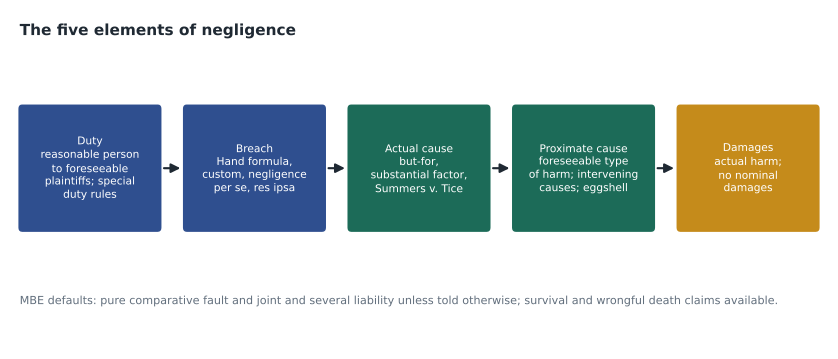
A negligence claim requires a duty of care owed by the defendant to the plaintiff, breach of that duty, actual cause, proximate cause, and actual damages. Each element can be the hinge of an MBE question, and the answer choices often state the right conclusion for the wrong element. Marchetti's habit is to write the five elements in the margin and cross them off as the facts satisfy them.
Duty: the general standard
Everyone who engages in conduct owes a duty to act as a reasonably prudent person would under the circumstances to all foreseeable plaintiffs. The standard is objective: a defendant's own lack of intelligence or experience does not lower it. But physical characteristics are taken into account, so a blind person must act as a reasonable blind person would. Children are held to the standard of a reasonable child of similar age, intelligence and experience, except when engaged in adult activities such as driving a car or boat, when the adult standard applies; very young children, often under five, are usually incapable of negligence. Professionals must exercise the knowledge and skill of a member of the profession in good standing in similar communities; for doctors, the modern trend applies a national standard, particularly for specialists. Doctors must also obtain informed consent by disclosing the material risks of treatment.
The question of whom a duty runs to is the subject of Palsgraf v. Long Island Railroad (N.Y. 1928). Under Chief Judge Cardozo's majority view, a duty is owed only to plaintiffs within the zone of foreseeable danger. Under Judge Andrews's dissent, a defendant who breaches a duty to anyone owes a duty to everyone harmed. On the MBE, the Cardozo view is the usual answer. Rescuers are foreseeable plaintiffs: danger invites rescue, so a defendant who negligently puts himself or another in peril owes a duty to a rescuer.
Special duty rules
Owners and occupiers of land owe duties that depend, in many states, on the entrant's status. To trespassers, the owner owes no duty for undiscovered trespassers, but must warn of or make safe known, man-made, deadly concealed conditions for discovered or anticipated trespassers. Under the attractive nuisance doctrine, an owner must exercise ordinary care to avoid reasonably foreseeable risks to children from artificial conditions, if the owner knows children are likely to trespass, the condition poses an unreasonable risk of serious injury, children would not appreciate the danger because of their youth, and the burden of eliminating the danger is slight compared to the risk.
To licensees, social guests and others who enter with permission for their own purposes, the owner must warn of known dangerous conditions that create an unreasonable risk of harm and that the licensee is unlikely to discover. There is no duty to inspect. To invitees, who enter for a business purpose or as members of the public on land held open to the public, the owner owes the duty to warn of or make safe dangerous conditions the owner knows of or could discover with a reasonable inspection. An invitee who exceeds the scope of the invitation becomes a licensee or trespasser. A growing number of states have abandoned the distinction between licensees and invitees, or all three categories, in favor of a general duty of reasonable care.
There is generally no duty to act affirmatively to aid or rescue another. Exceptions include a special relationship such as common carrier and passenger, innkeeper and guest, employer and employee, or parent and child; a defendant who created the peril; and a defendant who voluntarily began a rescue and must then act reasonably, without leaving the victim worse off. Many states have Good Samaritan statutes protecting off-duty medical personnel from liability for ordinary negligence in emergency aid. A defendant who controls a third person, such as a parent of a dangerous child or a psychotherapist whose patient makes a serious threat against an identifiable victim, may owe a duty to protect others (Tarasoff v. Regents of the University of California, Cal. 1976).
Negligent infliction of emotional distress has limited duties. A plaintiff in the zone of danger who suffers emotional distress from a threat of physical impact can recover, and traditionally must show physical symptoms. A bystander outside the zone can recover, in most states, if he is closely related to the injured person, was present at the scene and personally observed the injury (Thing v. La Chusa, Cal. 1989, narrowing Dillon v. Legg). A few special relationships, such as a hospital negligently reporting that a patient has a fatal disease, or mishandling a corpse, allow recovery without physical injury.
Breach: proving the standard was not met
Breach is conduct falling short of the standard of care. Factors include the foreseeability and gravity of the harm and the burden of precautions, captured in Judge Learned Hand's formula from United States v. Carroll Towing Co. (2d Cir. 1947): a defendant is negligent if the burden of precaution is less than the probability of harm multiplied by the magnitude of the loss. Custom in an industry is evidence of the standard of care, but not conclusive; an entire industry may be negligent (The T.J. Hooper, 2d Cir. 1932). Medical custom, by contrast, generally sets the standard.
Negligence per se applies when a statute provides a criminal penalty and a clear standard of conduct. The violation establishes duty and breach as a matter of law in most states if the plaintiff is in the class the statute was designed to protect and the harm is of the type it was designed to prevent. A violation is excused if compliance would have been more dangerous or was impossible. Compliance with a statute is evidence of due care but does not prove it.
Res ipsa loquitur lets the jury infer breach from the accident itself when the accident is of a kind that ordinarily does not occur without negligence and is of a type attributable to the defendant, traditionally shown by the defendant's exclusive control of the instrumentality, and the plaintiff did not contribute. The classic case is a barrel falling from a warehouse window onto a pedestrian (Byrne v. Boadle, 1863). In most states, res ipsa creates only a permissible inference, so the case goes to the jury but the jury may reject the inference. In medical cases with several defendants and an unconscious patient, courts have extended the doctrine to all defendants who had control (Ybarra v. Spangard, Cal. 1944).
Actual cause
The defendant's breach must be a cause in fact of the plaintiff's injury. The usual test is but-for causation: the injury would not have occurred without the breach. When two or more independent forces combine and each alone would have caused the injury, such as two fires merging to burn a house, courts use the substantial factor test, holding each defendant liable. When two defendants act negligently but only one could have caused the harm, and the plaintiff cannot tell which, the burden shifts to each defendant to prove he was not the cause (Summers v. Tice, Cal. 1948). Some courts have allowed market share liability against manufacturers of an identical, fungible product when the plaintiff cannot identify which manufacturer made the product that harmed her (Sindell v. Abbott Laboratories, Cal. 1980). And in loss-of-chance cases, some states let a patient recover for a reduced chance of survival caused by a doctor's negligence.
Proximate cause
Proximate cause limits liability to harms that are a foreseeable result of the defendant's conduct. The modern rule asks whether the type of harm was foreseeable, not its extent or the precise manner in which it occurred (Overseas Tankship v. Morts Dock, the Wagon Mound, 1961). Under the eggshell plaintiff rule, once a defendant causes a foreseeable injury, the defendant is liable for its full extent, even if a pre-existing condition makes it far worse than expected.
An intervening cause that comes after the defendant's act cuts off liability only if it is unforeseeable. Foreseeable intervening causes include subsequent medical malpractice in treating the injury, negligent rescue efforts, efforts to protect the person or property, reactionary forces such as a crowd's panic, subsequent diseases or accidents caused by weakness from the original injury, and negligent acts of third persons. Unforeseeable intentional crimes or torts of third persons and acts of God usually supersede, unless the defendant's negligence consisted of creating the very risk that the criminal act would occur, such as a landlord's failure to repair a broken lock.
Damages
Negligence requires actual harm; nominal damages are not available, and property damage or personal injury must be shown. Purely economic loss without personal injury or property damage is generally not recoverable in negligence. A plaintiff recovers compensatory damages for past and future medical expenses, lost earnings, pain and suffering and property damage, reduced to present value for future economic losses. Under the collateral source rule, damages are not reduced by benefits the plaintiff receives from other sources, such as health insurance, though many states have modified the rule by statute. A plaintiff must take reasonable steps to mitigate. Punitive damages require wanton, willful or malicious conduct, not ordinary negligence. Survival actions let the estate recover the decedent's own claim, and wrongful death statutes let survivors recover for their losses.
Defenses
Under traditional contributory negligence, still followed in a handful of jurisdictions, any negligence by the plaintiff barred recovery, subject to the last clear chance doctrine. Most states have adopted comparative negligence. Under pure comparative negligence, a plaintiff's recovery is reduced by his percentage of fault, so a plaintiff 80 in 100 at fault recovers 20 in 100 of his damages. Under modified comparative negligence, a plaintiff is barred if his fault equals or exceeds the defendant's (or exceeds it, depending on the state). Remember NCBE's instruction: on the MBE, pure comparative fault and joint and several liability apply unless the question says otherwise.
Joint and several liability means that when two or more defendants cause an indivisible injury, each is liable to the plaintiff for the entire amount, and a defendant who pays more than its share can seek contribution from the others, usually in proportion to fault. Indemnity shifts the whole loss to another defendant, as when a retailer held strictly liable for a defective product seeks indemnity from the manufacturer, or an employer held vicariously liable seeks it from the negligent employee.
Express assumption of risk, such as a signed release, bars recovery unless it is against public policy, for example for gross negligence or in essential services. Implied assumption of risk applies when the plaintiff knew of a specific risk and voluntarily proceeded; in most comparative fault states, implied secondary assumption of risk merges into comparative fault, while primary assumption of risk, the inherent risks of an activity such as being hit by a foul ball, means the defendant had no duty to protect against that risk. Vicarious liability rules round out the topic: employers are liable for employees' torts within the scope of employment, generally not for independent contractors except for inherently dangerous activities or nondelegable duties, and car owners in some states are liable under owner-consent statutes.
Worked problem
Comparative fault and joint liability
A pedestrian is struck by two cars driven negligently by Driver 1 and Driver 2. A jury finds total damages of 100,000 dollars and assigns fault as follows: pedestrian 20 percent, Driver 1 60 percent, Driver 2 20 percent. Driver 2 is insolvent. Under the MBE's default rules, how much can the pedestrian recover from Driver 1?
Show solution
- Pure comparative fault reduces the pedestrian's recovery by her 20 percent share, to 80,000 dollars.
- Joint and several liability makes each defendant liable for the entire recoverable amount.
- Driver 1 must pay the full 80,000 dollars and may seek contribution from Driver 2, who is insolvent.
Answer: 80,000 dollars from Driver 1.
Practice problems
Work each problem on paper first, then reveal the answer to check.
Which view of duty does the MBE usually apply to unforeseeable plaintiffs?
Show answer
Cardozo's Palsgraf view: duty only to plaintiffs in the zone of foreseeable danger.
What duty does a landowner owe to a social guest?
Show answer
To warn of known dangerous conditions the guest is unlikely to discover; no duty to inspect.
Does violating a speed statute make a driver negligent per se in hitting a pedestrian?
Show answer
Generally yes, if the pedestrian is in the protected class and the harm is the type the statute aims to prevent, absent an excuse.
A patient's rare bone condition makes a minor bump result in a fracture. Is the defendant liable for the fracture?
Show answer
Yes, under the eggshell plaintiff rule.
Is subsequent medical malpractice a superseding cause?
Show answer
No. It is foreseeable and does not break the chain.
Can a plaintiff recover purely economic loss in negligence?
Show answer
Generally no, without personal injury or property damage.
Common mistakes
MistakeA defendant's low intelligence lowers the standard of care.
InsteadThe reasonable person standard is objective; only physical characteristics are considered.
MistakeRes ipsa loquitur requires the defendant to prove it was not negligent.
InsteadIn most states it creates only a permissible inference for the jury.
MistakeAny intervening act cuts off the defendant's liability.
InsteadOnly unforeseeable intervening acts supersede.
MistakeOn the MBE, a plaintiff who is more than half at fault recovers nothing.
InsteadThat is modified comparative fault; the MBE default is pure comparative fault.
Summary and key terms
- Prove duty, breach, actual cause, proximate cause and damages; check each element separately.
- The reasonable person standard is objective; special rules govern children, professionals, landowners, rescue and emotional distress.
- Breach can be shown by the Hand formula, custom, negligence per se or res ipsa loquitur.
- Actual cause uses but-for, substantial factor or burden-shifting tests; proximate cause asks whether the type of harm was foreseeable.
- On the MBE, apply pure comparative fault and joint and several liability unless told otherwise; know assumption of risk and vicarious liability.
- Negligence per se
- Using a safety statute's violation to establish duty and breach.
- Res ipsa loquitur
- An inference of negligence from an accident that ordinarily does not occur without negligence.
- Proximate cause
- The limit on liability to foreseeable types of harm.
- Eggshell plaintiff rule
- A defendant takes the plaintiff as he finds him and is liable for the full extent of a foreseeable injury.
- Pure comparative negligence
- Reduction of a plaintiff's recovery by his percentage of fault, without a bar.
Lesson quiz · 5 questions
Score 60% or more to complete this lesson.
Create a free account to save your progress, take quizzes and earn a certificate.