
BAR-111 · Lesson 6 of 12 · 24 min
Witnesses, experts and privileges
▶ Video coming soon A video version of this lesson is on the way.
The last of the evidence sessions, on Monday, October 26, covers what Marchetti calls the courtroom mechanics: who may testify, how witnesses are examined and impeached, what experts may say, which communications are privileged, and how documents and recordings come in. 'These questions reward precise rule knowledge,' she tells the group. 'The answer choices often differ by a single requirement, such as whether extrinsic evidence is allowed or whether the conviction was for a crime of dishonesty.' Eddie, who has followed all three evidence sessions, says Louisiana's version of the impeachment rules is nearly identical. Marchetti adds that this lesson also covers three of the amendments that took effect on December 1, 2024: new Rule 107 on illustrative aids, the change to Rule 613(b) on prior inconsistent statements, and the change to Rule 1006 on summaries.
Competency and the form of examination
Every person is competent to be a witness unless the rules provide otherwise (Rule 601), but in a civil case state law governs competency on a claim or defense for which state law supplies the rule of decision, so state Dead Man's statutes can apply in diversity cases. A witness must have personal knowledge (Rule 602) and must take an oath or affirmation (Rule 603). A judge may not testify at a trial over which he presides, and a juror may not testify before the jury on which he sits (Rules 605 and 606).
Rule 606(b) bars a juror from testifying about statements or deliberations during deliberations, or about the effect of anything on a juror's vote, to impeach a verdict. Exceptions allow testimony about extraneous prejudicial information improperly brought to the jury's attention, outside influence, or a mistake in entering the verdict on the form. The Sixth Amendment also requires an exception when a juror makes a clear statement that he relied on racial stereotypes or animus to convict (Pena-Rodriguez v. Colorado, 2017).
The court exercises reasonable control over the mode and order of examination (Rule 611). Cross-examination is limited to the subject matter of the direct and matters affecting credibility, though the court may allow inquiry into additional matters as if on direct. Leading questions should not be used on direct except as necessary to develop testimony, such as preliminary matters or a forgetful witness, but are ordinarily allowed on cross and when a party calls a hostile witness, an adverse party or a witness identified with an adverse party. Rule 615, amended in 2023, lets a party have witnesses excluded so they cannot hear others' testimony, and the court may also order that excluded witnesses not obtain or be told about trial testimony.
Refreshing recollection versus recorded recollection
A witness whose memory fails may have it refreshed with anything, a document, a photograph or even a song. Under Rule 612, if a witness uses a writing to refresh memory while testifying, the adverse party is entitled to have it produced, inspect it, cross-examine about it and introduce relevant portions; if used before testifying, the court decides in its discretion. The writing itself is not evidence. Contrast recorded recollection under Rule 803(5), where the memory cannot be refreshed and the record itself is read into evidence as a hearsay exception.
Impeachment
Any party, including the party that called the witness, may attack a witness's credibility (Rule 607). The main methods are bias, prior inconsistent statements, character for untruthfulness through reputation or opinion, specific instances of untruthful conduct, prior convictions, contradiction and sensory or mental defects.
Bias, interest or motive to lie, such as a family relationship, a financial stake, a plea deal or hostility, is always relevant, and extrinsic evidence is allowed if the witness denies the bias and a foundation is laid. Prior inconsistent statements can be used to impeach. Under Rule 613(b) as amended in 2024, extrinsic evidence of a witness's prior inconsistent statement is admissible only after the witness is given an opportunity to explain or deny it and the adverse party is given an opportunity to examine the witness about it, unless the court orders otherwise. Before the amendment, many courts let the opportunity come after the extrinsic evidence. The foundation requirement does not apply to an opposing party's statement under Rule 801(d)(2). Extrinsic evidence of an inconsistency on a collateral matter is not allowed.
Under Rule 608(a), a witness's credibility may be attacked or supported by reputation or opinion testimony about character for truthfulness, but evidence of truthful character is admissible only after the witness's character for truthfulness has been attacked. Under Rule 608(b), specific instances of conduct may not be proved by extrinsic evidence to attack or support character for truthfulness, but the court may allow inquiry on cross-examination if they are probative of truthfulness, such as lying on a job application or filing false tax returns. The cross-examiner must take the witness's answer.
Impeachment by prior conviction: Rule 609
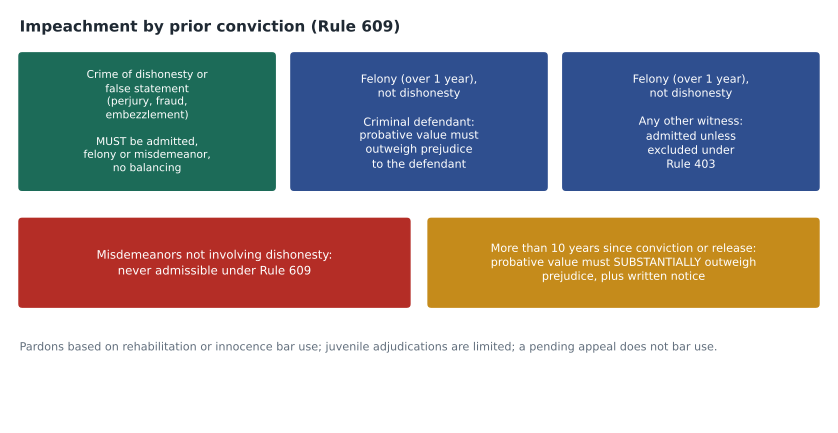
Rule 609 is among the most tested evidence rules. A conviction for any crime, felony or misdemeanor, whose elements required proving or admitting a dishonest act or false statement, such as perjury, fraud or embezzlement, must be admitted, with no balancing. A conviction for a crime punishable by death or more than one year in prison that does not involve dishonesty must be admitted, subject to Rule 403, in a civil case or against a witness other than a criminal defendant; against a criminal defendant who testifies, it is admitted only if its probative value outweighs its prejudicial effect to that defendant, a balance that favors exclusion. Misdemeanors that do not involve dishonesty are never admissible under Rule 609.
If more than ten years have passed since the conviction or release from confinement, whichever is later, the conviction is admissible only if its probative value, supported by specific facts and circumstances, substantially outweighs its prejudicial effect, and the proponent gives reasonable written notice. A pardon or annulment based on rehabilitation or innocence generally bars use, and juvenile adjudications are admissible only in a criminal case against a witness other than the defendant if admission is necessary to fairly determine guilt. A pending appeal does not bar use.
Rehabilitation and opinion testimony
After impeachment, a party may rehabilitate a witness by explanation on redirect, by reputation or opinion evidence of truthful character after an attack on character for truthfulness, and by a prior consistent statement under Rule 801(d)(1)(B). A lay witness may give opinions that are rationally based on the witness's perception, helpful to understanding the testimony or determining a fact in issue, and not based on scientific, technical or other specialized knowledge (Rule 701). Typical lay opinions include speed, intoxication, emotional state and handwriting familiarity.
Experts: Rules 702 to 706
A witness qualified by knowledge, skill, experience, training or education may testify in the form of an opinion if the proponent demonstrates to the court that it is more likely than not that the expert's specialized knowledge will help the trier of fact, the testimony is based on sufficient facts or data, it is the product of reliable principles and methods, and the expert's opinion reflects a reliable application of those principles and methods to the facts. The 2023 amendment to Rule 702 made explicit that the proponent must establish these requirements by a preponderance under Rule 104(a), and that the opinion must stay within what a reliable application of the method can support. Under Daubert v. Merrell Dow Pharmaceuticals (1993), extended to all experts by Kumho Tire Co. v. Carmichael (1999), the judge is the gatekeeper, considering factors such as testing, peer review, error rates, standards and general acceptance. General acceptance under the older Frye test is no longer the sole test in federal court.
Under Rule 703, an expert may base an opinion on facts or data the expert has been made aware of or personally observed, including inadmissible facts if experts in the field would reasonably rely on that kind of data; but the proponent may disclose otherwise inadmissible underlying facts to the jury only if their probative value in helping the jury evaluate the opinion substantially outweighs their prejudicial effect. In a criminal case, Smith v. Arizona (2024) adds that basis evidence an expert conveys as true is offered for its truth for Confrontation Clause purposes. An expert may testify to an ultimate issue (Rule 704(a)), except that in a criminal case an expert may not state an opinion about whether the defendant did or did not have a mental state that is an element of the crime or a defense (Rule 704(b)); in Diaz v. United States (2024), the Court held that the rule bars only opinions about the defendant himself, not general opinions about most people in the defendant's situation. A learned treatise can be read into evidence during an expert's testimony if established as reliable authority.
Privileges
Under Rule 501, federal common law, as interpreted by the courts in light of reason and experience, governs privileges in federal question and criminal cases, and state privilege law governs in civil cases where state law supplies the rule of decision. On the MBE, the main privileges are attorney-client, spousal, psychotherapist-patient and the privilege against self-incrimination.
The attorney-client privilege protects confidential communications between a client, or a prospective client, and a lawyer made for the purpose of obtaining or providing legal advice. The client holds it and may waive it. It protects communications, not underlying facts. For a corporation, it covers communications with employees at any level about matters within their duties made at the direction of superiors to get legal advice (Upjohn Co. v. United States, 1981). It survives the client's death (Swidler & Berlin v. United States, 1998). Exceptions include communications in furtherance of a future crime or fraud, disputes between the lawyer and client, and disputes between parties who claim through the same deceased client. Rule 502 limits waiver: inadvertent disclosure in a federal proceeding does not waive the privilege if the holder took reasonable steps to prevent and rectify it, and an intentional disclosure waives undisclosed material only if it concerns the same subject matter and in fairness ought to be considered together.
There are two spousal privileges under federal common law. The spousal testimonial privilege lets a spouse refuse to testify against the other spouse in a criminal case; under Trammel v. United States (1980), the witness-spouse alone holds it and may choose to testify. It exists only during a valid marriage. The marital communications privilege protects confidential communications made during the marriage; both spouses hold it, and it survives divorce. Neither applies in cases where one spouse is charged with a crime against the other or against a child of either. The psychotherapist-patient privilege covers licensed psychiatrists, psychologists and clinical social workers (Jaffee v. Redmond, 1996). There is no federal physician-patient privilege, and no general privilege for accountants or journalists under federal common law.
| Privilege | Holder | Survives? | Main exceptions |
|---|---|---|---|
| Attorney-client | Client | Yes, after death | Crime-fraud; lawyer-client disputes; joint clients in later dispute |
| Spousal testimonial (criminal cases) | Witness-spouse | Only during marriage | Crimes against the spouse or a child of either |
| Marital communications | Both spouses | Yes, after divorce, for statements made during marriage | Crimes against the spouse or a child; not confidential |
| Psychotherapist-patient | Patient | Yes | Patient puts condition in issue; some dangerousness exceptions |
Writings, recordings and photographs
Before any exhibit is admitted, it must be authenticated: the proponent must produce evidence sufficient to support a finding that the item is what the proponent claims it is (Rule 901). Methods include testimony of a witness with knowledge, nonexpert opinion on handwriting based on familiarity not acquired for the litigation, comparison by an expert or the jury, distinctive characteristics, voice identification, and evidence about a process or system. Rule 902 lists self-authenticating documents, such as certified public records, official publications, newspapers, trade inscriptions, acknowledged documents, commercial paper, and certified business records and electronic records under Rules 902(11), (13) and (14).
The best evidence rule, formally the original writing rule, requires the original writing, recording or photograph to prove its content (Rule 1002), but only when a party seeks to prove the content, such as the terms of a contract or what a recording shows, or when a witness testifies from the document rather than from independent knowledge. A duplicate is admissible to the same extent as the original unless a genuine question is raised about authenticity or it would be unfair (Rule 1003). Other evidence of content is admissible if the original is lost or destroyed without bad faith, cannot be obtained by judicial process, is in the opponent's control and the opponent was given notice, or the writing is not closely related to a controlling issue (Rule 1004).
Under Rule 1006 as amended in 2024, the court may admit a summary, chart or calculation offered to prove the content of voluminous admissible evidence that cannot be conveniently examined in court, whether or not the underlying evidence has been introduced, and the summary is itself evidence. The underlying originals or duplicates must be made available for examination or copying. New Rule 107 separately governs illustrative aids, such as a diagram or animation used only to help the jury understand evidence or argument. The court may allow an illustrative aid if its utility in assisting comprehension is not substantially outweighed by the danger of unfair prejudice, confusing the issues, misleading the jury, undue delay or wasting time. An illustrative aid is not evidence and may not go to the jury room during deliberations unless all parties consent or the court orders otherwise, and when practicable it must be entered into the record.
Worked problem
Impeachment with a conviction
In a civil negligence suit, the defendant calls an eyewitness. On cross-examination, the plaintiff seeks to ask the witness about (1) a conviction six years ago for misdemeanor shoplifting, (2) a conviction four years ago for felony assault, and (3) a conviction 14 years ago for felony fraud, from which the witness was released 13 years ago. Which may be used?
Show solution
- Shoplifting is a misdemeanor theft that does not require proof of a dishonest act or false statement as an element in most jurisdictions, so it is not admissible under Rule 609.
- Felony assault was punishable by more than a year; the witness is not a criminal defendant, so it is admissible subject to Rule 403.
- Felony fraud is a crime of dishonesty, but more than ten years have passed since conviction and release, so it is admissible only if its probative value substantially outweighs its prejudicial effect and the plaintiff gave written notice.
Answer: The assault conviction (subject to Rule 403); the fraud conviction only under the ten-year test; not the shoplifting.
Practice problems
Work each problem on paper first, then reveal the answer to check.
May a party impeach its own witness?
Show answer
Yes. Rule 607 allows any party to attack any witness's credibility.
Can a cross-examiner prove a witness lied on a loan application with the application itself?
Show answer
No. Rule 608(b) bars extrinsic evidence of specific instances; the examiner must take the answer.
Is a misdemeanor perjury conviction admissible to impeach?
Show answer
Yes. Crimes of dishonesty or false statement are admissible regardless of punishment, subject to the ten-year rule.
Who holds the spousal testimonial privilege in federal court?
Show answer
The witness-spouse (Trammel v. United States).
Does the best evidence rule apply to a witness who testifies from memory that a payment was made?
Show answer
No. The witness is not proving the content of a writing.
Under Rule 107, may an illustrative aid go to the jury room?
Show answer
Only if all parties consent or the court orders otherwise.
Common mistakes
MistakeAny felony conviction is automatically admissible to impeach any witness.
InsteadNon-dishonesty felonies are subject to Rule 403, or a stricter balance for criminal defendants.
MistakeExtrinsic evidence of a prior inconsistent statement may come in before the witness is confronted.
InsteadSince 2024, Rule 613(b) requires the opportunity to explain or deny first, unless the court orders otherwise.
MistakeFederal courts recognize a physician-patient privilege.
InsteadFederal common law recognizes a psychotherapist-patient privilege but not a general physician-patient privilege.
MistakeA summary under Rule 1006 requires that the underlying documents be admitted.
InsteadThe 2024 amendment allows the summary whether or not the underlying evidence is introduced.
Summary and key terms
- Witnesses need personal knowledge and an oath; Rule 606(b) limits juror testimony about deliberations.
- Impeach by bias, prior inconsistent statements (with the 2024 Rule 613(b) foundation), character for untruthfulness, specific acts on cross and Rule 609 convictions.
- Experts must meet Rule 702 by a preponderance, applying reliable methods reliably; Rule 704(b) limits mental-state opinions in criminal cases.
- Know the federal privileges: attorney-client (Upjohn, Rule 502), the two spousal privileges, and psychotherapist-patient.
- Authenticate exhibits; use originals to prove content; Rule 1006 summaries are evidence; Rule 107 illustrative aids are not.
- Impeachment
- Attacking a witness's credibility.
- Extrinsic evidence
- Evidence other than the witness's own testimony on cross-examination, such as documents or other witnesses.
- Gatekeeper
- The judge's role under Daubert and Rule 702 in screening expert testimony for reliability.
- Illustrative aid
- A visual or other aid used to help the jury understand evidence or argument, which is not itself evidence.
- Original writing rule
- The best evidence rule requiring the original to prove a writing's content.
Lesson quiz · 5 questions
Score 60% or more to complete this lesson.
Create a free account to save your progress, take quizzes and earn a certificate.