
BAR-111 · Lesson 5 of 12 · 23 min
Hearsay and its exceptions
▶ Video coming soon A video version of this lesson is on the way.
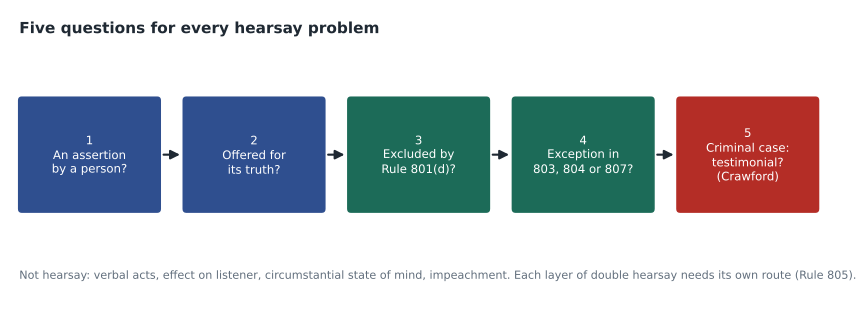
On Monday, October 19, Marchetti shares a slide with a single sentence on it: 'The light was red,' said the bystander to the officer. 'Is it hearsay?' she asks. Ngozi says yes, if offered to prove the light was red. Dana says it depends on whether the bystander testifies. Eddie, the evidence-weeks guest, says it might be a present sense impression. 'All three answers belong in your analysis,' Marchetti says. 'Hearsay questions are a sequence: Is it a statement? Is it offered for its truth? Is it excluded from the definition? Does an exception apply? And in a criminal case, does the Confrontation Clause still bar it?' About a quarter of the MBE's evidence questions come from hearsay.
The definition
Hearsay is a statement that the declarant does not make while testifying at the current trial or hearing, which a party offers in evidence to prove the truth of the matter asserted in the statement (Rule 801(c)). A statement is a person's oral assertion, written assertion or nonverbal conduct intended as an assertion (Rule 801(a)). Hearsay is inadmissible unless a statute, the rules or other Supreme Court rules provide otherwise (Rule 802).
Several things are not hearsay because they are not assertions or not offered for their truth. Questions and commands usually assert nothing. Machine output, such as a radar reading or a computer-generated timestamp, is not a statement by a person, although a proposed new Rule 707 on machine-generated evidence remains under consideration by the federal rules committees and is not in effect. Nonassertive conduct, such as a ship captain inspecting a vessel and then sailing with his family, is not hearsay under the federal rules even if offered to prove what the actor believed.
Many out-of-court statements are offered for a purpose other than their truth. Verbal acts or legally operative facts, such as the words of a contract offer, a defamatory statement or a bribe, are offered because they were said, not because they are true. A statement offered to show its effect on the listener, such as a warning offered to prove the listener had notice of a danger, is not hearsay. Nor is a statement offered to show the declarant's state of mind circumstantially, such as 'I am the Emperor of Mars' offered to prove insanity, or to impeach a witness with a prior inconsistent statement.
Not hearsay by definition: prior statements of a testifying witness
Rule 801(d)(1) treats three kinds of prior statements as not hearsay when the declarant testifies and is subject to cross-examination about the prior statement. First, a prior inconsistent statement. Under the rule as it stood through November 30, 2026, the prior inconsistent statement had to have been given under penalty of perjury at a trial, hearing or other proceeding or in a deposition. An amendment adopted by the Supreme Court on April 8, 2026, takes effect on December 1, 2026, and removes that requirement, so that any prior inconsistent statement of a witness who testifies and is subject to cross-examination about it is admissible as substantive evidence, not just for impeachment. The amendment applies to proceedings begun on or after that date and, insofar as just and practicable, to pending proceedings.
Marchetti flags the timing for the February 2027 takers. 'NCBE tests the Federal Rules of Evidence as currently in effect,' she says. 'Know both versions, and watch NCBE's announcements about when a change is tested. If a question turns on it, it will give you the facts you need, such as whether the earlier statement was under oath.'
Second, a prior consistent statement is not hearsay if offered to rebut a charge that the declarant recently fabricated the testimony or acted from a recent improper influence or motive, or to rehabilitate the declarant's credibility when attacked on another ground, such as inconsistency or faulty memory. Under Tome v. United States (1995), a statement offered to rebut a charge of recent fabrication must have been made before the alleged motive to fabricate arose. Third, a statement of identification of a person made after perceiving the person, such as a lineup identification, is not hearsay.
Not hearsay by definition: opposing party's statements
Under Rule 801(d)(2), a statement offered against a party is not hearsay if it was made by the party in an individual or representative capacity; is one the party manifested that it adopted or believed to be true, including by silence when a reasonable person would have denied it; was made by a person the party authorized to make a statement on the subject; was made by the party's agent or employee on a matter within the scope of that relationship while it existed; or was made by the party's co-conspirator during and in furtherance of the conspiracy. The statement does not need to be against interest when made, and personal knowledge is not required. The court may consider the statement itself in deciding authority, agency or conspiracy, but it alone is not enough.
A 2024 amendment, effective December 1, 2024, added that if a party's claim or defense is directly derived from a declarant or the declarant's principal, a statement that would be admissible against the declarant or principal is also admissible against the party. A statement by a decedent can therefore be used against the estate's representative, and a statement by an assignor against the assignee, resolving a split among the circuits.
Exceptions where availability does not matter: Rule 803
Rule 803 lists exceptions that apply whether or not the declarant is available. A present sense impression is a statement describing an event made while or immediately after the declarant perceived it. An excited utterance is a statement relating to a startling event made while the declarant was under the stress of excitement it caused; the time gap can be longer than for a present sense impression if the stress continues. A statement of the declarant's then-existing state of mind, emotional, sensory or physical condition, such as intent, plan, motive, pain or bodily health, is admissible, but not a statement of memory or belief to prove the fact remembered, except about the declarant's will. Under Mutual Life Insurance Co. v. Hillmon (1892), a statement of intent to do something can prove the declarant did it.
Statements made for medical diagnosis or treatment, describing medical history, symptoms or their general cause, are admissible if reasonably pertinent to diagnosis or treatment, even if made to a doctor hired only to testify. Statements of fault, such as who ran the red light, usually are not pertinent. A recorded recollection is a record of a matter the witness once knew but now cannot recall well enough to testify fully, made or adopted when fresh in memory and accurately reflecting the witness's knowledge; it may be read into evidence but received as an exhibit only if offered by the adverse party.
Records of a regularly conducted activity, the business records exception, cover a record made at or near the time by, or from information transmitted by, someone with knowledge, kept in the course of a regularly conducted activity, if making the record was a regular practice, all shown by a custodian's testimony or a certification, unless the opponent shows the source or method indicates a lack of trustworthiness. Reports prepared in anticipation of litigation often fail this test (Palmer v. Hoffman, 1943). Public records cover a public office's activities, matters observed under a legal duty to report (but not, in a criminal case, matters observed by law enforcement personnel), and, in civil cases and against the government in criminal cases, factual findings from a legally authorized investigation.
Other Rule 803 exceptions appear less often: the absence of a business or public record, vital statistics, learned treatises established as reliable authority (read into evidence but not received as exhibits), statements in ancient documents prepared before January 1, 1998, market reports, reputation concerning personal or family history, and judgments of previous felony convictions offered to prove a fact essential to the judgment.
Exceptions requiring unavailability: Rule 804
A declarant is unavailable if exempted by privilege, if he refuses to testify despite a court order, testifies to not remembering, is dead or ill, or is absent and the proponent could not procure attendance or, for some exceptions, testimony by reasonable means (Rule 804(a)). A proponent who wrongfully caused the unavailability cannot use it.
Former testimony given at a trial, hearing or lawful deposition is admissible if the party against whom it is offered, or in a civil case a predecessor in interest, had an opportunity and similar motive to develop it by examination. A statement under the belief of imminent death is admissible in a homicide prosecution or civil case if the declarant believed death was imminent and the statement concerns its cause or circumstances; the declarant need not actually die, but must be unavailable. A statement against interest is one a reasonable person would have made only if believed true because it was so contrary to the declarant's pecuniary, proprietary or penal interest or would expose the declarant to civil or criminal liability. If offered in a criminal case and it tends to expose the declarant to criminal liability, it must be supported by corroborating circumstances clearly indicating its trustworthiness; the 2024 amendment directs the court to consider the totality of the circumstances under which it was made and any evidence that corroborates or contradicts it. Statements of personal or family history and statements offered against a party who wrongfully caused the declarant's unavailability (forfeiture by wrongdoing) complete the list.
The residual exception and hearsay within hearsay
Rule 807 admits a hearsay statement not covered by Rules 803 or 804 if it is supported by sufficient guarantees of trustworthiness, considering the totality of the circumstances and any corroborating evidence, and it is more probative on the point for which it is offered than any other evidence the proponent can obtain through reasonable efforts. The proponent must give reasonable written notice. Under Rule 805, hearsay within hearsay is admissible only if each layer fits an exception or exclusion, a favorite MBE test point with police reports quoting bystanders.
| Exception | Rule | Availability needed? | Key requirement |
|---|---|---|---|
| Present sense impression | 803(1) | No | Describes event while or immediately after perceiving it |
| Excited utterance | 803(2) | No | Made under stress of a startling event |
| State of mind or condition | 803(3) | No | Then-existing; not memory to prove the fact remembered |
| Medical diagnosis or treatment | 803(4) | No | Reasonably pertinent to diagnosis or treatment |
| Business records | 803(6) | No | Regular practice, at or near the time, by someone with knowledge |
| Former testimony | 804(b)(1) | Yes | Opportunity and similar motive to examine |
| Dying declaration | 804(b)(2) | Yes | Homicide or civil case; belief of imminent death; cause or circumstances |
| Statement against interest | 804(b)(3) | Yes | Against interest when made; corroboration if exculpatory in criminal case |
The Confrontation Clause
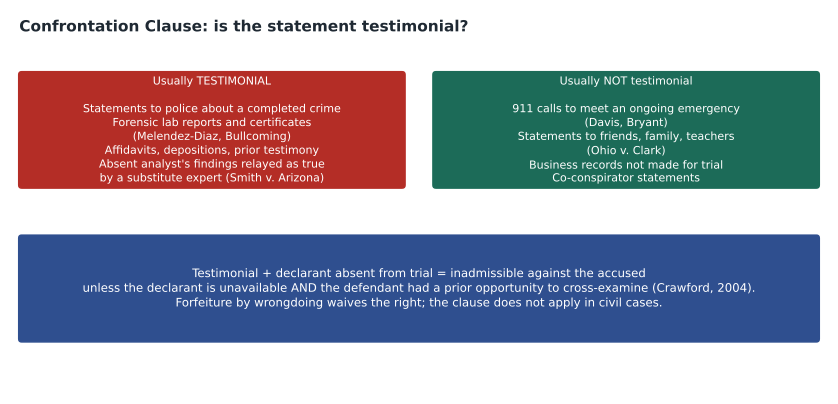
In a criminal case, an out-of-court statement that satisfies a hearsay exception may still be barred by the Sixth Amendment. Under Crawford v. Washington (2004), testimonial statements of a witness who does not appear at trial are admissible against the accused only if the witness is unavailable and the defendant had a prior opportunity to cross-examine. Statements are testimonial when their primary purpose is to establish or prove past events potentially relevant to later prosecution, such as statements to police describing a completed crime; statements to police whose primary purpose is to meet an ongoing emergency are not testimonial (Davis v. Washington, 2006; Michigan v. Bryant, 2011). Statements to private persons, such as a child's statements to a teacher, are much less likely to be testimonial (Ohio v. Clark, 2015).
Forensic reports prepared to prove a fact at trial are testimonial, and the analyst must testify (Melendez-Diaz v. Massachusetts, 2009); a surrogate analyst who did not perform or observe the test is not enough (Bullcoming v. New Mexico, 2011). In Smith v. Arizona (2024), the Court held that when an expert conveys an absent analyst's statements in support of the expert's opinion, and the statements support that opinion only if they are true, the statements are offered for their truth; it left to the state courts whether the statements there were testimonial. And a defendant does not forfeit confrontation rights by 'opening the door' through his own argument (Hemphill v. New York, 2022). The Confrontation Clause does not apply in civil cases.
Worked problem
Layered hearsay in a police report
In a civil suit over a car crash, the plaintiff offers a police officer's report. It records the officer's own measurements of skid marks and a bystander's statement, "The blue car ran the red light." The officer made the report as part of her duty to investigate accidents. Which parts are admissible?
Show solution
- The report itself is a public record of matters observed under a legal duty, admissible in a civil case under Rule 803(8), so the officer's measurements come in.
- The bystander's statement is a second layer of hearsay. The bystander had no duty to report, so the public records exception does not cover the bystander's words.
- Under Rule 805, the bystander's statement is admissible only if it fits its own exception, such as present sense impression or excited utterance, which depends on timing and stress the facts must show.
Answer: The measurements are admissible; the bystander's statement needs its own exception.
Practice problems
Work each problem on paper first, then reveal the answer to check.
A plaintiff offers a written warning sign to show the defendant knew of the danger. Is it hearsay?
Show answer
No, if offered to show notice (effect on the reader), not the truth of the warning.
Must a party's own statement have been against interest when made to be admissible against him?
Show answer
No. Opposing party statements need not be against interest.
Which hearsay exceptions require unavailability?
Show answer
Former testimony, dying declaration, statement against interest, personal or family history and forfeiture by wrongdoing (Rule 804).
A victim tells an emergency dispatcher, "He has a gun and is coming back!" Is it testimonial?
Show answer
Likely not; its primary purpose is to meet an ongoing emergency.
From December 1, 2026, must a prior inconsistent statement have been under oath to be substantive evidence?
Show answer
No. The amendment removes the oath and proceeding requirement for a witness who testifies and is subject to cross-examination.
Is a statement to a doctor that "the driver who hit me was drunk" within the medical diagnosis exception?
Show answer
Generally no; fault is not reasonably pertinent to diagnosis or treatment.
Common mistakes
MistakeEvery out-of-court statement is hearsay.
InsteadOnly statements offered to prove the truth of the matter asserted.
MistakeA dying declaration is admissible in any criminal case.
InsteadOnly in homicide prosecutions and civil cases, and the declarant must be unavailable.
MistakeBusiness records come in if any employee wrote them.
InsteadThe record must be made at or near the time by someone with knowledge as a regular practice.
MistakeA hearsay exception satisfies the Confrontation Clause.
InsteadTestimonial statements still require unavailability and a prior opportunity to cross-examine.
Summary and key terms
- Hearsay is an out-of-court statement offered for its truth; verbal acts, effect on the listener and circumstantial state of mind are not hearsay.
- Rule 801(d) excludes certain prior statements of testifying witnesses and opposing party statements; from December 1, 2026, prior inconsistent statements need no oath.
- Rule 803 exceptions apply regardless of availability; Rule 804 exceptions require unavailability; Rule 807 is the residual exception with notice.
- Each layer of hearsay within hearsay needs its own exception.
- In criminal cases, testimonial statements require unavailability and a prior opportunity to cross-examine (Crawford, Melendez-Diaz, Smith v. Arizona).
- Hearsay
- An out-of-court statement offered to prove the truth of the matter asserted.
- Declarant
- The person who made the out-of-court statement.
- Opposing party's statement
- A party's own statement, adopted statement, or statement of its agent or co-conspirator, offered against it.
- Testimonial statement
- A statement whose primary purpose is to establish past facts for possible prosecution.
- Unavailability
- A declarant's absence, death, illness, privilege, refusal or lack of memory under Rule 804(a).
Lesson quiz · 5 questions
Score 60% or more to complete this lesson.
Create a free account to save your progress, take quizzes and earn a certificate.