
BAR-111 · Lesson 9 of 12 · 22 min
Conveyancing, mortgages and recording acts
▶ Video coming soon A video version of this lesson is on the way.
The last Monday session, on November 16, is the one Ngozi has been dreading. 'In Nigeria we have land registration,' she says. 'Recording acts with three different notice rules feel like a puzzle designed to trick me.' Marchetti agrees that they are a puzzle, but a solvable one. 'Every recording act question has the same structure,' she says. 'Who conveyed to whom, in what order? Who recorded, and when? Who paid value, and who had notice? Then you read the statute the question gives you.' This lesson covers the other three-fifths of the real property outline: real estate contracts, mortgages and other security devices, and titles, including adverse possession, deeds and recording.
Real estate contracts
A contract for the sale of land must satisfy the statute of frauds: a writing signed by the party to be charged that identifies the parties, describes the land and states the price. Under the part performance doctrine, a court may enforce an oral contract if the buyer has done things unreferable to anything but a contract, usually some combination of taking possession, paying all or part of the price and making substantial improvements.
Every land sale contract carries an implied promise that the seller will deliver marketable title at closing: title reasonably free from doubt, so that a reasonable buyer would not fear litigation. Defects that make title unmarketable include a gap in the chain of title, adverse possession claims, encumbrances such as mortgages and liens, easements that are not visible or beneficial, and violations of restrictive covenants. A seller may cure a mortgage by paying it off at closing with the sale proceeds. Zoning restrictions do not make title unmarketable, but an existing violation of a zoning ordinance does. If title is unmarketable, the buyer must notify the seller and give a reasonable time to cure before closing; the buyer may then rescind, sue for damages or demand specific performance with a price reduction.
Under the doctrine of equitable conversion, once the contract is signed, the buyer is treated as the equitable owner of the land and the seller as the holder of a right to the money. As a result, under the majority rule, the risk of loss from casualty, such as fire, falls on the buyer between signing and closing, unless the contract or a statute says otherwise; the Uniform Vendor and Purchaser Risk Act, adopted in some states, leaves the risk on the seller until the buyer takes possession or title. If the seller has insurance and the buyer bears the loss, the buyer is credited with the insurance proceeds. Equitable conversion also means that if the buyer dies before closing, the buyer's interest passes as real property to the heirs, who can demand the land, while if the seller dies, the seller's interest passes as personal property, the right to the proceeds.
A seller of residential property generally must disclose known, material latent defects not reasonably discoverable by the buyer; a general 'as is' clause does not protect against fraud or concealment. Builders of new homes give an implied warranty of fitness or quality, which in many states runs to later purchasers for latent defects. Time is ordinarily not of the essence in a land contract unless the contract says so or circumstances show the parties intended it, so a party who misses the closing date by a reasonable time can still enforce the contract, subject to damages.
Deeds and delivery
A deed must identify the parties, describe the land adequately, show words of present intent to convey, and be signed by the grantor; consideration and recording are not required for validity between the parties. The deed transfers title only when delivered, meaning the grantor intends it to take effect immediately, even if possession is postponed. Physical handing over creates a presumption of delivery, and recording creates one too; a deed kept by the grantor raises a presumption of no delivery. A deed handed to the grantee with an oral condition is generally treated as delivered free of the condition. Delivery to an escrow agent with instructions to deliver on the occurrence of a condition is effective, and on the condition's occurrence title relates back to the original delivery when necessary to accomplish justice.
Deeds differ in the title promises they make. A general warranty deed contains six covenants. The three present covenants, breached if at all at the time of conveyance, are seisin (the grantor owns the estate), the right to convey, and against encumbrances. The three future covenants, breached only when the grantee is disturbed, are quiet enjoyment, warranty and further assurances, and they run with the land to later grantees. A special warranty deed covers only defects arising while the grantor held title. A quitclaim deed makes no promises at all, conveying whatever interest the grantor has. After closing, the contract's promise of marketable title merges into the deed, so the buyer's remedies are limited to the deed's covenants.
Adverse possession
A person acquires title by adverse possession through possession that is actual, open and notorious, exclusive, hostile or adverse, and continuous for the statutory period. Hostile means without the owner's permission; in most states the possessor's state of mind does not matter. Successive possessors may tack their periods together if they are in privity, such as by a deed or will. The statute does not run against an owner who was under a disability, such as minority or insanity, when the possession began, and it does not run against the government. A possessor who enters under color of title, a defective deed, may acquire title to the whole parcel described in the deed even if he actually occupied only part. An adverse possessor's title is not recorded until a court action to quiet title, but it is valid against the record owner and later purchasers.
Recording acts
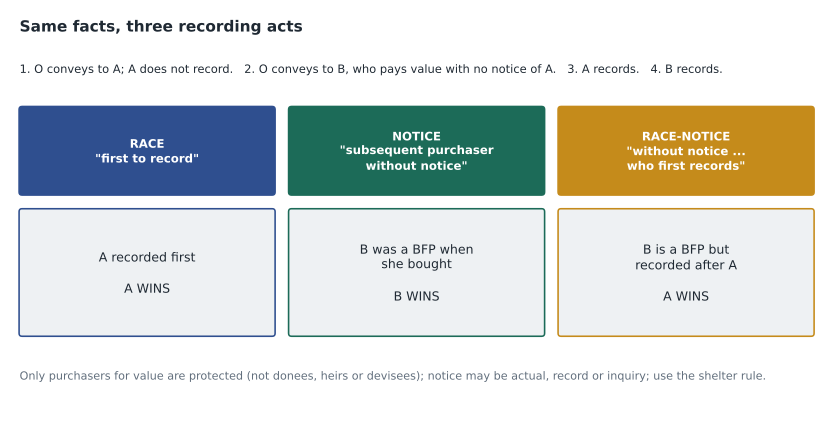
At common law, the first in time prevailed: once O conveyed to A, O had nothing left to convey to B. Recording acts change that result to protect later purchasers who rely on the public records. There are three kinds. Under a race statute, used in only a few states, the first to record wins, regardless of notice. Under a notice statute, a subsequent bona fide purchaser for value without notice of the earlier conveyance prevails, whether or not he records; a typical notice statute says an unrecorded conveyance is invalid against any subsequent purchaser for value without notice. Under a race-notice statute, a subsequent bona fide purchaser prevails only if he also records before the earlier grantee; a typical statute says an unrecorded conveyance is invalid against a subsequent purchaser for value without notice who first records.
Marchetti's tip is to identify the statute by its wording. If the statute mentions only notice, it is a notice statute. If it mentions both notice and recording first ('who first duly records,' 'whose conveyance is first recorded'), it is race-notice. If it mentions only recording first, it is a race statute.
Only purchasers for value are protected; donees, heirs and devisees are not, though they take the protection of a protected grantor under the shelter rule. Value need not be market value, but must be more than nominal. A mortgagee who lends money is a purchaser for value, and in most states a judgment creditor is not. A purchaser's notice can be actual; record notice, from a properly recorded instrument in the chain of title; or inquiry notice, from facts that would lead a reasonable purchaser to investigate, such as someone else in possession of the land, or a reference in a recorded document to an unrecorded one.
The shelter rule says a person who takes from a bona fide purchaser stands in the shoes of that purchaser and is protected, even if he himself had notice or is a donee. An exception prevents a grantor who was once on the chain of title with notice from reacquiring the land and sheltering under an intervening bona fide purchaser.
Chain-of-title problems are a favorite. A wild deed, recorded but outside the chain of title because a link in the chain is unrecorded, does not give record notice. A deed recorded late, after the grantor conveyed to someone else, may not give notice to later purchasers in many states because a searcher would not look for it. And under the estoppel by deed doctrine, if a grantor conveys land she does not own and later acquires it, title passes automatically to the earlier grantee, though a subsequent bona fide purchaser from the grantor after she acquires title may prevail in some states.
Mortgages and security devices
A mortgage is a security interest in land that secures a debt, usually a promissory note. Most states follow the lien theory, under which the mortgagee holds only a lien and the mortgagor keeps title and the right to possession until foreclosure. A few follow the title theory, under which the mortgagee holds legal title until the debt is paid. Equitable mortgages arise from a deed absolute on its face given as security, and installment land contracts and deeds of trust serve similar purposes; courts increasingly treat installment contracts like mortgages and require foreclosure rather than forfeiture.
When the mortgagor transfers the land, the buyer takes it subject to the mortgage. A buyer who takes subject to the mortgage is not personally liable on the debt, but the land can be foreclosed. A buyer who assumes the mortgage agrees to pay and becomes personally liable, with the original mortgagor still liable as a surety. Most mortgages include a due-on-sale clause that lets the lender demand full payment if the property is transferred; such clauses are generally enforceable under federal law, with exceptions for certain residential transfers. The mortgagee may transfer the note and mortgage together; a holder in due course of a negotiable note takes free of personal defenses.
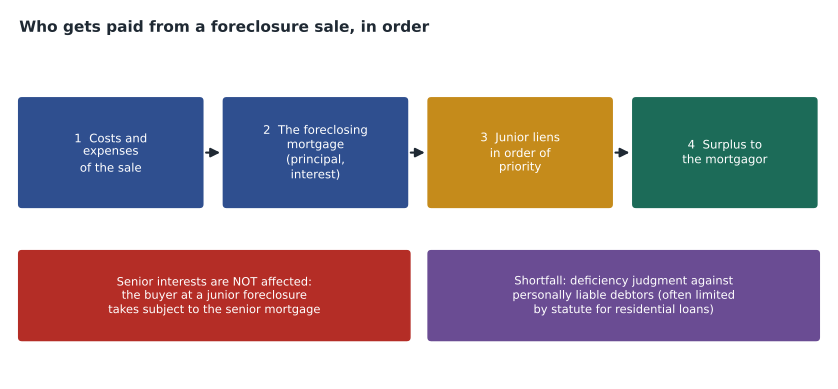
Before a foreclosure sale, the mortgagor has an equitable right of redemption, paying the full amount due, including any accelerated balance. About half the states also give a statutory right of redemption for a period after the sale. Foreclosure is usually by judicial sale, though many states allow a nonjudicial power-of-sale foreclosure under a deed of trust. Sale proceeds pay the costs of sale, then the foreclosing mortgage, then junior interests in order of priority, with any surplus going to the mortgagor. If proceeds fall short, the mortgagee may seek a deficiency judgment against a personally liable debtor, though many states limit deficiencies, especially for residential purchase-money mortgages.
Foreclosure wipes out interests junior to the foreclosing mortgage, if those holders are made parties, but does not affect senior interests; the buyer at the sale takes subject to senior mortgages. Priority generally follows the recording acts and the order of creation. A purchase-money mortgage, given to finance the purchase of the land itself, takes priority over other liens arising through the mortgagor, even earlier judgment liens, and a seller's purchase-money mortgage beats a third-party lender's. A senior mortgage may lose priority to a junior one under subordination agreements, or when the senior mortgagee agrees to a modification that materially prejudices the junior holder, as to the change only.
| Situation | Rule |
|---|---|
| Buyer takes subject to the mortgage | Land is liable; buyer not personally liable |
| Buyer assumes the mortgage | Buyer personally liable; original mortgagor remains liable as surety |
| Foreclosure by senior mortgagee | Junior interests made parties are extinguished; surplus goes to juniors then mortgagor |
| Foreclosure by junior mortgagee | Buyer at sale takes subject to the senior mortgage |
| Purchase-money mortgage | Priority over earlier liens against the mortgagor |
| Equitable redemption | Before sale, pay the full amount due; cannot be waived in the mortgage |
Worked problem
A race-notice problem
A jurisdiction's statute provides: "No conveyance of land is valid against any subsequent purchaser for value without notice whose conveyance is first recorded." O sells Greenacre to A, who does not record. O then sells Greenacre to B for value; B has no notice of A. A records the next day. B records a week later. Who owns Greenacre?
Show solution
- The statute protects a subsequent purchaser who is without notice and whose conveyance is first recorded, so it is a race-notice statute.
- B is a subsequent purchaser for value without notice, so B would win under a pure notice statute.
- But A recorded before B, so B fails the race element.
Answer: A owns Greenacre.
Practice problems
Work each problem on paper first, then reveal the answer to check.
Between signing and closing, a house burns without fault. Who bears the loss under the majority rule?
Show answer
The buyer, under equitable conversion, unless the contract or a statute provides otherwise.
Does an existing zoning violation make title unmarketable?
Show answer
Yes, though zoning restrictions themselves do not.
Which deed covenants run with the land?
Show answer
The future covenants: quiet enjoyment, warranty and further assurances.
Is a donee protected by a recording act?
Show answer
No. Only purchasers for value, though a donee from a protected purchaser takes shelter.
A buyer takes "subject to" a mortgage and the debt goes unpaid. Is the buyer personally liable?
Show answer
No. The land can be foreclosed, but the buyer has no personal liability.
Does a foreclosure by a junior mortgagee wipe out the senior mortgage?
Show answer
No. The buyer at the sale takes subject to it.
Common mistakes
MistakeRecording is required for a deed to be valid.
InsteadA deed is valid between the parties on delivery; recording protects against later purchasers.
MistakeUnder a race-notice statute, a later bona fide purchaser always wins.
InsteadHe must also record first.
MistakeMarketable title means perfect title.
InsteadIt means title reasonably free from doubt; mortgages paid at closing do not defeat it.
MistakeForeclosure eliminates every interest in the property.
InsteadOnly junior interests made parties; senior interests survive.
Summary and key terms
- Land contracts need a signed writing; sellers must deliver marketable title; equitable conversion puts risk of loss on the buyer in most states.
- Deeds require delivery with present intent; warranty deeds carry three present and three future covenants; the contract merges into the deed.
- Adverse possession requires actual, open and notorious, exclusive, hostile and continuous possession for the statutory period, with tacking in privity.
- Identify the recording act by its words: race, notice or race-notice; only purchasers for value without notice are protected; use the shelter rule.
- Mortgagees in most states hold liens; know subject-to versus assumption, redemption, foreclosure order and purchase-money priority.
- Equitable conversion
- The doctrine treating the buyer as owner of the land once a sale contract is signed.
- Marketable title
- Title reasonably free from doubt, which the seller impliedly promises to deliver.
- Bona fide purchaser
- A purchaser for value without notice of an earlier conveyance.
- Shelter rule
- A person taking from a bona fide purchaser receives that purchaser's protection.
- Equitable right of redemption
- The mortgagor's right to pay off the debt and keep the land before a foreclosure sale.
Lesson quiz · 5 questions
Score 60% or more to complete this lesson.
Create a free account to save your progress, take quizzes and earn a certificate.