
BAR-111 · Lesson 2 of 12 · 23 min
Inchoate crimes, parties and defenses
▶ Video coming soon A video version of this lesson is on the way.
On Monday, September 21, Marchetti starts with a question she says catches more strong candidates than any homicide problem. Two friends agree to rob a pharmacy. One buys masks, then gets cold feet and calls the other to say he is out. The other robs the pharmacy alone. 'What is the first friend guilty of?' Dana answers conspiracy at once. Sofia adds that he might be liable for the robbery too. Ngozi asks whether withdrawal helps. 'All three of you are partly right,' Marchetti says, 'and that is the whole lesson. Inchoate crimes, accomplice liability and defenses interact. You have to take them one at a time.'
Solicitation
Solicitation is asking, encouraging or commanding another person to commit a crime, with the intent that the person commit it. The crime is complete when the request is made; the other person need not agree or act. If the person solicited agrees, both become conspirators, and solicitation merges into the conspiracy. If the solicited crime is committed, the solicitor is usually liable for it as an accomplice. Most states do not recognize withdrawal or renunciation as a defense to a completed solicitation, though the Model Penal Code allows renunciation if the solicitor persuades the other person not to commit the crime or otherwise prevents it.
Conspiracy
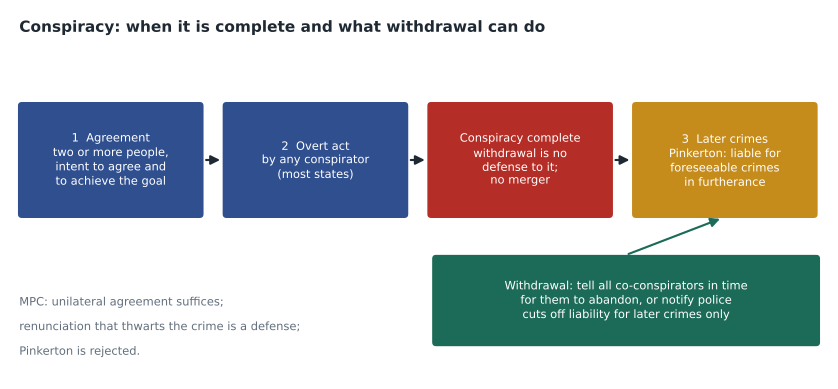
Conspiracy at common law is an agreement between two or more persons to commit an unlawful act, with the intent to agree and the intent to achieve the objective. Most states, and federal law for most conspiracy statutes, also require an overt act in furtherance of the agreement, though any act by any conspirator suffices, even a trivial one such as buying a map. Unlike attempt, conspiracy does not merge into the completed crime: a defendant may be convicted of both conspiracy to rob and robbery.
The agreement does not need to be written or even spoken; it may be inferred from concerted action. The traditional bilateral approach required at least two guilty minds, so if the only other party was an undercover officer or was feigning agreement, there was no conspiracy. The Model Penal Code and many modern statutes take a unilateral approach: a defendant is guilty if he agrees with another person, even if that person secretly does not agree. On the MBE, read the question for a statute or a hint about which approach applies; absent a hint, the majority of states now follow the unilateral approach, but the bilateral approach remains the traditional answer when the question asks about the common law.
Wharton's Rule says that when a crime by definition requires two people, such as adultery, bigamy or dueling, there is no conspiracy unless more people than the minimum agree. Similarly, a person in the class the statute protects, such as a minor in a statutory rape case, cannot be a conspirator to that crime.
Each conspirator is liable not only for the conspiracy but also for crimes committed by co-conspirators in furtherance of the conspiracy, if those crimes were reasonably foreseeable. This is the Pinkerton rule, from Pinkerton v. United States (1946). The Model Penal Code rejects Pinkerton and holds conspirators liable for co-conspirators' crimes only if they are accomplices.
Withdrawal is narrow. At common law, withdrawal is never a defense to the conspiracy itself once the agreement and any overt act have occurred. But a conspirator who withdraws can avoid liability for co-conspirators' later crimes by communicating the withdrawal to all co-conspirators in time for them to abandon the plan, or by notifying the police. The Model Penal Code allows renunciation as a defense to conspiracy if the defendant thwarts the conspiracy's success.
Attempt
Attempt requires a specific intent to commit the target crime and an act that goes beyond mere preparation. Because attempt is a specific intent crime, there is no attempt to commit a crime that does not require intent: there is no attempted involuntary manslaughter and no attempted felony murder. For attempted murder, the defendant must intend to kill; intent to cause serious bodily harm is not enough even though it would support murder if the victim died.
Courts use different tests for the act. The traditional proximity test asked whether the defendant came dangerously close to completing the crime. The Model Penal Code, followed by most modern courts and usually the MBE answer, asks whether the defendant took a substantial step that strongly corroborates the criminal intent, such as lying in wait, enticing the victim to the scene, reconnoitering the place, or possessing materials specially designed for the crime near the scene.
Impossibility is a frequent test point. Factual impossibility, where the defendant would have committed the crime if the facts had been as he believed, is no defense: a pickpocket who reaches into an empty pocket is guilty of attempted larceny. Legal impossibility, where the defendant's intended act is not a crime at all even if completed as planned, is a defense. A defendant who smuggles what he thinks is a prohibited item, but which the law does not in fact prohibit, has committed no attempt. Most modern statutes and the Model Penal Code abolish the distinction for cases in which the defendant would be guilty if the circumstances were as he believed them to be.
Abandonment is not a defense at common law once the attempt is complete. The Model Penal Code permits abandonment if it is fully voluntary and complete; abandonment because of a police officer's arrival or the victim's unexpected resistance is not voluntary. Attempt merges into the completed crime, so a defendant cannot be convicted of both attempted robbery and robbery for the same act.
| Inchoate crime | Mental state | Act required | Merges with completed crime? | Withdrawal or abandonment |
|---|---|---|---|---|
| Solicitation | Intent that the person commit the crime | The request itself | Yes | Not at common law; MPC allows if crime is prevented |
| Conspiracy | Intent to agree and to achieve the objective | Agreement plus overt act (most states) | No | Not to conspiracy itself; can cut off later crimes |
| Attempt | Specific intent to commit the target crime | Substantial step (MPC) or dangerous proximity | Yes | Not at common law; MPC allows voluntary and complete abandonment |
Accomplice liability
At common law, parties were classified as principals in the first degree (who commit the act), principals in the second degree (who are present and aid), accessories before the fact (who aid or encourage but are absent), and accessories after the fact (who help a felon avoid arrest after the crime). Modern law treats the first three as accomplices, all liable for the crime itself. An accessory after the fact commits a separate, less serious crime, often called obstruction or harboring.
An accomplice is one who, with the intent that the crime be committed, aids, counsels or encourages the principal. Mere presence at the scene, even with knowledge that a crime is occurring, is not enough. Selling goods or services to a person you know will use them for a crime is usually not enough either, unless the seller has a stake in the venture, charges an inflated price, or the crime is very serious. An accomplice is liable for the crime he intended to assist and for other crimes that were the natural and probable consequences of it, under the majority common-law view.
An accomplice may withdraw before the crime is committed by repudiating encouragement or, if he provided material help, by neutralizing the help, for example by retrieving the weapon he supplied, or by notifying the police in time. Going home without saying anything is not enough if his earlier aid remains effective.
Worked problem
Conspiracy, Pinkerton and withdrawal
Ava and Ben agree to burglarize a warehouse. Ben buys bolt cutters. The next day Ava tells Ben she is out and will not help. Ben recruits Cal, and that night they break in; Cal shoots and wounds a guard. In a common-law jurisdiction that follows Pinkerton, of what is Ava guilty?
Show solution
- The agreement plus Ben's purchase of bolt cutters completed the conspiracy, so Ava is guilty of conspiracy; withdrawal is no defense to it.
- Ava communicated her withdrawal to Ben before the burglary, which in most courts cuts off Pinkerton liability for later crimes if communicated to all co-conspirators in time. Ben was then the only other conspirator.
- Ava gave no material aid that remained effective, so she is not an accomplice to the burglary or the shooting.
Answer: Conspiracy to commit burglary only.
Responsibility defenses: insanity
Insanity is a legal, not medical, concept, and the jurisdiction's test controls. Under the M'Naghten rule, a defendant is not guilty if, because of a mental disease or defect, he did not know the nature and quality of his act or did not know that it was wrong. The irresistible impulse test, used in some states alongside M'Naghten, also excuses a defendant who, because of mental illness, could not control his conduct. The Durham rule, now used only in New Hampshire, asks whether the crime was the product of mental disease. The Model Penal Code test excuses a defendant who lacked substantial capacity either to appreciate the criminality of his conduct or to conform his conduct to the law. Federal law, under the Insanity Defense Reform Act of 1984, uses a version of M'Naghten and requires the defendant to prove insanity by clear and convincing evidence.
The Constitution does not require any particular insanity test. In Kahler v. Kansas (2020), the Supreme Court held that due process does not require a state to adopt an insanity test that turns on whether a defendant knew his act was morally wrong; Kansas could allow mental illness only to negate mens rea and to mitigate the sentence. Separately, a defendant who cannot understand the proceedings or assist counsel is incompetent to stand trial, a question about his condition at the time of trial, not at the time of the crime.
Intoxication
Voluntary intoxication, from the knowing ingestion of a substance known to be intoxicating, is a defense only to specific intent crimes, and only if it prevented the defendant from forming the intent. It is never a defense to general intent, malice or strict liability crimes, so a drunk driver who kills cannot escape depraved-heart murder by showing intoxication. A defendant who gets drunk to build courage for a planned crime gets no defense. Involuntary intoxication, from unknowing ingestion or duress, is treated like a mental illness and can defend against any crime if it meets the jurisdiction's insanity test. In Montana v. Egelhoff (1996), the Supreme Court upheld a state law barring the jury from considering voluntary intoxication on the question of mental state.
Justification: self-defense and related defenses
A person may use non-deadly force when he reasonably believes it necessary to protect himself from imminent unlawful force. Deadly force is justified only when the person reasonably believes he faces imminent death or serious bodily harm. The majority rule imposes no duty to retreat before using deadly force; a minority of states require retreat if it can be done in complete safety, but even those states do not require retreat from one's own home or by a victim of a violent crime such as rape or robbery. An initial aggressor may regain the right of self-defense by withdrawing in good faith and communicating it, or when the other party escalates suddenly from non-deadly to deadly force.
A person may defend others on the same terms as self-defense; in most states the defender may act on a reasonable appearance of the need, even if wrong. Deadly force is never justified to protect property alone, though reasonable non-deadly force is. Police and citizens may use reasonable force to make a lawful arrest; deadly force by police against a fleeing suspect is constitutional only if necessary to prevent escape and the officer has probable cause to believe the suspect poses a significant threat of death or serious physical injury, under Tennessee v. Garner (1985).
Necessity justifies conduct that would otherwise be criminal when the defendant reasonably believed it was necessary to avoid a greater harm, and the harm avoided was greater than the harm caused. It applies to pressure from natural forces, does not justify homicide, and is unavailable if the defendant created the danger.
Excuse: duress, mistake and entrapment
Duress excuses a crime other than intentional homicide if the defendant reasonably believed another person would imminently kill or seriously injure him or a family member unless he committed the crime. Unlike necessity, the pressure comes from a person. It is no defense to murder.
Mistake of fact defends if it negates the required mental state. For specific intent crimes, any honest mistake, even unreasonable, can negate intent; for general intent and malice crimes, the mistake must be reasonable; for strict liability crimes, mistake is no defense. Mistake of law is generally no defense, but it helps when the statute itself makes knowledge of the law an element, when the law was not published or reasonably available, or when the defendant reasonably relied on an official statement of the law later held invalid, such as a statute, a judicial decision, or an official interpretation by the public officer responsible for enforcing it. Advice from a private lawyer is not enough.
Entrapment requires that the criminal design originated with the government and that the defendant was not predisposed to commit the crime. Under the subjective test used by federal courts and most states, predisposition defeats the defense. Merely providing an opportunity, such as an undercover officer offering to buy drugs, is not entrapment. And a private person, as opposed to a government agent, cannot entrap.
Practice problems
Work each problem on paper first, then reveal the answer to check.
Is there attempted felony murder?
Show answer
No. Attempt requires specific intent to commit the target crime, and felony murder requires no intent to kill.
Two people agree to rob a bank, and one buys a getaway car. One then says he quits. Is he guilty of conspiracy?
Show answer
Yes. The conspiracy was complete with the agreement and overt act; withdrawal is no defense to it.
Under the subjective test, does entrapment succeed if the defendant was predisposed?
Show answer
No. Predisposition defeats entrapment.
Can duress excuse murder?
Show answer
No. Duress is not a defense to intentional homicide.
A shop owner sells ordinary gloves to a customer at the regular price, knowing he will wear them during a burglary. Is the owner an accomplice?
Show answer
Usually no. Knowledge alone, with no stake in the crime and an ordinary sale, is generally not enough.
Which mistake of fact defends against larceny?
Show answer
Any honest mistake, even an unreasonable one, that negates the intent to steal, such as believing the property was one's own.
Common mistakes
MistakeConspiracy merges into the completed crime.
InsteadConspiracy does not merge; solicitation and attempt do.
MistakeFactual impossibility is a defense to attempt.
InsteadFactual impossibility is no defense; legal impossibility is.
MistakeVoluntary intoxication is a defense to any crime if the defendant was very drunk.
InsteadOnly specific intent crimes, and only if it prevented forming the intent.
MistakeThere is always a duty to retreat before using deadly force.
InsteadThe majority imposes no duty; minority states require retreat only if completely safe, and never from one's home.
Summary and key terms
- Solicitation is complete on asking; conspiracy needs agreement, intent and (in most states) an overt act; attempt needs specific intent and a substantial step.
- Conspiracy does not merge; Pinkerton makes conspirators liable for foreseeable crimes in furtherance, and withdrawal cuts off only later crimes.
- Accomplices must intend to aid; mere presence or knowledge is not enough; withdrawal requires neutralizing aid.
- Know the insanity tests by name; voluntary intoxication helps only against specific intent; involuntary intoxication is treated like insanity.
- Self-defense requires reasonable belief and proportional force; duress does not excuse murder; mistake of fact tracks the mental state.
- Pinkerton rule
- A conspirator is liable for reasonably foreseeable crimes committed by co-conspirators in furtherance of the conspiracy.
- Substantial step
- The Model Penal Code act requirement for attempt: conduct strongly corroborating criminal intent.
- Wharton's Rule
- No conspiracy where the crime necessarily requires two participants and only those two agree.
- M'Naghten rule
- An insanity test asking whether, because of mental disease, the defendant did not know the nature of the act or that it was wrong.
- Entrapment
- A defense when the government induced the crime and the defendant was not predisposed.
Lesson quiz · 5 questions
Score 60% or more to complete this lesson.
Create a free account to save your progress, take quizzes and earn a certificate.