
BAR-111 · Lesson 8 of 12 · 23 min
Landlord and tenant, easements and covenants
▶ Video coming soon A video version of this lesson is on the way.
On Monday, November 9, Dana arrives at the session with a story from the law clerk's desk in Austin: a tenant who stopped paying rent after the landlord refused for months to fix a broken air conditioner in August. 'Is that a constructive eviction or a breach of the warranty of habitability?' she asks. 'Either could work,' Marchetti says, 'and the MBE loves that overlap. But you have to know what each requires and what the tenant has to do.' This lesson covers the rights in land that NCBE's outline groups together: landlord and tenant, easements, profits and licenses, and covenants and equitable servitudes. Each produces a steady share of the fifth of property questions on rights in real property.
Types of tenancies
A tenancy for years, or term of years, lasts for a fixed period, whether a week or 99 years, and ends automatically at the end of the term with no notice required. A lease of more than one year generally must be in writing under the statute of frauds. A periodic tenancy continues for successive periods, such as month to month, until either party gives proper notice; at common law, notice equal to one period, but for year-to-year tenancies six months, timed to end at the end of a period, unless a statute provides otherwise. A periodic tenancy can be created expressly or by implication, as when a tenant pays and a landlord accepts periodic rent without a fixed term.
A tenancy at will lasts as long as both parties want and ends when either party chooses, though most states now require some notice; it also ends on the death of either party or an attempt to transfer. A tenancy at sufferance arises when a tenant wrongfully stays after the lease ends. The landlord may evict the holdover tenant or, in most states, elect to bind the tenant to a new periodic tenancy, usually measured by how rent was paid under the old lease but no longer than a year, on the same terms.
The tenant's duties
The tenant must pay rent. If the tenant abandons the premises and stops paying, the landlord may treat the abandonment as a surrender and accept it, or, in most states today, must make reasonable efforts to mitigate damages by trying to relet before suing for the rent. The tenant must also avoid waste and make ordinary repairs to keep the premises in the condition received, but is not liable for ordinary wear and tear. A tenant who commits waste, uses the premises for illegal purposes or stays over may be evicted, and in residential settings landlords must use judicial process rather than self-help; many states forbid self-help evictions entirely.
The landlord's duties
The landlord must deliver possession. Under the majority American rule, the landlord must deliver actual possession, so if a holdover tenant is still there when the new term begins, the landlord is in breach. The minority rule requires only delivery of the legal right to possession. Every lease includes an implied covenant of quiet enjoyment: the landlord may not interfere with the tenant's possession by actually evicting the tenant or by constructively evicting the tenant through acts or omissions that make the premises unfit.
Constructive eviction requires that the landlord, by act or by failing to provide a service it has a duty to provide, substantially interfered with the tenant's use and enjoyment; that the tenant gave the landlord notice and a reasonable time to fix the problem; and that the tenant vacated within a reasonable time afterward. If the tenant stays, there is no constructive eviction, though there may be a claim for breach of the warranty of habitability.
The implied warranty of habitability, which applies to residential leases in nearly every state, requires the landlord to maintain the premises in a condition fit for human habitation, usually measured by the local housing code. It cannot be waived by the tenant. If the landlord breaches it, the tenant may stay and withhold rent, often by paying it into escrow; repair and deduct the cost from the rent, within limits set by statute; reduce the rent to the fair rental value of the premises in their defective condition; or move out and terminate the lease. Unlike constructive eviction, the tenant need not leave. Most states also bar retaliatory eviction, refusal to renew or rent increases in response to a tenant's complaint about housing code violations.
| Remedy | Requires notice? | Must tenant leave? | Applies to |
|---|---|---|---|
| Constructive eviction | Yes, and a reasonable time to cure | Yes, within a reasonable time | Residential and commercial leases |
| Breach of implied warranty of habitability | Yes, and a reasonable time to cure | No; may stay and withhold, repair and deduct, or reduce rent | Residential leases |
| Actual eviction | No | Tenant is excluded | All leases; partial actual eviction by landlord excuses all rent |
Assignment and sublease
Absent a lease provision, a tenant may freely assign or sublet. An assignment transfers the tenant's entire remaining term; a sublease transfers less than the whole, for example by keeping a reversion of a day or a right of reentry. In an assignment, the assignee is in privity of estate with the landlord and is directly liable for rent and for covenants that run with the land while in possession. The original tenant stays liable on the original contract, in privity of contract, as a surety unless the landlord releases him. If the assignee expressly assumed the lease, the assignee is also in privity of contract and stays liable after a further transfer. In a sublease, the subtenant has no privity with the landlord and is not personally liable for rent to the landlord; the tenant remains liable, and the subtenant answers to the tenant.
A clause forbidding assignment or sublease without the landlord's consent is valid, but construed strictly against the landlord: a clause forbidding assignment does not forbid sublease, and vice versa. Once the landlord consents to one assignment, many courts hold the landlord has waived the right to object to later ones unless it expressly reserved the right. A growing number of states require a landlord to be reasonable in withholding consent in commercial leases.
Landlord tort liability
Traditionally, a landlord was not liable for injuries to tenants or their guests, with exceptions: concealed dangers the landlord knew about and failed to disclose, common areas under the landlord's control, negligent repairs the landlord undertook, short-term furnished rentals, and premises leased for public use where the landlord knew of a dangerous condition. Many modern courts simply apply a general duty of reasonable care, especially when the landlord is required by statute to repair. Marchetti tells the group that on the MBE the safest course is to look for one of the traditional exceptions in the facts and to remember that the warranty of habitability can support tort liability in some jurisdictions.
Easements
An easement is a nonpossessory right to use another's land. An affirmative easement lets the holder do something on the servient land, such as cross it; a negative easement, which the common law recognized only for light, air, support and stream water flow, prevents the servient owner from doing something. An easement appurtenant benefits a particular parcel, the dominant estate, and passes automatically with it; an easement in gross benefits a person or company, such as a utility line, and commercial easements in gross are transferable.
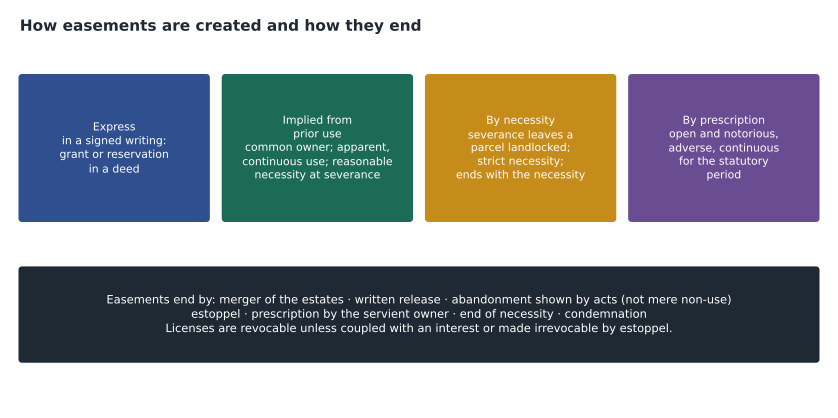
Easements are created in four main ways. An express easement must satisfy the statute of frauds, by grant or by reservation in a deed. An easement implied from prior use arises when land is divided, a use of one part for the benefit of another existed before the division, was apparent and continuous, and the parties reasonably expected it to continue because it is reasonably necessary to the dominant land. An easement by necessity arises when land is divided and one parcel is left landlocked; strict necessity is required, and the easement ends when the necessity ends. A prescriptive easement arises from use that is open and notorious, adverse, continuous and uninterrupted for the statutory period, the same elements as adverse possession except exclusivity. A use with the owner's permission is not adverse.
The scope of an easement is set by its terms or the use that created it, and may change with normal development of the dominant estate but not to burden the servient estate unreasonably. Easements end by unity of ownership of the dominant and servient estates (merger), by written release, by abandonment shown by physical action indicating intent to abandon (mere non-use is not enough), by estoppel, by prescription when the servient owner adversely blocks the use for the statutory period, by the end of necessity, and by condemnation or destruction of the servient structure in some cases.
A profit gives the right to enter another's land and take a natural resource, such as timber, minerals, fish or game; it follows the rules for easements. A license is permission to enter land, such as a ticket to a concert. It is revocable at will, unless it is coupled with an interest or the licensee has reasonably and substantially invested in reliance on it, in which case it may become irrevocable by estoppel.
Real covenants and equitable servitudes
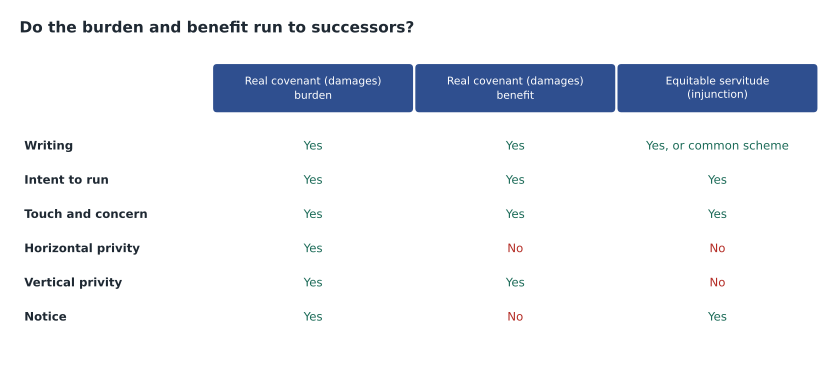
A real covenant is a written promise about the use of land that runs with the land at law, so that later owners are bound or benefited and the remedy is damages. For the burden to run, the covenant must be in writing, the original parties must have intended it to run, it must touch and concern the land, there must be horizontal privity between the original parties (a transfer of an interest in land between them, such as a deed) and vertical privity between an original party and the successor (the successor took the original party's estate), and the burdened successor must have notice. For the benefit to run, the covenant must touch and concern, the parties must have intended it to run, and there must be vertical privity, but horizontal privity is not required.
An equitable servitude is a covenant enforceable in equity by injunction. It binds successors who have notice, actual, inquiry or record, if the parties intended it to run and it touches and concerns the land; no privity is required. Under the common scheme doctrine, a court may imply a reciprocal negative servitude when a developer sells lots under a general plan of restrictions, such as residential use only, even if some deeds omit the restriction, and a purchaser had notice of the plan, for example from the uniform appearance of the neighborhood or from recorded deeds of other lots. Defenses to enforcement include unclean hands, acquiescence, abandonment, laches and changed conditions so radical that the purpose of the servitude cannot be achieved.
Restrictions based on race are unenforceable; courts may not enforce racially restrictive covenants (Shelley v. Kraemer, 1948), and the Fair Housing Act prohibits them. Homeowners associations commonly enforce modern restrictions through declarations recorded before lots are sold, and those declarations bind owners as covenants or servitudes.
Worked problem
Covenant or servitude?
A developer subdivides a tract into 50 lots and records a plat stating that all lots are restricted to single-family homes. Each deed includes the restriction except the deed to Lot 12. The buyer of Lot 12, who could see that all neighboring lots had single-family homes, sells to a company that plans to build a gas station. The neighbors sue to enjoin construction. What result?
Show solution
- The neighbors seek an injunction, so the question is whether there is an equitable servitude.
- The recorded plat and uniform deeds show a common scheme, so a reciprocal negative servitude can be implied on Lot 12.
- The company had record notice from the plat and inquiry notice from the neighborhood's uniform character. No privity is required for an equitable servitude.
Answer: The neighbors win an injunction under the common scheme doctrine.
Practice problems
Work each problem on paper first, then reveal the answer to check.
A tenant under a month-to-month lease wants to leave. What notice is required at common law?
Show answer
One full period, ending at the end of a period, unless a statute provides otherwise.
Must a tenant move out to claim a breach of the warranty of habitability?
Show answer
No. Constructive eviction requires vacating; habitability does not.
After an assignment, is the original tenant still liable for rent?
Show answer
Yes, on privity of contract, unless the landlord released him.
Does non-use alone terminate an easement?
Show answer
No. Abandonment requires physical action showing intent to abandon.
For the burden of a real covenant to run, is horizontal privity required?
Show answer
Yes, along with writing, intent, touch and concern, vertical privity and notice.
Is a concert ticket an easement?
Show answer
No. It is a license, generally revocable.
Common mistakes
MistakeA sublessee is directly liable to the landlord for rent.
InsteadOnly an assignee is in privity of estate; a sublessee answers to the tenant.
MistakeAn easement by necessity lasts forever.
InsteadIt ends when the necessity ends.
MistakeAn equitable servitude requires horizontal privity.
InsteadNo privity is required; notice, intent and touch and concern suffice.
MistakeThe warranty of habitability can be waived by a lease clause.
InsteadIt cannot be waived in residential leases.
Fixtures, security deposits and abandonment
Three smaller landlord-tenant topics appear from time to time. A fixture is a chattel annexed to the land so that it becomes part of the realty. Courts look mainly at the objective intent of the person who attached it, shown by the degree of annexation, how well the item is adapted to the property and whether removal would cause damage. Between landlord and tenant, the tenant may remove chattels she installed, including trade fixtures used in her business, before the lease ends, if removal does not cause substantial damage, and must repair any damage removal causes. Items the tenant leaves behind, and items whose removal would destroy them or seriously damage the premises, belong to the landlord.
Most states regulate residential security deposits by statute, limiting the amount, requiring the landlord to return the deposit or an itemized list of deductions within a fixed time after the tenant leaves, and imposing penalties for wrongful withholding. When a tenant abandons the premises with rent unpaid, the landlord may accept a surrender and end the lease, may relet on the tenant's account and hold the tenant for any shortfall, or, in the minority of states that do not require mitigation, leave the premises vacant and sue for rent as it comes due. Under the majority rule, the landlord's failure to make reasonable efforts to relet reduces the damages by what a reasonable reletting would have produced.
Summary and key terms
- Know the four tenancies and how each ends; holdovers can be evicted or bound to a periodic tenancy.
- Constructive eviction requires substantial interference, notice and vacating; the warranty of habitability offers remedies without leaving.
- Assignees are in privity of estate with the landlord; sublessees are not; original tenants remain liable on the contract.
- Easements are created expressly, by prior use, by necessity or by prescription, and end by merger, release, abandonment, estoppel or prescription.
- Real covenants (damages) require horizontal and vertical privity for the burden; equitable servitudes (injunctions) need only notice, intent and touch and concern.
- Periodic tenancy
- A tenancy that renews for successive periods until proper notice is given.
- Constructive eviction
- A landlord's substantial interference with the tenant's use that lets the tenant leave and stop paying rent.
- Privity of estate
- The relationship between a landlord and a tenant or assignee holding the leasehold.
- Easement appurtenant
- An easement benefiting a particular parcel and passing with it.
- Equitable servitude
- A land-use restriction enforceable by injunction against successors with notice.
Lesson quiz · 5 questions
Score 60% or more to complete this lesson.
Create a free account to save your progress, take quizzes and earn a certificate.