
BAR-111 · Lesson 3 of 12 · 23 min
Criminal procedure: the Fourth, Fifth and Sixth Amendments
▶ Video coming soon A video version of this lesson is on the way.
Camila Ortiz Rivera joins the Monday call on September 28 for the first of two criminal procedure sessions (the second is October 5). 'Puerto Rico has its own constitution with its own search and seizure clause,' she says, 'but our courts apply the federal minimum the same way state courts do.' Marchetti nods and puts the outline weights on the screen. About half of the MBE's criminal law and procedure questions come from the constitutional protection of accused persons. 'That makes this the single biggest topic in the subject,' she says. 'And unlike the substantive crimes, the answers come from Supreme Court cases, so names and holdings matter.'
The Fourth, Fifth and Sixth Amendments apply to the states through the Fourteenth Amendment's Due Process Clause. On the MBE, assume these federal rules apply in every state unless the question says otherwise.
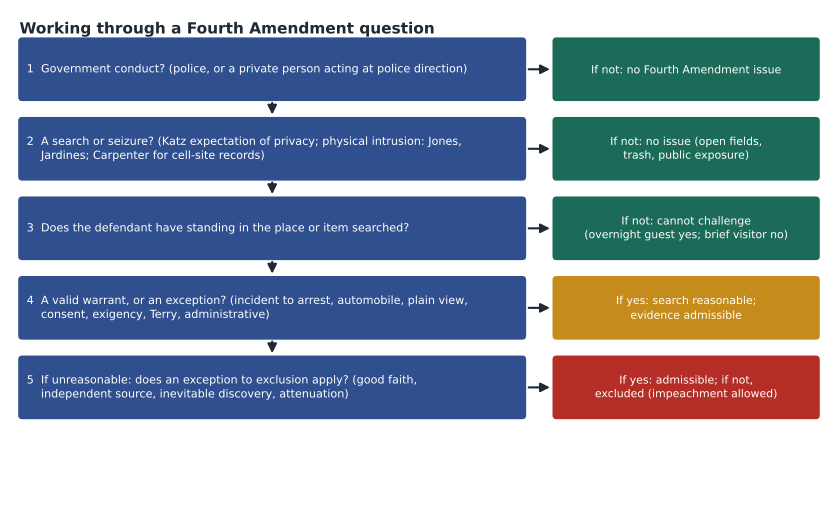
The Fourth Amendment: is there a search or seizure?
The Fourth Amendment protects against unreasonable searches and seizures by government agents. It does not apply to private persons acting on their own, though a private person acting at police direction is a government agent. The first question is always whether government conduct was a search or seizure at all.
A search occurs when the government violates a reasonable expectation of privacy, under Justice Harlan's test from Katz v. United States (1967), or physically intrudes on a constitutionally protected area to gather information, under United States v. Jones (2012) and Florida v. Jardines (2013). Jones held that attaching a GPS tracker to a car was a search; Jardines held that bringing a drug-sniffing dog onto a home's front porch was a search. Kyllo v. United States (2001) held that using a thermal imager not in general public use to detect heat inside a home was a search.
No search occurs when a person knowingly exposes something to the public: open fields, garbage left at the curb for collection (California v. Greenwood, 1988), what can be seen from public airspace (California v. Ciraolo, 1986), the exterior of a car, a person's voice and handwriting, and bank records and dialed phone numbers given to third parties under the traditional third-party doctrine. Carpenter v. United States (2018) limited that doctrine: acquiring seven days or more of historical cell-site location information from a wireless carrier is a search that generally requires a warrant, because it reveals the whole of a person's movements. A dog sniff of luggage or of a car's exterior during a lawful stop is not a search, but police may not prolong a traffic stop to conduct one without reasonable suspicion (Rodriguez v. United States, 2015).
Standing means the defendant's own rights were violated. A person has standing if he owns or lawfully possesses the place searched, lives there, or is an overnight guest (Minnesota v. Olson, 1990). A person present only briefly for a commercial transaction does not (Minnesota v. Carter, 1998). A passenger has no standing to challenge a search of the car he does not own, but he may challenge the stop itself, because a traffic stop seizes everyone in the car (Brendlin v. California, 2007).
Warrants and probable cause
A search is presumptively unreasonable without a warrant issued by a neutral and detached magistrate on probable cause, supported by oath, particularly describing the place to be searched and the things to be seized. Probable cause is a fair probability that evidence of a crime will be found, judged by the totality of the circumstances, including an informant's tip (Illinois v. Gates, 1983). Even if a warrant is later found defective, evidence is admissible if the officers relied on it in objective good faith, under United States v. Leon (1984), unless the affidavit was so lacking in probable cause that reliance was unreasonable, the warrant was facially deficient, the magistrate was biased, or the affiant lied or recklessly misstated facts (Franks v. Delaware, 1978). Officers executing a warrant generally must knock and announce, but violating that rule does not trigger exclusion (Hudson v. Michigan, 2006).
Exceptions to the warrant requirement
The MBE spends most of its Fourth Amendment questions on exceptions. Search incident to a lawful arrest allows a search of the arrestee and the area within his immediate control (Chimel v. California, 1969). For a car, police may search the passenger compartment incident to arrest only if the arrestee is unsecured and within reaching distance, or if it is reasonable to believe evidence of the crime of arrest is in the car (Arizona v. Gant, 2009). Police may not search the digital contents of an arrestee's cell phone without a warrant (Riley v. California, 2014).
The automobile exception allows police with probable cause to believe a vehicle contains evidence to search it and any container in it that might hold the evidence, without a warrant (California v. Acevedo, 1991). It does not let officers enter the curtilage of a home to search a vehicle parked there (Collins v. Virginia, 2018).
Plain view allows seizure if the officer is lawfully in the place, the item's incriminating nature is immediately apparent, and the officer has lawful access to it. Consent searches are valid if consent is voluntary under the totality of the circumstances, even if the person did not know he could refuse (Schneckloth v. Bustamonte, 1973). A third party with apparent authority over shared premises can consent, but a physically present co-occupant who objects overrides the other's consent (Georgia v. Randolph, 2006).
Exigent circumstances include hot pursuit of a fleeing felon, the imminent destruction of evidence, and an emergency need to protect life. In Lange v. California (2021), the Court held that pursuit of a fleeing misdemeanant does not categorically justify a warrantless entry into a home; courts decide case by case. In Caniglia v. Strom (2021), it held that there is no freestanding community caretaking exception for homes. Administrative inspections and checkpoints follow separate rules: sobriety checkpoints and border searches are permitted, but checkpoints for general crime control are not (City of Indianapolis v. Edmond, 2000).
Stops, frisks and arrests
A Terry stop, from Terry v. Ohio (1968), is a brief detention justified by reasonable suspicion, meaning specific and articulable facts that criminal activity is afoot. A frisk is a pat-down of outer clothing justified by reasonable suspicion that the person is armed and dangerous; under the plain feel doctrine, officers may seize contraband whose identity is immediately apparent during a lawful frisk (Minnesota v. Dickerson, 1993). Unprovoked headlong flight in a high-crime area can supply reasonable suspicion (Illinois v. Wardlow, 2000), and an officer may infer that the registered owner of a car is driving it absent contrary information (Kansas v. Glover, 2020).
A person is seized when, under the totality of the circumstances, a reasonable person would not feel free to leave or decline the officer's requests, and either submits to a show of authority or is physically touched with intent to restrain (Torres v. Madrid, 2021). An arrest requires probable cause. Police may arrest in public without a warrant, even for a minor offense punishable only by a fine (Atwater v. City of Lago Vista, 2001), but need an arrest warrant to enter a suspect's home, and a search warrant to enter a third party's home, absent exigency or consent.
The exclusionary rule and its limits
Evidence obtained in violation of the Fourth Amendment is generally inadmissible in state and federal trials (Mapp v. Ohio, 1961), and so is derivative evidence, the fruit of the poisonous tree. But the rule has major exceptions, and MBE answers often turn on them. Evidence is admissible if it came from an independent source, would inevitably have been discovered by lawful means (Nix v. Williams, 1984), or if the connection to the illegality is attenuated, for example by intervening free will or the discovery of a valid pre-existing arrest warrant (Utah v. Strieff, 2016). Good-faith reliance on a warrant, a statute later held unconstitutional, binding appellate precedent later overruled, or a negligent clerical error in a police database also defeats exclusion. Illegally obtained evidence can be used to impeach the defendant's own testimony. And the exclusionary rule does not apply in grand jury proceedings, civil cases or parole revocation hearings.
The Fifth Amendment: Miranda and self-incrimination
The privilege against self-incrimination protects testimonial evidence compelled from the accused. It does not cover physical evidence such as fingerprints, blood samples, lineups or handwriting exemplars. A prosecutor may not comment on a defendant's decision not to testify (Griffin v. California, 1965).
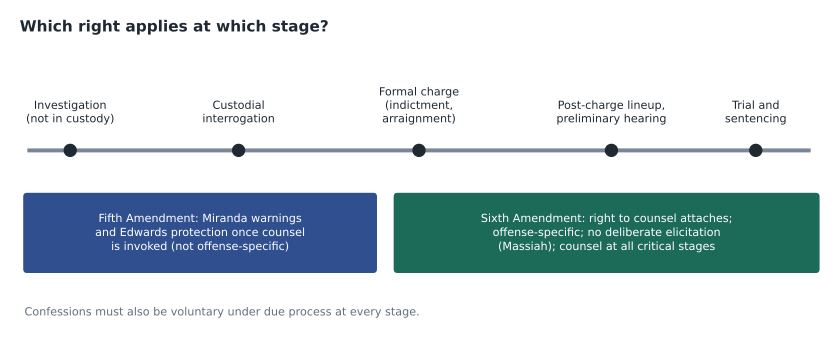
Under Miranda v. Arizona (1966), statements made during custodial interrogation are inadmissible in the prosecution's case-in-chief unless police first warned the suspect of the right to remain silent, that anything said can be used against him, the right to an attorney, and the right to appointed counsel if he cannot afford one. Custody means a reasonable person would feel not free to leave under circumstances resembling a station-house interrogation; a routine traffic stop is not custody (Berkemer v. McCarty, 1984). Interrogation includes express questioning and words or actions police should know are reasonably likely to elicit an incriminating response (Rhode Island v. Innis, 1980).
A suspect who invokes the right to counsel must do so unambiguously (Davis v. United States, 1994); then all questioning must stop until counsel is present, unless the suspect himself reinitiates (Edwards v. Arizona, 1981). Edwards protection ends after a 14-day break in custody (Maryland v. Shatzer, 2010). An invocation of the right to silence must also be unambiguous, and police may resume questioning later after scrupulously honoring it (Michigan v. Mosley, 1975). A suspect who stays silent through hours of questioning and then answers has waived the right (Berghuis v. Thompkins, 2010).
Miranda has exceptions. A public safety exception allows questions needed to address an immediate danger (New York v. Quarles, 1984). Statements taken in violation of Miranda but voluntary can be used to impeach the defendant if he testifies (Harris v. New York, 1971), and physical evidence found as a result of a voluntary but unwarned statement is admissible (United States v. Patane, 2004). But a deliberate two-step strategy of questioning first and warning later makes the warned confession inadmissible (Missouri v. Seibert, 2004). A Miranda violation alone does not support a civil damages claim under section 1983 (Vega v. Tekoh, 2022). Separately from Miranda, any involuntary confession produced by police coercion violates due process and cannot be used for any purpose.
The Sixth Amendment: counsel, jury and confrontation
The Sixth Amendment right to counsel attaches when adversary judicial proceedings begin, at a formal charge, preliminary hearing, indictment, information or arraignment, and it is offense-specific (Texas v. Cobb, 2001). After attachment, police may not deliberately elicit statements about the charged offense outside counsel's presence, including through an undercover informant (Massiah v. United States, 1964). Counsel is required at critical stages: post-charge lineups, preliminary hearings, trial, sentencing and the first appeal. An indigent defendant is entitled to appointed counsel in any felony case (Gideon v. Wainwright, 1963) and in any misdemeanor case resulting in actual imprisonment or a suspended sentence. Ineffective assistance requires deficient performance and prejudice (Strickland v. Washington, 1984), including in advising a defendant about plea offers and the deportation consequences of a plea.
The jury right applies to any offense punishable by more than six months' imprisonment. State jury verdicts in serious cases must be unanimous (Ramos v. Louisiana, 2020). Any fact other than a prior conviction that increases the maximum penalty or a mandatory minimum must be found by a jury beyond a reasonable doubt (Apprendi v. New Jersey, 2000; Alleyne v. United States, 2013). The Confrontation Clause bars testimonial hearsay against the accused unless the declarant is unavailable and the defendant had a prior opportunity for cross-examination (Crawford v. Washington, 2004). Lesson 5 covers what counts as testimonial, including forensic reports (Melendez-Diaz, 2009) and expert basis testimony (Smith v. Arizona, 2024).
Two other trial rights recur. The prosecution must disclose material exculpatory and impeachment evidence (Brady v. Maryland, 1963), and suppressed evidence is material if there is a reasonable probability the result would have been different. Double jeopardy bars a second prosecution for the same offense after acquittal or conviction, with offenses the same if neither requires proof of a fact the other does not (Blockburger v. United States, 1932); separate sovereigns, such as a state and the federal government, may each prosecute (Gamble v. United States, 2019). Jeopardy attaches when the jury is sworn or, in a bench trial, when the first witness is sworn.
Worked problem
Miranda, invocation and the fruit of the statement
Police arrest a suspect for a shooting and read him his rights. He says, "Maybe I should talk to a lawyer." The detective keeps asking questions, and the suspect says the gun is in his car. Police find it there. Before trial, the suspect moves to suppress his statement and the gun.
Show solution
- "Maybe I should talk to a lawyer" is ambiguous under Davis, so the detective did not have to stop questioning.
- The statement followed valid warnings and was not coerced, so it is admissible.
- Even if the invocation had been clear, the gun would likely be admissible under Patane, because Miranda violations do not require suppression of physical fruits of voluntary statements.
Answer: Deny both motions: the request was ambiguous, and the physical fruit of a voluntary statement is admissible in any event.
Practice problems
Work each problem on paper first, then reveal the answer to check.
Is collecting a week of a suspect's historical cell-site records from a carrier a search?
Show answer
Yes, under Carpenter v. United States; police generally need a warrant.
May police search the passenger compartment of a car after arresting the driver and securing him in a patrol car?
Show answer
Only if it is reasonable to believe evidence of the crime of arrest is in the car (Arizona v. Gant).
Does a routine traffic stop create Miranda custody?
Show answer
No (Berkemer v. McCarty), unless it escalates into a situation resembling formal arrest.
After a suspect clearly asks for a lawyer, may police question him about a different crime?
Show answer
No. Under Edwards, all questioning must stop until counsel is present unless the suspect reinitiates.
Must a state jury in a felony case be unanimous?
Show answer
Yes, under Ramos v. Louisiana (2020).
Can evidence suppressed under the Fourth Amendment be used to impeach the defendant's testimony?
Show answer
Yes. The impeachment exception allows it.
Common mistakes
MistakeThe Sixth Amendment right to counsel applies to all crimes once a suspect is arrested.
InsteadIt attaches at formal charging and is offense-specific; Miranda governs pre-charge interrogation.
MistakeAny violation of the Fourth Amendment requires exclusion.
InsteadGood faith, independent source, inevitable discovery, attenuation and impeachment are exceptions.
MistakeA co-occupant's consent always validates a home search.
InsteadA physically present co-occupant who objects overrides it (Georgia v. Randolph).
MistakePolice may search a cell phone incident to arrest.
InsteadRiley v. California requires a warrant for the phone's digital contents.
Summary and key terms
- Ask whether there was government action, a search or seizure, standing, and a warrant or valid exception, then whether exclusion applies.
- Know the key search cases: Katz, Jones, Jardines, Kyllo, Carpenter, Gant, Riley, Randolph, Collins, Lange and Caniglia.
- Terry stops need reasonable suspicion; arrests need probable cause; home entries need a warrant absent exigency or consent.
- Miranda applies to custodial interrogation; invocations must be unambiguous; impeachment, public safety and physical-fruit exceptions apply.
- The Sixth Amendment covers counsel after formal charges, unanimous juries in serious cases, Apprendi facts and the Confrontation Clause.
- Reasonable expectation of privacy
- The Katz test for a search: a subjective expectation that society recognizes as reasonable.
- Exclusionary rule
- The rule barring evidence obtained in violation of the Fourth Amendment, with several exceptions.
- Terry stop
- A brief investigative detention based on reasonable suspicion.
- Custodial interrogation
- Questioning of a person in custody that triggers Miranda warnings.
- Massiah rule
- After the right to counsel attaches, police may not deliberately elicit statements about the charged offense without counsel.
Lesson quiz · 5 questions
Score 60% or more to complete this lesson.
Create a free account to save your progress, take quizzes and earn a certificate.