
BAR-130 · Lesson 1 of 12 · 16 min
Why the bar exam is changing
▶ Video coming soon A video version of this lesson is on the way.
On Sunday morning, September 20, 2026, Hollis Marchetti opens a video call that is different from her other study sessions. Her Tuesday group, her Saturday and Monday drills, her Wednesday essays and her Friday performance tests are all aimed at the exam most of her students will sit in February 2027: the legacy Uniform Bar Examination (UBE), built from the Multistate Bar Examination (MBE), the Multistate Essay Examination (MEE) and the Multistate Performance Test (MPT). This new series is for the exam that will replace it. She calls it NextGen Sundays.
Marcus Bell co-leads. In July 2026 he sat Missouri's bar exam, one of the first ten administrations of the NextGen bar exam anywhere, and he passed. Two new members join the call because they will take the new exam soon. Tessa Halvorsen finishes law school in Washington in December 2026 and is registered for Washington's February 2027 exam, which is a NextGen exam. Andre Baptiste is a third-year student in Oregon who plans to sit Oregon's NextGen exam in July 2027. The regulars drop in when they can. Dana Whitfield, Ngozi Adeyemi and Sofia Reyes will all sit legacy exams in February, but they want to know what changed, and Sofia's California has said it will move to NextGen in July 2028.
This course explains the NextGen exam: why it exists, what it covers, how its questions work, how it is scored and how to prepare. Every sample question, fact pattern, document and task in this course is original and written for the course. None is taken from the sample questions or study aids that the National Conference of Bar Examiners (NCBE) publishes. The facts about the exam itself come from NCBE's own descriptions, and where something depends on your jurisdiction, the course tells you to check your bar admission authority, because that office, not NCBE, decides who is admitted.
The exam it replaces
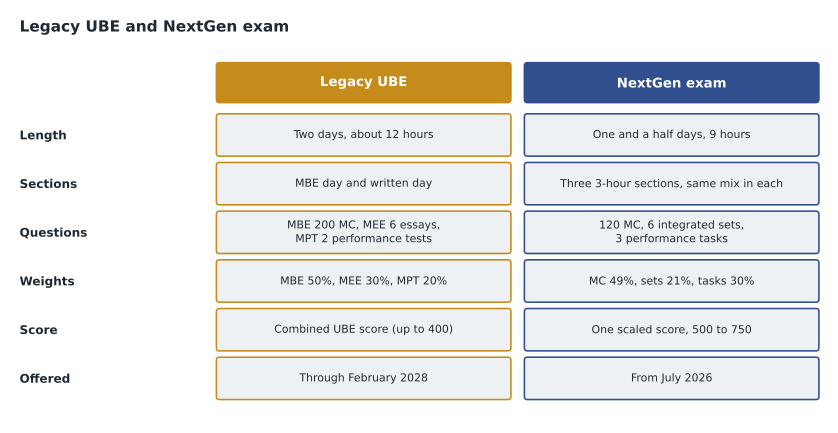
The UBE was first given in 2011. A UBE jurisdiction gives the same three NCBE components on the same two days and accepts a single combined score: the MBE, 200 multiple-choice questions over six hours, worth 50 percent; the MEE, six 30-minute essays, worth 30 percent; and the MPT, two 90-minute performance tests, worth 20 percent. Because every UBE jurisdiction uses the same exam and the same scaling, an examinee can transfer a UBE score to another UBE jurisdiction instead of sitting again. NCBE reports that through the end of 2024 nearly 330,000 UBE scores had been earned and nearly 66,000 had been transferred.
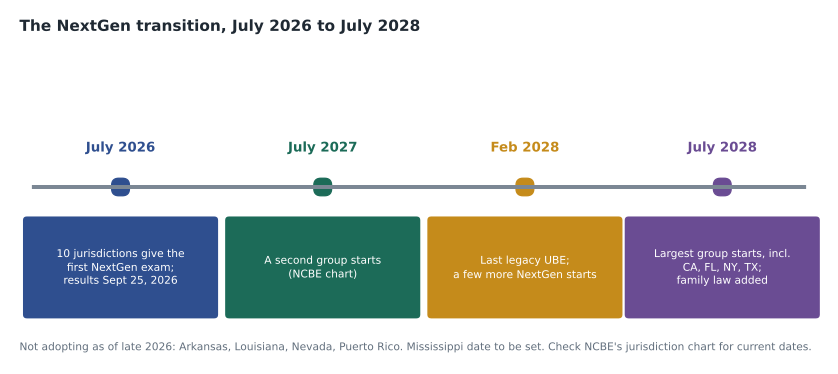
The legacy exam is not disappearing overnight. NCBE will keep producing the MBE, MEE and MPT through the February 2028 administration. After that, they will no longer be given. Between July 2026 and July 2028, jurisdictions are moving one by one to the NextGen exam, each on its own date.
Why NCBE redesigned the exam
Marchetti puts the reason in one sentence: 'The old exam tested whether you could remember a lot of law. The new one tests whether you can do what a new lawyer does with a smaller set of law you really need to know.'
The redesign began with research into the work newly licensed lawyers actually do. NCBE's testing task force, created in 2018, ran a nationwide practice analysis; NCBE says more than 14,000 attorneys answered its survey about the knowledge and skills new lawyers use. The results pointed in two directions at once. New lawyers need a core of legal knowledge in a limited number of subjects. And they spend much of their time on skills the legacy exam measured only indirectly: researching, writing, investigating facts, counseling clients, negotiating and managing client relationships.
From that research NCBE defined the content scope of the new exam: a set of foundational concepts and principles, and a set of foundational lawyering skills. NCBE says a committee chose the legal topics using three criteria: how often new lawyers encounter them, how universal they are across jurisdictions, and the risk of harm to clients if a new lawyer gets them wrong. Before launch NCBE also field-tested the new question types; it says more than 10,000 newly licensed lawyers and law students took part in its NextGen research.
The resulting exam is designed to balance litigation and transactional practice, to test fewer subjects at greater depth, and to give examinees legal materials to work with when a question goes beyond what a new lawyer should know from memory. It is shorter than the legacy exam and is delivered entirely on laptops.
What the new exam looks like
The NextGen exam takes a day and a half: three sections of three hours each. NCBE schedules the second day on the last Wednesday of February or July, and the first day on the Tuesday before it. Two sections are given on the Tuesday and one on the Wednesday morning. A jurisdiction with its own local law component may extend the second day.
Every section has the same mix of question types. According to NCBE's blueprint, each three-hour section contains 40 standalone multiple-choice questions, two integrated question sets and one performance task. Across the whole exam that is 120 multiple-choice questions, six integrated question sets and three performance tasks. NCBE's suggested pace is about 1.8 minutes per multiple-choice question, 24 minutes per integrated question set and 60 minutes per performance task, which adds up to the three hours. Within a section you may answer the questions in any order.
The three question types are the heart of the exam, and later lessons cover each in depth. Standalone multiple-choice questions look much like MBE questions, though some ask you to choose two answers from six. Integrated question sets build several questions on one fact scenario, sometimes with documents or legal sources, and mix multiple-choice with short or medium written answers. Performance tasks are closed-universe lawyering problems, like the MPT but shorter, and some focus on legal research.
| Component | Per section | Whole exam | Suggested time each | Share of score |
|---|---|---|---|---|
| Standalone multiple-choice questions | 40 | 120 | About 1.8 minutes | 49 percent |
| Integrated question sets | 2 | 6 | About 24 minutes | 21 percent |
| Performance tasks | 1 | 3 | About 60 minutes | 30 percent |
Some of those items do not count. NCBE says that 20 of the 120 multiple-choice questions and one of the six integrated question sets are unscored pretest items, used to try out questions for future exams. They are not labeled, so you must treat every question as if it counts. All three performance tasks are scored; NCBE pretests performance tasks separately.
The exam produces a single score on a scale from 500 to 750. There are no separate multiple-choice and written scores as there are on the legacy UBE. NCBE scores the multiple-choice questions; graders appointed by each jurisdiction score the written responses using NCBE's rubrics; and NCBE does the scaling and equating. Each jurisdiction sets its own passing score, and most have chosen scores between 610 and 620. Lesson 10 explains the scoring in detail.
The first administration
Ten jurisdictions gave the first NextGen exam on July 28 and 29, 2026: Connecticut, Guam, Idaho, Maryland, Missouri, the Northern Mariana Islands, Oregon, Palau, the US Virgin Islands and Washington. It did not go perfectly. One Washington testing site's July sitting was canceled and NCBE held a make-up exam on September 1 and 2, and in Missouri some examinees tested on an adjusted schedule after delays. Marcus was in Missouri. 'We sat around for a while on the first morning,' he says. 'It was stressful. But once it started, the software worked, and the questions felt like work I'd done in clinic.'
NCBE released the first results on September 25, 2026. In those ten jurisdictions, 2,630 examinees earned a score. The mean score was 640.6 and the median 640. The overall pass rate was 72.7 percent, which NCBE noted was within 4.3 percentage points of every July national pass rate from 2021 to 2025. First-time examinees passed at 85.2 percent and repeat examinees at 41.0 percent. NCBE also said it had found no consistent pattern showing that examinees affected by the July disruptions scored differently from others.
Two cautions come with those numbers. NCBE pointed out that the group was much smaller than a typical national July administration. And it changed its definition of a first-time examinee: someone who has never taken a bar exam in any jurisdiction, rather than someone taking a particular jurisdiction's exam for the first time. Comparisons with earlier years should be made carefully.
Marcus's own score report showed a single number, 648, above Missouri's passing score of 610. 'That's all you get,' he says. 'No subscore for the multiple choice, no essay grades. It took me a minute to realize that one number was the whole story.'
Who moves when
Each jurisdiction decides when to switch. NCBE tracks those decisions in a chart of jurisdictions, first-administration dates, acceptance of transferred scores and jurisdiction-specific components. As of late 2026 it shows the ten July 2026 jurisdictions, a second group starting in July 2027, a few starting in February 2028, and the largest group, including California, Florida, New York and Texas, starting in July 2028. Mississippi's date had not been set. Four jurisdictions, Arkansas, Louisiana, Nevada and Puerto Rico, had not announced plans to adopt the NextGen exam.
Jurisdiction-specific components continue. Some jurisdictions will add a state law test, a course or an essay session alongside the NextGen exam, much as Texas adds its Texas Law Component to the legacy UBE. The jurisdiction courses in this program describe each jurisdiction's choices.
| Member | Jurisdiction | Exam | Status |
|---|---|---|---|
| Marcus Bell | Missouri | NextGen, July 2026 | Passed with 648 (Missouri passing score 610) |
| Tessa Halvorsen | Washington | NextGen, February 2027 | Graduates December 2026 |
| Andre Baptiste | Oregon | NextGen, July 2027 | Third-year student |
| Dana Whitfield | Texas | Legacy UBE plus Texas Law Component, February 2027 | Texas moves to NextGen in July 2028 |
| Ngozi Adeyemi | New York | Legacy UBE, February 2027 | New York moves to NextGen in July 2028 |
| Sofia Reyes | California | California exam, February 2027 | California moves to NextGen in July 2028 |
What the change means for you
If your jurisdiction has already switched, or will switch before you sit, this course is your map of the exam. If you sit a legacy exam before your jurisdiction switches, the change still matters in three ways.
First, retakes. If you sit a legacy exam and do not pass, your next attempt may be a NextGen exam, because your jurisdiction may switch in between. A February 2028 examinee who fails in a jurisdiction that switches in July 2028 will retake on the new exam. Dana's Texas, for example, gives the legacy exam in February 2027 and the NextGen exam from July 2028.
Second, score transfer. A legacy UBE score and a NextGen score are different measurements on different scales. Whether a jurisdiction accepts a transferred score from the other exam is its own decision, and NCBE's chart shows that some jurisdictions accept transfers from both while others do not. Hawaii, for example, has said it does not intend to accept transferred NextGen scores, and Florida and New York will accept transferred NextGen scores only from exams given from July 2028 onward. If you plan to practice in more than one jurisdiction, check both jurisdictions' rules before you choose where to sit.
Third, study materials. Commercial courses, old outlines and released questions were built for the legacy exam. Much of the law carries over, but the new exam tests fewer subjects, tests some topics only with materials supplied, and tests skills the old materials never covered. Lessons 2 and 11 show how to adapt.
Worked problem
Should Andre wait or switch plans?
Andre asks whether he should sit in a jurisdiction that still gives the legacy UBE in July 2027 and transfer the score to Oregon, instead of taking Oregon's NextGen exam.
Show solution
- Oregon gave the NextGen exam from July 2026, so an Oregon exam in July 2027 is a NextGen exam.
- A transferred legacy UBE score is useful only if Oregon accepts transferred legacy scores, for how long after the exam, and at what minimum. Those are Oregon's rules, listed in NCBE's charts and on the Oregon bar's website.
- Sitting elsewhere also means meeting that jurisdiction's eligibility rules, character and fitness process and fees.
- His law school's bar support and his clinic work already point toward the skills the NextGen exam tests.
Answer: Andre checks Oregon's transfer rules, finds the detour adds cost and uncertainty, and stays with Oregon's July 2027 NextGen exam. The right answer depends on the jurisdictions' current rules, so check them, not a summary.
Marchetti ends the first session with a short assignment: download NCBE's free content scope and its free sample questions, read only the list of foundational concepts and skills, and try two sample multiple-choice questions on the free exam software preview. 'Do not buy anything yet,' she says. 'Look at the real format first, then decide what you need.'
Common mistakes
MistakeThe legacy UBE ends everywhere in July 2026.
InsteadJurisdictions switch between July 2026 and July 2028; the legacy UBE is given through February 2028.
MistakeThe NextGen exam reports a multiple-choice score and a written score, like the legacy UBE.
InsteadIt reports one scaled score from 500 to 750.
MistakeEvery question on the exam counts toward the score.
InsteadTwenty multiple-choice questions and one integrated question set are unscored pretest items, unlabeled.
MistakeA legacy UBE score converts directly into a NextGen score.
InsteadThey are different scales; each jurisdiction decides whether to accept transfers from the other exam.
Summary and key terms
- NCBE redesigned the bar exam after a practice analysis of what new lawyers do, focusing on fewer legal subjects and more lawyering skills.
- The NextGen exam is nine hours over a day and a half: three sections, each with 40 multiple-choice questions, two integrated question sets and one performance task.
- It reports one score from 500 to 750; jurisdictions set passing scores, mostly 610 to 620.
- Ten jurisdictions gave the first exam in July 2026; NCBE reported a 72.7 percent pass rate on September 25, 2026.
- Jurisdictions switch between July 2026 and July 2028; the legacy UBE ends after February 2028.
- NextGen bar exam
- NCBE's new bar exam, first given in July 2026, also called the NextGen UBE.
- Legacy UBE
- The Uniform Bar Examination built from the MBE, MEE and MPT, given through February 2028.
- Practice analysis
- A survey-based study of the knowledge and skills newly licensed lawyers use, on which the NextGen content scope is based.
- Pretest item
- An unscored, unlabeled question used to try out content for future exams.
- First-time examinee
- For NCBE's NextGen statistics, someone who has never taken a bar exam in any jurisdiction.
Lesson quiz · 5 questions
Score 60% or more to complete this lesson.
Create a free account to save your progress, take quizzes and earn a certificate.