
BAR-130 · Lesson 11 of 12 · 16 min
Preparing for the transition
▶ Video coming soon A video version of this lesson is on the way.
On Wednesday, November 18, 2026, Marchetti holds a 30-minute lunchtime call with just Tessa and Andre. Tessa's exam is on February 23 and 24, 2027, about 14 weeks away. Andre's is in late July 2027. 'Two different plans,' Marchetti says. 'Same ingredients, different amounts. Let's build them.'
This lesson turns the course into a preparation plan: which official materials to use, how to adapt legacy materials, how to structure study weeks, how to handle the technology and logistics, and how to plan for the possibility of a retake when your jurisdiction is changing exams.
Start with the official materials
NCBE advises starting with its free sample questions and its exam software preview, so that you learn the format and the delivery before anything else. Its preparation page lists the main free resources: the content scope outline; sample multiple-choice questions, integrated question sets and performance tasks, including two legal research performance tasks; an interactive software tutorial; a Constructed Response Guide explaining how written responses work and are graded, with sample scoring guides; and an Examinees' Guide covering structure, timing, scoring and portability. Some sample questions also demonstrate accommodation features, such as stop-the-clock breaks, speech-to-text dictation and text-to-speech.
NCBE also sells official study aids that run on the real exam software. They include practice sets, each with 40 multiple-choice questions, two integrated question sets and one performance task, the same mix as one exam section; simulated exams that combine three practice sets in the nine-hour format; and banks of additional multiple-choice questions and integrated question sets, some developed with the AccessLex Institute. The digital sourcebooks, produced with West Academic, explain the rules within the content scope for each subject; some law libraries provide access. Products and prices change, so check NCBE's store for current offerings.
Adapting legacy materials
Most commercial study material was built for the legacy exam, and much of it still helps if you use it deliberately.
MBE questions remain good practice for seven of the eight foundational concepts, since NCBE says early NextGen multiple-choice questions closely resemble MBE questions. Check each topic against the content scope, though: a question on a topic outside the scope, or on an unstarred topic you would be given the law for, is lower priority. Released MEE business associations essays are useful for that subject. Released MPTs are useful for performance-task method, but practice them in 60 minutes and write only the part a NextGen task would likely request. Nothing on the legacy exam resembles an integrated question set, a select-two question or a legal research task, so those must come from NextGen materials.
Marchetti's rule of thumb: use legacy materials to learn law and method, and NextGen materials to learn the exam. 'If you only do MBE questions, you will be surprised in the exam room,' she says. 'If you only do NextGen samples, you will run out of practice. Use both, for different purposes.'
A study week
A good NextGen week touches every component, because every section contains every component. Marchetti sketches a full-time week for Tessa. Five days include a block of concept review from the content scope and sourcebooks, tied to a starred-topic checklist; 30 to 40 multiple-choice questions with careful review, including some select-two items; and either one integrated question set or one performance task under time. One day is lighter: review the error log and redo missed questions. One day is off. Every second or third week includes a timed three-hour section with the full mix, and the plan includes at least one full simulated exam in the format: two sections on one day, one the next morning.
Andre, who is still in school, will run a lighter version through the spring, with two concept blocks and one timed integrated set or performance task each week, and switch to the full-time week after graduation in May.
| Weeks before the exam | Tessa (February 2027) | Andre (July 2027) |
|---|---|---|
| More than 12 | Not applicable | School term: two concept blocks a week, one timed set or task, MPRE if needed |
| 12 to 8 | Content scope checklist; daily multiple choice; two sets or tasks a week; first timed section | After graduation: full-time week begins |
| 8 to 4 | Add select-two drills; three sets or tasks a week; timed section every other week | Same, plus first simulated exam |
| 4 to 1 | Simulated exam; error-log repair; starred-topic review; logistics check | Second simulated exam; error-log repair; logistics check |
| Final week | Light review; equipment and travel ready; rest | Light review; equipment and travel ready; rest |
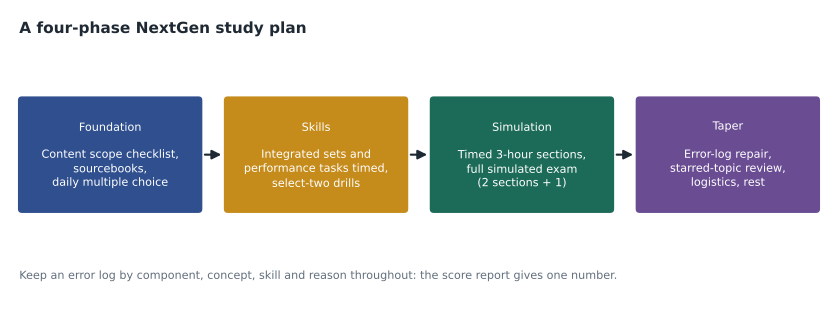
Keep an error log by component
Because the NextGen score report gives one number, your own records are the only breakdown you will have. Keep an error log with a row for every missed or uncertain item: the component, the foundational concept, the skill, and the reason for the miss. Reasons fall into a few groups: did not know the rule, misread the facts, misread the call, ran out of time, or, for written answers, answered the wrong question or failed to apply the rule to facts. After a few weeks the log shows patterns, and the patterns tell you what to fix.
Marcus kept such a log before July. 'Most of my misses in integrated sets were not law,' he says. 'They were me not answering the question in the first sentence. Once I saw it on the spreadsheet, it took a week to fix.'
Technology and test-day logistics
The NextGen exam is taken on your own laptop, in a secure testing browser, at an in-person proctored location. NCBE requires pre-exam technology and policy readiness steps, and its test day guidance says to bring the required equipment, verify identification and arrive with your NCBE Number. Your jurisdiction's instructions control the details. Complete every readiness step early, on the laptop you will use, and do not update its operating system the week before the exam without re-running the checks.
All examinees can adjust font size, change the color scheme and show or hide the timer. Practice with those settings on the software preview so that exam day holds no surprises. If you need testing accommodations, apply through your jurisdiction's process well before its deadline; NCBE's samples demonstrate several accommodation features, but the jurisdiction decides what is granted.
Registration runs through your jurisdiction, not NCBE, and deadlines can be months before the exam. Character and fitness applications, the MPRE and any jurisdiction-specific component run on their own schedules too. BAR-101 explains those steps.
If your jurisdiction is switching
If you sit a legacy exam shortly before your jurisdiction switches, plan for the possibility that a retake would be on the NextGen exam. Ngozi, for example, sits New York's legacy exam in February 2027. New York gives the NextGen exam from July 2028, so a July 2027 retake would still be a legacy exam, but Dana's Texas and Sofia's California follow the same July 2028 timetable. The practical step is simple: learn the NextGen format at a basic level even while studying for a legacy exam, so that a switch would not mean starting over.
If you plan to practice in more than one jurisdiction, look at their transition dates and transfer rules together before deciding where to sit first. Lesson 10 explains how to read transfer rules.
Worked problem
Tessa's first two weeks
Tessa has 14 weeks, finishes classes in early December, and starts full-time study on December 14. What should she do between November 18 and December 13?
Show solution
- Download the content scope and build the starred-topic checklist.
- Take NCBE's free sample questions on the software preview, untimed, to learn the format.
- Do 15 multiple-choice questions a day in the subjects she finds weakest, starting with business associations.
- Complete Washington's registration steps and confirm her laptop passes NCBE's readiness checks.
- Schedule two timed integrated sets on weekends.
Answer: Tessa uses the school weeks for setup and diagnosis, so that full-time study starts with a checklist, a baseline and no logistics left undone.
Marchetti closes the call with the same advice she gives every group. 'The exam is new, so everyone feels behind. They aren't. The people who pass are the ones who practice the real format, review honestly and keep going.'
Common mistakes
MistakeLegacy MBE books are enough to prepare for NextGen.
InsteadThey help with seven concepts, but integrated sets, select-two questions and research tasks need NextGen materials.
MistakeI register for the NextGen exam with NCBE.
InsteadYou register with your jurisdiction; NCBE provides the exam and an NCBE Number.
MistakeMy score report will show which component to work on if I need to retake.
InsteadNextGen reports one score; your error log is your only breakdown.
MistakeThe technology checks can wait until the week of the exam.
InsteadComplete NCBE's mandatory readiness steps early on the laptop you will use.
Common preparation mistakes
Marchetti has seen the first wave of NextGen preparation and names four mistakes. The first is studying only law. The skills components are more than half the score, and they improve only with practice in the format. The second is ignoring the content scope. Examinees who study every topic in an old outline waste time on material outside the exam and under-prepare starred topics. The third is avoiding timed practice. A three-hour section with every question type feels different from untimed questions, and pacing decisions such as which component to do first must be practiced. The fourth is neglecting logistics: a laptop that fails the readiness check, a missed registration deadline or an accommodation request filed late can derail months of study.
Looking after yourself
Bar preparation is long and stressful, and the transition adds uncertainty. Build rest into the plan, as Marchetti's sample week does with one day off. Keep sleep and exercise steady, especially in the final weeks. If anxiety or other health concerns interfere with study, most law schools offer support to recent graduates, and many state bars run confidential lawyer assistance programs for applicants as well as lawyers. Asking for help is a sign of good judgment, not weakness, and it is the same judgment the exam is trying to measure.
Studying with others
The Sunday group is itself a strategy. Explaining a rule to someone else exposes gaps; grading each other's short answers against a rubric teaches what graders reward; and a study partner keeps the schedule honest. Tessa and Andre agree to swap one integrated set each week through February and grade each other's answers before comparing them with the model answers. Marcus volunteers to grade a performance task for each of them every other week. 'I wish I'd had this in June,' he says. 'Nobody knew what the new exam would feel like. You two will.'
The final week
The last week before the exam is for consolidation, not new material. Marchetti suggests three short timed sets early in the week to keep pacing sharp, a final pass through the starred-topic checklist, and a review of the error log's most frequent mistakes. Confirm the testing location, the travel plan and the start time; recharge and test the laptop; and pack the required identification and equipment the day before. The day before the exam should be light. Sleep matters more than one more set of questions.
On exam days, follow the plan you practiced. In each section, use the pacing order you chose in practice. If a question stalls, flag it, make your best choice and move on; you can return within the section if time allows. Between sections, do not discuss answers with other examinees. The next section is all that matters. And after the second day, rest. Results will take weeks, and the waiting is easier with the exam truly behind you.
Marcus describes his own final week in July as boring on purpose. 'I did a few timed sets, reread my error log every night, checked my laptop twice and went to bed early,' he says. 'The exam itself was hard enough. I didn't want anything else to be.'
Choosing a commercial course
Many examinees will use a commercial bar review course, and most providers now offer NextGen versions. When comparing them, ask concrete questions. Does the course map its outlines to NCBE's content scope, including starred and unstarred topics? Does it include integrated question sets, select-two questions and legal research tasks, not just MBE-style questions and essays? Does it give feedback on written answers, and against what rubric? Does it use NCBE's licensed questions or its own, and does it include NCBE's official practice sets? Does its schedule fit your exam date and your work or school commitments? A cheaper course that teaches the real format can serve you better than an expensive one built for the legacy exam.
Andre's school offers a free bar support program with weekly timed NextGen sets and faculty feedback. He plans to combine it with NCBE's practice sets and the sourcebooks, and to decide in the spring whether he needs a commercial course as well. Tessa, with less time, has already enrolled in one and checked that it includes integrated sets and research tasks. 'I asked them to show me a sample counseling set before I paid,' she says. 'If they couldn't, I wasn't interested.'
Finally, plan for the weeks after the exam. Results take time, and jurisdictions often require further steps before admission, such as completing character and fitness review, finishing a jurisdiction-specific component, or attending a swearing-in. Note those deadlines now, so that the end of the exam is not the end of your planning.
Summary and key terms
- Start with NCBE's free content scope, sample questions, software preview and Constructed Response Guide.
- Official practice sets mirror one section; simulated exams mirror the full nine-hour format.
- Use legacy materials to learn law and method, NextGen materials to learn the exam.
- Plan weeks that touch every component, with timed sections and at least one full simulation.
- Keep an error log by component, concept, skill and reason; complete technology and registration steps early.
- Practice set
- An NCBE study aid with 40 multiple-choice questions, two integrated sets and one performance task, matching one section.
- Simulated exam
- An NCBE study aid combining three practice sets in the full exam format.
- Error log
- A record of missed items by component, concept, skill and reason, used to direct study.
- NCBE Number
- The identifier NCBE assigns to each examinee, needed on test day.
Lesson quiz · 5 questions
Score 60% or more to complete this lesson.
Create a free account to save your progress, take quizzes and earn a certificate.