
BAR-130 · Lesson 6 of 12 · 16 min
Performance tasks
▶ Video coming soon A video version of this lesson is on the way.
On Sunday, October 25, 2026, the Friday performance-test regulars join the Sunday call. Dana, Ngozi and Sofia have spent five weeks on 90-minute MPTs with Marchetti, and they want to see what the NextGen version looks like. Marcus took three NextGen performance tasks in July. 'Same family,' he tells them. 'Shorter, and on a screen. And one of mine was a research task, which is a different animal.'
Performance tasks are the NextGen exam's closed-universe lawyering problems. This lesson explains their format, scoring and two forms, compares them with the MPT, and walks through a 60-minute approach using an original task.
The basics
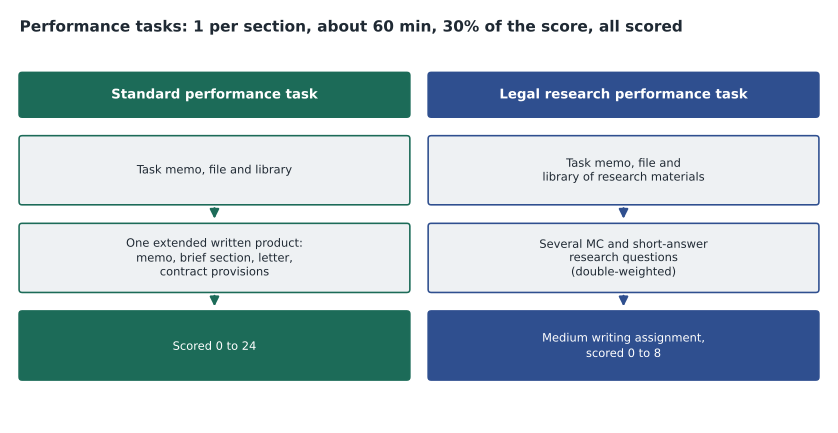
Each three-hour section contains one performance task, so the exam has three. NCBE estimates about 60 minutes per task, which makes performance tasks about a third of the exam's time. They carry 30 percent of the total score. All three are scored; NCBE pretests performance tasks separately, so none of them is a pretest item.
Like the MPT, each task is built around a single client matter and supplies everything you need. NCBE's sample tasks open with a memo that introduces the client and lists the documents in the file and the resources in the library. The file contains the facts, such as interview notes, correspondence, records or a draft document. The library contains the law, such as statutes, regulations, cases or rules. You are expected to work from those materials, not from memory, though your knowledge of the foundational concepts helps you read faster.
Two forms
NCBE describes two forms of performance task, scored differently.
A standard performance task asks for one extended piece of writing, such as an objective memo or part of one, a section of a brief, a client letter or a set of contract provisions. NCBE's blueprint describes it as a longer-answer response scored on a scale of zero to 24 points.
A legal research performance task tests research skills directly. It begins with a series of multiple-choice and short-answer questions about the research problem, which the blueprint says are double-weighted, and ends with a medium-answer writing assignment scored on a scale of zero to eight points. NCBE's August 2025 description of a sample legal research task listed four multiple-choice questions, one short-answer question and one medium-answer writing assignment. NCBE's free sample questions include two legal research performance tasks. Lesson 7 covers research skills in depth.
How performance tasks differ from the MPT
| Feature | Legacy MPT | NextGen performance task |
|---|---|---|
| Number per exam | Two items | Three tasks, one per section |
| Time each | 90 minutes | About 60 minutes |
| Weight | 20 percent of the UBE | 30 percent of the NextGen score |
| Forms | One written product per item | Standard tasks and legal research tasks |
| Grading | Jurisdiction graders, usually on a relative scale | Jurisdiction graders using NCBE rubrics, scored on fixed point scales |
| Delivery | Printed booklet and laptop in most jurisdictions | Entirely in the secure exam software |
Three differences matter most in practice. The time is shorter, so there is less room to read everything twice; the tasks are scaled to fit, but the habit of reading the assignment first matters even more. The weight is higher, 30 percent across three tasks, about 10 percent each, the same as one MPT item. And grading is rubric-based. Instead of ranking answers against one another on a relative scale, graders apply NCBE's rubric with defined points. NCBE's Constructed Response Guide includes sample scoring guides that show what earns credit.
A 60-minute plan
Marchetti adapts her MPT method to 60 minutes. Spend about 15 to 20 minutes reading and organizing, and about 40 to 45 minutes writing. Within the reading time, the order matters.
Read the task memo first and restate the assignment: what document, for whom, about which issues, in what form and with what stance. Then read the library, starting with any statute, and write down each rule with its source. Then read the file, sorting facts under the issues. Outline with headings that mirror the issues the memo assigns, and start writing by minute 20 at the latest. When time is short, cover every assigned issue briefly rather than one issue perfectly; rubric points are spread across the issues.
Marcus followed that plan in July. 'The memo for my second task said, in bold, do not address the statute of limitations, another associate is handling it,' he says. 'Two of the cases in the library were about limitations. That was the trap. I skipped them.'
Practice task: the Kessler lease
The following standard performance task is original and abbreviated so that it fits a lesson. It is set in the fictional State of Marlow, the same fictional jurisdiction used in BAR-121. The statute and cases are fictional and written for this course.
Task memo. From the supervising partner to the associate: 'Our client, Nora Kessler, rents an apartment from Harbor Point Properties. Her heating has failed three times this winter. She paid a contractor 640 dollars to fix it after giving notice and wants to deduct that from next month's rent. Write an objective memo, about two pages, analyzing whether she may do so under Marlow law. Do not address whether she can terminate the lease; I will handle that.'
File. Kessler's text messages to the property manager show written notice on January 6 and January 10. The manager replied on January 11, 'We'll get to it when we can.' The contractor's invoice is dated January 20 and shows 640 dollars. Her monthly rent is 1,600 dollars. A building notice says tenants must report maintenance through an online portal; Kessler used text messages.
Library. The fictional Marlow Residential Tenancies Act, section 22, provides that if a landlord fails to remedy a condition that materially affects health or safety within ten days after written notice, the tenant may have the condition repaired and deduct the reasonable cost from rent, up to one half of one month's rent. The fictional case Alvarez v. Pine Court Apartments (Marlow Court of Appeals 2019) holds that a text message to the landlord's designated manager is written notice under section 22. The fictional case Brandt v. Corliss (Marlow Supreme Court 2015) holds that loss of heat in winter materially affects health or safety. A third fictional case concerns lease termination and is not relevant to the assignment.
Worked problem
Working the Kessler task
What does a strong answer contain, and where are the points?
Show solution
- Assignment: an objective memo on repair-and-deduct only; termination is excluded, so the third case is a distractor.
- Rule synthesis: written notice, a condition materially affecting health or safety, ten days without remedy, reasonable cost, and a cap of half a month's rent.
- Written notice: the January 6 text qualifies under Alvarez; the portal requirement in a building notice does not change the statute, though the landlord may argue it.
- Condition: under Brandt, loss of heat in winter qualifies.
- Timing: ten days from January 6 is January 16; the repair on January 20 came after the period ran.
- Amount: the cap is 800 dollars, half of 1,600; the 640 dollar cost is within it if reasonable.
Answer: Conclusion: Kessler may likely deduct the 640 dollars. The memo should flag the portal argument and recommend documenting reasonableness, such as a second quote, and stop there, without discussing termination.
A rubric for a task like this would assign points to each element of the rule and to each application, with credit for the conclusion, for recognizing the excluded issue and for organization. The arithmetic is worth points of its own. Graders cannot credit a cap you did not compute or a deadline you did not count.
Legal research tasks, in brief
A legal research task changes the first half. Instead of writing straight away, you answer research questions: which source to consult first, which authority is binding, whether a case remains good law in light of a later statute, what search terms would locate the governing rule, or whether the research question has been answered. Because those questions are double-weighted, each one carries real points. The writing assignment that follows is shorter than a standard task's. Lesson 7 shows the research skills these tasks test.
Practicing performance tasks
NCBE's official practice sets each include a full performance task, and its free samples include standard and research tasks. Released MPTs remain useful practice for the core method, especially reading the assignment and synthesizing a library, but practice them in 60 minutes, not 90, and write only the portion of the document a NextGen task would likely ask for. Andre has started doing one a week on Sunday afternoons. Tessa, who sits in February, is doing two.
Common mistakes
MistakeNextGen performance tasks are just MPTs with less time.
InsteadThey are shorter and rubric-graded, and some are legal research tasks with questions before a shorter writing assignment.
MistakeSome performance tasks are unscored pretest items.
InsteadAll three performance tasks are scored; NCBE pretests them separately.
MistakeI should address every authority in the library.
InsteadLibraries contain distractors; the task memo controls what to address.
MistakeArithmetic is a detail graders overlook.
InsteadDeadlines, caps and amounts are often specific rubric points.
Synthesizing a library under time pressure
In 60 minutes you cannot brief every case. Synthesis means extracting one usable rule statement from several authorities and noting what each adds. Start with the statute, because it usually supplies the elements. Then read each case for three things: which element it interprets, what facts it found sufficient or insufficient, and whether a later authority limits it. Write each rule element on its own line with its source in parentheses. That list becomes the skeleton of your analysis, and the cases become the authority for each step.
A useful test for each case is the sentence, 'This case matters because it tells us that ...'. If you cannot finish the sentence in terms of an element of the assignment, the case may be a distractor. In the Kessler task, Alvarez finishes the sentence for notice and Brandt for the condition; the termination case does not finish it at all.
Using the file
The file supplies the facts, and the rubric rewards specific facts used in the right place. Sort facts under the elements as you read: dates, amounts, who said what and when, and any document that confirms or contradicts a client's account. Watch for facts that cut against your client. An objective memo must address them, and a persuasive document must deal with them candidly. In the Kessler file, the building notice about the online portal is that kind of fact: the landlord will use it, and a strong memo explains why it probably does not change the statutory analysis.
Arithmetic and dates deserve their own pass. Count deadlines from the triggering event, compute caps and percentages, and show the computation in a short clause. A grader who sees '1,600 divided by two is 800, and 640 is within that cap' can award the point without guessing what you meant.
Writing to the rubric
Rubric grading rewards structure. Use headings that match the issues the task memo assigns, in the order it lists them. Begin with a short answer or conclusion. Within each issue, state the rule with its source, apply it to the specific facts, address the strongest counterargument, and conclude. Do not spend words on background the reader already has. If time runs short, finish every issue in outline form rather than polishing one; graders cannot award points for analysis that is not on the screen.
Andre timed himself on the Kessler task twice. The first time he spent 28 minutes reading and wrote a strong analysis of notice and nothing else. The second time he started writing at minute 18, covered all four elements and the cap, and finished with three minutes to spare. 'The second answer was less elegant,' he says, 'and it would have scored far higher.'
After the task: reviewing your own answer
Self-review is where most improvement happens. After a timed task, compare your answer with a model answer or rubric, not for style but for coverage. List the rubric points you earned, the points you missed, and why: a rule you did not extract, a fact you did not use, an issue you ran out of time to reach, or an excluded issue you wasted time on. Then rewrite only the weakest section, in ten minutes. That habit trains the specific skill that cost points, and it takes far less time than writing a second full answer.
Marchetti's graders' tip applies here too. 'A rubric rewards things a reader can find,' she says. 'Put the rule in its own sentence. Put the key fact in the same paragraph as the rule it proves. Put the conclusion where it can't be missed. Graders are not looking for brilliance. They are looking for the points.'
Tessa's own review after her first timed task found one pattern repeated three times: she stated rules without the source in parentheses. 'Graders can't tell where a rule came from if I don't say,' she says. 'It's two words each time, and it's points.'
One more difference from the MPT is worth noting. Because NextGen performance tasks are delivered in the exam software, the file and library are read on screen rather than in a printed booklet. Practice reading long documents on a laptop, using whatever highlighting or note tools the software preview offers, and decide in advance whether you take notes in the answer window or on the scratch materials your jurisdiction permits. Small habits like these save minutes when every minute is budgeted.
Summary and key terms
- Each section has one performance task of about 60 minutes; the three tasks are 30 percent of the score and all are scored.
- Standard tasks require one longer written response scored 0 to 24.
- Legal research tasks pose double-weighted multiple-choice and short-answer research questions, then a medium writing assignment scored 0 to 8.
- Read the task memo first, then the library, then the file, and start writing by about minute 20.
- Rubric grading rewards covering every assigned issue, accurate rules and specific facts and arithmetic.
- Performance task
- A closed-universe NextGen problem with a file and library, about 60 minutes long.
- Standard performance task
- A performance task requiring one extended written response, scored 0 to 24.
- Legal research performance task
- A performance task with double-weighted research questions followed by a medium writing assignment.
- Rubric
- A scoring guide that assigns defined points to the elements of a good response.
- Repair and deduct
- A tenant remedy, governed by statute, allowing a tenant to fix a serious defect after notice and deduct the cost from rent.
Lesson quiz · 5 questions
Score 60% or more to complete this lesson.
Create a free account to save your progress, take quizzes and earn a certificate.