
BAR-130 · Lesson 9 of 12 · 16 min
Business associations, family law and trusts and estates
▶ Video coming soon A video version of this lesson is on the way.
On Sunday morning, November 15, 2026, Andre opens with a confession. He never took a business associations course. 'It was an elective at my school, and I took evidence and a clinic instead,' he says. 'Now it's one of eight subjects on my bar exam.' Tessa has the opposite problem: she took business associations but skipped wills and trusts, and she has heard that a trusts and estates performance task appears on every NextGen exam. Marcus took both courses. 'You're both fine,' he says. 'But you need to understand which of these you have to know and which they give you.'
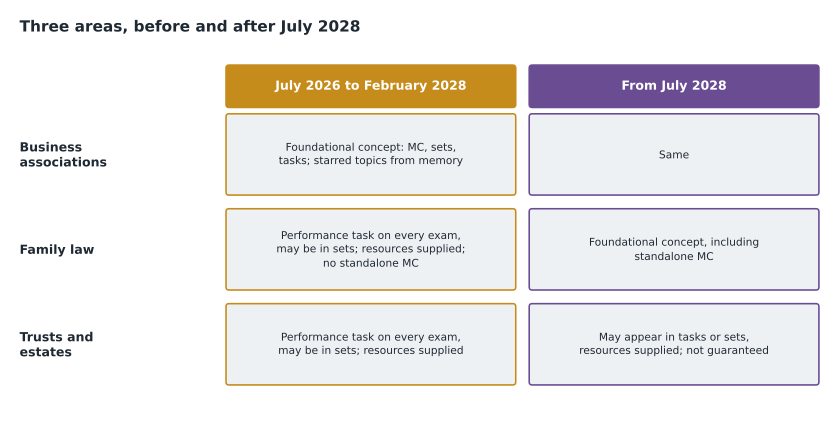
Three areas of law sit at the edges of the legacy exam and the new one. Business associations moved from the MEE into the NextGen foundational concepts. Family law and trusts and estates left the MEE in July 2026 and now appear on the NextGen exam in a different way, with materials supplied. This lesson explains how each is tested and gives a working overview of business associations, the one you must know from memory.
How each area is tested
Business associations and relationships is one of the eight foundational concepts. It appears in standalone multiple-choice questions in roughly equal numbers with the other seven, and in integrated sets and performance tasks when a scenario calls for it. Some topics are starred, tested from memory only, and others are unstarred.
Family law and trusts and estates are not foundational concepts until July 2028, and trusts and estates never becomes one. An article in NCBE's journal, The Bar Examiner, explains the arrangement for July 2026 through February 2028: each subject appears in a performance task on every NextGen exam and may also appear in integrated question sets, but neither appears in standalone multiple-choice questions. When they appear, the exam supplies the legal resources, such as statutes, regulations and cases, and examinees should rely on those materials.
From July 2028, family law becomes a foundational concept and is tested like the others, including in standalone multiple-choice questions and without materials supplied for starred topics. NCBE has published a separate family law content outline listing the topics it expects to test. Trusts and estates stays outside the foundational concepts: after July 2028 it may still appear in performance tasks or integrated sets, always with resources, but it is no longer guaranteed on every exam.
Business associations: what to know
Business associations covers agency and the main business entities. Bar-prep providers who have mapped the content scope report that most agency topics are starred, while for partnerships, corporations and limited liability companies the starred topics center on fiduciary duties and liability. Check the outline for the exact list. The core rules below are the ones a new lawyer uses most and the ones questions most often turn on.
Agency
An agency relationship arises when a principal manifests assent that an agent will act on the principal's behalf and subject to the principal's control, and the agent manifests assent or otherwise consents. No contract or payment is required.
A principal is bound by an agent's contracts made with authority. Actual authority comes from the principal's manifestations to the agent, express or implied, including authority reasonably necessary to accomplish what the agent was expressly told to do. Apparent authority comes from the principal's manifestations to a third party that make it reasonable for the third party to believe the agent is authorized. A principal can also ratify an unauthorized act by affirming it with knowledge of the material facts.
An employer is vicariously liable for torts an employee commits within the scope of employment, the doctrine of respondeat superior. A principal is generally not liable for the torts of an independent contractor, with exceptions such as nondelegable duties and inherently dangerous activities. The distinction turns largely on the principal's right to control the manner and means of the work.
An agent owes the principal fiduciary duties: loyalty, including not competing or self-dealing without consent, and duties of care, obedience and good conduct within the scope of the agency.
Partnerships
Under the Revised Uniform Partnership Act, which most states follow, a general partnership is formed when two or more persons associate to carry on as co-owners a business for profit, whether or not they intend to form a partnership. Sharing profits creates a presumption of partnership, subject to exceptions such as payments of wages or debts. Each partner is an agent of the partnership for carrying on its business in the ordinary course. Partners are jointly and severally liable for partnership obligations, though a creditor generally must first exhaust partnership assets. Partners owe each other duties of loyalty and care, and an obligation of good faith and fair dealing. Limited partnerships and limited liability partnerships modify liability: in a limited liability partnership, partners are generally not personally liable for partnership obligations merely by being partners.
Limited liability companies
A limited liability company combines limited liability for its members with flexible management and pass-through tax treatment by default. It may be member-managed or manager-managed. In a member-managed company, members generally owe fiduciary duties to the company and to each other; in a manager-managed company, managers owe them. A member is not personally liable for the company's obligations merely because she is a member, though she remains liable for her own torts, and courts may disregard the entity in limited circumstances.
Corporations
A corporation is formed by filing articles of incorporation with the state. Promoters who contract before incorporation are generally personally liable on those contracts unless the contract or a later novation provides otherwise; the corporation becomes liable only if it adopts the contract.
Shareholders are generally not personally liable for corporate obligations. Courts may pierce the corporate veil in exceptional cases, typically where the corporation is the alter ego of its owners, for example through commingling of funds, ignoring corporate formalities or inadequate capitalization, and recognizing the corporation as separate would promote fraud or injustice.
Directors and officers owe the corporation duties of care and loyalty. The business judgment rule presumes that directors acted on an informed basis, in good faith and in the honest belief that their decision served the corporation; a plaintiff who overcomes that presumption, for example by showing gross negligence in becoming informed or a conflict of interest, may obtain review of the decision on its merits. A conflicting-interest transaction is protected if it is approved after full disclosure by disinterested directors or shareholders, or is fair to the corporation. Shareholders may sue directly for injuries to themselves and derivatively, on the corporation's behalf, for injuries to the corporation, usually after a demand on the board or a showing that demand would be futile, depending on the jurisdiction.
| Entity | Formation | Owner liability | Who owes fiduciary duties |
|---|---|---|---|
| General partnership | Co-owners carry on a business for profit; no filing required | Joint and several, generally after partnership assets | Partners, to the partnership and each other |
| Limited liability partnership | Filing a statement of qualification | Generally no personal liability merely as a partner | Partners |
| Limited liability company | Filing a certificate or articles of organization | Generally none merely as a member | Members if member-managed; managers if manager-managed |
| Corporation | Filing articles of incorporation | Generally none, subject to veil piercing | Directors and officers; controlling shareholders in some situations |
Family law and trusts and estates: what to do now
Because both subjects come with materials until February 2028, the work is different. You do not need to memorize, for example, a state's intestacy shares or child support formula. You do need to read a statute or case you have never seen and use it quickly. Vocabulary helps you read faster. For trusts and estates, know what a will, a codicil, a testator, a beneficiary, an executor, intestacy, a trust, a trustee and a fiduciary duty are. For family law, know the basic stages of a divorce, the difference between property division and support, and the idea of the best interests of the child.
Marchetti adds a strategic point. A performance task in each subject appears on every exam in this period. That means two of your three performance tasks may well involve family law and trusts and estates, with all the law in the library. Practice reading those libraries. Released MPTs on family law and estates topics are good practice for this, since the MPT gives all the law too. 'Ngozi's old flashcards finally have a job,' she says. 'Use them to read faster, not to answer from memory.'
Examinees who will sit in July 2028 or later should plan for family law as a ninth foundational concept. NCBE's family law outline and its planned family law sourcebook are the places to start.
Worked problem
Which area, which approach?
Tessa reviews three original practice items. Item 1: a standalone multiple-choice question asks whether a corporation is bound by a contract its promoter signed before incorporation. Item 2: a performance task gives her a fictional state's pretermitted-child statute and asks for a memo on a child born after a will was signed. Item 3: an integrated set gives her a fictional custody statute and asks her to advise a parent.
Show solution
- Item 1 tests business associations, a foundational concept; no resources will be supplied, so she must know that the corporation is bound only if it adopts the contract.
- Item 2 tests trusts and estates with the law supplied; she reads the statute's conditions and applies them to the facts.
- Item 3 tests family law with the law supplied and the counseling skill; she applies the statute's factors and advises in plain language.
- For items 2 and 3, prior study helps with vocabulary, but the supplied statutes control even if they differ from rules she remembers.
Answer: Business associations is a memory subject; family law and trusts and estates, for now, are reading subjects.
Building a plan for the three areas
Andre leaves with a plan. Four weeks of business associations from the sourcebook and practice questions, starting with agency because so much of it is starred. Then weekly practice with performance tasks on family law and estates topics, read for speed. Tessa, who has less time, will do the same in compressed form, with one extra session on fiduciary duties and veil piercing, the two areas Marcus says showed up most in his July questions.
Common mistakes
MistakeFamily law and trusts and estates will appear in standalone multiple-choice questions before July 2028.
InsteadThrough February 2028 they appear in performance tasks and possibly integrated sets, with resources supplied, not in standalone multiple choice.
MistakeTrusts and estates becomes a foundational concept in July 2028.
InsteadOnly family law does; trusts and estates remains a subject tested with resources supplied.
MistakeA promoter is never personally liable once the corporation forms.
InsteadA promoter generally remains liable unless the contract says otherwise or a novation releases him.
MistakeBusiness associations is still only an essay subject.
InsteadIt is a NextGen foundational concept with its own share of multiple-choice questions.
How business associations shows up in skills questions
Business associations questions are not limited to doctrine. In an integrated set, a new lawyer might advise a client choosing between a general partnership and a limited liability company, explaining liability, management and formalities. In a drafting set, she might revise an operating agreement clause on who may bind the company, or a resolution approving a transaction in which a director has an interest. In a performance task, she might analyze whether a manager breached a fiduciary duty under a supplied statute. In each case, the foundational rules are the starting point, and the skill determines what you do with them.
Andre finds that framing helpful. 'I was trying to memorize business associations like a list,' he says. 'It sticks better when I picture the client. Two friends starting a bakery. Who's liable if the oven catches fire? Who can sign the lease? What happens when one wants out?' Marchetti nods. 'That's exactly the kind of question the exam asks.'
Distinguishing the entities in a fact pattern
Questions often hinge on recognizing which entity exists. If two people run a business together and share profits but never filed anything, a general partnership may exist even if they never used the word. If they filed articles of organization, it is a limited liability company, and the operating agreement and the statute govern management. If they filed articles of incorporation, corporate rules apply, including the roles of shareholders, directors and officers. Before applying any rule, identify the entity and, where it matters, whether it is member-managed or manager-managed. Many wrong answers apply partnership rules to an LLC or corporate rules to a partnership.
Remember too that the NextGen exam can test these rules through skills. A question might ask what document a client should file to obtain limited liability, which facts a lawyer should gather before advising on veil-piercing risk, or how to explain to two business partners what they owe each other. The rules are the same; the task decides how you use them.
Andre turns that into practice. For each rule in his business associations notes, he writes one client question it answers, such as 'Am I personally on the hook?' or 'Can my partner sign this lease without me?' The client question becomes the cue, and the rule becomes the answer.
Summary and key terms
- Business associations is a foundational concept tested in all question types, with many agency topics starred.
- Through February 2028, family law and trusts and estates each appear in a performance task on every exam and may appear in integrated sets, with resources supplied.
- From July 2028 family law becomes a foundational concept; trusts and estates continues to appear only with resources.
- Know agency authority, respondeat superior, partnership formation and liability, LLC and corporate liability, veil piercing, fiduciary duties and the business judgment rule.
- For family law and trusts and estates, practice reading supplied statutes quickly, using vocabulary to speed comprehension.
- Actual authority
- An agent's power to bind the principal based on the principal's manifestations to the agent.
- Apparent authority
- An agent's power to bind the principal based on the principal's manifestations to a third party.
- Respondeat superior
- An employer's vicarious liability for an employee's torts within the scope of employment.
- Piercing the corporate veil
- Disregarding a corporation's separate existence to hold owners liable, in exceptional cases.
- Business judgment rule
- A presumption that directors acted on an informed basis, in good faith and in the corporation's interest.
Lesson quiz · 5 questions
Score 60% or more to complete this lesson.
Create a free account to save your progress, take quizzes and earn a certificate.