
BAR-130 · Lesson 12 of 12 · 16 min
Capstone: a NextGen-style practice session
▶ Video coming soon A video version of this lesson is on the way.
On Saturday, November 21, 2026, from 1:00 to 4:00 p.m. Eastern time, Tessa and Andre sit the capstone Marchetti and Marcus wrote for them: a NextGen-style practice session with every question type. It is shorter than a real three-hour section, about 90 minutes, so that it can be reviewed in one sitting. They take it on their own laptops, cameras on, timers running. Marcus grades the written answers that evening using the rubrics below, and the debrief is on Sunday morning, November 22, at 9:00.
Everything in the session is original and written for this course. The fictional State of Marlow supplies the law for the performance task; its statute and case are fictional. Take the session yourself before reading the answers. Suggested timing: 20 minutes for Part A, 25 minutes for Part B and 45 minutes for Part C.
Part A: standalone multiple-choice questions
A1. A city ordinance bans all signs on residential lawns except signs identifying the owner's address. A homeowner is fined for a sign urging votes for a ballot measure. She sues, claiming the ordinance violates the First Amendment. Is she likely to prevail? (A) No, because cities may regulate land use. (B) Yes, because the ordinance forecloses an important and inexpensive medium of political speech on residential property. (C) No, because the ordinance applies to everyone equally. (D) Yes, because all regulations of signs are subject to strict scrutiny regardless of content.
A2. Dalton offered in writing to sell his lake cabin to Moore for 300,000 dollars, stating that the offer would remain open for 10 days. Moore paid nothing for the promise. On day 4, Dalton sold the cabin to Price and Moore learned of the sale from a reliable neighbor. On day 6, Moore mailed an acceptance to Dalton. Is there a contract between Dalton and Moore? (A) Yes, because the offer stated it would stay open for 10 days. (B) Yes, because acceptance was effective on mailing. (C) No, because the offer was revoked when Moore learned from a reliable source that Dalton had sold the cabin. (D) No, because contracts for land must be accepted in person.
A3. At a robbery trial, the prosecution calls a store clerk who, minutes after the robbery and while still shaking, told a police officer, 'The guy had a red jacket and a scar on his cheek.' The clerk now testifies he does not remember the robber. The prosecution offers the officer's testimony repeating the clerk's statement. The defendant objects on hearsay grounds. The objection should be: (A) Sustained, because the clerk is available. (B) Overruled, because the statement is an excited utterance. (C) Sustained, because the statement was made to police. (D) Overruled, because the officer has personal knowledge of what the clerk said.
A4. Gant, an employee of Fresh Haul Deliveries, stopped during his delivery route to pick up his own dry cleaning two blocks off the route and, while parking, negligently struck a pedestrian. The pedestrian sues Fresh Haul. What is Fresh Haul's strongest argument? (A) Gant was an independent contractor. (B) Gant was on a frolic outside the scope of employment. (C) The pedestrian assumed the risk. (D) Employers are never liable for employees' negligence.
A5. In a federal diversity action, the plaintiff's complaint alleges in conclusory terms that the defendant 'conspired to restrain trade' without facts suggesting an agreement. The defendant moves to dismiss under Rule 12(b)(6). The court should most likely: (A) Deny the motion, because notice pleading requires only a short statement. (B) Grant the motion, because the complaint does not plead facts making an agreement plausible. (C) Deny the motion, because conspiracy is a fact question for the jury. (D) Grant the motion, because conspiracy claims must be pleaded with particularity under Rule 9(b).
A6. Ortiz and Lam own a building as joint tenants with right of survivorship. Without telling Lam, Ortiz conveys her interest to her brother. Ortiz then dies. Who owns the building? (A) Lam alone, by survivorship. (B) Lam and Ortiz's brother as joint tenants. (C) Lam and Ortiz's brother as tenants in common. (D) Ortiz's estate and Lam as tenants in common.
A7 (select two). Hale Corp.'s board approved a merger after a two-hour meeting at which directors reviewed a valuation report from an independent bank and asked questions of the bank's analysts. One director, Ruiz, owned a 40 percent stake in the merger partner and did not disclose it. A shareholder sues. Which TWO statements are most accurate? (A) The business judgment rule presumptively protects the directors' process. (B) Ruiz's undisclosed interest raises a duty of loyalty issue. (C) Directors are strictly liable for any merger that loses value. (D) Shareholders may never challenge a board decision. (E) The two-hour meeting is gross negligence as a matter of law. (F) Reliance on an independent bank's report is never permitted.
A8 (select two). Police received an anonymous tip that a man in a green coat at a bus stop was carrying a gun. Officers arrived, saw a man in a green coat doing nothing unusual, frisked him and found a gun. He moves to suppress. Which TWO statements are correct? (A) An anonymous tip that only describes a person's appearance and location, without predictive information or corroboration of illegality, generally does not supply reasonable suspicion for a stop and frisk. (B) Any tip about a gun automatically justifies a frisk. (C) The gun is likely to be suppressed. (D) The frisk was valid because the officers confirmed the coat color. (E) Officers need probable cause, not reasonable suspicion, for any stop. (F) The man consented by standing at the bus stop.
Part B: integrated question set (counseling)
Scenario. You are a newly licensed associate. Mira Okon owns Okon Print Studio, a sole proprietorship. A customer, Halvard Supply, ordered 5,000 printed catalogs for 9,000 dollars, delivery by October 1. Mira delivered on October 6 because her press broke. Halvard refused the catalogs and has not paid, saying it needed them for an October 3 trade show. The parties' purchase order says nothing about the trade show.
B1 (short answer). Mira asks whether Halvard can refuse the catalogs. What do you tell her?
B2 (multiple choice). Which fact would most help Mira's position? (A) Mira had never been late before. (B) Halvard used some of the catalogs at a later event. (C) Mira's press is old. (D) Halvard is a large company.
New facts. Mira calls back. Halvard's purchasing manager, who has no lawyer involved, emailed asking Mira to 'just tell us honestly whether you knew the press was failing in September'. Mira did know.
B3 (short answer). Mira wants you to reply that the press failed without warning. What should you advise?
B4 (multiple choice). Mira asks you to tell Halvard's manager that the firm is a neutral party trying to help both sides settle. What should you do? (A) Agree, because it may encourage settlement. (B) Decline; you must not state or imply that you are disinterested when dealing with an unrepresented person. (C) Agree, but only in writing. (D) Refer the manager to Mira instead.
B5 (short answer). In two sentences, recommend a course of action to Mira.
Part C: performance task (trusts and estates, law supplied)
Task memo. From the supervising attorney: 'Our client, Leah Brandt, is the daughter of Owen Brandt, who died predeceasing his aunt, Clara Voss. Clara's will, signed in 2019, left her house to Owen. Clara died in March 2026. The residuary clause leaves everything else to the Harwick Library Foundation. Leah wants to know whether she takes the house. Write an objective memo, about one page of analysis, applying the Marlow anti-lapse statute and the Beale case. Do not address estate taxes.'
File. Clara's will, paragraph 3: 'I give my house at 14 Alder Lane to my nephew, Owen Brandt.' There is no language about what happens if Owen dies first. Owen died in 2024, survived by his only child, Leah. Clara's sister, Nell Brandt, was Owen's mother. A note from the probate clerk says the Foundation claims the house as residuary beneficiary.
Library. Fictional Marlow Probate Code section 2-603(b): 'If a devisee who is a grandparent, a descendant of a grandparent, or a stepchild of the testator fails to survive the testator, a substitute gift is created in the devisee's surviving descendants, unless the will expresses a contrary intention. Words of survivorship, such as "if he survives me", are a contrary intention. A residuary clause is not, by itself, a contrary intention.' Fictional case: In re Estate of Beale (Marlow Supreme Court 2018), holding that a niece is a descendant of the testator's grandparent under section 2-603(b), and that a general residuary clause does not defeat the substitute gift.
Answers to Part A
A1: B. In City of Ladue v. Gilleo (1994), the Supreme Court struck down a near-total ban on residential signs because it foreclosed a venerable, inexpensive and important medium of speech. D overstates: not every sign regulation receives strict scrutiny.
A2: C. An offer not supported by consideration can be revoked even if it says it will stay open, unless it is a merchant's firm offer for goods or an option contract. A land sale is not governed by the firm-offer rule. An offeree's reliable knowledge that the offeror has taken definite action inconsistent with the offer, such as selling the property to someone else, operates as an indirect revocation.
A3: B. A statement relating to a startling event made while the declarant was under the stress of excitement it caused is an excited utterance, admissible regardless of the declarant's availability. The call asks only about hearsay, so constitutional objections are not in play.
A4: B. Fresh Haul's strongest argument is that Gant was on a frolic, a substantial personal departure, rather than a minor detour within the scope of employment. A brief stop two blocks off route may well be found a detour, so the argument may fail, but it is Fresh Haul's best one. A and D misstate the facts or the law; assumption of risk does not fit a pedestrian.
A5: B. Under Bell Atlantic Corp. v. Twombly (2007) and Ashcroft v. Iqbal (2009), a complaint must plead enough facts to make a claim plausible, not merely conceivable; conclusory allegations of conspiracy do not suffice. Rule 9(b) applies to fraud and mistake, not to conspiracy as such.
A6: C. Ortiz's conveyance severed the joint tenancy as to her share, so her brother holds as a tenant in common with Lam. Survivorship no longer applied to that share when Ortiz died.
A7: A and B. The board's informed process, relying on an independent report and asking questions, is the kind of decision the business judgment rule presumptively protects, while Ruiz's undisclosed interest raises a loyalty issue that can remove the rule's protection for the conflicted transaction unless it is cleansed or fair. C, D and F are wrong as stated, and E overstates.
A8: A and C. Under Florida v. J.L. (2000), a bare anonymous tip that a person at a location has a gun, without predictive detail or corroboration of illegality, does not supply reasonable suspicion; the frisk is likely unlawful and the gun likely suppressed. Confirming innocent details such as coat color does not corroborate the claim of illegality.
Answers to Part B
B1 model answer: Probably not, unless timing was essential. Under Article 2 of the Uniform Commercial Code, a buyer may reject goods that fail to conform to the contract in any respect, including late delivery, but whether a five-day delay justifies rejection depends on the contract's terms and circumstances; the purchase order did not mention the trade show or make time of the essence, so Mira has a reasonable argument that Halvard must pay, perhaps less damages caused by the delay. Rubric: answer first (1 point); rule and the key fact that the order did not mention the trade show (1 point).
B2: B. If Halvard used the catalogs, that is strong evidence of acceptance, which undercuts its rejection and supports Mira's claim for the price.
B3 model answer: I cannot send that reply, because a lawyer may not knowingly make a false statement of material fact to a third person, and Mira knew the press was failing. I recommend we not answer the question directly in a way that misleads, and instead respond through a settlement proposal focused on the catalogs' value. Rubric: refuse the false statement with the reason (1 point); offer a lawful alternative (1 point).
B4: B. Under Model Rule 4.3, a lawyer dealing with an unrepresented person must not state or imply that the lawyer is disinterested.
B5 model answer: Because the order did not make the October 1 date essential and Halvard may have used some catalogs, I recommend we propose a settlement in which Halvard pays most of the 9,000 dollars, with a modest discount for the delay, rather than suing immediately. It is your decision whether to make that offer and at what amount; I will draft it if you agree. Rubric: recommendation with reason (1 point); respects the client's decision (1 point).
Answer to Part C
A strong memo answers the question first, then analyzes each element. Conclusion: Leah likely takes the house under the anti-lapse statute.
Analysis. The gift to Owen lapsed because he did not survive Clara. Section 2-603(b) creates a substitute gift in a deceased devisee's surviving descendants if the devisee is a grandparent, a descendant of a grandparent, or a stepchild of the testator. Owen was Clara's nephew, the son of her sister Nell; Owen is therefore a descendant of Clara's grandparents, the parents of Clara and Nell. Beale confirms that a niece qualifies as a descendant of a grandparent, and a nephew stands in the same relationship. Leah is Owen's surviving descendant. The statute does not apply if the will expresses a contrary intention. Paragraph 3 contains no words of survivorship, and the statute and Beale both say that a residuary clause is not, by itself, a contrary intention. The Foundation's claim therefore fails unless other evidence of contrary intention appears in the will, and the file shows none. Estate taxes are outside the assignment and are not discussed.
Rubric used by Marcus (24 points, matching the standard task scale): responsiveness and format, an objective memo with a conclusion first (3); the lapse and the statute's elements stated accurately (4); the relationship analysis tracing Owen to Clara's grandparents (5); use of Beale on relationship and the residuary clause (4); contrary intention, including the absence of survivorship words (4); clear conclusion and recognition that taxes are excluded (2); organization and clarity (2).
The debrief
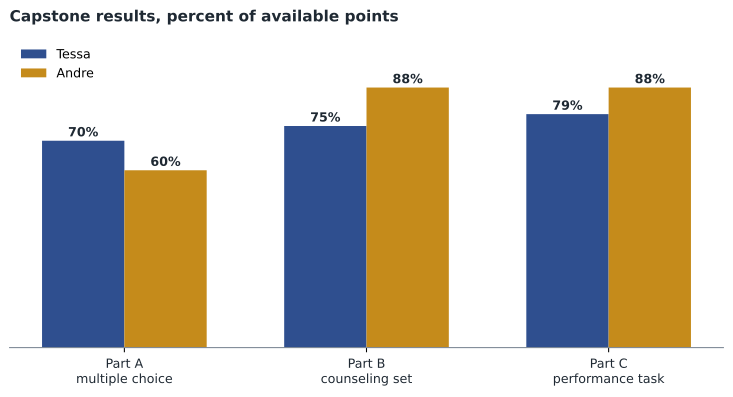
At the Sunday debrief, Marcus shares the results. Tessa scored 7 of 10 points on Part A (she missed A2 and A4 and earned half credit on A7), 6 of 8 on Part B, and 19 of 24 on Part C, where she lost points for not tracing the grandparent relationship step by step. Andre scored 6 of 10 on Part A, missing A2, A5 and A6 and earning half credit on A8, but 7 of 8 on Part B and 21 of 24 on Part C. 'Different strengths,' Marcus tells them. 'Tessa, your law is ahead of your writing. Andre, your writing is ahead of your law. Both of those are fixable by February and July.'
They leave with plans. Tessa will add one timed performance task a week and write every relationship or element analysis as a chain of short steps. Andre will add 20 multiple-choice questions a day in civil procedure and real property, his two weakest concepts, and keep his error log by subject. Marchetti closes the series with the advice she started it with. 'Practice the real format, review honestly, and keep going. The exam changed. What it rewards didn't: knowing the law well enough to use it for a client.'
Common mistakes
MistakeSelect-two items should be skipped if I am unsure of one option.
InsteadPartial credit is available; choose the two options that survive independent evaluation.
MistakeA residuary clause shows the testator intended to defeat anti-lapse.
InsteadUnder the supplied statute and case, a residuary clause alone is not a contrary intention.
MistakeA brief personal stop always takes an employee outside the scope of employment.
InsteadMinor detours usually stay within the scope; only a substantial frolic takes the employee outside it.
MistakeI can tell an unrepresented opponent I am neutral to help settlement.
InsteadRule 4.3 forbids stating or implying that the lawyer is disinterested.
Summary and key terms
- The capstone combined standalone multiple choice, a counseling integrated set and a standard performance task with supplied law.
- Multiple-choice answers turned on precise rules: revocation by indirect notice, excited utterances, severance of joint tenancy and anonymous tips.
- The counseling set tested the UCC, acceptance by use, Rule 4.1 truthfulness and Rule 4.3 dealings with unrepresented persons.
- The performance task applied a supplied anti-lapse statute and case, tracing the relationship element step by step.
- Review results by component and skill to build the next study plan.
- Anti-lapse statute
- A statute that substitutes a deceased devisee's descendants for a lapsed gift when its conditions are met.
- Lapse
- The failure of a gift because the beneficiary died before the testator.
- Severance
- The conversion of a joint tenancy into a tenancy in common, for example by one joint tenant's conveyance.
- Excited utterance
- A statement about a startling event made under the stress of excitement it caused, admissible despite the hearsay rule.
- Frolic and detour
- The distinction between substantial personal departures outside the scope of employment and minor deviations within it.
Lesson quiz · 5 questions
Score 60% or more to complete this lesson.
Create a free account to save your progress, take quizzes and earn a certificate.