
BAR-130 · Lesson 5 of 12 · 26 min
Integrated question sets
▶ Video coming soon A video version of this lesson is on the way.
On Sunday, October 18, 2026, Marchetti asks Marcus which part of the July exam surprised him most. He does not hesitate. 'The integrated sets. You get a client, and then the facts keep changing. Two questions in, the client calls with news, and the next question is about the news. It felt like a week at the firm squeezed into 24 minutes.'
Integrated question sets are the newest kind of bar exam question. They have no direct ancestor on the legacy exam. This lesson explains what they are, how they are scored and how to answer the short and medium written responses they require, using original practice sets.
The basics
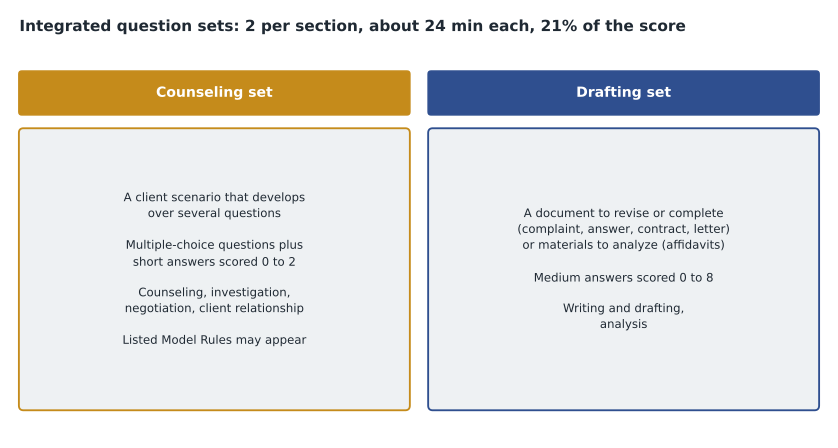
Each three-hour section contains two integrated question sets, so the exam has six. One of the six is an unscored pretest set, unlabeled. NCBE's suggested pace is about 24 minutes per set. Together, the sets make up 21 percent of the total score.
NCBE's preparation page describes each set as built on a common fact scenario, sometimes with legal resources or supplemental documents such as a contract, a letter, an affidavit or a statute. The questions in the set may be multiple-choice, short-answer or medium-answer. They test the foundational concepts and, especially, the skills: investigation and evaluation, counseling, negotiation, client relationship and management, and drafting.
Two kinds of set
NCBE's blueprint describes two kinds of integrated set, scored differently.
A counseling set combines multiple-choice questions with short-answer questions. Each short answer is scored on a scale of zero to two points. Bar-prep providers who have studied NCBE's samples describe these sets as following a newly licensed lawyer through a client matter as circumstances change, with a mix of short-answer and multiple-choice questions along the way.
A drafting set calls for medium-answer responses, each scored on a scale of zero to eight points. A typical drafting set gives you a document, such as a complaint, an answer, a contract or a letter, and asks you to revise or complete part of it, or gives you materials such as affidavits to analyze. The skill is producing language that does what the client needs and complies with the governing law.
Written responses are scored by graders appointed by each jurisdiction, using rubrics written by NCBE. Partial credit is available. NCBE publishes a free Constructed Response Guide that explains how the written components work and how they are graded, with sample scoring guides and screenshots of the platform.
The selected Model Rules of Professional Conduct appear here and only here. NCBE says they are tested within integrated sets that focus on counseling, negotiation and client relationship skills.
Writing a short answer
A short answer is not a mini-essay. It is the answer a busy supervising lawyer wants in a hallway: direct, specific and supported. Marchetti teaches a three-part shape. Answer the question in the first sentence. Give the rule or reason in the second. Tie it to the decisive facts in the third. Three or four sentences are usually enough. If the question asks for two things, such as two facts to investigate or two risks to explain, give exactly two, clearly separated.
Short answers lose points in predictable ways: hedging without committing, stating a rule without applying it, answering a different question than the one asked, or burying the answer at the end of a paragraph. Because each short answer is worth up to two points, one well-aimed sentence can be worth as much as a page of general discussion.
Writing a medium answer
Medium answers in drafting sets take longer, and the task usually says exactly what to produce: revise a paragraph, draft a clause, identify problems in a document and fix them, or explain changes. The scoring scale of zero to eight rewards both the drafting and the reasoning. A good approach is to identify what the document is supposed to accomplish, find each place where it fails to do so or violates a rule in the materials, fix each failure with precise language, and, if asked, explain each change in a sentence tied to the rule.
Practice counseling set: Vale Grooming
The following set is original and written for this course. The legal concepts are contract law, business associations and torts, and the skills are counseling, investigation and client relationship management.
Scenario. You are a newly licensed associate at a small firm. Corinne Vale owns Vale Grooming LLC, a dog-grooming business with two employees, organized as a single-member limited liability company. She meets with you because a customer, Dev Patel, says his dog was injured when a grooming table collapsed. Patel's email demands 4,000 dollars for veterinary bills and says he will 'see Corinne personally in court'.
Worked problem
Question 1 (short answer)
Corinne asks whether Patel can collect from her personally if he sues. What should you tell her?
Show solution
- Answer first: generally no, as to the business's debts, but she may still be liable for her own conduct.
- Rule: a member of an LLC is not personally liable for the company's obligations merely because she is a member, though a member is liable for her own torts and courts may disregard the entity in limited circumstances.
- Facts: the table belongs to the business and an employee may have been grooming the dog; whether Corinne herself set up or maintained the table matters.
Answer: Model answer: Generally, no. As a member of the LLC, Corinne is not personally liable for the company's debts just because she owns it, but she could be liable for her own negligence, for example if she personally set up or failed to repair the table, and a court could disregard the LLC in rare cases such as commingling of funds. We should find out who maintained the table and how the business keeps its finances.
Worked problem
Question 2 (multiple choice)
Which of the following should you ask Corinne for first? (A) Her personal tax returns for the last five years. (B) The table's purchase records, maintenance history and any photographs of the collapsed table. (C) A list of all customers who have complained about prices. (D) Her lease for her home.
Show solution
- The claim turns on whether the business was negligent in maintaining equipment.
- Evidence of the table's condition and maintenance bears directly on breach.
- Price complaints and her home lease are irrelevant; personal tax returns may matter for veil piercing but are not the first priority.
Answer: The answer is B.
New facts. Two days later Corinne calls. She has found a maintenance log showing that an employee reported a wobbly table leg three weeks before the incident, and no repair was made. She also mentions that Patel signed a release form when he dropped off his dog, saying the business 'is not responsible for any injury to your pet for any reason'.
Worked problem
Question 3 (short answer)
Identify two ways the maintenance log affects the case.
Show solution
- Answer with exactly two effects, clearly separated.
- First: it shows the business had notice of the defect, which supports breach of the duty of reasonable care.
- Second: it is evidence that must be preserved, and destroying or altering it would expose the business and the lawyer to serious consequences.
Answer: Model answer: First, the log shows the business knew of the wobbly leg and did not fix it, which strongly supports a finding that it breached its duty of care. Second, the log is relevant evidence that must be preserved; Corinne should not alter or discard it.
Worked problem
Question 4 (short answer)
Corinne asks whether the release form ends the matter. What should you tell her?
Show solution
- Answer first: probably not, at least not with certainty.
- Rule: exculpatory clauses are construed narrowly against the party relying on them, and many courts refuse to enforce them for negligence unless the language clearly covers negligence, and some refuse to enforce them for gross negligence at all.
- Facts: the form does not mention negligence, and the business ignored a known defect for three weeks.
Answer: Model answer: Probably not. Courts read releases narrowly against the business, and this form does not mention negligence. Ignoring a reported defect for three weeks also invites an argument of gross negligence, which many courts will not allow a release to excuse. The form helps a little, but it should not drive her decision.
Worked problem
Question 5 (multiple choice)
Corinne asks you to call Patel directly to negotiate. Patel's email was signed "Dev Patel" and copied "my attorney, Lena Ortiz". What should you do? (A) Call Patel, because he wrote to Corinne himself. (B) Communicate with Ms. Ortiz about the matter, not with Patel, unless she consents. (C) Call Patel but avoid discussing the merits. (D) Ask Corinne to call Patel and read him a script you prepare.
Show solution
- Model Rule 4.2 bars a lawyer from communicating about the subject of the representation with a person the lawyer knows is represented by counsel, without that lawyer's consent or other authorization.
- The email tells you Patel has a lawyer in the matter.
- Scripting the client's call to circumvent the rule raises the same concern.
Answer: The answer is B.
Worked problem
Question 6 (short answer)
Write two sentences advising Corinne how to respond to the demand.
Show solution
- Counseling: give a recommendation, the reason, and respect her decision.
- The log makes liability likely and the amount is modest compared with the cost of litigation.
- She should notify her liability insurer before negotiating.
Answer: Model answer: Because the maintenance log makes liability likely and 4,000 dollars is less than defending a lawsuit would cost, I recommend that we notify your liability insurer promptly and then negotiate a settlement through Ms. Ortiz, with a written release. The decision whether and for how much to settle is yours, and I will give you a range once we confirm the veterinary bills.
Look at what the set did. It started with entity law, moved to investigation, absorbed new facts, tested a contract defense, raised an ethics rule and ended with advice. No single question required much writing, but each required you to know a rule and use it for a client.
Practice drafting task: a letter that says too much
A short original drafting item gives the flavor of the medium answer. Corinne has drafted her own reply to Patel's lawyer and asks you to fix it. The key sentence reads: 'We are very sorry; my staff knew the table was broken and should have fixed it, and we will pay whatever the vet charges.'
A strong medium answer identifies three problems and fixes them. The sentence admits notice and fault, which the business may want to contest or at least not volunteer before its insurer is involved. It promises to pay an unlimited, undocumented amount, which gives away the negotiation. And it comes from Corinne rather than through counsel, after Patel has a lawyer. A revised version might read, in a letter from you to Ms. Ortiz: 'Vale Grooming regrets that Mr. Patel's dog was hurt and is reviewing the matter. Please send copies of the veterinary invoices, and we will respond promptly.' An explanation of each change, tied to the reasons above, earns the rest of the credit.
How to practice integrated sets
NCBE sells official integrated question set banks and full practice sets, and its free sample questions include integrated sets. Commercial providers are building their own. Whatever you use, practice the timing. Twenty-four minutes for six questions with changing facts feels generous until a new fact arrives at minute 15. Tessa, after her first timed set, has one rule written on a sticky note: 'Answer first. Then explain.'
Common mistakes
MistakeShort answers should show everything I know about the topic.
InsteadAnswer the question directly in the first sentence, then give the rule and the decisive facts.
MistakeThe facts in an integrated set stay the same throughout.
InsteadSets often add new facts midway; later questions depend on them.
MistakeDrafting means making the document sound better.
InsteadDrafting means making it accomplish the client's goal and comply with the governing law.
MistakeEthics rules appear in standalone multiple-choice questions.
InsteadThe selected Model Rules are tested within integrated sets on client-facing skills.
Timing an integrated set
Twenty-four minutes is a budget, not a target. Marchetti suggests reading the scenario and any documents once, carefully, in the first four or five minutes, noting the client's goals and the key dates and amounts. Then answer in order, because later questions often build on earlier ones and new facts arrive midway. Give a multiple-choice question in a set about two minutes and a short answer three or four. If a short answer stalls, write your best direct answer in one sentence and move on; a committed one-sentence answer often earns a point, while a blank earns nothing. Save two minutes at the end to reread the answers against their questions.
Reading the documents in a drafting set
Drafting sets reward a particular way of reading. Before revising anything, ask three questions about the document. What is it supposed to accomplish for the client? Who will read it, and what will they do with it? What rule in the materials governs its content or form? Then read line by line looking for three kinds of problems: statements that harm the client, such as admissions or promises the client has not authorized; terms that do not achieve the client's goal, such as a deadline with no consequence or a definition that leaves a gap; and content that breaks a rule, such as a demand with no basis or a communication to someone who has a lawyer. Each problem you identify, fix and explain is a likely rubric point.
Tessa practiced that routine on a sample set and found it changed her answers. 'My first instinct was to rewrite the whole letter so it sounded better,' she says. 'The rubric didn't care how it sounded. It cared that I removed the admission, fixed the deadline and sent it to the right person.'
Summary and key terms
- Each section has two integrated question sets, about 24 minutes each; the sets are 21 percent of the score, and one of six is a pretest.
- Counseling sets mix multiple-choice questions with short answers scored 0 to 2; drafting sets require medium answers scored 0 to 8.
- Jurisdiction graders score written responses using NCBE rubrics, with partial credit.
- Write short answers in three parts: answer, rule, decisive facts.
- Expect facts to change mid-set and ethics rules to appear in client situations.
- Integrated question set
- A group of questions built on one fact scenario, mixing multiple-choice, short-answer and medium-answer questions.
- Counseling set
- An integrated set with multiple-choice and short-answer questions, each short answer scored 0 to 2.
- Drafting set
- An integrated set with medium-answer drafting or analysis responses, each scored 0 to 8.
- Exculpatory clause
- A contract term that tries to release a party from liability, construed narrowly by courts.
- Constructed Response Guide
- NCBE's free guide to how NextGen written responses work and are graded.
Lesson quiz · 5 questions
Score 60% or more to complete this lesson.
Create a free account to save your progress, take quizzes and earn a certificate.