
BAR-130 · Lesson 7 of 12 · 22 min
Legal research on the exam
▶ Video coming soon A video version of this lesson is on the way.
On Sunday, November 1, 2026, Tessa admits that research is the skill she fears most. 'In law school we had databases,' she says. 'How do you test research without a database?' Marcus answers with his July experience. 'They give you the sources. A statute, a couple of cases, maybe a regulation or a secondary source. The questions ask what a good researcher would do with them. Which one controls. Which one is out of date. What you would look for next. Whether you're done.'
Legal research is one of the seven foundational skills, and the NextGen exam is the first bar exam to test it directly. This lesson explains what the skill includes, the principles of authority that most research questions turn on, how to read supplied sources efficiently, and how legal research performance tasks work, with an original practice set.
What the research skill includes
NCBE's content scope describes the research skill as identifying and carrying out research strategies. That includes spotting the issues that need research, working with the sources provided, developing a theory of the case and deciding when a research question has been answered. The exam does not test whether you can operate a commercial database or remember citations. It tests the judgment behind good research: where to look, what to trust, what controls and when to stop.
The skill appears mainly in the legal research performance tasks described in Lesson 6, where research questions come before a shorter writing assignment. It can also appear in multiple-choice questions and integrated sets, for example a question asking which of several sources a new lawyer should consult first.
Principles of authority
Most research questions turn on a small set of principles that every first-year legal research course teaches. Know them cold.
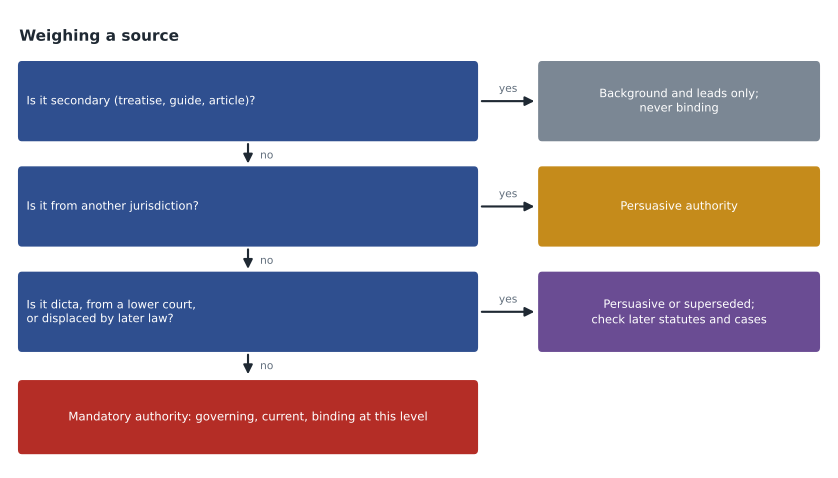
Primary and secondary authority. Primary authority is the law itself: constitutions, statutes, regulations, court rules and judicial decisions. Secondary authority explains or comments on the law: treatises, law review articles, practice guides, restatements and encyclopedias. Secondary sources are excellent starting points for an unfamiliar area, but they are not the law.
Mandatory and persuasive authority. Mandatory, or binding, authority must be followed by the court deciding the case: the governing constitution and statutes, valid regulations, and decisions of higher courts in the same jurisdiction. Persuasive authority may be considered but need not be followed: decisions of other jurisdictions, lower courts, secondary sources, and dicta.
Hierarchy and time. Within a jurisdiction, a constitution prevails over a statute, a statute over a regulation, and a valid statute over a conflicting common-law rule. A later statute can displace an earlier case. A higher court's decision binds lower courts, and a later decision of the same court may overrule an earlier one. A case can be good law on one point and superseded on another.
Holding and dicta. The holding is the rule necessary to the decision on the facts before the court. Statements not necessary to the decision are dicta: possibly persuasive, never binding.
Reading supplied sources quickly
Research tasks give you more material than you need, so read with purpose. For a statute, read the definitions first, then the operative section, then the exceptions, then any effective-date or transition provision. Many research traps hide in a definition or an effective date. For a case, note the court, the date, the procedural posture, the holding and any rule the court states; then check whether a later source in the library changes it. For a secondary source, use it to understand the landscape and to find primary authority, not as the answer.
Andre has a habit from his research course that Marcus endorses: before reading any source in full, list every source in the library with its court or issuer and date. 'Half of the research questions were answered by that list,' Marcus says. 'Which is binding, which is newer, which is from somewhere else.'
Research strategy questions
Some questions ask what a researcher should do, not what the law is. Typical calls include: which source should the lawyer consult first; what additional research is most needed; which search terms would best locate the governing rule; whether the research is complete. The principles above usually decide them.
When the area is unfamiliar, start with a reliable secondary source for orientation and leads to primary authority. When a statute governs, start with the statute, preferably in an annotated version that leads to cases interpreting it. Before relying on a case, confirm that it is still good law. Stop when you have found the governing mandatory authority, confirmed it is current, and found no binding authority pointing the other way; continuing to collect persuasive authority after that is rarely the best next step.
Practice research set: the Ridley Bakery permit
The following set is original and written for this course. It is set in the fictional State of Marlow, and all statutes, regulations and cases are fictional.
Task memo. 'Our client, Ridley Bakery, wants to put four outdoor tables on the sidewalk in front of its shop in the city of Harwick. The city says Ridley needs a permit under the Harwick municipal code and has refused one because the sidewalk is less than eight feet wide. Research whether the city may deny the permit on that ground, answer the research questions below, and then write a short paragraph for the client.'
Library. (1) The fictional Marlow Sidewalk Dining Act, enacted in 2024, section 4: 'A municipality may require a permit for sidewalk dining but may not deny a permit on the basis of sidewalk width if at least five feet of clear pedestrian passage remains.' Section 9: 'This Act takes effect January 1, 2025.' (2) Harwick Municipal Code section 12-40, adopted in 2019: permits for sidewalk tables require a sidewalk at least eight feet wide. (3) The fictional case City of Harwick v. Lark Cafe (Marlow Court of Appeals 2021), upholding the eight-foot rule against a challenge under Marlow common law. (4) A fictional 2023 practice guide chapter on Marlow municipal permits, describing the eight-foot rule as 'well settled'. (5) The fictional case Torres v. Village of Elm Bluff (a court in a neighboring state, 2022), striking down a similar width rule. (6) A site sketch in the file showing that with Ridley's tables in place, six feet of clear passage remains.
Worked problem
Research question 1 (multiple choice)
Which source controls whether Harwick may deny the permit on the basis of sidewalk width? (A) The practice guide. (B) City of Harwick v. Lark Cafe. (C) The Marlow Sidewalk Dining Act. (D) Torres v. Village of Elm Bluff.
Show solution
- The state statute is primary, mandatory authority and was enacted after both the ordinance and Lark Cafe.
- A municipality's ordinance must yield to a valid state statute that limits its power on the subject.
- Lark Cafe decided a common-law challenge before the statute existed.
- The practice guide is secondary and predates the statute; Torres is from another jurisdiction.
Answer: The answer is C.
Worked problem
Research question 2 (multiple choice)
Which statement about Lark Cafe is most accurate? (A) It remains binding and requires denial of the permit. (B) It was decided before the Act and does not address the Act's limit, so it does not control the permit decision now. (C) It is persuasive only because it came from an intermediate appellate court. (D) It was overruled by Torres.
Show solution
- An intermediate appellate decision binds trial courts in the same state, so C is wrong in general.
- But the later statute changes the governing law on the specific question.
- A court in another state cannot overrule a Marlow case.
Answer: The answer is B.
Worked problem
Research question 3 (short answer)
What fact must Ridley establish for the Act's limit to apply, and does the file establish it?
Show solution
- Read the operative condition: at least five feet of clear pedestrian passage must remain.
- The site sketch shows six feet with the tables in place.
- A careful answer notes that the city may dispute the measurement.
Answer: Model answer: Ridley must show that at least five feet of clear pedestrian passage remains with the tables in place. The site sketch shows six feet, which satisfies the Act, though the city may contest the measurement, so an independent measurement would help.
Worked problem
Research question 4 (multiple choice)
What is the best next research step? (A) Find more out-of-state cases like Torres. (B) Confirm the Act has not been amended or held invalid and check whether any Marlow case has interpreted section 4. (C) Read more practice guide chapters on permits. (D) Stop; the research is complete.
Show solution
- The governing authority has been found; the remaining risk is that it has changed or been interpreted narrowly.
- Collecting persuasive authority adds little once mandatory authority is identified.
Answer: The answer is B. Confirming currency and checking for interpretation is the last step before concluding.
The writing assignment would then ask for a short client paragraph. A strong one says, in plain language, that a 2024 state law bars the city from denying a sidewalk-dining permit based on width when at least five feet of clear walkway remains, that Ridley's layout leaves six feet, that an older city rule and court decision pointing the other way predate the state law, and that the firm will confirm the law is unchanged and recommend a fresh measurement before re-applying.
Look at the traps the set contained, because they are the traps research tasks rely on. A secondary source that calls a rule well settled, written before the law changed. A binding case that a later statute displaced. A persuasive case from elsewhere that happens to reach the right result for the wrong reason. An effective date. And a factual condition in the statute that the file has to satisfy.
Building the skill
The best preparation is to practice reading unfamiliar materials against the clock. Use NCBE's two free sample legal research tasks and the research tasks in its practice sets. Supplement with exercises from your law school's research course: take any statute and a few cases and ask the four questions of every source: is it primary, is it from the governing jurisdiction, is it binding at this level, and is it still current. Tessa now does that with every library she reads, MPT or NextGen. 'It takes ninety seconds,' she says, 'and it tells me which sources to read carefully.'
Common mistakes
MistakeA practice guide that calls a rule well settled is reliable authority.
InsteadSecondary sources are not binding and may predate changes in the law.
MistakeA court of appeals decision is always binding on the question it decided.
InsteadA later statute or higher-court decision can displace it.
MistakeMore authority is always better research.
InsteadOnce current mandatory authority is found and confirmed, collecting persuasive authority adds little.
MistakeEffective dates are boilerplate.
InsteadWhether a statute applies can turn on its effective date.
Statutory interpretation basics
Research tasks often turn on reading a statute correctly, so a few interpretive habits are worth practicing. Start with the text and its ordinary meaning, read in context with the rest of the statute. Apply definitions the statute supplies, even when they differ from everyday usage. Watch the difference between 'shall' and 'may', and between 'and' and 'or' in a list of conditions. Read exceptions narrowly unless the statute says otherwise, and check whether a later section limits an earlier one. If a case in the library interprets the statute, its reading binds lower courts in that jurisdiction unless a later amendment changes the text.
Explaining your research in writing
The writing assignment at the end of a research task is short, so every sentence should carry weight. State the answer. Identify the controlling authority and why it controls. Address the authorities that seem to point the other way and explain briefly why they do not govern: they are older, from another jurisdiction, secondary or superseded. Identify any remaining uncertainty, such as a fact that must be confirmed or an interpretation no court has addressed, and say what the next step is. That structure answers the four questions a supervising lawyer cares about: what is the answer, how sure are we, what could go wrong, and what do we do next.
Research questions in multiple-choice form
Research questions in multiple-choice form usually test one principle at a time, and the wrong answers are built from common misconceptions: treating a secondary source as binding, treating any appellate case as binding everywhere, ignoring a later statute, or relying on dicta. When you read the options, label each one with the principle it violates. The option you cannot label is usually the answer. Andre tried that on the Ridley questions and finished them in under four minutes, which left him more time for the client paragraph.
Marcus puts it simply for the group. 'Research questions are not trick questions. They are questions about trust. Which source can I trust for this question, in this jurisdiction, today? If you ask that every time, most of them answer themselves.'
Andre adds a reminder about federal and state law. If a problem concerns a state-law claim, a state statute or a state supreme court decision from the governing state controls, and a federal court decision on the same state-law question is at most persuasive to that state's courts. If the question is federal, the reverse is true. Many research questions become easy once you identify which sovereign's law governs.
Summary and key terms
- The research skill covers spotting issues, working with provided sources, developing a theory and deciding when research is complete.
- Know primary versus secondary, mandatory versus persuasive, hierarchy, the effect of later law, and holding versus dicta.
- List every source with its issuer and date before reading; read statutes starting with definitions and effective dates.
- Research strategy questions ask where to start, what to verify and when to stop.
- Research tasks hide traps: outdated secondary sources, superseded cases, out-of-state authority and statutory conditions.
- Primary authority
- The law itself: constitutions, statutes, regulations, court rules and judicial decisions.
- Secondary authority
- Sources that explain or comment on the law, such as treatises and practice guides.
- Mandatory authority
- Authority a court must follow, such as governing statutes and higher-court decisions in its jurisdiction.
- Persuasive authority
- Authority a court may consider but need not follow.
- Dicta
- Statements in an opinion not necessary to the decision; never binding.
Lesson quiz · 5 questions
Score 60% or more to complete this lesson.
Create a free account to save your progress, take quizzes and earn a certificate.