
BAR-201 · Lesson 10 of 12 · 18 min
Alabama wills, trusts and probate
▶ Video coming soon A video version of this lesson is on the way.
One of Avery's first assignments is to help a probate judge's office find the right form for admitting a will to probate. The second is to read a client's homemade will, written by hand on a legal pad and signed at the bottom, and tell the senior partner whether it is any good. 'Start with the statute,' the partner says. 'Then tell me what happens if it fails.' This lesson covers the Alabama rules behind both tasks: how a will is executed, how wills are admitted to probate, what happens without a will, the surviving spouse's elective share and other protections, and the basics of Alabama trust law.
Wills and trusts are no longer MEE subjects after July 2026, though they may appear on the MPT with the law supplied, and on the NextGen exam trusts and estates appears with resources supplied. In Alabama practice, they are everyday work, and they are one of the eight modules of the online course on Alabama law. They are also a likely subject for the state law component that Alabama plans for July 2028.
Executing a will
Alabama's will execution statute is Code of Alabama section 43-8-131, part of the Alabama Probate Code. Except as provided in section 43-8-135, every will must be in writing, signed by the testator or in the testator's name by some other person in the testator's presence and by the testator's direction, and signed by at least two persons, each of whom witnessed either the signing or the testator's acknowledgment of the signature or of the will.
The two-witness requirement is the key point. A will that is entirely handwritten and signed by the testator but not witnessed, often called a holographic will, does not meet section 43-8-131. Alabama does not have a separate rule validating unwitnessed holographic wills, as some states do. A handwritten document can be a valid will in Alabama only if it is witnessed as the statute requires, or if it qualifies under section 43-8-135, which deals with wills executed elsewhere.
Section 43-8-135 is a choice-of-law rule. In general terms, it recognizes a written will as validly executed if it was executed in compliance with section 43-8-131 or with the law of the place where it was executed, or of the place where the testator was domiciled when the will was executed or at death. A handwritten will made by a resident of a state that recognizes holographic wills may therefore be valid in Alabama, while one made by an Alabama resident in Alabama generally is not.
Alabama also allows a will to be made self-proved by attaching the testator's and witnesses' sworn statements, made before an officer authorized to administer oaths. A self-proved will can be admitted to probate without testimony from the witnesses, which saves time and expense when the witnesses have died or moved away. Most wills drafted by Alabama lawyers are executed with two witnesses and a notary to make them self-proving.
Worked problem
Is the legal-pad will valid?
The firm's client brings a will written entirely in her late father's handwriting, dated and signed by him in Alabama, where he lived. No one else signed it. It leaves everything to the client. Her brother says it is not valid. What is the analysis?
Show solution
- Section 43-8-131 requires a writing signed by the testator and by at least two witnesses who saw the signing or the testator's acknowledgment.
- The document is in writing and signed, but it has no witnesses.
- Alabama does not separately validate unwitnessed holographic wills, and section 43-8-135 does not help because the father executed it in Alabama while domiciled there.
- The document therefore fails as a will. The father's estate passes under the earlier will, if any, or by intestate succession.
Answer: The brother is likely right. The partner asks Avery to check for an earlier valid will and, if none exists, to work out the intestate shares, beginning with the father's surviving spouse, if any.
Probate in Alabama
Alabama's probate courts, presided over by a judge of probate in each county, have jurisdiction over the probate of wills, the administration of estates, guardianships and conservatorships, among other matters. A will is admitted to probate in the county where the decedent was domiciled. The court appoints a personal representative, called an executor if named in the will and an administrator if not, who collects the assets, pays debts and expenses, and distributes the remaining property.
Alabama law allows the administration of some estates to be removed from probate court to circuit court, which has general jurisdiction and can handle contested matters more fully. Removal is common in disputed estates. Alabama also has simplified procedures for small estates. The details of these procedures are covered in the online course's wills and probate module; for practice, the local probate court's forms and staff are an essential resource.
A will contest in Alabama typically challenges execution, capacity or undue influence. Testamentary capacity requires that the testator understand the nature and extent of his or her property, know the natural objects of his or her bounty, understand the disposition being made and be able to recall these things long enough to make the will. Undue influence requires more than persuasion; in Alabama, a presumption of undue influence can arise where a favored beneficiary had a confidential relationship with the testator, the beneficiary was dominant in that relationship, and the beneficiary was actively involved in procuring the will. The beneficiary must then rebut the presumption.
Intestate succession
When someone dies without a valid will, the Alabama Probate Code's intestacy provisions decide who inherits. The surviving spouse's share depends on whether the decedent left descendants or parents, and whether the descendants are also the spouse's descendants. Descendants share what remains, then parents, then siblings and their descendants, and so on through more distant relatives. If no relative qualifies, the property escheats to the state. Because the shares are formula-based and depend on the family's structure, work them out from the current statute in each case rather than from memory.
The surviving spouse: elective share and allowances
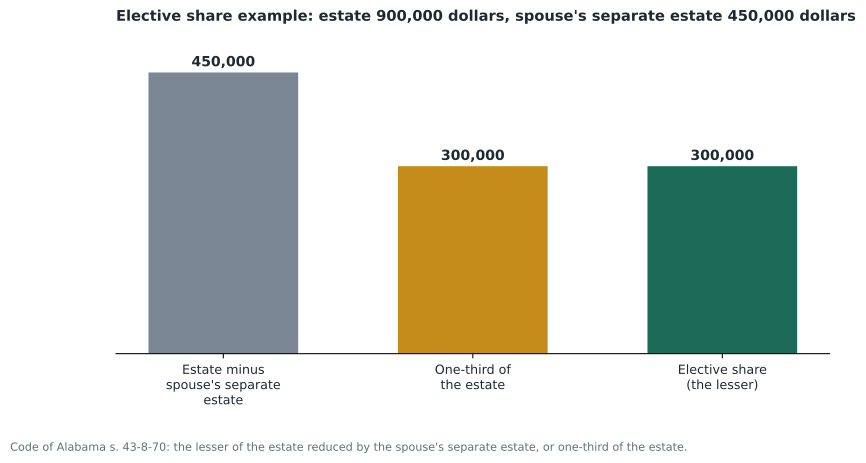
Alabama protects a surviving spouse against disinheritance through an elective share. Under Code of Alabama section 43-8-70, a surviving spouse who elects against the will takes the lesser of two amounts: all of the decedent's estate reduced by the value of the surviving spouse's separate estate, or one-third of the decedent's estate.
The reduction for the spouse's separate estate is what makes Alabama's rule distinctive. Section 43-8-70 defines the separate estate to include property the spouse owns outright immediately after the decedent's death, interests the spouse receives only by surviving the decedent, and certain benefits such as trust income and life insurance proceeds on the decedent's life, along with some broad-based employer benefit plans. A wealthy surviving spouse may therefore take little or nothing by electing, because the separate estate is subtracted first.
The election must be made within a short period set by the statute after the will is probated or after death, and the right is personal to the surviving spouse. Alabama law also gives a surviving spouse, and in some cases minor children, other protections that come off the top of the estate, including a homestead allowance, an exempt property allowance and a family allowance during administration. A lawyer advising a surviving spouse should compare the will's provisions, the elective share and these allowances before deciding whether to elect.
Worked problem
Should Ruth elect against the will?
Thomas died domiciled in Alabama. His probate estate is worth 900,000 dollars. His will leaves Ruth, his wife, nothing and leaves everything to his children from a first marriage. Ruth owns a house and investments in her own name worth 300,000 dollars and receives 150,000 dollars of life insurance on Thomas's life. What would her elective share be?
Show solution
- Under section 43-8-70, the elective share is the lesser of the estate reduced by Ruth's separate estate, or one-third of the estate.
- Ruth's separate estate includes property she owns outright after Thomas's death, 300,000 dollars, and the life insurance on his life, 150,000 dollars, for a total of 450,000 dollars.
- Estate minus separate estate: 900,000 minus 450,000 equals 450,000 dollars.
- One-third of the estate: 300,000 dollars. The lesser amount is 300,000 dollars.
Answer: Ruth's elective share would be 300,000 dollars, plus any allowances she is entitled to. If her separate estate were 700,000 dollars instead, the first figure would be 200,000 dollars and her share would drop to 200,000 dollars.
Trusts
Alabama enacted a version of the Uniform Trust Code, codified as the Alabama Uniform Trust Code in Chapter 3B of Title 19 of the Code of Alabama. It governs the creation, validity, modification and termination of trusts, the duties and powers of trustees, beneficiaries' rights to information, and the rights of creditors. Like the uniform act, it allows revocable trusts to be used as will substitutes and sets default rules that the trust's terms can generally change, subject to mandatory rules such as the trustee's duty to act in good faith.
Revocable trusts are popular in many states for avoiding probate. In Alabama, where probate is generally manageable, many estate plans still use wills as the main document, with trusts for particular purposes such as minor children, special needs planning or tax planning. A new lawyer should learn the Alabama Uniform Trust Code's rules on revocable trusts, trustee duties and notice to beneficiaries, which matter in both drafting and litigation.
| Topic | Alabama rule | Source |
|---|---|---|
| Will execution | Writing, signed by the testator, two witnesses | Code s. 43-8-131 |
| Holographic wills | Not separately validated; must meet s. 43-8-131 unless valid under s. 43-8-135 | Code ss. 43-8-131, 43-8-135 |
| Wills executed elsewhere | Valid if executed under the law of the place of execution or domicile | Code s. 43-8-135 |
| Elective share | Lesser of the estate minus the spouse's separate estate, or one-third of the estate | Code s. 43-8-70 |
| Trusts | Alabama Uniform Trust Code | Code Title 19, Chapter 3B |
Common mistakes
MistakeA handwritten, signed will is valid in Alabama without witnesses.
InsteadAlabama requires two witnesses under section 43-8-131, unless the will is valid under the law of another place under section 43-8-135.
MistakeThe Alabama elective share is always one-third of the estate.
InsteadIt is the lesser of one-third or the estate reduced by the spouse's separate estate.
MistakeLife insurance the spouse receives does not affect the elective share.
InsteadLife insurance on the decedent's life is part of the spouse's separate estate and reduces the first figure.
MistakeAlabama has no Uniform Trust Code.
InsteadAlabama enacted the Alabama Uniform Trust Code in Title 19, Chapter 3B.
Drafting and executing wills in practice
Because the formalities are strict, Alabama lawyers follow a careful routine when a client signs a will. The client, two witnesses and a notary are present together. The lawyer confirms that the client has read the will and understands it, asks the client to declare it to be the client's will, and watches the client sign. The witnesses then sign, and the notary completes the self-proving affidavit for the client and the witnesses. Witnesses should generally be disinterested people, not beneficiaries, to avoid later questions. The original will is kept in a safe place, often in the lawyer's office or the client's safe deposit box, and the client is told where it is.
Lawyers also review the client's nonprobate assets, which pass outside the will: life insurance and retirement accounts with beneficiary designations, accounts with payable-on-death or transfer-on-death designations, and property held in joint tenancy with a right of survivorship. A will that leaves everything to the children may have little effect if most of the assets pass by beneficiary designation to someone else. And because life insurance on the decedent's life counts in a surviving spouse's separate estate under section 43-8-70, nonprobate transfers can also affect the elective share.
Personal representatives and administration
An Alabama personal representative has fiduciary duties to the estate and its beneficiaries and creditors. The usual steps include admitting the will, obtaining letters testamentary or letters of administration, giving notice to creditors as the Probate Code requires, collecting and inventorying assets, paying valid claims and expenses, filing tax returns, and distributing the remaining property under the will or the intestacy statute. Many wills waive bond and court supervision of some steps; where they do not, the probate court supervises more closely. New lawyers handling an estate should learn the local probate court's procedures and forms, which differ from county to county in detail.
Wills and trusts on the exams
For the legacy UBE after July 2026, trusts and estates is no longer an MEE subject but may appear on the MPT with the law supplied, in which case the examinee applies the library's rules, not Alabama's or the general rules from memory. On the NextGen exam, trusts and estates may appear with resources supplied. For the online course and Alabama's state law component from July 2028, the Alabama rules in this lesson are the ones that matter.
When the estate plan meets the elective share
A careful lawyer advising a married client who wants to leave most of the estate to children from an earlier marriage will consider the elective share at the drafting stage. Options include giving the spouse enough under the will to make an election unattractive, using nonprobate assets with the spouse's informed consent, or using a prenuptial or postnuptial agreement in which the spouse waives the elective share after full disclosure. Alabama law allows a spouse to waive the right of election by a written agreement, subject to requirements of fairness and disclosure. Each choice has tax, family and fairness consequences that the lawyer should explain to the client in writing.
Summary and key terms
- Under section 43-8-131, a will must be in writing, signed by the testator and signed by at least two witnesses.
- Unwitnessed holographic wills are not separately validated, but section 43-8-135 recognizes wills executed under the law of the place of execution or domicile.
- Probate courts in each county admit wills and supervise administration; contested estates are often removed to circuit court.
- The elective share under section 43-8-70 is the lesser of the estate minus the spouse's separate estate, or one-third of the estate.
- Alabama trusts are governed by the Alabama Uniform Trust Code.
- Testator
- The person who makes a will.
- Holographic will
- A will written in the testator's own handwriting; not valid in Alabama without witnesses unless valid where executed or under the testator's domicile's law.
- Self-proved will
- A will with sworn statements of the testator and witnesses attached, admissible without witness testimony.
- Elective share
- A surviving spouse's statutory right to take a share of the estate instead of what the will provides.
- Separate estate
- Under section 43-8-70, the surviving spouse's own property and certain benefits that reduce the elective share.
Lesson quiz · 5 questions
Score 60% or more to complete this lesson.
Create a free account to save your progress, take quizzes and earn a certificate.