
BAR-201 · Lesson 11 of 12 · 15 min
Score transfer, admission without examination and practice after admission
▶ Video coming soon A video version of this lesson is on the way.
Not everyone becomes an Alabama lawyer by sitting the Alabama exam. Avery's firm has hired two lawyers in recent years who came from other states: one transferred a UBE score earned in Tennessee, and the other was admitted without examination after years of practice in another state. This lesson covers the routes into the Alabama State Bar for people with scores or licenses from elsewhere, the transfer of an Alabama score to other jurisdictions, and what happens after admission: bar membership, continuing legal education and the Alabama Rules of Professional Conduct.
Transferring a UBE score into Alabama
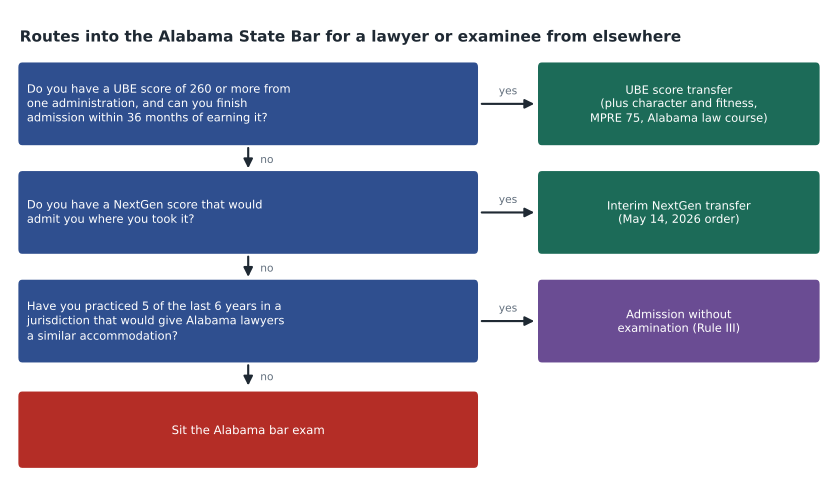
Alabama accepts transferred UBE scores. To transfer a score, the score must come from a single UBE administration and be 260 or higher. Admission must be finalized within 36 months of the date the score was earned. The MPRE requirement must be met within the 36 months before the UBE administration or before the UBE score expires. Carried-forward or transferred MBE and essay scores cannot be used to earn a transferable UBE score; the score must be a complete UBE score from one sitting.
A transfer applicant must still meet every other requirement for admission by examination: an application and fee, character and fitness certification, the MPRE and the online course on Alabama law. Transfer applicants receive access to the course after the Committee on Character and Fitness approves their application. The deadline structure for transfer applications differs from exam applications; check the Admissions Office's page on UBE score transfer for the current deadlines and fees.
Transferring a NextGen score into Alabama
As Lesson 5 explained, a May 14, 2026 interim order of the Supreme Court of Alabama allows an applicant who took the entire NextGen exam in a single administration in another jurisdiction, and earned a total scaled score that entitles the applicant to admission there, to transfer that score to Alabama and be excused from the Alabama UBE. The applicant must also meet the requirements for transferring a UBE score and all other admission-by-examination rules. The court will set Alabama's own NextGen passing score before July 2028.
Admission without examination
Rule III of the Rules Governing Admission provides for admission without examination, often called reciprocity or admission on motion. The main requirements, as the rule stood in 2026, are these. The applicant must be admitted to practice in another state, territory or the District of Columbia. The applicant must have been primarily engaged in the active practice of law for five of the six years immediately before filing the application. The applicant's licensing jurisdiction must allow Alabama lawyers a similar accommodation; Alabama keeps a list of reciprocal jurisdictions, and an applicant licensed only in a jurisdiction not on the list must file a certificate of jurisdictional reciprocity. The applicant must be in good standing in every jurisdiction of admission and not subject to discipline or a pending disciplinary matter.
Rule III also requires an MPRE score of 75 or better, with no time limit on when it was earned; the character and fitness that the Committee on Character and Fitness requires; and either permanent residence in Alabama or a certification that the applicant intends to conduct the primary practice of law in Alabama, with an office in the state. An applicant who has taken and failed the Alabama bar exam within the previous ten years is not eligible. On education, the rule has required a first professional degree in law from a school on the ABA's approved list when the degree was conferred; the April 30, 2026 order, effective January 1, 2027, changes Rule III to refer instead to law schools approved under the amended Rule IV. Rule III has special provisions for certain law school teachers and for military service members and their spouses.
Admission without examination costs 875 dollars plus NCBE's character report fee, and there is no application period or deadline. As with all applications, fees are non-refundable.
| Route | Key requirements | Fee |
|---|---|---|
| Exam | Eligible education, UBE 260, MPRE 75, Alabama law course, character and fitness | 575 dollars |
| UBE transfer | Single-administration UBE score of 260 or more; admission within 36 months; MPRE window; course; character and fitness | See Admissions Office |
| NextGen transfer (interim) | Passing NextGen score where earned; UBE transfer requirements; course; character and fitness | See Admissions Office |
| Without examination | Practice 5 of the last 6 years; reciprocity; good standing; MPRE 75 at any time; Alabama residence or primary practice; no failed Alabama exam in 10 years | 875 dollars plus NCBE fee |
Worked problem
Can Priya be admitted without examination?
Priya graduated from an ABA-approved law school in 2015 and has practiced full time in Tennessee since 2016. She scored 92 on the MPRE in 2014. She has never taken the Alabama exam. Her husband's job is moving them to Huntsville, where she plans to open an office. Is she eligible for admission without examination?
Show solution
- Licensed elsewhere: yes, in Tennessee, and in good standing with no discipline.
- Active practice for five of the six years before applying: yes, she has practiced since 2016.
- Reciprocity: check whether Tennessee is on Alabama's reciprocal list; if not, she must show Tennessee would give Alabama lawyers a similar accommodation.
- MPRE: 75 or better at any time; her 92 from 2014 qualifies, because Rule III sets no time limit.
- Residence or primary practice in Alabama with an office: yes. No failed Alabama exam: yes. Education: an ABA-approved law school.
Answer: Priya appears eligible. She files an application with the 875-dollar fee and NCBE's character report fee, and the Committee on Character and Fitness must certify her.
Taking an Alabama score elsewhere
An Alabama UBE score can be transferred to other jurisdictions that accept UBE scores, subject to each receiving jurisdiction's own rules. Two limits matter. First, passing scores differ: Alabama's 260 is at the low end of UBE passing scores, which run from 260 to 270. A score of 262 passes in Alabama but would not meet a 266 or 270 requirement elsewhere. Second, score age limits differ, ranging from two to five years in many jurisdictions. Candidates who expect to seek admission in another jurisdiction should aim for that jurisdiction's passing score and check its age limit.
After admission: the Alabama State Bar
Every licensed Alabama lawyer is a member of the Alabama State Bar, a unified bar, and must keep a current license by paying the annual license fee and meeting continuing legal education requirements. The bar also offers resources for new lawyers, such as practice management help and ethics guidance from its Office of General Counsel, which are worth using in the first years of practice.
Continuing legal education
Alabama requires each lawyer subject to its continuing legal education rules to complete at least 12 hours of approved continuing legal education each year, at least one of which must be on ethics or professionalism. The deadline to earn the hours is December 31. No more than six of the twelve hours may come from online activities, though live webcasts count as live rather than online, and self-study courses are not accepted.
Newly admitted lawyers are exempt from the annual requirement until the end of the calendar year in which they are admitted. Under MCLE Rule 9, new admittees must complete a three-hour professionalism course, which counts toward the twelve-hour requirement. Credits earned after admission during the year of admission can carry over if reported by the bar's deadline early in the following year. Lawyers who fall short receive a notice of noncompliance and may cure it within a short period with a late fee.
The Alabama Rules of Professional Conduct
Alabama lawyers are governed by the Alabama Rules of Professional Conduct, adopted by the Supreme Court of Alabama. They follow the structure and much of the language of the ABA Model Rules, so the MPRE preparation from Lesson 3 is a good foundation. But there are differences, and an Alabama lawyer must follow the Alabama version.
The most significant recent change is in advertising. On May 13, 2025, the court approved a rewrite of Rules 7.1, 7.2 and 7.3, effective January 1, 2026. The new rules require lawyers in advertisements who are not licensed in Alabama to say so; require firms to disclose whether they have a bona fide office in the state or locality and to list at least one office location; make every lawyer who appears or is identified in an advertisement personally responsible for it; require disclaimers that are easy to see, read or hear; restrict testimonials, endorsements and case results; prohibit actors portraying clients or lawyers except in the background when not misleading; prohibit deceptive manipulation of search results; and allow a one-click link to a disclaimer on platforms without room for a full disclaimer. Lawyers no longer must routinely file advertisements with the Office of General Counsel but must keep copies for six years. Comparison advertising remains prohibited.
Alabama has not adopted ABA Model Rule 8.4(g), the 2016 Model Rule on harassment and discrimination in conduct related to the practice of law, and there was no known active consideration of it as of late 2024. On the MPRE, answer by the Model Rules; in practice, follow the Alabama rules and the ethics opinions of the Alabama State Bar's Office of General Counsel.
Common mistakes
MistakeAny UBE score of 260 can be transferred to Alabama at any time.
InsteadThe score must come from one administration and admission must be finalized within 36 months of earning it.
MistakeAdmission without examination requires a recent MPRE score.
InsteadRule III requires 75 or better with no time limit on when it was earned.
MistakeA score of 262 earned in Alabama will transfer anywhere.
InsteadOther UBE jurisdictions may require up to 270 and have their own age limits.
MistakeNew Alabama lawyers must complete 12 CLE hours in their year of admission.
InsteadThey are exempt until the end of that calendar year but must complete a three-hour professionalism course.
Practicing in Alabama without full admission
Several rules allow lawyers who are not members of the Alabama State Bar to do limited legal work in the state. A lawyer licensed elsewhere may seek permission to appear in a particular case pro hac vice, usually with the association of local counsel, under the rules of the Supreme Court of Alabama. Some jurisdictions also have special rules for in-house counsel, military lawyers and lawyers providing pro bono services after disasters. Lawyers relying on any of these should read the current Alabama rule; practicing law in Alabama without authorization can lead to discipline at home and trouble later in an application for full admission.
The first year of practice
Avery's firm gives every new lawyer the same advice for the first year. Keep a calendar that cannot fail, with every limitations period, appeal deadline and court date entered twice. Join the local bar association and a section of the Alabama State Bar in the areas where you practice. Ask the Office of General Counsel for an informal ethics opinion when a question arises, rather than guessing. Take the three-hour professionalism course early. And keep learning Alabama law, because the online course is a beginning, not an end.
For Avery, the first year will also include a decision about other jurisdictions. Her firm has clients in Georgia and Mississippi, and she wonders whether to seek admission there later. Neither Georgia nor Mississippi gives the legacy UBE, so her Alabama score would not transfer to either. Both states have their own rules for admission on motion, usually requiring years of practice. 'Get admitted here, practice for a few years, and then look at motion admission,' Marchetti advises. 'And check each state's rules before you promise a client anything.'
Keeping the license current
Admission is the beginning of ongoing obligations. Each year an Alabama lawyer pays the license fee, completes and reports CLE, and keeps contact information current with the bar. Lawyers must also comply with trust account rules for client funds, including the rules for interest on lawyers' trust accounts. A lawyer who leaves practice can move to an inactive or special membership status rather than letting the license lapse. Disciplinary matters are handled by the Alabama State Bar's disciplinary system under the Rules of Disciplinary Procedure, with review by the Disciplinary Board and the Supreme Court of Alabama.
Finally, Marchetti reminds Avery that the routes in this lesson change. Rule III was amended in March 2026 for military service members and spouses and again by the April 30, 2026 order, and the NextGen transfer rule is expressly interim. Before advising anyone, including herself, about transfer or admission without examination, she should read the current rules on the Admissions Office's site and confirm any doubtful point with the office in writing.
Summary and key terms
- UBE transfers into Alabama need a single-administration score of 260 or more, with admission within 36 months; NextGen transfers follow the May 14, 2026 interim order.
- Admission without examination requires practice for five of the last six years, reciprocity, good standing, an MPRE of 75 at any time, Alabama residence or primary practice, and no failed Alabama exam in ten years.
- Alabama's 260 is at the low end of UBE passing scores; check any other jurisdiction's minimum and age limit.
- Alabama lawyers must complete 12 CLE hours a year, including one on ethics or professionalism; new admittees take a three-hour professionalism course.
- Alabama rewrote its advertising rules effective January 1, 2026; it has not adopted Model Rule 8.4(g).
- Admission without examination
- Admission based on years of practice elsewhere, under Rule III; also called reciprocity or admission on motion.
- Reciprocal jurisdiction
- A jurisdiction that allows Alabama lawyers a similar accommodation.
- Score age limit
- The maximum time between earning a score and admission in a receiving jurisdiction.
- MCLE
- Mandatory continuing legal education; 12 hours a year in Alabama.
- One-Click Rule
- Alabama's 2026 advertising rule allowing a link to a disclaimer on platforms without space for it.
Lesson quiz · 5 questions
Score 60% or more to complete this lesson.
Create a free account to save your progress, take quizzes and earn a certificate.