
BAR-201 · Lesson 5 of 12 · 15 min
Exam changes ahead: NextGen in 2028 and the 2027 admission rules
▶ Video coming soon A video version of this lesson is on the way.
Avery will sit the legacy UBE in February 2027, so the NextGen exam may never affect her directly. But two people she knows will feel it. Her younger cousin starts law school in Alabama in the fall of 2026 and will graduate in 2029, after Alabama switches. And a classmate who plans to retake in 2028 asks Avery whether her next attempt will be the same exam. Marchetti uses their questions to frame this lesson: what is changing in Alabama, when, and what it means for different candidates.
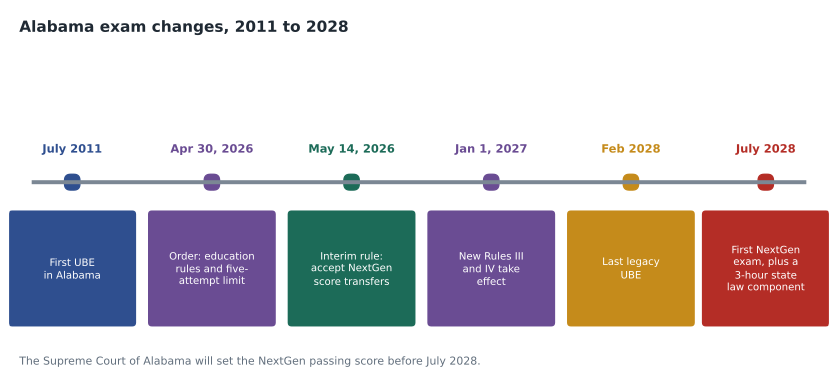
Three changes are under way at once. The national exam is changing from the legacy UBE to the NextGen bar exam. Alabama has set July 2028 as its first NextGen administration and has said it will add a state law component. And Alabama's own admission rules changed in 2026, with new education rules and an attempt limit taking effect January 1, 2027. This lesson takes them in turn.
The national change
NCBE spent several years redesigning the bar exam after a nationwide study of the work newly licensed lawyers do. The result, the NextGen bar exam, first given in ten jurisdictions in July 2026, is nine hours over a day and a half rather than twelve hours over two days. It has three three-hour sections, each with 40 standalone multiple-choice questions, two integrated question sets and one performance task. It tests eight foundational subjects and seven foundational lawyering skills, and it reports a single score on a scale from 500 to 750. NCBE will keep producing the legacy MBE, MEE and MPT through February 2028; after that, jurisdictions that use NCBE's exam will give the NextGen exam. This program's BAR-130 course covers the NextGen exam in depth.
For Alabama candidates, the key points are the dates and the scale. Alabama's last legacy UBE is February 2028. Its first NextGen exam is July 2028. And a NextGen score is not comparable number for number with a legacy UBE score: the scales are different, and Alabama will need to set a new passing score.
Alabama's NextGen decision
Alabama announced in July 2025 that it intends to give the NextGen exam beginning in July 2028. NCBE lists Alabama among the large group of jurisdictions starting that month, alongside California, Florida, New York and Texas. NCBE's jurisdiction chart shows that Alabama will have a jurisdiction-specific component with the NextGen exam: a three-hour essay examination on Alabama state law. The University of Alabama School of Law has told its students that the Supreme Court of Alabama ordered the bar examiners to draft a three-hour state law component for the July 2028 administration.
That component is a significant change. Under the legacy UBE, Alabama tests no state law on exam day and requires the online course instead. Under the NextGen exam, Alabama examinees will face Alabama law questions in an essay format, in addition to the national exam. The details, including the subjects, the weight of the component in the overall result and the passing standard, had not been published as of November 2026. Candidates graduating in 2028 or later should watch the Admissions Office's site and the court's orders for the rules.
Which Alabama subjects are likely? The court has not said. The current online course covers the Alabama Constitution, alternative dispute resolution, civil litigation, criminal law, family law, real property, torts, and wills, trusts and probate. Those subjects are a reasonable guide to the areas the bar considers most important for new Alabama lawyers, and they are the subjects this course emphasizes in Lessons 7 through 10. Treat that as a study strategy, not a prediction.
The interim rule on NextGen score transfers
On May 14, 2026, the Supreme Court of Alabama adopted an interim rule on transferring NextGen scores into Alabama. The court explained that NCBE is replacing the UBE with the NextGen exam, that some jurisdictions would give it as early as July 2026, and that the NextGen exam uses a 750-point scale instead of the UBE's 400-point scale. The court said it would set Alabama's NextGen passing score before the exam's first administration in Alabama in July 2028.
Until it does, the interim rule lets an applicant who took the entire NextGen exam in a single administration in another jurisdiction, and earned a total scaled score that entitles the applicant to admission in that jurisdiction, transfer that score to Alabama and be excused from taking the UBE in Alabama. The applicant must also meet the existing requirements for transferring a UBE score and all other rules for admission by examination, including character and fitness, the MPRE and the Alabama law course. NCBE lists Alabama as accepting NextGen score transfers starting July 2026.
In effect, during the transition Alabama borrows the passing judgment of the jurisdiction where the NextGen exam was taken. A candidate who passed the NextGen exam in Missouri, where the passing score is 610, can use that score in Alabama, even though Alabama has not yet set its own standard. Once Alabama sets its passing score, the transfer rule will presumably refer to that number instead. Check the current rule before relying on a transfer.
Worked problem
Can Marcus transfer his NextGen score to Alabama?
Marcus Bell took the NextGen exam in Missouri in July 2026 and scored 648, above Missouri's passing score of 610. He was admitted in Missouri. Suppose, as a hypothetical Marchetti poses, that his firm asked him to help open an office in Mobile. Could he use his score to seek admission in Alabama in 2027?
Show solution
- The May 14, 2026 interim rule lets an applicant transfer a NextGen score earned in one administration elsewhere if it entitles the applicant to admission there.
- Marcus took the whole exam in one administration and his 648 entitled him to admission in Missouri.
- He must also meet the UBE transfer requirements, including the 36-month time limit measured from when the score was earned, and every other requirement for admission by examination.
- That means an application, character and fitness certification, an MPRE score of 75 or higher within the required period, and completion of the online course on Alabama law.
Answer: Marcus can likely transfer his score under the interim rule, as long as he completes admission within the time limit and meets the other requirements. He should check whether the court has set Alabama's passing score before he applies.
The 2027 admission rules
The third change is to Alabama's own eligibility rules. As Lesson 2 explained, the April 30, 2026 order, effective January 1, 2027, names five Alabama law schools whose graduates may sit, replaces the ABA-approval test for out-of-state graduates with other conditions, and limits applicants to five attempts, counted for life from July 2026. The order also amended Rule III on admission without examination, which Lesson 11 covers.
Alabama is not alone. Texas finalized an end to its ABA-only rule in January 2026, Florida opened its rules to other accreditors from October 1, 2026, and other states, including Ohio and Tennessee, have been reconsidering the role of ABA accreditation. The Federal Trade Commission wrote to the Tennessee Supreme Court in April 2026 urging it to open law school accreditation to competition. The ABA's accrediting council has defended national accreditation as the best approach. For candidates, the practical effect in Alabama is that more people may be eligible to sit from 2027, while each person has a limited number of attempts.
| Candidate | Exam in Alabama | What changes for them |
|---|---|---|
| Graduate sitting February 2027 or any 2027 exam | Legacy UBE, 260 to pass | New eligibility rules and the attempt limit apply |
| Graduate sitting February 2028 | Last legacy UBE | A failed attempt means retaking on the NextGen exam with a state law component |
| Graduate sitting July 2028 or later | NextGen exam plus a three-hour state law component | New national format, new scale, Alabama passing score to be set |
| Lawyer with a NextGen score from elsewhere | No exam if the transfer rules are met | Interim rule of May 14, 2026 allows transfer of a passing score |
What the changes mean for retakers
The most exposed group is candidates who might need more than one attempt around the switch. An examinee who sits the February 2028 legacy exam and does not pass will retake in July 2028 on the NextGen exam, with a different format, different subjects and a state law essay component. Study materials, practice routines and timing strategies built for the legacy UBE will need to change. For that reason, Marchetti advises anyone planning to sit in February 2028 to prepare as if it were the last chance on the familiar format, and to start learning the NextGen format early as insurance.
The attempt limit adds pressure. Every attempt from July 2026 counts toward five, regardless of which format it is on. Two attempts on the legacy exam and three on the NextGen exam would use up the limit. The waiver for an incomplete attempt or a medical emergency is narrow.
Common mistakes
MistakeAlabama's NextGen passing score is 610, like Missouri's.
InsteadAlabama has not set its NextGen passing score; the court will set it before July 2028.
MistakeAlabama will keep testing no state law on exam day after the switch.
InsteadAlabama plans a three-hour state law essay component with the NextGen exam.
MistakeA legacy UBE score of 260 equals some fixed NextGen score.
InsteadThe scales differ; no direct conversion is used for passing.
MistakeOnly attempts on the new exam count toward the five-attempt limit.
InsteadEvery Alabama attempt from July 2026 counts, on either format.
How the NextGen exam differs for a candidate
For a candidate used to the legacy UBE, the NextGen exam changes the work in several ways. It tests eight foundational subjects instead of the MBE and MEE lists: civil procedure, constitutional law, contracts, criminal law, evidence, real property, torts and business associations, with family law added from July 2028, the same month Alabama starts. Some topics are tested only from memory and others only with legal materials supplied. Its questions test lawyering skills directly: legal research, writing, issue spotting, investigation, client counseling, negotiation and client relationship management. And its written work comes in shorter pieces, in integrated question sets and three performance tasks of about an hour each, rather than six essays and two 90-minute performance tests.
For Alabama examinees from July 2028, the state law component will sit alongside that national exam. A candidate will therefore need two kinds of preparation: NextGen practice, using NCBE's sample questions and study aids, and Alabama law, using the online course modules and the rules covered in this course. Planning for both should start well before the final ten weeks.
Watching for further rules
The Supreme Court of Alabama acts by order, and its admission orders appear on the Admissions Office's site and the court's website. Between November 2026 and July 2028, candidates should expect the court to set Alabama's NextGen passing score, publish the rules for the state law component, adjust the transfer rules once it has its own passing score, and possibly clarify parts of the April 30, 2026 order. Each of these could affect eligibility or preparation. A sensible habit is to check the Admissions Office's news page at the start of each semester of law school and again before applying.
A note on law students starting now
Avery's cousin, who started law school in the fall of 2026, will graduate in 2029 and sit after Alabama's switch. For students in that position, Marchetti offers three suggestions. First, take courses in the NextGen foundational subjects, including business associations and evidence, rather than avoiding them. Second, take the Alabama practice courses the law school offers, because the state law component will reward them. Third, take clinics and externships that build the counseling, negotiation and research skills the NextGen exam tests. 'For the first time,' she says, 'the bar exam will reward the same things that make you a better lawyer.'
Why states add a state law component
Jurisdictions that add a state law component to a national exam usually do so because they want new lawyers to know local law that clients rely on from the first day. The UBE's portability made that harder, and states responded with courses like Alabama's, tests like the Texas Law Component, or essay sessions like those some jurisdictions plan for the NextGen exam. A state law essay tests more than a course: it measures whether a candidate can apply local rules to facts under time pressure. That is why Alabama's planned component, together with its new passing score, will change how Alabama candidates prepare more than any other part of the transition.
Avery's classmate who plans to retake in 2028 takes the point. She decides to sit in July 2027 instead of waiting, so that a second attempt, if she needs one, would still be on the legacy exam in February 2028. 'I would rather face one format twice than two formats once each,' she says. Marchetti tells her the reasoning is sound, as long as she is genuinely ready by July: a rushed first attempt still counts toward the five.
Summary and key terms
- Alabama gives its last legacy UBE in February 2028 and its first NextGen exam in July 2028.
- With the NextGen exam, Alabama will add a three-hour essay component on Alabama law; details were not yet published in November 2026.
- A May 14, 2026 interim rule lets applicants transfer a NextGen score that would admit them where they took it, until Alabama sets its own passing score.
- New education rules and a five-attempt limit take effect January 1, 2027.
- Candidates who may retake around 2028 should prepare for a change of format.
- NextGen bar exam
- NCBE's redesigned bar exam, first given in July 2026 and scored from 500 to 750.
- Jurisdiction-specific component
- A state's own requirement added to the national exam, such as Alabama's planned state law essay.
- Interim rule
- A temporary rule; Alabama's May 14, 2026 order on NextGen transfers is one.
- Legacy UBE
- The MBE, MEE and MPT version of the UBE, given in Alabama through February 2028.
- Score transfer
- Using a score earned in one jurisdiction to seek admission in another.
Lesson quiz · 5 questions
Score 60% or more to complete this lesson.
Create a free account to save your progress, take quizzes and earn a certificate.