
BAR-201 · Lesson 2 of 12 · 15 min
Eligibility, education, deadlines and fees
▶ Video coming soon A video version of this lesson is on the way.
At their second session, Marchetti asks Avery to bring the Rules Governing Admission and a calendar. 'Eligibility is where the rules are least forgiving,' she says. 'Most of the exam rewards preparation. Eligibility either fits or it does not, and the deadlines do not move.'
This lesson covers who may sit for the Alabama bar exam, how the April 30, 2026 order changes the education rules for exams from February 2027 on, the law student registration requirement, the filing deadlines and the fees. Because the rules changed in 2026 and the new version takes effect January 1, 2027, the lesson describes both the rule that governed exams through July 2026 and the rule that governs exams beginning February 2027. If you are reading this after those dates, check which version applies to the exam you plan to take.
Basic conditions
Rule IV of the Rules Governing Admission sets the conditions for admission by examination. An applicant must be at least 19 years old and must meet the general requirements of Rule I. The applicant must also meet the prelegal and legal education requirements, file a timely application, and satisfy the character and fitness, MPRE and other requirements covered in later lessons.
Education under the rule in force through 2026
Under the version of Rule IV in force through the July 2026 exam, the education rule had several branches. The main branch required graduation from a law school approved by the ABA or by the Association of American Law Schools at the time of graduation, after at least three academic years of at least 30 weeks each. A second branch covered three Alabama law schools that are not ABA-approved: Birmingham School of Law, Miles Law School and, for graduates before June 11, 2006, Jones School of Law. A third branch allowed some graduates of unaccredited out-of-state schools to sit after five years of practice in the state where the school is located, but only if that state extends comity to graduates of Birmingham School of Law and Miles College of Law. A fourth branch covered foreign-educated lawyers.
Prelegal education also mattered. Graduates of ABA-approved schools were generally exempt from proving their undergraduate education, unless the Committee on Character and Fitness asked for proof. Graduates of other schools had to show a bachelor's degree from an accredited college, received before entering law school. Foreign-educated applicants were exempt from the prelegal requirement.
For foreign-educated applicants, the rule required a law degree from an approved university outside the United States and admission to practice in that country, plus one of three additional showings: a program that included substantial study of English common law, at least 24 semester hours of bar-subject courses at an ABA-approved school, or at least three years of continuous active practice in good standing after admission in a US jurisdiction.
The April 30, 2026 order
On April 30, 2026, the Supreme Court of Alabama amended Rule III and Rule IV. The order says the court considered whether to reduce reliance on ABA accreditation of law schools and whether to limit how many times an applicant may sit for the exam. The amendments take effect January 1, 2027 and govern who may sit beginning with the February 2027 exam. One justice concurred in most of the order but dissented from the new attempt limit.
The order names five Alabama law schools whose graduates may sit: the University of Alabama School of Law, Cumberland School of Law at Samford University, Jones School of Law at Faulkner University, Birmingham School of Law and Miles Law School. Three of those are ABA-approved and two are not. For graduates of law schools outside Alabama, the order replaces the ABA-approval test with other conditions. According to reporting on the order, graduates of out-of-state schools may sit if they qualify to sit in their home jurisdictions, and the rule requires that the applicant pursued and satisfactorily completed law study as a resident student over at least three academic years of at least 30 weeks each. Foreign-educated applicants are addressed separately.
Commentators raised questions the order does not answer on its face: whether fully or partly online programs count as resident study, whether accelerated two-and-a-half-year programs satisfy the three-year rule, and how the 30-week requirement applies to unusual schedules. If your legal education is anything other than a standard three-year program at a school whose graduates may sit in its home state, read the amended rule itself and ask the Admissions Office before you apply.
The five-attempt limit
The same order added a limit on attempts. Under the amended rule, an applicant may take the Alabama exam five times. The count is a lifetime, cumulative total, and it begins with attempts from July 2026 on; earlier attempts are not counted. The bar may waive the limit in two situations: when the applicant did not complete a prior exam, or when the applicant or an immediate family member had a medical emergency during or just before an exam.
Before the order, Alabama allowed unlimited attempts, and the Admissions Office's frequently asked questions still describe the old rule. In his partial dissent, Justice Mendheim noted that fewer than ten jurisdictions impose a hard limit like this one and argued for a process to request permission to try again after the limit. For candidates, the practical point is simple: from July 2026, every Alabama attempt counts toward five.
Law student registration
Alabama expects law students who plan to practice in the state to register with the Alabama State Bar while they are in law school. Registration lets the bar begin its character and fitness work early. An applicant who never registered, or never paid the fee that replaces registration, must pay a law student non-registration fee of 250 dollars when applying, in addition to the application fee. The fee applies to exam applicants and to applicants for admission without examination.
Deadlines
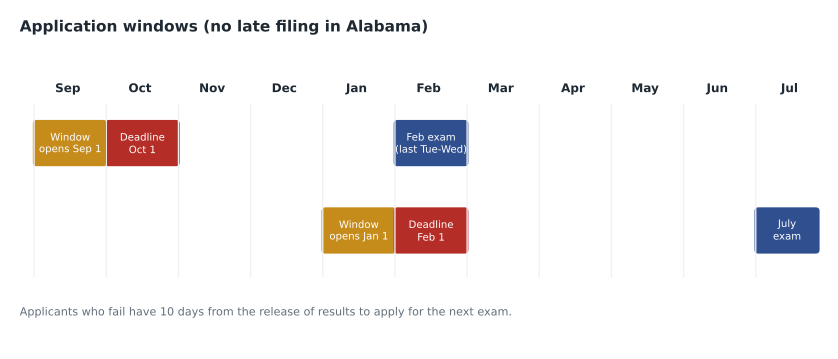
Alabama's filing deadlines are set by the Supreme Court in the rules. For the February exam, the application period opens September 1 and the Admissions Office must receive the application by October 1. For the July exam, the period opens January 1 and the deadline is February 1. The Alabama State Bar states that it does not have the ability to grant waivers or exceptions to the deadlines, and there is no late filing deadline or late filing fee.
Applicants who fail an exam have a special window: 10 days from the release of results to apply for the next exam. Because Alabama releases results about eight to nine weeks after the exam, that window falls in late September or October for July examinees and in late April for February examinees.
Fees
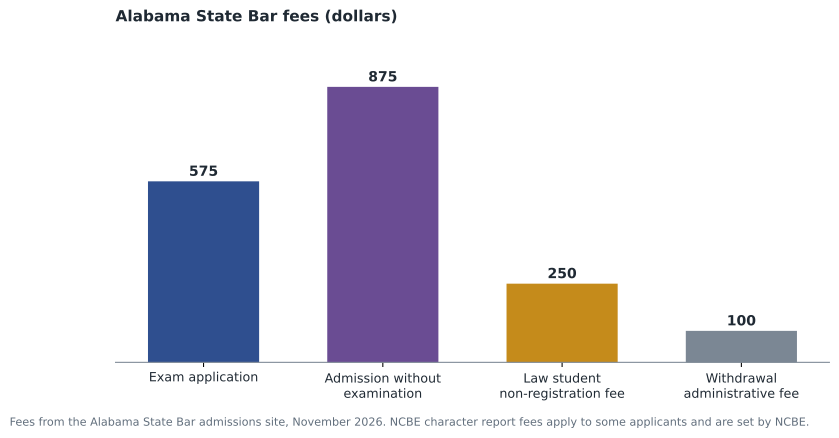
The Alabama State Bar's application fee for exam applicants is 575 dollars, the same for first-time applicants, re-applicants and applicants who have applied elsewhere or were educated or licensed abroad. Applicants in the last group also pay an investigation fee set by NCBE for a character report, which depends on the applicant's category. NCBE's fees changed on October 1, 2026, so check its current schedule. Alabama charges the 250-dollar non-registration fee to applicants who did not register as law students. Admission without examination costs 875 dollars plus NCBE's investigation fee.
All application fees are non-refundable. An applicant who withdraws from an exam may carry the fee forward to the next exam only, paying the difference if the fee has gone up, and the bar charges a 100-dollar withdrawal administrative fee. Laptop testing for the written portion may involve a separate software fee; check the Admissions Office's laptop testing page for the current amount.
| Item | Amount or rule |
|---|---|
| Exam application fee | 575 dollars |
| Admission without examination application fee | 875 dollars |
| Law student non-registration fee | 250 dollars, if never registered |
| NCBE character report | Set by NCBE; required for applicants who applied elsewhere or were educated or licensed abroad, and for admission without examination |
| Withdrawal administrative fee | 100 dollars; fee carries forward to the next exam only |
| Late filing | Not available; no late deadline or late fee |
Accommodations
Applicants with disabilities may request testing accommodations. Requests are made through the Admissions Office with the application and supporting documentation, and they take time to review, so they should be filed with the application rather than after it. Accommodations for the MPRE are requested separately from NCBE, because NCBE runs that test.
Worked problem
Will Jordan be eligible in July 2027?
Jordan graduated in 2025 from a law school in another state that is not ABA-approved. Graduates of Jordan's school may sit for the bar exam in that state. The program took four academic years of part-time evening study, each at least 30 weeks long, attended in person. Jordan has not practiced law. Can Jordan sit for the Alabama exam in July 2027?
Show solution
- Under the rule in force through July 2026, Jordan could not sit without five years of practice in the home state and that state's reciprocal treatment of Birmingham and Miles graduates.
- The July 2027 exam is governed by the amended rule effective January 1, 2027.
- Under the amended rule as reported, an out-of-state graduate may sit if qualified to sit in the home jurisdiction and if the study was completed as a resident student over at least three academic years of 30 weeks each. Jordan qualifies at home and attended in person over four years.
- Jordan must still meet the prelegal requirement for a non-ABA graduate, file by February 1, 2027, and meet every other requirement.
Answer: Jordan appears eligible under the amended rule but should confirm with the Admissions Office, because the order is new and its terms have not yet been tested in practice.
Avery's own case is simpler. She graduated from an ABA-approved Alabama school after a standard three-year program, registered as a law student, and filed in September 2026 for the February 2027 exam. She qualifies under both versions of the rule. Her concern is the attempt limit, which applies to her February 2027 sitting because it is after July 2026.
Common mistakes
MistakeAlabama still requires every applicant to have graduated from an ABA-approved law school.
InsteadFrom January 1, 2027, the amended Rule IV no longer uses ABA approval as the test for out-of-state graduates.
MistakeAlabama allows unlimited attempts at the exam.
InsteadUnder the April 30, 2026 order, an applicant may take the exam five times, counted for life from July 2026.
MistakeIf I miss October 1, I can pay a late fee and still sit in February.
InsteadAlabama has no late filing period or late fee.
MistakeWithdrawing from an exam gets my fee back.
InsteadFees are non-refundable; a withdrawn fee carries forward to the next exam only, and a 100-dollar administrative fee applies.
Planning a timeline backward from the exam
Marchetti teaches candidates to plan from the exam date backward. For a February exam, the application must be in by October 1, which means gathering documents in August and September: transcripts and proof of graduation or expected graduation, addresses for the past several years, employment history, information about any criminal, civil or disciplinary matters, and the documents those matters require, such as court dispositions. For a July exam, the same work happens in December and January, before the February 1 deadline. Candidates who are still in law school when they apply should know that the bar will need proof of graduation before the exam, and that any problem at the law school, such as an incomplete grade that delays graduation, can affect eligibility.
Applicants educated abroad, or who have applied for admission elsewhere, should start even earlier, because the NCBE character report adds steps and time. Foreign-educated applicants should also confirm, before applying, which branch of Rule IV they rely on and gather proof of it, such as transcripts showing the required bar-subject courses or certificates of admission and good standing from a US jurisdiction where they have practiced.
Questions to ask the Admissions Office
The Admissions Office answers questions by email and phone, and its staff see every unusual situation. Good questions are specific and documented: which branch of the education rule applies to a particular degree, whether a withdrawn exam counts toward the five-attempt limit, how to document an accommodation request, or what to do if a document from another country will be late. Keep copies of every message and answer. If the answer matters to your eligibility, ask for it in writing.
Avery sent one question in October: whether her February 2027 sitting would count toward the five-attempt limit even though the amendments take effect January 1, 2027. The answer matched the order: attempts are counted from July 2026, so February 2027 would be her first counted attempt. She added the answer to her file.
Summary and key terms
- Exam applicants must be at least 19 and meet Rule IV's education and other requirements.
- Through 2026, the main path required an ABA- or AALS-approved law school, with branches for three Alabama non-ABA schools, some unaccredited out-of-state graduates and foreign-educated lawyers.
- The April 30, 2026 order, effective January 1, 2027, names five Alabama schools, drops ABA approval as the test for out-of-state graduates, and adds a lifetime five-attempt limit counted from July 2026.
- Applications are due October 1 (February exam) and February 1 (July exam), with no late filing.
- Fees: 575 dollars to apply for the exam, 875 dollars for admission without examination, 250 dollars if you never registered as a law student.
- Law student registration
- Registering with the Alabama State Bar during law school so character and fitness work can begin early.
- Non-registration fee
- A 250-dollar fee charged to applicants who did not register as law students.
- Attempt limit
- The rule, effective January 1, 2027, that an applicant may take the Alabama exam five times, counted from July 2026.
- Resident student
- The amended rule's term for the type of law study out-of-state graduates must have completed; its scope for online study is unsettled.
- NCBE character report
- A background investigation NCBE prepares for some applicants, for a fee set by NCBE.
Lesson quiz · 5 questions
Score 60% or more to complete this lesson.
Create a free account to save your progress, take quizzes and earn a certificate.