
BAR-201 · Lesson 7 of 12 · 15 min
Alabama courts, the Constitution of 2022 and procedure
▶ Video coming soon A video version of this lesson is on the way.
The first week Avery spent at her Montgomery firm, a senior partner asked her to file an answer in circuit court, check the deadline for an appeal from a probate court order and find a section of the state constitution that a client's county ordinance relied on. She knew how to do all three things in a federal court or under the Model Rules. In Alabama she had to learn the map. This lesson provides it: the courts, the 2022 recompiled constitution, and the main features of civil and criminal procedure that an Alabama lawyer meets in the first year of practice.
The Unified Judicial System
Alabama's state courts form a single Unified Judicial System under the supervision of the Supreme Court of Alabama. At the top is the Supreme Court, with nine justices: a chief justice and eight associate justices. It is the court of last resort, hears certain appeals directly, including civil appeals over 50,000 dollars that no other appellate court has jurisdiction to hear, and adopts rules of practice and procedure for the state's courts, including the Rules Governing Admission.
Below it are two intermediate appellate courts, each with five judges. The Court of Civil Appeals hears domestic relations appeals such as divorce, custody and adoption, appeals in workers' compensation and many administrative matters, and civil appeals where the amount in controversy does not exceed 50,000 dollars. The Court of Criminal Appeals hears appeals in felony and misdemeanor cases, including capital cases.
The circuit courts are the trial courts of general jurisdiction. They hear all felony prosecutions and civil cases above the district court's limit, generally claims over 10,000 dollars, along with some other matters. District courts hear misdemeanors, preliminary hearings in felony cases, and civil cases between 3,000 and 10,000 dollars, with small claims under 3,000 dollars handled in a small claims division. Probate courts handle wills, estates, guardianships, certain property matters such as partition, and name changes; in Alabama the probate judge also keeps the county's land records, which is why recorded deeds are filed with the probate judge. Most cities have municipal courts for ordinance violations.
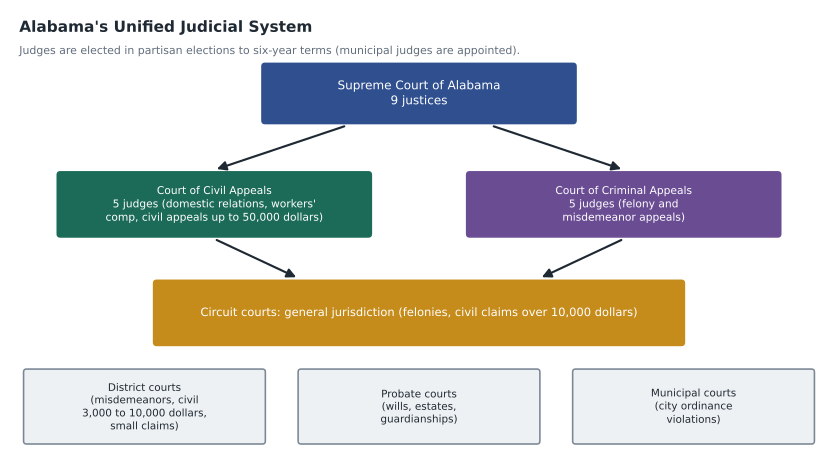
Alabama elects its judges. Appellate judges and justices are elected statewide, and circuit, district and probate judges by the voters of their circuit or county, in partisan elections for six-year terms. Municipal judges are appointed by their cities. Partisan judicial elections are uncommon nationally and shape the political context of Alabama's courts, though they do not change the rules a lawyer follows in a case.
The Constitution of 2022
Alabama's constitution was, for more than a century, the Constitution of 1901, the longest state constitution in the country. By 2022 it had been amended 977 times, more than any other state constitution, and most amendments were local amendments that applied to a single county. In 2020 voters authorized a recompilation, and on November 8, 2022, they approved the recompiled document, now called the Constitution of Alabama of 2022, by about 76 percent to 24 percent.
The recompilation did not rewrite the substance of the constitution. It reorganized the 1901 text into articles, parts and sections; removed racist language, including provisions on segregated schools and the ban on interracial marriage that had long been unenforceable; deleted duplicative and repealed provisions; grouped the economic development provisions together; and arranged the local amendments by county instead of in numerical order. For a lawyer, the practical effects are new section numbers and the need to cite the 2022 constitution correctly, while older cases cite the 1901 numbering.
The constitution's length has a practical consequence. Many matters that other states handle by statute, especially local government powers, taxes and county-specific programs, are in the Alabama constitution, and changing them takes a constitutional amendment. A county ordinance or local tax often rests on a local constitutional amendment, which a lawyer must find in the part of the constitution for that county. Alabama's Declaration of Rights, the constitution's bill of rights, includes protections that parallel the federal Bill of Rights, sometimes with different wording.
Civil procedure
Civil cases in Alabama's state courts are governed by the Alabama Rules of Civil Procedure, adopted in 1973 and modeled closely on the Federal Rules of Civil Procedure. A lawyer who knows the federal rules will recognize most of them, from pleadings and joinder to discovery, summary judgment and post-trial motions. Rule numbers generally match the federal rules. District courts follow the rules with some modifications set out in the rules themselves.
Pleading is one place to be careful. Alabama's Rule 8(a) uses wording that matches the federal rule, but Alabama's state courts did not adopt the plausibility standard of Bell Atlantic Corp. v. Twombly (2007) and Ashcroft v. Iqbal (2009) when the federal courts did; the Court of Civil Appeals declined to adopt it while deferring to the Supreme Court of Alabama. Alabama courts have traditionally said that a complaint should not be dismissed for failure to state a claim unless it appears the plaintiff can prove no set of facts entitling the plaintiff to relief. Check current Supreme Court of Alabama decisions before relying on either standard in a motion.
Limitations periods are another. Under the Code of Alabama, most tort actions for personal injury must be brought within two years, under section 6-2-38. Actions on contracts not under seal generally have six years, under section 6-2-34. A wrongful death action must be commenced within two years after the death, under section 6-5-410. Fraud claims generally run from discovery of the fraud. These periods differ from the ones many candidates remember from other states.
Appeals have firm deadlines. In civil cases, the notice of appeal must generally be filed within 42 days of the entry of the judgment or order appealed from, under Rule 4 of the Alabama Rules of Appellate Procedure, and some orders, such as certain interlocutory injunction orders, have a 14-day deadline. Juvenile appeals have 14 days. In criminal cases, a defendant generally has 42 days after sentencing, with the period running from the denial of certain timely post-trial motions.
| Matter | Alabama rule | Source |
|---|---|---|
| Personal injury torts | Two years | Code of Alabama s. 6-2-38 |
| Contracts not under seal | Six years | Code of Alabama s. 6-2-34 |
| Wrongful death | Two years from death | Code of Alabama s. 6-5-410 |
| Civil notice of appeal | Generally 42 days; some orders 14 days | Ala. R. App. P. 4 |
| Juvenile appeal | 14 days | Ala. R. App. P. 4 |
| Criminal notice of appeal | Generally 42 days after sentencing | Ala. R. App. P. 4 |
Criminal law and procedure
Alabama's criminal law is codified in Title 13A of the Code of Alabama, the Alabama Criminal Code, which took effect in 1980 and draws on the Model Penal Code and the New York Penal Law for its structure: defined culpable mental states, classes of felonies and misdemeanors, and general defenses. Procedure is governed by the Alabama Rules of Criminal Procedure and the state and federal constitutions.
Two features stand out for new lawyers. The first is Alabama's Habitual Felony Offender Act, which increases the sentencing range for a defendant with prior felony convictions. It affects plea negotiations in a large share of felony cases. The second is capital punishment. Capital murder is defined by statute as murder with specified aggravating circumstances. In 2017 Alabama ended judicial override, the practice that had allowed judges to impose death sentences despite a jury's verdict for life imprisonment without parole; the jury's sentencing verdict now controls, and a death verdict requires the votes of at least ten jurors. Alabama authorized execution by nitrogen hypoxia in 2018 and first used it in January 2024. These subjects are covered in the online course's criminal law module and matter to any lawyer who handles criminal appointments.
Worked problem
Which court, and how long to appeal?
A client loses a contract case in circuit court with a judgment of 35,000 dollars entered on March 3. She wants to appeal. Which appellate court will hear it, and when is the notice of appeal due?
Show solution
- Civil appeals where the amount in controversy does not exceed 50,000 dollars go to the Court of Civil Appeals, which also hears domestic relations and certain administrative appeals.
- At 35,000 dollars, the appeal falls within the Court of Civil Appeals' jurisdiction.
- Under Rule 4, the notice of appeal must generally be filed within 42 days of the entry of the judgment.
- Forty-two days from March 3 is April 14. Post-judgment motions can affect the timing, so check whether any were filed.
Answer: The appeal goes to the Court of Civil Appeals, and the notice is due by April 14 unless a timely post-judgment motion changes the deadline. Calendar it the day the judgment is entered.
Courts in the online course
The online course's civil litigation module covers the Alabama Rules of Civil Procedure and the court system, and its Alabama Constitution module covers the 2022 constitution. For the legacy UBE, none of this is tested. For practice, it is the daily map. For the NextGen state law component from July 2028, civil procedure and the constitution are natural candidates for questions, because they are areas where a new Alabama lawyer must know local rules on the first day.
Common mistakes
MistakeAlabama has one intermediate appellate court.
InsteadAlabama has two: the Court of Civil Appeals and the Court of Criminal Appeals, each with five judges.
MistakeThe Constitution of 2022 replaced the substance of the 1901 constitution.
InsteadIt recompiled the 1901 text, removing racist and obsolete language and reorganizing it, without major substantive change.
MistakeAlabama courts apply Twombly and Iqbal.
InsteadAlabama courts have traditionally applied a more lenient standard; check current Supreme Court of Alabama decisions.
MistakeThe civil notice of appeal is due in 30 days, as in federal court.
InsteadIn Alabama it is generally due in 42 days, and some orders have 14 days.
Working in circuit court
Most of a new civil litigator's work happens in circuit court. Cases are filed electronically through the state's electronic filing system, and lawyers must register to use it. Local practices vary from circuit to circuit, including scheduling, motion dockets and expectations about mediation, so a new lawyer should read the circuit's local rules and ask experienced colleagues how a particular judge runs a docket. Discovery follows the Alabama Rules of Civil Procedure, and discovery disputes are resolved by motion in the trial court.
Jury trials remain an important part of Alabama civil practice, particularly in injury cases, and the rules on jury selection, instructions and post-trial motions follow the federal pattern with Alabama variations. The Alabama Pattern Jury Instructions are a standard resource. For wantonness and contributory negligence, the pattern instructions are often the clearest statement of how the rules are put to a jury.
Evidence
Alabama has its own Rules of Evidence, adopted by the Supreme Court of Alabama and modeled on the Federal Rules of Evidence, with differences in some areas. For the MBE, answer evidence questions under the Federal Rules. For Alabama practice, check the Alabama rule, because the numbering usually matches the federal rule but the content sometimes differs. Expert testimony, character evidence and hearsay exceptions are areas where a new lawyer should compare the two sets of rules before trial.
Constitutional litigation in state court
Alabama's Declaration of Rights can matter in cases that also raise federal constitutional claims. A lawyer challenging a statute or government action in Alabama should consider both the federal constitution and the Alabama constitution, including its specific provisions on local government and taxation. Because so much local law is embedded in local constitutional amendments, disputes over county powers often turn on reading a specific local amendment in the 2022 constitution's county-by-county arrangement.
Avery's first research assignment, the county ordinance, turned out to rest on a local amendment that had been renumbered in the 2022 recompilation. The ordinance cited the old amendment number. She found the new location in the county's part of the constitution, confirmed that the text had not changed, and noted both citations in her memo. 'That,' the senior partner told her, 'is the kind of thing nobody teaches you in law school.'
Appeals in practice
Appeals in Alabama follow the Alabama Rules of Appellate Procedure. After the notice of appeal, the appellant orders the record and transcript, and briefing proceeds on schedules set by the rules. Cases in the Supreme Court may be transferred to the Court of Civil Appeals under the court's rules on jurisdiction and workload, and a party dissatisfied with a decision of an intermediate appellate court may seek review in the Supreme Court by petition for a writ of certiorari, which is discretionary. Because appellate deadlines are jurisdictional in many respects, a missed notice of appeal usually cannot be cured.
Avery's appeal question from her first week, about a probate court order, had its own wrinkle: appeals from some probate court orders follow special statutory routes and deadlines. She found the governing statute, confirmed the deadline, and added a row to her rule sheet. The lesson she drew was the general one this course keeps repeating: when an Alabama deadline matters, read the rule or statute that sets it, every time.
Summary and key terms
- Alabama's courts: Supreme Court (9 justices), Court of Civil Appeals and Court of Criminal Appeals (5 judges each), circuit, district, probate and municipal courts.
- Judges are elected in partisan elections for six-year terms, except municipal judges.
- Voters approved the recompiled Constitution of Alabama of 2022 on November 8, 2022; it reorganized the much-amended 1901 text and removed racist language.
- The Alabama Rules of Civil Procedure follow the federal rules, but Alabama courts have not adopted plausibility pleading; tort claims generally have two years, contracts six.
- Civil appeals are generally due in 42 days; Alabama ended judicial override in capital cases in 2017.
- Unified Judicial System
- Alabama's single statewide court system under the Supreme Court of Alabama.
- Constitution of 2022
- Alabama's recompiled constitution, approved by voters on November 8, 2022.
- Local amendment
- A constitutional amendment that applies to one county; Alabama has hundreds.
- Judicial override
- A judge imposing a sentence other than the jury's verdict; ended in Alabama capital cases in 2017.
- Habitual Felony Offender Act
- Alabama's statute increasing sentences for defendants with prior felony convictions.
Lesson quiz · 5 questions
Score 60% or more to complete this lesson.
Create a free account to save your progress, take quizzes and earn a certificate.