
BAR-201 · Lesson 3 of 12 · 16 min
Character and fitness and the MPRE
▶ Video coming soon A video version of this lesson is on the way.
Avery's application for the February 2027 exam asked about things she had not thought about in years: a speeding ticket in college, a credit card she paid late after graduation, an apartment where she lost part of her deposit in a dispute with the landlord. 'Do they really care about the deposit?' she asks Marchetti. 'They care whether you tell them,' Marchetti answers. 'Almost nobody is turned away for a ticket. People get into trouble for leaving things out.'
This lesson covers the two requirements that test fitness rather than knowledge: certification by the Committee on Character and Fitness and a passing score on the MPRE. Both are conditions of admission. Neither is graded on a curve, and neither can be skipped by doing well on the bar exam.
The Committee on Character and Fitness
In Alabama, the Committee on Character and Fitness gives final approval or disapproval of every application for admission, under Rule V of the Rules Governing Admission. Its job is to decide whether an applicant has the honesty, trustworthiness, diligence and reliability that clients, courts and other lawyers are entitled to expect. The committee reviews the information in the application, the results of background checks and references, and anything else that comes to its attention.
The committee's jurisdiction continues until the applicant is admitted. The Alabama State Bar tells applicants that they must disclose changes at all times before admission. If something happens after the application is filed, such as an arrest, a citation, a lawsuit, a judgment, a new debt problem or a disciplinary matter at work or school, the applicant must update the application. Failing to update is itself a candor problem.
What the committee looks at
Like most jurisdictions, Alabama asks about criminal history, including arrests and charges that did not lead to convictions; civil litigation; employment history, including terminations; academic and disciplinary history in college and law school; financial responsibility, including defaulted debts, judgments and tax problems; driving record; licensing and discipline in other professions; and past bar applications elsewhere. Applicants who have applied in another jurisdiction, or who were educated or licensed abroad, also need a character report prepared by NCBE.
The questions are broad on purpose. The committee is not looking for a perfect past. It is looking for an accurate account of the past and evidence of the applicant's present fitness. Courts and bar examiners across the country treat lack of candor in the application as more serious than most of the underlying conduct. An applicant who discloses a youthful arrest, explains it and shows years of responsible conduct since is in a much better position than one who leaves it out and is found out.
| Area | Typical concern | What helps |
|---|---|---|
| Criminal history | Dishonesty offenses, patterns, recent conduct | Full disclosure, court records, evidence of rehabilitation |
| Financial responsibility | Defaulted debts, judgments, unpaid taxes | Payment plans, documentation, explanation of circumstances |
| Academic discipline | Plagiarism, cheating, honor code violations | Records from the school, honest explanation, later conduct |
| Employment | Firing for dishonesty, unexplained gaps | Accurate dates, references, context |
| Candor | Omissions or inconsistencies between documents | Careful, complete answers; prompt amendments |
Hearings
Most applicants are certified without a hearing. When an application raises questions the committee wants to explore, it may require the applicant to appear in person. The Alabama State Bar says applicants who must appear are notified about three to four weeks before the hearing, and that for exam applicants the hearing is held only if the applicant passes the bar exam. That sequence spares applicants and the committee the cost of hearings for people who have not yet qualified on the exam.
An applicant called to a hearing should treat it seriously: gather records, prepare a clear written explanation, bring evidence of rehabilitation and present character references from people who know the full story. Many applicants are represented by a lawyer at the hearing. The goal is not to argue that the conduct did not matter but to show that the applicant understands why it raised concerns and is fit to practice now.
Conditional admission and other outcomes
Jurisdictions handle doubtful cases in different ways. Some admit applicants on conditions, such as monitoring for substance use or financial reporting, for a set period. Alabama's rules give the committee authority over character and fitness; if your file raises issues, read Rule V and related rules on the Admissions Office's site to see what outcomes are available and how review works. A denial can usually be followed by a later reapplication after a waiting period, but the details depend on the rule and the committee's decision.
The MPRE
The Multistate Professional Responsibility Examination is NCBE's two-hour, 60-question multiple-choice test on the law governing lawyers. It is based mainly on the ABA Model Rules of Professional Conduct and the ABA Model Code of Judicial Conduct, together with controlling constitutional decisions and generally accepted principles in the law of lawyering. Fifty of the 60 questions are scored and ten are unscored pretest items. NCBE gives the MPRE three times a year at Pearson VUE test centers. Scores are reported on a scale from 50 to 150.
Alabama requires a scaled score of 75 or higher. That is the lowest passing score any jurisdiction uses; the highest, 86, is used by California and a few others. A candidate who expects to seek admission in several jurisdictions should aim for the highest score any of them requires.
The 36-month window
For exam applicants, Alabama counts an MPRE score for 36 months from the administration in which it was earned. An applicant who passes the bar exam without a valid MPRE score has 36 months from the passed exam to meet the requirement. Applicants for admission without examination need a score of 75 or higher with no time limit on when it was earned. Applicants transferring a UBE score must meet the MPRE requirement within the 36 months before the UBE administration or before the UBE score expires.
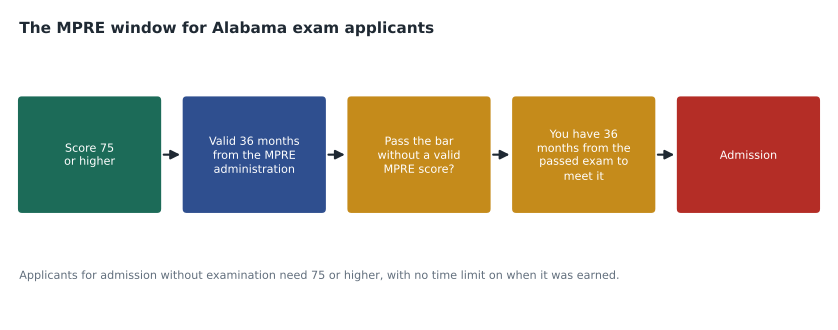
The window rule produces a common planning question. A student who takes the MPRE early in the second year of law school and then sits the bar exam twice may find the MPRE score has lapsed by the time of admission. The 36 months run from the MPRE administration, not from graduation. Students who plan to take the MPRE early should check that the score will still be valid on the expected admission date, or be prepared to retake it.
Worked problem
Is Darnell's MPRE score still good?
Darnell earned an 82 on the MPRE in March 2024, during his second year of law school. He sat the Alabama bar exam in July 2026 and did not pass. He passes in February 2027, results are released in late April 2027, and he expects character and fitness certification in June 2027. Can he use his 2024 score?
Show solution
- Alabama counts an MPRE score for 36 months from the administration in which it was earned.
- March 2024 plus 36 months is March 2027.
- Darnell's February 2027 exam falls inside the window, but his admission in June 2027 falls outside it.
- Because he passed the bar without an MPRE score that will be valid at admission, the rule gives him 36 months from the passed exam to meet the requirement, so he can retake the MPRE.
Answer: Darnell should register for the next MPRE administration rather than assume his 2024 score will carry him to admission. If he scores 75 or higher, he meets the requirement.
Preparing for the MPRE
Most candidates prepare for the MPRE in two to four weeks of part-time study. The scored content is heavy on conflicts of interest, the client-lawyer relationship, confidentiality, and litigation and other forms of advocacy, with smaller shares on judicial conduct, advertising and the regulation of the profession. NCBE publishes a subject matter outline with percentage ranges, and this program's BAR-140 course covers the whole outline with practice questions.
The MPRE tests the ABA Model Rules, not Alabama's version. Alabama's Rules of Professional Conduct follow the Model Rules closely, but there are differences, including Alabama's advertising rules, which were rewritten effective January 1, 2026. For the MPRE, answer by the Model Rules unless a question says otherwise. For practice in Alabama, follow the Alabama rules. Lesson 11 notes some of the Alabama differences.
Avery took the MPRE practice test from NCBE and scored well above 75. She plans to sit in March 2027, after the bar exam. 'The bar exam is the bigger risk,' she says. 'And if I pass the bar first, the rules still give me time.' Marchetti approves, with one adjustment: register as soon as registration opens, because seats at nearby test centers can fill.
Common mistakes
MistakeDisclosing a minor arrest will hurt me, so it is safer to leave it out.
InsteadLack of candor is treated as more serious than most underlying conduct; disclose and explain.
MistakeOnce my application is filed, I do not need to update it.
InsteadThe committee keeps jurisdiction until admission; disclose changes at all times.
MistakeAlabama requires an MPRE score of 85.
InsteadAlabama requires 75; some jurisdictions require up to 86.
MistakeAn MPRE score is good forever in Alabama.
InsteadFor exam applicants it counts for 36 months from the administration in which it was earned, with a 36-month grace period after passing the bar.
Writing the explanations
When an application asks about a past problem, the answer should do three things: state the facts accurately and completely, take responsibility without minimizing, and show what has changed since. Attach the documents that confirm the facts, such as a court disposition, a payment record or a letter from the school. Keep the tone plain. A committee reading hundreds of files responds better to a short, accurate account than to a long argument.
Avery's lost apartment deposit is a good example of how small matters should be handled. She lists the dispute, explains that the landlord withheld part of the deposit for damage she disputed, that she chose not to sue, and that there was no judgment against her. Her late credit card payment is listed with the dates and the fact that the account has been current for two years. Her college speeding ticket is listed with the court and the fine. None of these items is likely to cause concern. Leaving any of them out could.
Consistency matters as much as completeness. The committee compares the bar application with other records: the law school application, court records, credit reports and references. A difference between what an applicant told the law school years ago and what the bar application says can raise a candor question even when the underlying event was minor. Before filing, applicants should reread their law school application and, if it omitted something the bar asks about, consider amending the law school record and explaining the difference.
Substance use, mental health and conduct
Bar applications across the country have changed how they ask about mental health, with many jurisdictions moving from questions about diagnosis or treatment to questions focused on conduct and current ability to practice. Read Alabama's current questions carefully and answer exactly what they ask. Seeking help for a mental health or substance use problem is generally viewed as a sign of responsibility, not a reason for concern. Applicants with questions about how to answer should consult the Admissions Office, a lawyer who handles bar admission matters, or a lawyer assistance program.
The MPRE on test day
The MPRE is given on a computer at a test center. Candidates register with NCBE, choose a date within the administration window and a test center, and must follow the testing vendor's identification and security rules. NCBE does not allow late registration, so a candidate who misses the registration deadline must wait for the next administration. Scores are released by NCBE several weeks after the administration and sent to the jurisdictions the candidate designates. Candidates sending scores to Alabama should make sure their NCBE account lists Alabama, so the Admissions Office receives the score directly.
Because Alabama's passing score of 75 is lower than other jurisdictions', a candidate who expects to transfer later to a jurisdiction with a higher MPRE requirement should prepare for the higher score from the start. Retaking the MPRE later costs time and another registration fee.
Character and fitness for transfer and reciprocity applicants
Applicants who transfer a UBE score or seek admission without examination face the same character and fitness review as exam applicants, plus questions about their practice history. Lawyers already admitted elsewhere must show good standing in every jurisdiction of admission and disclose any discipline, malpractice claims and fee disputes. Because these applicants usually need an NCBE character report, the review can take longer than for a recent graduate, and they should file early. A transfer applicant's access to the online course on Alabama law begins only after the committee approves the application, so delays in the character review also delay the course and admission.
Avery's colleague who transferred a Tennessee UBE score into Alabama learned this the hard way: a missing employment reference held up her file for six weeks, and with it her access to the course. Her advice to Avery was practical. 'Ask your references before you list them, give them the bar's form right away, and follow up.'
Summary and key terms
- The Committee on Character and Fitness gives final approval or disapproval of every Alabama application and keeps jurisdiction until admission.
- Applicants must disclose fully and update the application whenever something changes; candor matters more than a perfect past.
- For exam applicants, any required hearing is held only after the applicant passes the bar exam, with about three to four weeks' notice.
- Alabama requires an MPRE score of 75, valid for 36 months from the administration, with 36 months after passing the bar to meet it.
- Answer the MPRE by the ABA Model Rules; practice by the Alabama Rules of Professional Conduct.
- Character and fitness
- The review of an applicant's honesty, trustworthiness and reliability before admission.
- Candor
- Complete and truthful disclosure in the bar application and throughout the process.
- MPRE
- NCBE's 60-question test on professional responsibility, scored from 50 to 150.
- Scaled score
- A score adjusted for test difficulty so that results are comparable across administrations.
- Rule V
- The Alabama admission rule on character and fitness under which the committee acts.
Lesson quiz · 5 questions
Score 60% or more to complete this lesson.
Create a free account to save your progress, take quizzes and earn a certificate.