
BAR-201 · Lesson 8 of 12 · 16 min
Alabama torts: contributory negligence, wantonness and the AEMLD
▶ Video coming soon A video version of this lesson is on the way.
Most of Avery's firm's cases are injury cases: car wrecks, falls in stores, defective machinery. On her first day, the senior partner gave her one piece of advice: 'Forget comparative fault. In Alabama, if your client was even a little bit negligent, the negligence count is probably gone. Learn wantonness.' This lesson explains why that advice is right, and covers the other features of Alabama tort law that set it apart from the general rules tested on the bar exam: wantonness as a separate claim, the Alabama Extended Manufacturer's Liability Doctrine, punitive damages and the unusual measure of damages in wrongful death cases.
Remember the warning from Lesson 4. On the MBE and MEE, answer torts questions under the general rules NCBE tests, which include pure comparative fault unless a question says otherwise. The rules in this lesson are for Alabama practice, the online course's torts module and, from July 2028, the state law component.
Contributory negligence survives in Alabama
Most states abandoned the common-law rule of contributory negligence in the second half of the twentieth century, replacing it with some form of comparative fault. Alabama did not. Under Alabama law, a plaintiff whose own negligence proximately contributed to the injury is generally barred from recovering on a negligence claim, no matter how small the plaintiff's share of fault compared with the defendant's. Alabama is one of only five jurisdictions that keep the rule, along with Maryland, North Carolina, Virginia and the District of Columbia.
The Supreme Court of Alabama squarely considered abandoning the rule in Williams v. Delta International Machinery Corp., 619 So. 2d 1330 (Ala. 1993). The plaintiff asked the court to adopt comparative negligence. The court declined, leaving any change to the legislature, and the legislature has not made one. Williams remains the leading statement of Alabama's position.
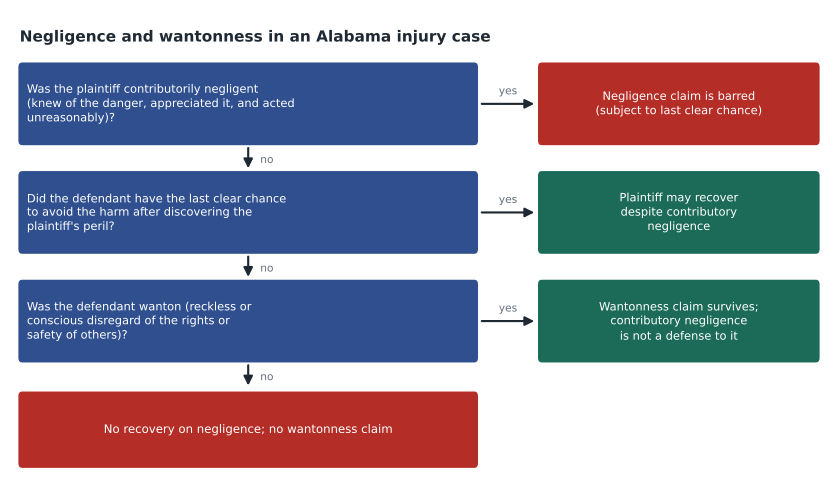
To establish contributory negligence, the defendant must generally show that the plaintiff knew of the dangerous condition, appreciated the danger, and failed to exercise reasonable care for the plaintiff's own safety by placing himself or herself in the way of that danger. Contributory negligence is an affirmative defense; the defendant must plead and prove it, and it is usually a question for the jury unless the evidence allows only one reasonable conclusion.
Last clear chance
Alabama softens contributory negligence with the doctrine of last clear chance. Even if the plaintiff was contributorily negligent, the plaintiff may recover if the defendant discovered the plaintiff's perilous position, had the opportunity to avoid the harm with reasonable care, and failed to do so. The doctrine focuses on the defendant's conduct after discovering the peril; it does not help a plaintiff when the defendant had no real chance to avoid the accident.
Wantonness: a separate claim
Alabama treats wantonness as a distinct tort, separate from negligence. The punitive damages statute defines wantonness as conduct carried on with a reckless or conscious disregard of the rights or safety of others. Wantonness is more than negligence: it involves knowledge that harm is likely to result from the conduct, or reckless indifference to that likelihood, rather than mere inattention.
Wantonness matters in practice for two reasons. First, contributory negligence is not a defense to wantonness. A plaintiff whose negligence would bar a negligence claim may still recover if the defendant's conduct was wanton. Second, wantonness supports punitive damages. That is why Alabama complaints in injury cases routinely plead both negligence and wantonness, and why the senior partner told Avery to learn wantonness first.
| Issue | General rule tested on the UBE | Alabama rule |
|---|---|---|
| Plaintiff's own negligence | Pure comparative fault reduces recovery (MBE default) | Contributory negligence generally bars a negligence claim |
| Defendant had last chance to avoid harm | Largely absorbed into comparative fault | Last clear chance can allow recovery |
| Reckless conduct | Factor in punitive damages; not a separate tort | Wantonness is a separate claim; contributory negligence is no defense |
| Product defects | Strict products liability (Restatement) | AEMLD, a fault-based judge-made doctrine |
| Wrongful death damages | Compensatory losses to survivors | Damages are punitive in nature under Alabama's statute |
The Alabama Extended Manufacturer's Liability Doctrine
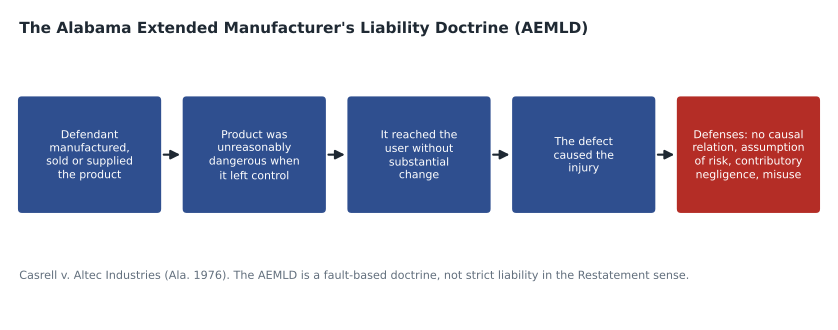
Alabama did not adopt strict products liability under section 402A of the Restatement (Second) of Torts in the form most states did. Instead, in Casrell v. Altec Industries, Inc., 335 So. 2d 128 (Ala. 1976), and its companion case Atkins v. American Motors Corp., 335 So. 2d 134 (Ala. 1976), the Supreme Court of Alabama created the Alabama Extended Manufacturer's Liability Doctrine, known as the AEMLD. The court described it as an extension of traditional negligence principles rather than true no-fault liability: a manufacturer or seller who markets a product that is not reasonably safe for its intended use is treated as negligent as a matter of law.
Under the AEMLD, a plaintiff generally must show that the defendant manufactured, designed, sold or otherwise supplied the product; that the product was in a defective condition unreasonably dangerous to the user or consumer when it left the defendant's control; that it reached the user without substantial change in its condition; and that the defect caused the injury. Because the doctrine is fault-based, Casrell recognized defenses that pure strict liability would not, including lack of causal relation, assumption of the risk and contributory negligence, which in the product context generally means the plaintiff's knowing and unreasonable use of a product the plaintiff knew to be defective, or misuse.
AEMLD cases in Alabama often involve crashworthiness claims against vehicle makers, where the claim is that a defect made injuries worse in an accident caused by something else. Alabama decisions have limited the role of the plaintiff's negligence in causing the accident in those cases. The details are beyond this course; what matters for a new lawyer is that Alabama product cases are pleaded under the AEMLD, often alongside negligence, wantonness and warranty claims.
Punitive damages
Alabama's punitive damages statute, Code of Alabama section 6-11-20, allows punitive damages in tort actions only where the plaintiff proves by clear and convincing evidence that the defendant consciously or deliberately engaged in oppression, fraud, wantonness or malice with regard to the plaintiff. The statute defines each term. Clear and convincing evidence is evidence that produces a firm conviction as to each element and a high probability that the conclusion is correct: more than a preponderance, less than beyond a reasonable doubt.
Section 6-11-21 limits the amount of punitive damages in most cases, generally by reference to a multiple of compensatory damages or a fixed dollar figure, with different limits for small businesses and for cases involving physical injury and exceptions for some kinds of cases. Other sections require the trial court to review punitive awards, prevent punitive damages against the state, limit a principal's liability for an agent's conduct and, importantly, provide that the article does not affect wrongful death actions. Check the current text of section 6-11-21 for the caps, which have been adjusted over time.
Wrongful death
Alabama's wrongful death statute, Code of Alabama section 6-5-410, lets the personal representative of a deceased person bring an action for a wrongful act, omission or negligence that caused the death, if the deceased could have sued had he or she lived. The jury may award such damages as it may assess. The action must be commenced within two years after the death. The damages are not subject to the decedent's debts; they are distributed according to the statute of distributions.
What makes Alabama unusual is the nature of those damages. Alabama courts have long held that damages under the wrongful death statute are punitive in nature, intended to punish the wrongdoer and deter similar conduct, rather than to compensate survivors for their losses. The amount turns on the culpability of the defendant's conduct, not on the economic value of the life lost or the survivors' grief. That is why the punitive damages article provides that it does not affect wrongful death actions, and why wrongful death verdicts in Alabama can look very different from those in other states.
Worked problem
Pat and Dana again
Pat was driving 10 miles per hour over the speed limit when Dana, reading a text message, ran a red light and struck Pat's car. Pat was seriously injured. In a separate case, Dana's truck struck and killed a pedestrian, Lee, who was crossing against the signal. What claims and defenses are likely under Alabama law?
Show solution
- Pat v. Dana, negligence: Dana will plead contributory negligence. If the jury finds Pat's speeding proximately contributed to the collision, the negligence claim is barred unless last clear chance applies; Dana had no time to avoid the collision after seeing Pat, so last clear chance is unlikely.
- Pat v. Dana, wantonness: texting through a red light may be conduct carried on with reckless or conscious disregard of the safety of others. Contributory negligence is not a defense to wantonness. If wantonness is proved by clear and convincing evidence, punitive damages are available.
- Lee's estate v. Dana: the personal representative sues under section 6-5-410 within two years of the death. Damages are punitive in nature and turn on the culpability of Dana's conduct. Lee's own negligence in crossing against the signal may bar a negligence-based wrongful death claim, but not one based on wantonness.
Answer: In both cases the wantonness claim does the real work. On the UBE, the same facts would be analyzed under comparative fault, with Pat's recovery reduced rather than barred.
Common mistakes
MistakeAlabama follows modified comparative fault.
InsteadAlabama keeps contributory negligence; Williams v. Delta International Machinery Corp. (Ala. 1993) declined to abandon it.
MistakeContributory negligence bars every claim arising from an accident.
InsteadIt is not a defense to wantonness.
MistakeAlabama product cases are pleaded under strict liability in tort.
InsteadThey are pleaded under the AEMLD, a fault-based doctrine from Casrell v. Altec Industries (Ala. 1976).
MistakeAlabama wrongful death damages compensate the survivors' losses.
InsteadThey are punitive in nature and turn on the defendant's culpability.
Pleading and proving wantonness
Because wantonness does so much work in Alabama injury cases, it is worth understanding how lawyers plead and prove it. The complaint pleads a separate count alleging that the defendant acted wantonly, with facts showing knowledge of the danger: prior warnings, prior incidents, a decision to continue despite known risks, or conduct so obviously dangerous that knowledge can be inferred. Proof often comes from documents and witnesses showing what the defendant knew and when. Defendants commonly move for summary judgment on wantonness counts, arguing that the evidence shows at most negligence; the line between inattention and conscious disregard is often where these cases are won or lost.
Wantonness is not the same as intent. A defendant need not intend to injure anyone. The question is whether the defendant acted with knowledge that injury was likely, or with reckless indifference to that likelihood. Alabama courts have described the difference between negligence and wantonness as a difference in kind, not merely degree, which is why evidence of mere carelessness, however serious, may not be enough.
Multiple defendants
Alabama's treatment of multiple defendants also differs from the comparative-fault approach. Because Alabama has not adopted comparative fault, it does not allocate fault among defendants by percentage in the way comparative-fault states do. Joint tortfeasors are generally jointly and severally liable for the plaintiff's damages, and Alabama generally does not allow contribution among joint tortfeasors. A defendant that pays a judgment usually cannot recover a share from a co-defendant unless a contract or a specific doctrine, such as indemnity, applies. Amounts paid in settlement by one defendant are generally credited against the plaintiff's recovery from others. These rules shape strategy in multi-defendant cases, including decisions about whom to sue and whether to settle early.
Torts on the bar exam and in practice
For the legacy UBE, none of this lesson is tested: answer under the general rules, and remember that the MBE assumes pure comparative fault and joint and several liability unless a question says otherwise. For the online course and practice, these rules are central. For the NextGen state law component from July 2028, torts is one of the most likely subjects, because the differences between Alabama and the general rules are so sharp and because tort cases make up a large part of new lawyers' work in the state.
Avery's practice test on torts, written for Marchetti, missed one point: she applied last clear chance to a case in which the defendant never saw the plaintiff in time to stop. Marchetti's comment was short: 'Last clear chance needs a real chance. If the defendant could not have avoided it after discovering the peril, the doctrine does not help.'
Avery also asks why Alabama has kept contributory negligence when most states have not. Marchetti gives the short history. Alabama's courts have treated the choice as one for the legislature, as Williams said, and proposals to adopt comparative fault have not passed. Supporters of the rule argue that it encourages personal responsibility and limits litigation costs; critics argue that it produces harsh results for slightly negligent plaintiffs. For a lawyer, the debate matters less than the rule: plead and prove wantonness when the facts allow it, and evaluate every negligence case with contributory negligence in mind.
Summary and key terms
- Alabama keeps contributory negligence; a negligent plaintiff's negligence claim is generally barred, softened by last clear chance.
- Wantonness, reckless or conscious disregard of others' rights or safety, is a separate claim to which contributory negligence is no defense.
- The AEMLD, created in Casrell v. Altec Industries (Ala. 1976), governs product cases as a fault-based doctrine with defenses such as assumption of the risk and contributory negligence.
- Punitive damages require clear and convincing evidence of oppression, fraud, wantonness or malice and are generally capped by section 6-11-21.
- Wrongful death damages under section 6-5-410 are punitive in nature; the action must be brought within two years.
- Contributory negligence
- A plaintiff's own negligence that proximately contributed to the injury; in Alabama it generally bars a negligence claim.
- Last clear chance
- A doctrine allowing recovery despite contributory negligence when the defendant discovered the peril and could have avoided the harm.
- Wantonness
- Conduct carried on with a reckless or conscious disregard of the rights or safety of others.
- AEMLD
- The Alabama Extended Manufacturer's Liability Doctrine, Alabama's fault-based approach to product liability.
- Personal representative
- The person appointed to administer an estate, who brings a wrongful death action in Alabama.
Lesson quiz · 5 questions
Score 60% or more to complete this lesson.
Create a free account to save your progress, take quizzes and earn a certificate.