
BAR-205 · Lesson 1 of 12 · 19 min
Becoming a lawyer in California
▶ Video coming soon A video version of this lesson is on the way.
Sofia Reyes opened her July 2026 results on October 30, 2026, and read the word she had been dreading. She had missed the California passing score by a small margin. Two days later she signed up for the February 2027 exam and asked Hollis Marchetti, the coach who runs her Tuesday study group, for something more than general bar review. 'Everyone else in the group is on the UBE or NextGen,' she wrote. 'I need the California version of everything.' Marchetti set up a separate series of evening calls with Sofia, undated in the group calendar because they fit around Sofia's law clerk job, and this course follows those calls.
Sofia's situation is common in California, and it shows why the state deserves its own course. California does not give the Uniform Bar Exam. It writes its own essays and its own performance test, it does not accept bar exam scores from other states, and it offers no admission on motion. It also allows more routes into the profession than almost any other jurisdiction: graduates of law schools approved by the American Bar Association (ABA), graduates of law schools accredited only by the State Bar of California, students at registered unaccredited schools, including distance-learning and correspondence schools, and people who study in a law office under a judge or lawyer. Every one of those routes ends at the same exam.
Every practice question in this course was written for it. None comes from the State Bar of California, the National Conference of Bar Examiners (NCBE) or any released exam. Facts about fees, deadlines and rules were checked against the State Bar's admissions pages, California Supreme Court orders and NCBE's published charts as of November 2026, and they change often, so confirm anything that matters with the State Bar's Office of Admissions before you rely on it.
Who controls admission
Admission to practice law in California belongs to the Supreme Court of California. The Legislature sets the basic statutory requirements in the State Bar Act, which is part of the Business and Professions Code, beginning around section 6060, and the State Bar of California runs the admissions system for the court. Within the State Bar, the Committee of Bar Examiners writes and grades the California Bar Examination, decides moral character questions and certifies to the Supreme Court the names of applicants who have met every requirement. The court admits them.
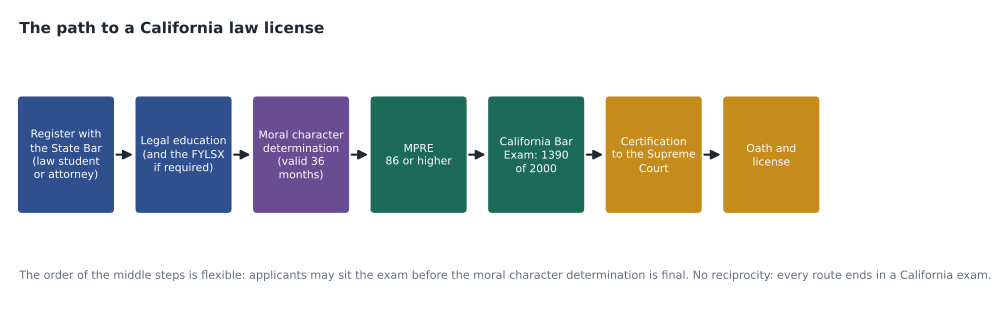
Three features of this structure matter in practice. First, the State Bar is both the regulator of lawyers and the agency that runs admissions, so its admissions rules sit inside a larger body of State Bar rules. The admissions rules are Title 4, Division 1 of the Rules of the State Bar, and they are where you find the detail on registration, education, the exams and moral character. Second, the Committee of Bar Examiners has real authority over the exam's content and grading, but major changes, such as switching to a different exam, need the Supreme Court's approval. You will see that relationship at work in Lesson 5, when the court rejected one proposal, approved another and then corrected course after the February 2025 exam. Third, because admission requirements are set partly by statute, some changes, such as reciprocity for lawyers licensed elsewhere, would need the Legislature as well as the court.
The requirements in one list
The State Bar describes the requirements for a general applicant in roughly the same terms on every admissions page. An applicant must:
Register with the State Bar, as a law student or as an attorney applicant, before filing other applications.
Complete the legal education the rules require, through one of the approved routes, and pass the First-Year Law Students' Examination if the applicant's route requires it.
Receive a positive moral character determination.
Pass the Multistate Professional Responsibility Examination (MPRE) with a scaled score of at least 86.
Pass the California Bar Examination, or for qualifying lawyers from other states, the Attorneys' Examination.
Be certified by the California Department of Child Support Services as complying with any child or family support order, then be certified by the State Bar to the Supreme Court and take the oath.
Marchetti tells Sofia that most of the list is already behind her. She registered as a law student years ago, she graduated in May 2026, she passed the MPRE in 2025 with a score high enough for California, and her moral character application is on file. The one item left is the exam.
The exam in brief
The California Bar Examination is a two-day, in-person exam given on the last Tuesday and Wednesday of February and July. The first day is written: five one-hour essay questions and one 90-minute performance test. The second day is the Multistate Bar Examination (MBE), NCBE's 200-question multiple-choice exam. The written score is scaled to the MBE and combined with it into a total scaled score out of 2,000 points, and a total of 1,390 passes. Lesson 4 explains the format and scoring in detail.
| Feature | California (February 2027 exam) |
|---|---|
| Exam | California Bar Examination: five essays and a performance test (day one), MBE (day two) |
| Passing score | 1390 out of 2000 total scaled points |
| MPRE | Scaled score of 86 or higher |
| Dates | February 23 and 24, 2027; results scheduled for April 30, 2027 |
| Filing | Opened October 1, 2026; timely through November 2; late filing through January 4, 2027 |
| Score transfer | None: California accepts no UBE, NextGen or MBE scores from elsewhere |
| Admission on motion | Not available; experienced lawyers may take the Attorneys' Examination |
| Next change | NextGen UBE from July 2028, with a California component planned from July 2029 |
What makes California different
Candidates who prepared in another state, or who studied for the UBE before switching, usually notice five differences.
California writes its own written exam. The essays test thirteen subjects, including several the MBE does not cover, such as community property, wills and succession, trusts, remedies, business associations and professional responsibility. California law matters on many of them, especially community property, civil procedure, evidence, wills, trusts and professional responsibility.
California has its own passing score and scale. The 2,000-point scale and the 1,390 passing score are unique to California, and the state does not report a UBE-style score that another jurisdiction could accept.
California has no reciprocity. Business and Professions Code section 6062 sets the requirements for lawyers admitted elsewhere, and the Supreme Court said in its October 2024 order that reciprocity would need a change in the statute. A lawyer with four years of good-standing practice elsewhere may take the shorter Attorneys' Examination, which is the written portion only, but no one is admitted without passing a California exam.
California allows unusual educational routes. A person can become a California lawyer without attending an ABA-approved school, through a California-accredited school, a registered unaccredited school or the Law Office Study Program. Those routes come with an extra test, the First-Year Law Students' Examination, often called the baby bar, which Lesson 2 explains.
California's exam is changing. The state returned to the MBE in July 2025 after a failed February 2025 exam, and on July 15, 2026 the Supreme Court approved a move to NCBE's NextGen Uniform Bar Exam starting in July 2028, with a California-specific component to follow from July 2029.
Sofia's starting point
Marchetti asks Sofia to describe her July result in the same terms the State Bar uses. Sofia's score report showed her MBE scaled score above the California average, two weak essays and a middling performance test. Her total was below 1,390 but close enough that a few better written answers would have changed the result. That pattern is common, and it shapes the plan: keep the MBE sharp with regular timed sets, and spend most of the new study time on the written day.
'You already know the law on most of these subjects,' Marchetti tells her. 'What costs you points is time and organization. In July you ran out of time on the last essay and wrote a summary of the facts on the performance test that the task memo did not ask for. We fix those first.'
Worked problem
Reading a California score report
Sofia's report (fictional numbers for teaching) shows an MBE scaled score of 1,480 on the State Bar's scale and a written scaled score of 1,250, for a total of 1,365. The passing score is 1,390.
Show solution
- Identify the gap: 1,390 minus 1,365 is 25 total scaled points.
- Remember the structure: the written portion and the MBE each contribute to the total, and NCBE reports the MBE as half of the combined score.
- Look at the components: one essay at a low raw score and a middling performance test cost more than the MBE did.
- Plan: written practice gives the largest return, while regular MBE sets keep that score from slipping.
Answer: The numbers here are illustrations, not Sofia's real report, but the method is how any repeater should read a California result: find the gap, find which component cost the most, and plan around it.
How this course is organized
The twelve lessons follow the order in which a California candidate meets each issue. Lessons 2 and 3 cover eligibility, education routes, the baby bar, registration, deadlines, moral character and the MPRE. Lesson 4 explains the exam's format and scoring. Lesson 5 tells the story of the exam's recent changes, from the October 2024 order through the February 2025 exam to the NextGen decision. Lesson 6 maps the written exam's thirteen subjects and shows where California law appears. Lessons 7 through 10 teach the four bodies of California law that the written exam tests most distinctively: community property, civil procedure and evidence, wills, trusts and probate, and professional responsibility. Lesson 11 covers the Attorneys' Examination, the absence of reciprocity and what happens after admission. Lesson 12 is a capstone with original practice essays and an exam-week plan.
Each lesson ends with a short quiz, and the course ends with a final exam. The quizzes test the facts and rules in the lessons, not general bar review, which the core courses in this program cover. If you are taking the California exam, pair this course with MBE Review I and II for the multiple-choice day and with the essay and performance test courses for method.
A note on change
Few jurisdictions have changed their bar exam as often as California has in the last ten years. The exam moved from three days to two in July 2017. The passing score fell from 1,440 to 1,390 in 2020. The Supreme Court ordered the State Bar to develop its own exam in October 2024, the new exam went badly wrong in February 2025, and the court ordered a return to the MBE three months later. In July 2026 the court approved NextGen for July 2028. Each change came with new rules, new deadlines and sometimes new fees.
Marchetti's advice to Sofia applies to every California candidate. Read the State Bar's page for your specific exam date, not a general page or a bar-prep summary from a year ago. Check the Applicant Portal for messages. When the State Bar announces something that affects you, such as a testing site change, act on it quickly.
Common mistakes
MistakeAssuming a UBE score from another state can be transferred to California.
InsteadCalifornia accepts no transferred UBE, NextGen or MBE scores; every applicant passes a California exam.
MistakeThinking an experienced lawyer from another state can be admitted on motion.
InsteadCalifornia has no admission on motion; lawyers with four years of good-standing practice may take the shorter Attorneys' Examination instead.
MistakeUsing the national MPRE score of another state, such as 75 or 80.
InsteadCalifornia requires 86, the highest MPRE requirement in the country.
MistakeRelying on an old summary of the exam's format.
InsteadCalifornia changed its exam several times since 2017; check the State Bar's page for your exam date.
A week in Sofia's plan
Marchetti ends the first call by sketching Sofia's weekly rhythm for December and January, a plan they will refine as the course goes on. Two timed essays a week, each written in exactly one hour and graded the next day against a released selected answer or a model outline. One performance test every other week, with the first fifteen minutes spent only on the task memo and the library. Fifty timed MBE questions every Saturday morning in the group's drill, with a short review of every miss. And one hour a week on the California-specific law in Lessons 7 through 10, because those are the subjects where a single missed rule can sink an essay.
The plan also has rest built in. Sofia works full time as a law clerk, and a repeater who burns out in January writes worse essays in February than one who studied a little less and slept more. Marchetti asks her to protect one evening a week and most of Sunday, and to tell the group if her firm's workload spikes so they can adjust the plan instead of abandoning it.
Summary and key terms
- The Supreme Court of California admits lawyers; the State Bar and its Committee of Bar Examiners run admissions under the Business and Professions Code and Title 4 of the State Bar Rules.
- A general applicant registers, completes legal education (and the baby bar if required), receives a positive moral character determination, scores 86 on the MPRE and passes the California Bar Exam.
- The exam has a written day (five essays and a performance test) and an MBE day, scored on a 2,000-point scale with 1,390 to pass.
- California has no reciprocity, no admission on motion and no score transfer; experienced lawyers may take the Attorneys' Examination.
- NextGen begins in California in July 2028, with a California component planned from July 2029.
- Committee of Bar Examiners
- The State Bar of California committee that writes and grades the bar exam and decides admissions questions for the Supreme Court.
- General applicant
- An applicant who is not a lawyer licensed elsewhere and who takes the full California Bar Examination.
- Attorney applicant
- A lawyer licensed in another US jurisdiction who applies for California admission.
- Baby bar
- The informal name for the First-Year Law Students' Examination.
- Total scaled score
- The combined written and MBE score on California's 2,000-point scale.
Practice problems
Work each problem on paper first, then reveal the answer to check.
Name the body that writes and grades the California Bar Exam.
Show answer
The Committee of Bar Examiners of the State Bar of California.
What are the two days of the California Bar Exam?
Show answer
A written day with five one-hour essays and a 90-minute performance test, and an MBE day with 200 multiple-choice questions.
Why can't a New York lawyer with twenty years of practice be admitted on motion in California?
Show answer
California has no admission on motion or reciprocity; Business and Professions Code section 6062 sets the requirements, and the lawyer must pass the Attorneys' Examination.
Lesson quiz · 5 questions
Score 60% or more to complete this lesson.
Create a free account to save your progress, take quizzes and earn a certificate.