
BAR-205 · Lesson 3 of 12 · 18 min
Moral character and the MPRE
▶ Video coming soon A video version of this lesson is on the way.
Sofia filed her moral character application in the fall of her final year of law school, as the State Bar recommends, and received her positive determination before she sat in July. Many of the candidates Marchetti coaches are not so organized, and she uses Sofia's file to walk through the process for the others in the group who may one day apply in California. 'In most states this is called character and fitness,' she says. 'California calls it moral character, and it runs on its own clock.'
The standard
Every applicant for admission in California must be of good moral character. The Business and Professions Code makes it a requirement for admission, and the State Bar's rules define the standard and the procedure. The idea is the same as in every jurisdiction: a license to practice law is a grant of public trust, and the State Bar must be satisfied that the applicant is honest, trustworthy and respectful of the law and the rights of others. The California Supreme Court has said in several cases over the decades that the inquiry looks at the applicant's present character, that past misconduct is evidence but not destiny, and that rehabilitation counts.
The applicant carries the burden of establishing good moral character. In practice that means answering every question completely and candidly, providing the documents the State Bar asks for and cooperating with the investigation.
The process and its timing
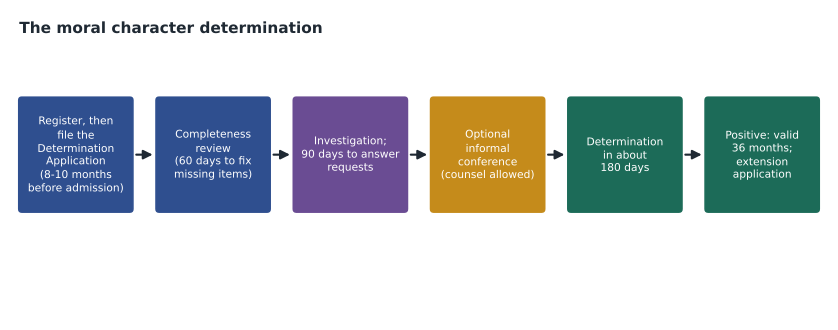
The State Bar's moral character pages describe the process in steps.
Filing. An applicant may file a Determination Application once registered as a law student or attorney applicant. The State Bar recommends filing at the start of the last year of law school, or at least eight to ten months before the applicant wants to be admitted.
Completeness review. The Office of Admissions checks the application for missing information, documents or payment and emails the applicant about anything missing. An application left incomplete for more than 60 days is deemed abandoned.
Investigation. A moral character investigator may be assigned and may ask for more information. The applicant has 90 days from the date of the request to respond, or the application is deemed abandoned.
Informal conference. If issues arise, the applicant may be invited to an informal conference to discuss them. Attendance is voluntary, the applicant may bring a lawyer, and declining leads to a decision on the available information without any negative inference.
Determination. The State Bar says applications are generally processed within about 180 days of filing, though background issues can take longer. An applicant who receives an adverse determination has review options under the State Bar's rules.
A positive determination is valid for 36 months. If the applicant has not been certified for admission by then, for example because she has not yet passed the bar exam, she can file an Extension Application between 30 and 36 months after the determination, and a positive extension is valid for another 36 months. Missing the window means filing a new Determination Application.
| Step | Timing rule (State Bar of California) |
|---|---|
| When to file | Start of the last year of law school, or 8 to 10 months before admission |
| Missing items | Application deemed abandoned if incomplete for more than 60 days |
| Investigator requests | 90 days to respond |
| Processing | Generally about 180 days, longer if issues need review |
| Validity | 36 months from a positive determination |
| Extension | File 30 to 36 months after the determination; valid another 36 months |
| Withdrawal refund | 60 percent within 30 days of submission; none later |
Sofia's determination came through in the spring of 2026. It is valid for 36 months, so it will still be valid if she passes in February or, if needed, in July 2027. Marchetti notes on Sofia's calendar the date 30 months after her determination, when an extension could first be filed, as a backstop.
What the State Bar looks at
The moral character application asks about criminal history, including arrests and dismissed charges, civil lawsuits, financial obligations, employment history and terminations, academic discipline, discipline in other professions, prior bar applications and other matters. The questions are detailed. As in every jurisdiction, the areas that most often lead to further review are candor problems, criminal conduct, financial irresponsibility and dishonesty in school or work.
| Area | What raises concern | What helps |
|---|---|---|
| Candor | Omissions and inconsistent answers | Complete answers, documents and prompt corrections |
| Criminal history | Convictions, especially for dishonesty or violence; recent or repeated offenses | Full disclosure, court records, time passed and evidence of rehabilitation |
| Finances | Unpaid judgments, defaults, unexplained debts | Payment plans and steady progress |
| School and work | Plagiarism, cheating, terminations for cause | Records, context and candid explanation |
| Other licenses | Discipline or unauthorized practice | Disciplinary records and good standing elsewhere |
Candor is the heart of it. An applicant who omits a dismissed arrest because it seemed irrelevant gives the investigator two problems instead of one: the old arrest, which by itself might never have mattered, and an omission on a sworn application, which looks like dishonesty in the very process meant to test honesty. Marchetti's rule is simple: read each question literally, answer what it asks, and if you are unsure whether something is covered, disclose it with a short explanation.
Worked problem
Reading the questions literally
An applicant has (1) a misdemeanor shoplifting charge at 19, dismissed after a diversion program, (2) a credit card in collections that she paid off last year, and (3) a semester of academic probation in college.
Show solution
- Check what the application asks: arrests and charges, not only convictions? Debts more than a set number of days past due? Academic discipline, or only academic probation for grades?
- Disclose the shoplifting charge and its outcome, with the court records.
- Disclose the collection account if the questions cover it, with proof of payment.
- Disclose the probation if the questions reach it, with a brief explanation.
Answer: None of these is likely to prevent admission when disclosed honestly. Hiding any of them could.
Rehabilitation
When an applicant does have serious past misconduct, the question becomes rehabilitation. California decisions and the State Bar's rules consider the nature of the misconduct, how long ago it happened, the applicant's age at the time, whether it was repeated, and what the applicant has done since: restitution, treatment, honest work, community involvement and candid acknowledgment of what happened. The more serious the past conduct, the stronger the showing of rehabilitation must be. An applicant in that position should consider consulting a lawyer who handles bar admission matters before filing.
The MPRE
California requires a scaled score of at least 86 on the Multistate Professional Responsibility Examination. The MPRE is NCBE's two-hour, 60-question multiple-choice ethics exam, given three times a year at Pearson VUE test centers, with scores reported from 50 to 150. Of the 60 questions, 50 are scored and 10 are unscored pretest questions.
California's 86 is the highest MPRE requirement in the country. NCBE's chart of required scores runs from 75 to 86 across jurisdictions, so a score that passes elsewhere may not pass in California. The State Bar's MPRE page cites the admissions rules for the requirement and explains how to have scores reported: first-time takers designate California to receive the score and add their NCBE number in the Applicant Portal, and scores usually appear in the applicant's State Bar account within two or three business days after NCBE releases them. For older scores, the page explains how to request a report through NCBE, and for exams before 1999, how to submit a copy with a signed statement.
NCBE's chart lists no time limit on when a California MPRE score must have been earned, so an old passing score can still count. Confirm the treatment of any older score with the State Bar if it applies to you.
| Fact | California MPRE requirement |
|---|---|
| Minimum scaled score | 86 (the highest in the country) |
| Score age | No time limit listed by NCBE |
| Reporting | Designate California and add the NCBE number in the Applicant Portal |
| When needed | Before admission; it is not part of the bar exam itself |
| Applies to | General applicants and attorney applicants |
Sofia passed the MPRE in 2025 with a score above 86. Marchetti points out that her MPRE preparation is not wasted now: California's professional responsibility essays test both the ABA Model Rules, which the MPRE covers, and California's own rules and statutes, which it does not. Lesson 10 covers the California side.
Child support certification
One more requirement surprises applicants. Before admission, the California Department of Child Support Services must certify that the applicant complies with any court order for child or family support. The State Bar lists it among the requirements for both general and attorney applicants. For most applicants it is a formality, but an applicant who is behind on court-ordered support should resolve it early.
Common mistakes
MistakeWaiting until after the bar exam to file the moral character application.
InsteadFile at the start of the last year of law school or 8 to 10 months before admission; processing takes about 180 days.
MistakeLetting a positive determination expire before admission.
InsteadIt is valid 36 months; file an Extension Application 30 to 36 months after the determination.
MistakeAssuming an MPRE score of 80 or 85 is enough for California.
InsteadCalifornia requires 86.
MistakeLeaving off a dismissed charge because it was not a conviction.
InsteadAnswer each question literally; disclose arrests and charges if the question asks about them.
Keeping the application current
A moral character application is not a one-time filing. Applicants must keep their answers current until admission, which means reporting changes such as a new address, a new job, a new arrest or citation, or a new civil lawsuit. An applicant who fails to update the file can face the same candor concerns as one who omitted information at the start. Marchetti asks every California candidate to set a monthly reminder to review the moral character file until admission, and to report changes promptly through the Applicant Portal.
Applicants sometimes worry that ordinary events will count against them. Most do not. A traffic ticket paid on time, a change of jobs, a move or a period of unemployment are facts to report if the questions ask, not problems. The State Bar's concern is with conduct that bears on honesty, trustworthiness and respect for the law, and with whether the applicant tells the truth about it.
When there is a real problem
Some applicants do have something serious to disclose: a criminal conviction, a significant debt in default, academic discipline for plagiarism, or discipline in another profession. For them, the order of steps matters. Gather the records first, such as court dockets, settlement agreements, school disciplinary files and proof of payment. Write a short, factual explanation that takes responsibility without excuses. Collect evidence of what has changed since, such as treatment, restitution, years of steady work and references from people who know about the conduct. Consider consulting a lawyer who handles moral character matters before filing, especially if the conduct is recent or repeated. And file early, because an application that raises issues takes longer than 180 days.
If the State Bar invites the applicant to an informal conference, the applicant can bring counsel and should prepare as for a professional interview: know the file, answer directly, and do not minimize. A conference is an opportunity to explain, not a hearing designed to catch the applicant out.
MPRE timing for California candidates
Because California requires 86, many California students take the MPRE more than once or schedule it early enough to retake it. The MPRE is given three times a year, and scores usually appear in the applicant's State Bar account a few days after NCBE releases them. A student who takes it in the spring or summer after the second year of law school has two more chances before graduation if the first score falls short. An applicant can sit for the bar exam before passing the MPRE, but cannot be admitted until the MPRE requirement is met, so a passing bar result with a missing MPRE score delays admission.
Sofia keeps a copy of everything she has submitted, so that if a question about her file ever arises, she can answer from her own records rather than from memory.
Summary and key terms
- California requires good moral character; the applicant carries the burden and must answer candidly and completely.
- File the Determination Application early; processing generally takes about 180 days, with 60- and 90-day limits for missing items and investigator requests.
- A positive determination lasts 36 months and can be extended for another 36.
- California requires an MPRE scaled score of 86, the highest in the country; NCBE lists no time limit on the score.
- Applicants must also be certified as complying with any child or family support order.
- Moral character determination
- The State Bar of California's decision whether an applicant has the good moral character required for admission.
- Informal conference
- A voluntary meeting where the State Bar discusses issues in an applicant's moral character file; counsel may attend.
- Extension Application
- The filing that extends a positive moral character determination for another 36 months.
- Rehabilitation
- Evidence that an applicant has addressed past misconduct and now has good moral character.
- MPRE
- NCBE's two-hour, 60-question ethics exam scored from 50 to 150; California requires 86.
Practice problems
Work each problem on paper first, then reveal the answer to check.
An applicant's positive determination was issued in March 2024. When can she first file an extension?
Show answer
In September 2026, 30 months after the determination; the window runs to the 36-month mark in March 2027.
An applicant scored 84 on the MPRE. Can she be admitted in California?
Show answer
Not on that score; California requires 86, so she must retake the MPRE.
What happens if an applicant does not answer an investigator's request within 90 days?
Show answer
The application is deemed abandoned.
Lesson quiz · 5 questions
Score 60% or more to complete this lesson.
Create a free account to save your progress, take quizzes and earn a certificate.