
BAR-205 · Lesson 10 of 12 · 18 min
California professional responsibility
▶ Video coming soon A video version of this lesson is on the way.
Sofia knows the ABA Model Rules well; she passed the MPRE in 2025 with a score above California's 86. In BAR-140's ethics workshop she missed questions on adverse authority and paying expert witnesses, and she has worked on both since. But the California written exam tests professional responsibility under two sets of authorities, and Marchetti wants her to be just as fluent in the second. 'When the call says California and ABA authorities, the points are in the differences,' she says.
The sources of California ethics law
California's lawyers are governed by three main sources. The California Rules of Professional Conduct, adopted by the Supreme Court and in effect in their current form since November 1, 2018, follow the numbering of the ABA Model Rules but differ in many places. The State Bar Act in the Business and Professions Code imposes statutory duties, most famously section 6068, and governs discipline. And California case law and ethics opinions, from the State Bar and county bar associations, interpret both.
Before 2018, California's rules used their own numbering and structure, and older study materials and opinions refer to those rules. The 2018 rules moved California much closer to the Model Rules, but not all the way, and California essays still test the remaining differences.
Confidentiality: the biggest difference
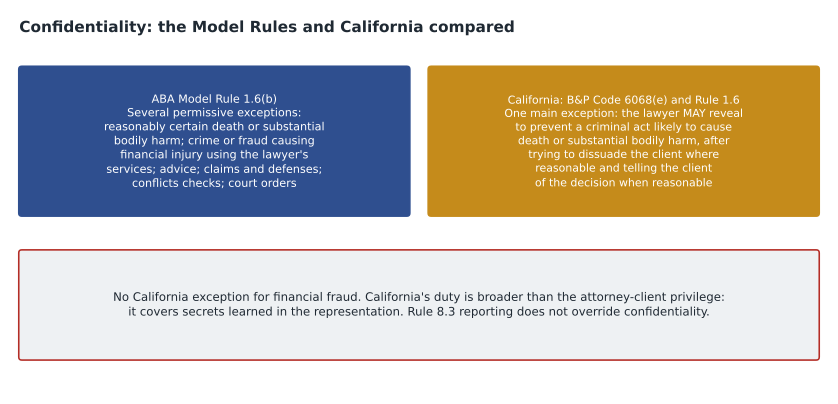
Business and Professions Code section 6068(e)(1) states the duty of every California lawyer to maintain inviolate the confidence, and at every peril to himself or herself to preserve the secrets, of his or her client. The duty covers information protected by the attorney-client privilege and more: information gained in the professional relationship that the client has asked be kept confidential, or whose disclosure would be embarrassing or likely detrimental to the client.
Section 6068(e)(2) and Rule 1.6 contain one main exception. A lawyer may, but is not required to, reveal confidential information to the extent the lawyer reasonably believes disclosure is necessary to prevent a criminal act that the lawyer reasonably believes is likely to result in death or substantial bodily harm to an individual. Before revealing, the lawyer must, if reasonable under the circumstances, make a good faith effort to persuade the client not to commit or continue the act, and must inform the client of the decision to reveal, when reasonable. The rule's comments make clear that a lawyer who chooses not to reveal does not violate the rule.
The Model Rules allow more. Model Rule 1.6(b) permits disclosure to prevent reasonably certain death or substantial bodily harm whether or not a crime is involved, to prevent or rectify a client's crime or fraud that causes substantial financial injury when the client used the lawyer's services, to obtain ethics advice, to establish claims or defenses in controversies with the client, to comply with law or a court order and to detect conflicts when changing firms. California has no general financial-fraud exception. California does recognize disclosure where the client has waived confidentiality and in some other limited circumstances, and the lawyer-client privilege in the Evidence Code has its own exceptions, but the core difference is the one essays test: in California, a lawyer cannot reveal a client's financial fraud to protect the victims, even when the lawyer's work was used.
Worked problem
A confidentiality essay issue
A client tells his California lawyer that he used the lawyer's draft contracts to defraud investors of large sums and plans to continue. He also says he will "make sure" a former business partner never testifies against him.
Show solution
- ABA: Model Rule 1.6(b)(2) and (3) would permit disclosure to prevent or rectify the financial fraud, since the client used the lawyer's services; Rule 1.16 requires withdrawal if continuing would assist a crime or fraud.
- California: no financial-fraud exception; the lawyer cannot reveal the fraud, though she must not assist it and must withdraw under Rule 1.16 if continuing would further it.
- The threat to the partner: if the lawyer reasonably believes the client will commit a criminal act likely to cause death or substantial bodily harm, both systems permit disclosure. In California, the lawyer should first try to dissuade the client if reasonable and inform the client of her decision when reasonable.
- Conclusion: a strong answer separates the two threats and states both systems for each.
Answer: The financial fraud can be revealed under the ABA rules but not under California's; the threat of violence permits disclosure under both.
Fees and fee agreements
California regulates fee agreements by statute. Business and Professions Code section 6147 requires a written contingency fee agreement signed by the client and lawyer, stating the contingency rate, how costs are treated and other required terms; if the agreement does not comply, it is voidable at the client's option and the lawyer is limited to a reasonable fee. Section 6148 requires a written fee agreement in most other cases where the total expense to the client, including fees, is reasonably foreseeable to exceed 1,000 dollars, with exceptions such as emergencies and corporate clients.
Rule 1.5 prohibits a lawyer from making an agreement for, charging or collecting an unconscionable or illegal fee, and lists factors to consider. The Model Rules use a reasonableness standard instead. Rule 1.5.1 governs fee divisions between lawyers who are not in the same firm, requiring a written agreement and the client's written consent after full written disclosure, but not requiring that the division be in proportion to the work done.
Conflicts of interest
California's Rule 1.7 follows the Model Rules' structure for current-client conflicts but requires the client's informed written consent, not just informed consent confirmed in writing. In California, informed written consent means the client's written agreement after the lawyer has communicated and explained the relevant circumstances and the material risks, including actual and reasonably foreseeable adverse consequences. California's Rule 1.7(c) adds a duty to disclose in writing certain relationships, such as a lawyer's personal or professional relationship with a party or witness, even when consent is not required.
California also has separate rules on business transactions with clients (Rule 1.8.1), which require fair terms, written disclosure, advice to seek independent counsel and the client's written consent, and on sexual relations with current clients (Rule 1.8.10), which are prohibited unless a consensual relationship existed before the representation, with exceptions for spouses and registered domestic partners.
The duty to report misconduct
For decades California had no rule requiring lawyers to report other lawyers' misconduct. That changed when the Supreme Court approved Rule 8.3, effective August 1, 2023. A California lawyer must inform the State Bar, or a tribunal with jurisdiction, when the lawyer knows of credible evidence that another lawyer has committed a criminal act or engaged in conduct involving dishonesty, fraud, deceit, or reckless or intentional misrepresentation or misappropriation of funds or property that raises a substantial question about the lawyer's honesty, trustworthiness or fitness as a lawyer. The State Bar's guidance adds that reports must be made without undue delay, that the rule does not require disclosing information protected by confidentiality, including section 6068(e), and that it does not apply to information gained in a lawyer assistance program. The duty covers conduct before August 1, 2023 if the lawyer learned of it on or after that date.
Model Rule 8.3 is similar in purpose but different in wording: it requires reporting a violation of the rules that raises a substantial question as to honesty, trustworthiness or fitness. California's standard of credible evidence of specified conduct is the version to apply on a California-law call.
Other California-specific duties
Section 6068 lists other statutory duties, including the duty to support the constitutions and laws, to maintain only actions that appear legal or just, to employ only means consistent with truth and never to mislead a judge by false statements, to respond promptly to client inquiries, and, under section 6068(o), to report to the State Bar within 30 days certain events, such as being sanctioned by a court in a significant amount or being charged with a felony.
Rule 1.4.2 requires a lawyer who does not have professional liability insurance to tell a client so in writing at the start of the representation when it is reasonably foreseeable that the representation will exceed four hours, with exceptions. Rule 1.15 governs client trust accounts, and California lawyers who handle client funds must also comply with the State Bar's Client Trust Account Protection Program, which requires annual registration and self-assessment.
Rule 8.4.1 prohibits unlawful discrimination, harassment and retaliation in representing clients and in law firm operations, which goes further than Model Rule 8.4(g) in some respects and is in force in California while the Model Rule has been adopted in only some states.
| Topic | ABA Model Rules | California |
|---|---|---|
| Confidentiality exceptions | Several, including financial crime or fraud using the lawyer's services | Mainly a criminal act likely to cause death or substantial bodily harm (6068(e)(2), Rule 1.6) |
| Fee standard | Reasonable fee (1.5) | Not unconscionable or illegal (1.5); written agreements under B&P 6147, 6148 |
| Conflict consent | Informed consent, confirmed in writing | Informed written consent |
| Fee division between firms | Proportion to work or joint responsibility | Written agreement and client's written consent; no proportion requirement (1.5.1) |
| Reporting misconduct | Report violations raising a substantial question (8.3) | Report credible evidence of specified conduct (8.3, since August 1, 2023) |
| Insurance disclosure | No Model Rule | Written disclosure if uninsured (1.4.2) |
Writing the answer
Professional responsibility calls on the California exam often ask the applicant to answer according to California and ABA authorities. A strong answer takes each issue in turn, states the ABA rule, states the California rule or statute, applies both to the facts and concludes under each. Where they agree, one sentence saying so is enough. Where they differ, the difference is usually where the points are.
Common mistakes
MistakeApplying the Model Rules' financial-fraud exception on a California call.
InsteadCalifornia permits disclosure mainly to prevent a criminal act likely to cause death or substantial bodily harm.
MistakeSaying California lawyers have no duty to report other lawyers.
InsteadRule 8.3 has required reporting of credible evidence of specified misconduct since August 1, 2023.
MistakeAccepting oral consent to a conflict.
InsteadCalifornia requires informed written consent.
MistakeForgetting the written fee agreement statutes.
InsteadB&P 6147 governs contingency fees; 6148 requires a writing when expenses will likely exceed 1,000 dollars.
Advertising and solicitation
California's advertising rules, in Rules 7.1 through 7.5, follow the Model Rules' structure: no false or misleading communications, limits on paying for recommendations and restrictions on in-person solicitation. California adds statutory overlays in the Business and Professions Code and has its own rules on specialization claims, which require certification by an approved body before a lawyer may state that she is a certified specialist. On essays, advertising issues usually appear as one issue among several, such as a lawyer who calls herself a specialist without certification or who pays a non-lawyer for referrals.
Duties to the court
Both systems require candor to the tribunal. Rule 3.3 prohibits knowingly making false statements of fact or law to a tribunal, failing to disclose controlling adverse authority known to the lawyer and not disclosed by opposing counsel, and offering evidence the lawyer knows is false. Sofia missed an adverse-authority question in the BAR-140 workshop, and she now remembers the rule this way: if the case is directly adverse, controlling in the jurisdiction and opposing counsel has not cited it, the lawyer must. Where California differs is in what happens when a lawyer learns that false evidence has been offered: California's Rule 3.3 requires remedial measures but limits disclosure to the tribunal when it would violate section 6068(e) and Rule 1.6, so a California lawyer may have to withdraw rather than reveal.
Marchetti adds a caution: the State Bar has proposed amendments to several rules, including Rules 1.6 and 3.3, so candidates should confirm on the State Bar's site that the rules they study are the ones in force on the exam date.
Summary and key terms
- California ethics law comes from the 2018 Rules of Professional Conduct, Business and Professions Code section 6068 and related statutes, and case law and opinions.
- Section 6068(e) and Rule 1.6 permit disclosure mainly to prevent a criminal act likely to cause death or substantial bodily harm; there is no financial-fraud exception.
- California requires written fee agreements in most cases (B&P 6147, 6148), bars unconscionable fees and requires informed written consent to conflicts.
- Rule 8.3, effective August 1, 2023, requires reporting credible evidence of a lawyer's criminal or dishonest conduct, subject to confidentiality.
- On a call naming both authorities, analyze ABA and California rules for each issue and highlight differences.
- Section 6068(e)
- The Business and Professions Code duty to preserve client confidences and secrets, with a narrow exception for preventing violent crime.
- Informed written consent
- A client's written agreement after the lawyer explains the relevant circumstances and material risks.
- Rule 8.3
- California's duty to report credible evidence of another lawyer's criminal or dishonest conduct, effective August 1, 2023.
- Unconscionable fee
- California's standard for a prohibited fee under Rule 1.5.
- Client Trust Account Protection Program
- The State Bar program requiring annual trust account registration and self-assessment.
Practice problems
Work each problem on paper first, then reveal the answer to check.
May a California lawyer reveal that a client is about to commit securities fraud using the lawyer's work?
Show answer
No; California has no financial-fraud exception, though the lawyer must not assist and must withdraw if continuing would further the fraud.
A California lawyer will charge a 900-dollar flat fee for a simple will. Is a written fee agreement required by section 6148?
Show answer
Not by section 6148 if the total expense is not reasonably foreseeable to exceed 1,000 dollars, though a writing is good practice.
When did California's duty to report other lawyers take effect?
Show answer
August 1, 2023, under Rule 8.3.
Lesson quiz · 5 questions
Score 60% or more to complete this lesson.
Create a free account to save your progress, take quizzes and earn a certificate.