
BAR-205 · Lesson 9 of 12 · 18 min
California wills, trusts and probate
▶ Video coming soon A video version of this lesson is on the way.
The wills essay that hurt Sofia in July turned on a California rule. A testator signed a typed will, one witness signed it in his presence, and the second witness signed the next day after the testator phoned to say it was his will. Sofia applied the majority rule that both witnesses must be present at the same time, concluded the will was invalid and moved on. She never mentioned the California statute that lets a court treat such a will as valid on clear and convincing evidence of intent. 'That one paragraph was the essay,' Marchetti tells her.
Wills and succession and trusts are written-only subjects on the California exam, and both are tested under California law, mainly the Probate Code. They often combine with community property, because a married testator can dispose of only her half of the community.
Capacity and execution
Under Probate Code section 6100, a person who is at least 18 and of sound mind may make a will. Section 6100.5 sets out the test for incapacity: the testator lacks capacity if she cannot understand the nature of the act, cannot understand and recollect the nature and situation of her property, or cannot remember and understand her relations to her spouse, children and other people whose interests are affected, or if she suffers from a mental disorder with delusions or hallucinations that cause the will's dispositions.
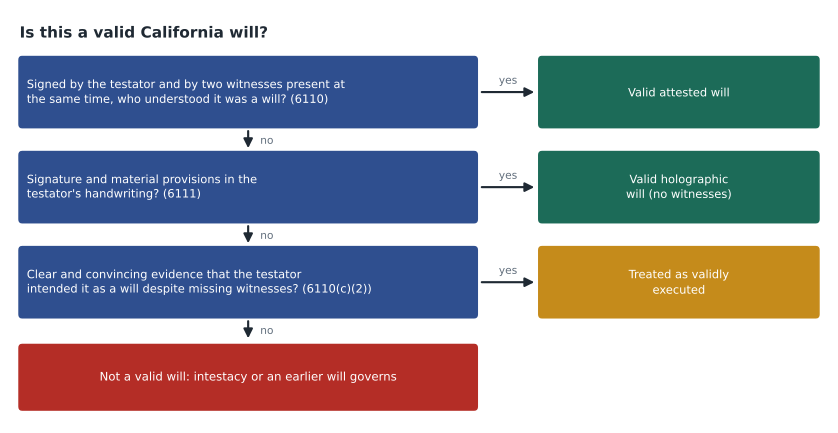
Attested wills. Section 6110 requires a will to be in writing and signed by the testator, or in the testator's name by another person in the testator's presence and at the testator's direction, or by a conservator under court order. It must be witnessed by at least two people who, being present at the same time, witnessed either the signing or the testator's acknowledgment of the signature or of the will, and who understand that the instrument they sign is the testator's will.
The harmless error rule. Since 2009, section 6110(c)(2) provides that if a will was not executed in compliance with the witnessing requirement, it is treated as validly executed if the proponent establishes by clear and convincing evidence that, at the time the testator signed it, the testator intended it to be the testator's will. It applies to defects in witnessing; the testator's signature is still required. Sofia's July essay needed exactly this analysis.
Holographic wills. Section 6111 makes a will valid as a holographic will, without witnesses, if the signature and the material provisions are in the testator's handwriting. Typed or printed material can be disregarded if the handwritten parts carry the essential dispositions. A holographic will need not be dated, but if the absence of a date creates doubt about whether it or an inconsistent will came later, or whether the testator had capacity when it was made, the undated holograph may be invalid to the extent of the inconsistency unless the time can be established.
Interested witnesses. Under section 6112, a will is not invalid because a witness is also a beneficiary. But if the only witnesses are interested, a rebuttable presumption arises that the witness procured the gift by duress, menace, fraud or undue influence. If the presumption is not rebutted, the interested witness takes no more than her intestate share.
Revocation
Under section 6120, a will is revoked by a later will that revokes it expressly or by inconsistency, or by being burned, torn, canceled, obliterated or destroyed with the intent and for the purpose of revoking it, by the testator or by another person in the testator's presence and at the testator's direction. Under section 6124, if a will last in the testator's possession cannot be found after death, or is found mutilated, it is presumed the testator destroyed it with intent to revoke; the presumption affects the burden of producing evidence.
Divorce. Under section 6122, dissolution or annulment of the testator's marriage revokes provisions in the will for the former spouse, unless the will provides otherwise, and the former spouse is treated as having predeceased the testator. California applies a similar rule to nonprobate transfers to a former spouse, such as revocable trust gifts.
Dependent relative revocation. If a testator revokes a will on the mistaken belief that a new will is valid, California courts may disregard the revocation where the testator would have preferred the old will to intestacy. It is a doctrine of intent, applied by courts, and essays reward applicants who name it when a revocation was based on a mistake.
Lapse and anti-lapse
If a beneficiary dies before the testator, the gift lapses unless an anti-lapse statute saves it. California's statute, Probate Code section 21110, saves the gift for the beneficiary's issue if the beneficiary was kindred of the testator or kindred of a surviving, deceased or former spouse of the testator. The issue take in the beneficiary's place unless the instrument shows a contrary intent, such as a survival requirement. A gift to a friend who predeceases the testator lapses; a gift to a niece who predeceases the testator passes to the niece's children.
Omitted spouses and children
California protects spouses and children left out of wills made before the marriage or birth.
Omitted spouse. Under section 21610, a spouse who married the testator after the testator executed all of her testamentary instruments receives a share: the decedent's one-half of the community and quasi-community property, and up to one-half of the decedent's separate property as an intestate share. Section 21611 lists exceptions: the omission was intentional and appears in the instrument, the decedent provided for the spouse by transfer outside the will intended to substitute for a testamentary gift, or the spouse made a valid agreement waiving the right.
Omitted child. Under section 21620, a child born or adopted after the testator executed all testamentary instruments, and not provided for in any of them, receives the share the child would have received in intestacy. Section 21621 has exceptions similar to the spouse's, and section 21622 extends protection to a child the testator omitted because the testator believed the child was dead or did not know of the birth.
Undue influence and prohibited transferees
A will or gift procured by undue influence is invalid. California case law raises a presumption of undue influence when the beneficiary had a confidential relationship with the testator, actively participated in procuring the will and unduly benefited. Probate Code section 21380 adds a statutory presumption of fraud or undue influence for gifts to the person who drafted the instrument, to a care custodian of a dependent adult, and to certain people related to or associated with them, subject to exceptions and rebuttal by clear and convincing evidence.
Intestate succession
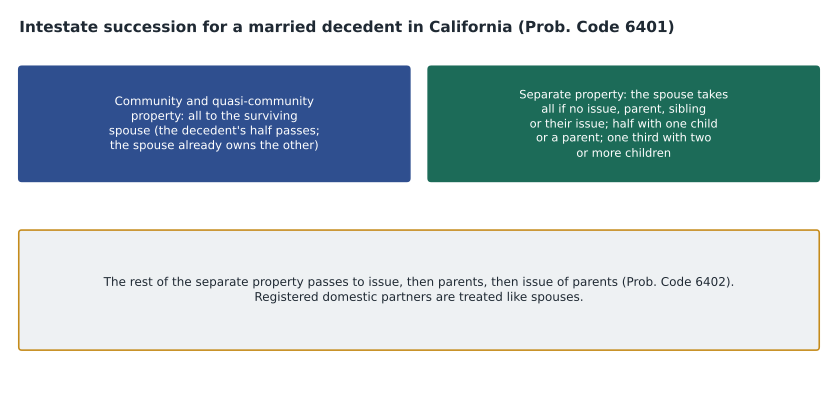
California intestacy combines community property and separate property rules. Under Probate Code section 6401, the surviving spouse takes all of the decedent's half of the community and quasi-community property. For separate property, the spouse takes all of it if the decedent left no issue, parent, sibling or issue of a deceased sibling; one-half if the decedent left one child or the issue of one deceased child, or no issue but a parent or parents or their issue; and one-third if the decedent left more than one child, or one child and the issue of a deceased child, or the issue of two or more deceased children. The rest of the separate property passes under section 6402, first to issue, then to parents, then to issue of parents and further out. Registered domestic partners are treated like spouses.
Worked problem
Intestacy with community and separate property
Ray dies intestate, survived by his wife Lin and their two children. His half of the community property is worth 600,000 dollars, and his separate property, inherited from his mother, is worth 300,000 dollars. (Numbers invented.)
Show solution
- Community: Lin already owns her half; Ray's half (600,000) passes entirely to Lin under section 6401.
- Separate property: with two children, Lin takes one-third (100,000) and the children share the remaining two-thirds (200,000), 100,000 each.
- Total to Lin from Ray's estate: 700,000 dollars, plus her own half of the community.
Answer: Lin receives 700,000 dollars from the estate; each child receives 100,000 dollars.
Trusts
California trust law is codified in the Probate Code's Trust Law. A trust is created by a settlor with intent to create a trust, identifiable property, a proper purpose and, generally, an identifiable beneficiary. Trusts of personal property can be oral if proven by clear and convincing evidence; trusts of real property need a writing.
Revocability is a California exam favorite. Under Probate Code section 15400, unless a trust is expressly made irrevocable by the trust instrument, the trust is revocable by the settlor. This reverses the traditional rule that trusts are irrevocable unless the settlor reserves a power to revoke. Section 15401 sets the methods of revocation: the method the trust provides, if it is made exclusive, or a writing other than a will signed by the settlor and delivered to the trustee during the settlor's lifetime.
Trustees owe fiduciary duties set out in the Probate Code: the duty of loyalty, the duty to administer the trust according to its terms, the duty to avoid conflicts and self-dealing, the duty to treat beneficiaries impartially and the duty to invest prudently under California's version of the Uniform Prudent Investor Act. A spendthrift clause, under section 15300, generally prevents beneficiaries from transferring their interests and protects trust income from their creditors, with statutory exceptions such as child support.
Pour-over wills, under section 6300, let a will leave property to an existing trust, even one amended after the will. Many Californians use revocable living trusts to avoid probate, which in California can be slow and expensive, with statutory fees for personal representatives and their lawyers.
No-contest clauses
California enforces no-contest clauses only in limited situations under Probate Code sections 21310 through 21315: against a direct contest brought without probable cause, a pleading challenging a transfer on the ground that the transferor did not own the property, or a creditor's claim, and only to the extent the clause expressly covers the last two. A beneficiary with probable cause can contest without forfeiting her gift.
Common mistakes
MistakeInvalidating a will for a witnessing defect without considering section 6110(c)(2).
InsteadAsk whether clear and convincing evidence shows the testator intended it as her will.
MistakeAssuming a California trust is irrevocable unless the settlor reserved a power to revoke.
InsteadUnder section 15400, a trust is revocable unless expressly made irrevocable.
MistakeApplying anti-lapse to a gift to a friend.
InsteadSection 21110 protects gifts to kindred of the testator or the testator's spouse.
MistakeGiving the surviving spouse all of the decedent's separate property when there are children.
InsteadThe spouse takes one-half with one child and one-third with two or more children.
Wills and community property together
California essays often combine wills with community property, because a married testator can dispose of only her half of the community. Two errors are common. The first is treating everything in the testator's name as hers to give. A will leaving 'all my property' to a sibling passes only the testator's separate property and her half of the community; the surviving spouse keeps the other half by right, not by inheritance. The second is ignoring quasi-community property. At death, Probate Code section 101 lets the decedent dispose of only half of quasi-community property, and the surviving spouse owns the other half, so a couple who earned their savings in another state before moving to California is treated much as if they had earned it here.
California also offers the surviving spouse a choice when the decedent's will tries to dispose of the spouse's half. Under the doctrine of election, a spouse who accepts benefits under a will that purports to give away the spouse's share of community property may be required to choose between taking under the will and keeping her community half. Essays reward applicants who spot a will that overreaches.
In practice, many California estate plans combine a revocable living trust with a pour-over will, so a California essay that mentions a trust often also tests whether the will validly pours property into it and whether later trust amendments apply.
Summary and key terms
- A will needs a signature and two witnesses present at the same time (section 6110), or handwritten material provisions and signature (section 6111); the harmless error rule in 6110(c)(2) can save a witnessing defect.
- Wills are revoked by later instrument or physical act (6120); divorce revokes gifts to a former spouse (6122); a missing will is presumed revoked (6124).
- Anti-lapse (21110) protects gifts to kindred of the testator or spouse; omitted spouses (21610) and children (21620) receive protected shares.
- Intestacy gives the spouse the decedent's half of the community and a share of separate property that depends on surviving relatives.
- California trusts are revocable unless expressly irrevocable (15400); trustees owe fiduciary duties; no-contest clauses are enforced only in limited cases.
- Holographic will
- A will whose signature and material provisions are in the testator's handwriting, valid without witnesses.
- Harmless error rule
- Probate Code 6110(c)(2), treating a will with a witnessing defect as valid on clear and convincing evidence of intent.
- Anti-lapse statute
- A statute that substitutes a predeceased beneficiary's issue for the beneficiary.
- Omitted spouse
- A spouse married after the testator executed all testamentary instruments, entitled to a statutory share.
- Pour-over will
- A will that leaves property to an existing trust.
Practice problems
Work each problem on paper first, then reveal the answer to check.
A testator types a will, signs it and has one witness sign. Is it valid?
Show answer
Not as an attested will; it may be valid under section 6110(c)(2) if clear and convincing evidence shows she intended it as her will.
A trust instrument says nothing about revocation. Can the settlor revoke it?
Show answer
Yes; under section 15400, a California trust is revocable unless expressly made irrevocable.
A will leaves property to the testator's cousin, who dies first leaving a daughter. Who takes?
Show answer
The daughter, under section 21110, because the cousin was kindred of the testator.
Lesson quiz · 5 questions
Score 60% or more to complete this lesson.
Create a free account to save your progress, take quizzes and earn a certificate.