
BAR-205 · Lesson 7 of 12 · 18 min
California community property
▶ Video coming soon A video version of this lesson is on the way.
Community property is the subject candidates from other states fear most and California graduates often underestimate. Sofia studied it in law school and wrote a community property essay in July that she thought went well. Marchetti reads it and points to the problem: Sofia characterized each asset correctly but never explained the presumptions, the burden or the tracing that got her there. 'Graders want the steps, not just the answers,' she says. This lesson gives the steps.
California is one of nine community property states. The rules are mostly statutory, in the Family Code, with key decisions of the California Supreme Court and Courts of Appeal filling in methods for difficult assets. Registered domestic partners have the same rights and duties as spouses under Family Code section 297.5, so everything in this lesson applies to them too.
The basic characterization
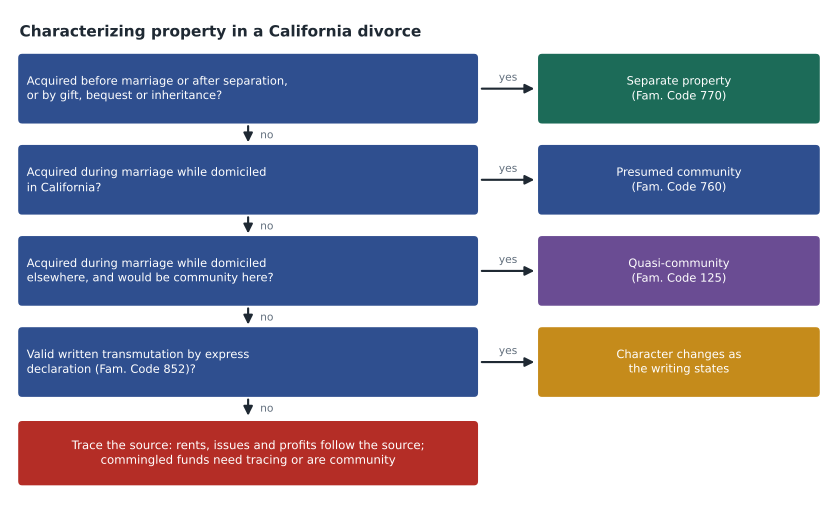
Community property. Family Code section 760 provides that, except as the Code provides otherwise, all property, real or personal, wherever located, acquired by a married person during the marriage while domiciled in California is community property. The core idea is that each spouse's labor during marriage belongs to the community, so earnings and everything bought with them are community.
Separate property. Section 770 makes separate property everything a spouse owned before marriage, everything acquired during marriage by gift, bequest, devise or descent, and the rents, issues and profits of that property. Section 771 makes earnings and accumulations after the date of separation separate property. Since 2017, Family Code section 70 defines the date of separation as the date a complete and final break in the marital relationship occurred, shown by a spouse expressing an intent to end the marriage and conduct consistent with that intent.
Quasi-community property. Section 125 defines quasi-community property as property acquired while domiciled elsewhere that would have been community property if the spouses had been domiciled in California when it was acquired. A couple who earned and saved in Texas or New York and then moved to California will find, at divorce, that those savings are treated like community property, divided equally.
Presumptions and the burden
Essays reward applicants who state the presumption first and then ask whether it has been rebutted. Property acquired during marriage is presumed community under section 760, and the spouse claiming it is separate must trace it to a separate source. Section 2581 adds a special presumption at divorce: property acquired during marriage in joint form, such as joint tenancy, is presumed community, and it can be rebutted only by a clear statement in the deed or other documentary evidence of title that it is separate, or by a written agreement. A spouse's testimony that the couple meant to keep a jointly titled house separate is not enough.
Transmutation
Spouses can change the character of property by agreement, but only in writing. Section 852 requires that a transmutation be made in writing by an express declaration made, joined in, consented to or accepted by the spouse whose interest is adversely affected. The California Supreme Court held in Estate of MacDonald (1990) that the writing must expressly state that the character or ownership of the property is being changed; signing a document that merely has that effect, without saying so, is not enough. Section 852 also contains an exception for gifts between spouses of clothing, jewelry and other tangible articles of a personal nature that are not substantial in value, considering the couple's circumstances.
Transmutations also raise fiduciary issues. Spouses owe each other the duties of a fiduciary relationship under sections 721 and 1100, and a transmutation that advantages one spouse can be challenged as the product of undue influence. Lesson 9 returns to the same idea in wills.
Mixed assets and tracing
Many assets have both community and separate components. Essays test the methods California courts use to apportion them.
Businesses. When a spouse owns a separate business before marriage and works in it during marriage, the community has a claim to the growth attributable to that spouse's labor. Courts use two methods. Under the Pereira approach, used when the spouse's personal efforts primarily caused the growth, the separate estate receives a fair return on its value, often computed as simple interest, and the rest of the growth is community. Under the Van Camp approach, used when the growth came mainly from the character of the business or market conditions, the community receives the reasonable value of the spouse's services, less family expenses already paid from those earnings, and the rest is separate. A good essay names both methods and explains which fits the facts.
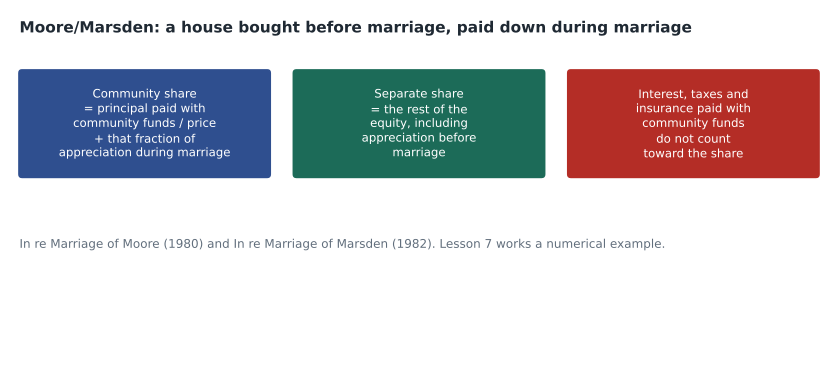
Real property bought before marriage and paid down during marriage. The Moore and Marsden decisions apportion a house one spouse bought before marriage when community funds pay down the loan during marriage.
Worked problem
A Moore/Marsden calculation
Before marrying Dev, Ana bought a house for 500,000 dollars with a 100,000-dollar down payment and a 400,000-dollar loan. At the marriage the house was worth 600,000 dollars. During the marriage, community earnings paid 50,000 dollars of loan principal, plus interest, taxes and insurance. At divorce the house is worth 900,000 dollars and the loan balance is 350,000 dollars. (Numbers are invented for teaching.)
Show solution
- Community percentage: community principal payments divided by the purchase price: 50,000 / 500,000 = 10 percent.
- Community share: the principal it paid (50,000) plus 10 percent of the appreciation during marriage (900,000 minus 600,000 = 300,000; 10 percent is 30,000) = 80,000 dollars.
- Separate share: the equity of 550,000 (900,000 minus 350,000) less the community share = 470,000 dollars. This includes Ana's down payment, the loan principal paid before marriage, if any, all appreciation before marriage and 90 percent of the appreciation during marriage.
- Interest, taxes and insurance paid with community funds do not increase the community share under Moore.
- At divorce the community share of 80,000 is divided equally: 40,000 to each spouse.
Answer: The community share is 80,000 dollars and Ana's separate share is 470,000 dollars.
Pensions and retirement accounts. Under In re Marriage of Brown (1976), pension rights earned during marriage are community property even if they have not vested. Courts commonly apportion a pension by a time rule: the fraction of the employee spouse's service during marriage before separation, over total service, is community.
Personal injury damages. Section 780 makes damages for personal injuries suffered during marriage community property, but at divorce section 2603 generally assigns them to the injured spouse unless the interests of justice require otherwise, in which case at least half goes to the injured spouse. Damages for injuries suffered before marriage or after separation are separate under section 781.
Reimbursement
Family Code section 2640 gives a spouse reimbursement at divorce for separate property contributions to the acquisition of community property, such as a down payment, payments that reduce the principal of a loan used to buy the property, and improvements, unless the spouse waived the right in writing. Reimbursement is without interest and cannot exceed the net value of the property. If a couple buys a house in joint title with a 100,000-dollar down payment from one spouse's inheritance, the house is community under section 2581, but that spouse is reimbursed 100,000 dollars at divorce.
Section 2641 provides a different kind of reimbursement: the community is reimbursed, with interest, for community contributions to a spouse's education or training that substantially enhances that spouse's earning capacity, subject to equitable limits, such as when the community has already substantially benefited from the education.
Debts and management
Each spouse has equal management and control of community personal property, with limits, such as needing the other spouse's written consent to give away community property, and both spouses generally must join in transfers of community real property. Spouses owe each other fiduciary duties of good faith and fair dealing in managing community property under sections 721 and 1100. For debts, section 910 generally makes the community estate liable for a debt incurred by either spouse before or during marriage, regardless of which spouse incurred it, with exceptions such as the protection of a spouse's earnings from the other spouse's premarital debts if those earnings are kept separately.
Division at divorce and at death
At divorce, section 2550 requires the court to divide the community estate equally, unless the parties agree otherwise in writing or on the record. Quasi-community property is divided the same way. Separate property stays with the owner.
At death, each spouse owns half of the community property, and Probate Code sections 100 and 101 let each spouse dispose of only his or her half of the community and quasi-community property by will. The surviving spouse keeps the other half. If the decedent dies without a will, Lesson 9 explains how intestacy passes the decedent's half.
Common mistakes
MistakeStating the answer without the presumption.
InsteadStart with section 760 or 2581, then ask whether tracing or a writing rebuts it.
MistakeAccepting an oral agreement to keep property separate.
InsteadTransmutations require an express written declaration under section 852 and Estate of MacDonald.
MistakeCounting interest and taxes in a Moore/Marsden calculation.
InsteadOnly community payments of principal count toward the community share.
MistakeForgetting reimbursement for a separate down payment on jointly titled property.
InsteadSection 2640 reimburses separate contributions to acquisition, without interest, unless waived in writing.
Premarital agreements
Couples can change the community property rules by agreement before marriage. California's Uniform Premarital Agreement Act, in the Family Code beginning at section 1600, requires a premarital agreement to be in writing and signed by both parties. Section 1615 makes an agreement unenforceable if the party challenging it did not execute it voluntarily, or if it was unconscionable when signed and the challenging party did not receive fair disclosure of the other's property and obligations. The statute also creates a presumption that an agreement was not executed voluntarily unless certain safeguards were met, such as independent legal counsel for the challenging party or a written waiver of counsel, and a waiting period of at least seven days between first receiving the final agreement and signing it. Essays combine premarital agreements with characterization: if the agreement is valid, it controls; if not, the default rules apply.
Common essay traps
Marchetti lists the community property points that most often cost candidates credit.
Gifts between spouses. A gift from one spouse to the other of community property is a transmutation and must meet section 852's writing requirement, unless it is a gift of a tangible personal item, such as jewelry, that is not substantial in value considering the couple's circumstances. An expensive watch given as a birthday present may or may not fall within the exception, and an essay should discuss the factors.
Life insurance. A term policy's character can depend on which funds paid the last premium, while a whole life policy is often apportioned by the share of premiums paid with community and separate funds. Essays reward an applicant who notices the type of policy.
Commingled bank accounts. A spouse who deposits separate funds into a joint account can still trace them, by direct tracing to specific separate deposits used for specific purchases, or by family expense tracing, which presumes family expenses were paid from community funds first. Without tracing, commingled funds are community.
The date of separation. Earnings after the date of separation are separate under section 771. Disputes about that date can shift large sums, and since 2017 section 70 sets the test: a complete and final break, shown by expressed intent and consistent conduct.
Death and community property
At death the characterization questions are the same as at divorce, but some divorce-only rules do not apply. Section 2581's joint-title presumption and section 2640 reimbursement are rules for dividing property at dissolution. At death, courts look to the form of title, the source of funds, any transmutation and the Probate Code. A house held in joint tenancy, for example, can pass by right of survivorship, while community property passes half to the surviving spouse by ownership and half under the decedent's will or by intestacy. Essays that mix death and divorce rules lose points; read the facts to see which event triggered the question.
Summary and key terms
- Property acquired during marriage while domiciled in California is presumed community (section 760); gifts, inheritances and premarital property are separate (section 770).
- Quasi-community property (section 125) is treated like community property at divorce and death.
- Transmutations need an express written declaration (section 852; Estate of MacDonald); jointly titled property is presumed community at divorce (section 2581).
- Mixed assets use Pereira or Van Camp for businesses, Moore/Marsden for houses and the time rule for pensions.
- Section 2640 reimburses separate contributions to acquisition of community property; the community estate is divided equally at divorce (section 2550).
- Community property
- Property acquired by a married person during marriage while domiciled in California, owned equally by both spouses.
- Quasi-community property
- Property acquired while domiciled elsewhere that would have been community property if acquired in California.
- Transmutation
- A change in the character of property between spouses, valid only by an express written declaration.
- Tracing
- Following property back to its source to prove its character.
- Pereira and Van Camp
- Two methods of apportioning growth in a separate business between the community and the separate estate.
Practice problems
Work each problem on paper first, then reveal the answer to check.
Before marriage, Ben bought a car with his savings. During marriage he sold it and bought a boat with the proceeds. Character?
Show answer
Separate property, traced to his premarital savings.
During marriage, Cara inherits 200,000 dollars and uses it as the down payment on a house titled in both names. At divorce?
Show answer
The house is presumed community under section 2581, but Cara is reimbursed 200,000 dollars under section 2640 unless she waived it in writing.
Dan signed a deed to his separate cabin "to Dan and Erin as joint tenants." Is that a transmutation?
Show answer
Likely yes if the deed meets section 852; a deed that changes title in this way has been treated as an express declaration, but check whether the writing expressly changes ownership.
Lesson quiz · 5 questions
Score 60% or more to complete this lesson.
Create a free account to save your progress, take quizzes and earn a certificate.