
BAR-205 · Lesson 8 of 12 · 18 min
California civil procedure and evidence
▶ Video coming soon A video version of this lesson is on the way.
Sofia works as a law clerk at a small Oakland litigation firm, and she has filed demurrers, opposed an anti-SLAPP motion and drafted special interrogatories under the California Code of Civil Procedure. On the MBE, none of that helps; the MBE tests the Federal Rules of Civil Procedure and the Federal Rules of Evidence. On the written exam, it can help a lot, but only when the call asks for California law. This lesson covers the California rules most often worth knowing and how to use them on an essay.
When the essay asks for California law
Civil procedure and evidence essays on the California exam usually test the federal rules, because the MBE subjects carry the same national content. Some calls ask for California law instead, and some ask for both. The October 2024 Supreme Court order on the California exam noted that California law and rules may apply in civil procedure and evidence, and that remains the pattern on the current written exam. When the call says California, use the Code of Civil Procedure and the Evidence Code; when it says nothing, use federal law and note a California difference only if it changes the result.
The California courts
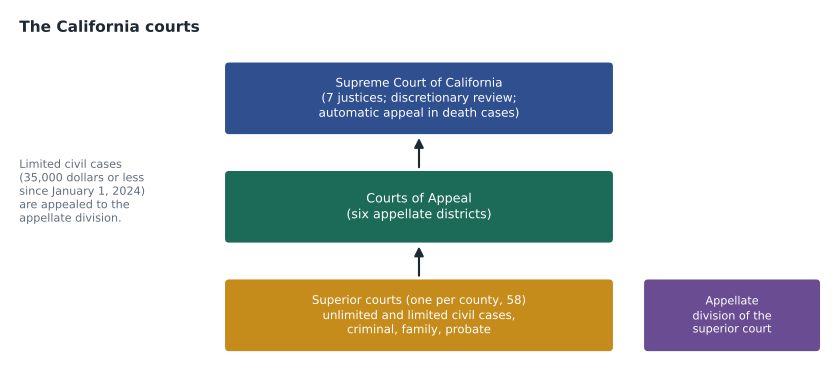
California has one trial court in each county, the superior court, for 58 in all. Civil cases are classified as limited or unlimited by the amount in controversy; since January 1, 2024, a limited civil case involves 35,000 dollars or less. Appeals in limited civil cases go to the appellate division of the superior court. Appeals in unlimited cases go to the Courts of Appeal, which sit in six appellate districts. The Supreme Court of California, with seven justices, grants review in selected cases and hears death penalty appeals automatically.
Jurisdiction
California's long-arm statute, Code of Civil Procedure section 410.10, allows a California court to exercise jurisdiction on any basis not inconsistent with the state or federal constitution. As a result, personal jurisdiction in California turns entirely on the constitutional due process analysis the MBE tests: general jurisdiction where the defendant is at home, specific jurisdiction where the claim arises out of or relates to the defendant's purposeful contacts with California, and fair play and substantial justice. An essay applying section 410.10 should say that the statute reaches the constitutional limit and then do the constitutional analysis.
Subject matter jurisdiction is simpler than in federal court. Superior courts are courts of general jurisdiction and hear all civil cases not given exclusively to federal courts.
Pleading
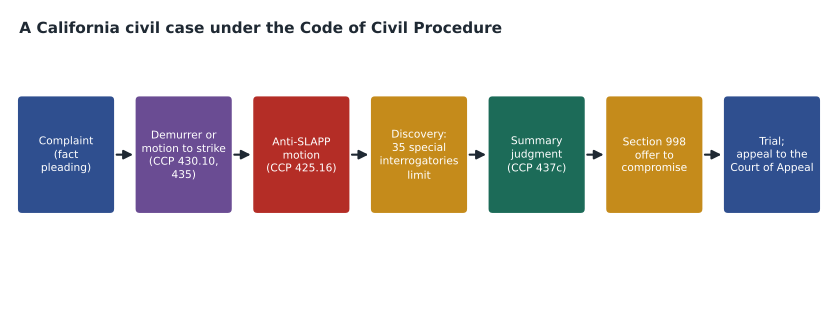
California is a fact-pleading state. A complaint must state the facts constituting the cause of action in ordinary and concise language, under section 425.10, which is more demanding than the federal short-and-plain-statement standard as interpreted in Twombly and Iqbal, though in practice California complaints often use approved form complaints for common claims.
The main pleading challenge is the demurrer. Under section 430.10, a defendant may demur on grounds that include lack of subject matter jurisdiction, failure to state facts sufficient to constitute a cause of action, and uncertainty. The demurrer is the California counterpart of a federal motion to dismiss for failure to state a claim, and courts generally grant leave to amend if the defect can be cured. A motion to strike under sections 435 and 436 removes irrelevant, false or improper matter, such as an unsupported claim for punitive damages.
The anti-SLAPP motion
California's anti-SLAPP statute, Code of Civil Procedure section 425.16, gives defendants a special motion to strike claims arising from protected activity: statements in official proceedings, statements on public issues in public forums and other conduct in furtherance of free speech or petition rights on a public issue. The court applies a two-step test. First, the defendant must show that the claim arises from protected activity. Second, the plaintiff must show a probability of prevailing, by demonstrating that the claim is legally sufficient and supported by a prima facie showing of facts. A prevailing defendant generally recovers attorney's fees. Federal courts disagree on whether the statute applies in federal diversity cases, so on an essay it belongs in a California-law answer.
Discovery
California discovery is broad: any matter not privileged that is relevant to the subject matter of the action, or reasonably calculated to lead to admissible evidence, under section 2017.010. That standard is broader in wording than the federal standard, which since 2015 limits discovery to matter relevant to a claim or defense and proportional to the needs of the case.
Several California discovery rules differ from federal practice. Specially prepared interrogatories are limited to 35 per party, under section 2030.030, unless the propounding party files a declaration for additional discovery, and form interrogatories approved by the Judicial Council do not count toward the limit. Requests for admission are limited to 35 as well, except for those about the genuineness of documents. Since January 1, 2024, section 2016.090 lets any party demand initial disclosures in most civil cases. California's version is triggered by a demand, while federal Rule 26(a)(1) disclosures are automatic.
Summary judgment
California summary judgment, under section 437c, is granted if all the papers show that there is no triable issue of material fact and the moving party is entitled to judgment as a matter of law. Since Aguilar v. Atlantic Richfield Co. (2001), California's standard closely tracks the federal approach in Celotex: a moving defendant can meet its burden by showing that the plaintiff cannot establish an element of the claim. California adds procedural requirements, such as a separate statement of undisputed material facts and long notice periods.
Offers to compromise
Section 998 lets either party make a written offer to allow judgment on stated terms. If the offeree rejects it and fails to obtain a more favorable judgment, the offeree cannot recover its post-offer costs and must pay the offeror's costs from the time of the offer, and the court may order the offeree to pay the offeror's reasonable expert witness fees. Section 998 is broader than federal Rule 68, which only defendants can use.
Peremptory challenge to a judge
Section 170.6 lets a party disqualify an assigned trial judge once by filing a timely declaration that the judge is prejudiced, without proving prejudice. It has no federal counterpart and is a favorite essay point.
| Issue | California | Federal |
|---|---|---|
| Long-arm jurisdiction | CCP 410.10: to the constitutional limit | Rule 4(k): follows the state long-arm statute in most cases |
| Pleading | Fact pleading (CCP 425.10) | Plausibility notice pleading (Twombly, Iqbal) |
| Challenge to pleading | Demurrer (CCP 430.10) | Rule 12(b)(6) motion |
| Interrogatories | 35 specially prepared plus form interrogatories | 25 including subparts |
| Disclosures | On demand (CCP 2016.090, since 2024) | Automatic (Rule 26(a)(1)) |
| Offers | CCP 998, either party | Rule 68, defendants only |
| Judge disqualification | One peremptory challenge (CCP 170.6) | For cause only |
Evidence: the Evidence Code and Proposition 8
California has its own Evidence Code, enacted in 1965, before the Federal Rules of Evidence. The two codes cover the same ground with different numbering and some substantive differences. In criminal cases, Proposition 8, adopted in 1982 and found in article I, section 28(f)(2) of the California Constitution, the Right to Truth-in-Evidence, provides that relevant evidence shall not be excluded in any criminal proceeding, subject to exceptions including existing statutory rules on hearsay, privilege and Evidence Code section 352. California essays often ask how Proposition 8 affects the admissibility of character evidence or impeachment in a criminal case.
Several differences come up often.
Relevance and balancing. Evidence Code section 352 lets the court exclude evidence if its probative value is substantially outweighed by the probability of undue consumption of time or substantial danger of undue prejudice, confusing the issues or misleading the jury. It works like Federal Rule 403.
Character evidence. Section 1101 bars character evidence to prove conduct, with section 1101(b) allowing evidence of other acts to prove a fact such as motive, intent or identity, like Federal Rule 404(b). California adds sections 1108 and 1109, which allow evidence of other sexual offenses and other domestic violence in cases charging those offenses, and in criminal cases Proposition 8 can make evidence admissible that the Evidence Code would otherwise exclude, such as some impeachment with prior misconduct.
Hearsay. The basic definition is similar, but California's exceptions differ in important ways. Under section 1235, a witness's prior inconsistent statement is admissible for its truth whether or not it was made under oath, which is broader than Federal Rule 801(d)(1)(A) as it stood before its December 2026 amendment. Under section 1230, a declaration against interest includes statements against penal, pecuniary and social interest, such as statements that would make the declarant an object of hatred, ridicule or social disgrace. California treats party admissions as a hearsay exception, under section 1220, rather than as non-hearsay.
Privileges. California privileges are statutory and include the lawyer-client privilege, the physician-patient and psychotherapist-patient privileges, the spousal testimonial privilege and the marital communications privilege, among others. Federal privileges, by contrast, are developed largely by common law under Federal Rule 501.
Worked problem
An evidence essay with two calls
In a California criminal trial for burglary, the prosecution offers (1) a neighbor's prior unsworn statement to police, now contradicted by her testimony, that she saw the defendant at the house, and (2) the defendant's two prior burglary convictions to show he committed this burglary.
Show solution
- Statement (1): under Evidence Code section 1235, a prior inconsistent statement is admissible for its truth even though it was not under oath. Under the federal rule before December 2026, it would be admissible only to impeach.
- Convictions (2): section 1101(a) bars character evidence to prove conduct; section 1101(b) allows them only for a non-propensity purpose such as a common plan or identity. Proposition 8 does not override section 1101, and section 352 balancing applies.
- If the defendant testifies, Proposition 8 and California case law allow impeachment with prior felony convictions involving moral turpitude, subject to section 352.
Answer: Statement (1) comes in for its truth under California law; the convictions come in only for a proper non-propensity purpose or for impeachment.
Common mistakes
MistakeAnswering a California civil procedure call with a Rule 12(b)(6) analysis.
InsteadUse the demurrer under CCP 430.10 and California's fact-pleading standard.
MistakeForgetting the anti-SLAPP statute in a defamation or free-speech case.
InsteadApply the two-step test of CCP 425.16 when the call asks for California law.
MistakeTreating Proposition 8 as abolishing all exclusionary rules.
InsteadIt preserves hearsay, privilege and section 352, among other exceptions.
MistakeApplying the federal rule to prior inconsistent statements in a California case.
InsteadEvidence Code 1235 admits them for their truth without an oath requirement.
Statutes of limitations and other California points
A few more California procedure rules appear on essays often enough to know. The statute of limitations for personal injury actions is two years under Code of Civil Procedure section 335.1. California recognizes a delayed discovery rule that postpones accrual until the plaintiff discovers, or has reason to discover, the cause of action. Claims against public entities generally require a timely written claim to the entity under the Government Claims Act before a lawsuit can be filed. And California's venue rules generally place an action in the county where a defendant resides, with special rules for contract, tort and real property actions.
Answering a California procedure call
When a call asks for California law, Marchetti suggests a simple discipline: for every procedural step in the facts, name the California mechanism first, then explain any federal comparison only if the call also asks about federal court. A defendant who wants to challenge a vague complaint files a demurrer for uncertainty or failure to state facts sufficient to constitute a cause of action, not a Rule 12(b)(6) motion. A defendant sued for speaking at a public hearing files an anti-SLAPP motion. A party who wants to pressure settlement serves a section 998 offer. A party unhappy with the assigned judge files a section 170.6 challenge promptly.
Sofia's clerk work helps here: she has seen how often the parties in her firm's cases use section 998 offers to shift costs, and she uses those real examples, without client details, to remember the rule's mechanics.
Summary and key terms
- Use federal law on the MBE and on civil procedure and evidence essays unless the call asks for California law.
- California reaches the constitutional limit of personal jurisdiction (CCP 410.10) and requires fact pleading; the demurrer tests the complaint.
- The anti-SLAPP motion (CCP 425.16), section 998 offers and section 170.6 peremptory challenges have no exact federal match.
- California discovery limits specially prepared interrogatories to 35 and allows initial disclosures on demand since 2024.
- The Evidence Code differs from the FRE on prior inconsistent statements (section 1235), declarations against interest (1230), party admissions (1220) and character evidence (1108, 1109), and Proposition 8 affects criminal cases.
- Demurrer
- A California pleading challenge for failure to state facts sufficient to constitute a cause of action and other defects.
- Anti-SLAPP motion
- A special motion to strike claims arising from protected speech or petition activity under CCP 425.16.
- Section 998 offer
- A pretrial offer to allow judgment that shifts costs if the offeree does not do better at trial.
- Proposition 8 (1982)
- The Right to Truth-in-Evidence provision of the California Constitution, limiting exclusion of relevant evidence in criminal cases.
- Limited civil case
- A California civil case involving 35,000 dollars or less since January 1, 2024.
Practice problems
Work each problem on paper first, then reveal the answer to check.
What is the second step of an anti-SLAPP analysis?
Show answer
The plaintiff must show a probability of prevailing with a legally sufficient claim supported by a prima facie showing of facts.
How many specially prepared interrogatories may a party serve in California without a declaration?
Show answer
Thirty-five.
Is a party's own statement hearsay under the California Evidence Code?
Show answer
Yes, but it is admissible under the party admission exception in section 1220.
Lesson quiz · 5 questions
Score 60% or more to complete this lesson.
Create a free account to save your progress, take quizzes and earn a certificate.